
Space Oddity: The Harmony of Isolation – Star Trails: A Weekly Astronomy Podcast
Episode 91
As the year winds down, we make one last stop beneath the night sky for the week of December 21–27, marking the arrival of the winter solstice, the longest night of the year and a quiet turning point in Earth’s journey around the Sun.
In this short holiday episode, we reflect on what the solstice means from an astronomical perspective, why ancient cultures saw it as a rebirth of light, and how it gifts modern stargazers with long, early nights and some of the most iconic sights in the sky.
We tour the familiar winter constellations as Orion rises into prominence, with the Orion Nebula, the Pleiades, Sirius, and the steady guideposts of the northern sky all on display. This week also features some of winter’s planetary beacons, with Jupiter blazing brightly, Saturn lingering quietly in the early evening, and Mercury making a brief predawn appearance for sharp-eyed observers.
The episode also includes a spoiler-free book recommendation for listeners who enjoyed November’s deeper dives into time dilation, interstellar travel, and the limits imposed by physics. Drew shares thoughts on Project Hail Mary by Andy Weir, author of The Martian.
Finally, as a holiday gift to listeners, we introduce Liminal Horizon, a new music project featuring three albums of space-inspired, planetarium-style music designed for stargazing, night drives, and quiet contemplation.
Links
Transcript
[MUSIC]
Howdy stargazers and happy winter solstice! My name is Drew, and I’ll be your guide to the night sky for the week of December 21 to the 27th.
I know I said in our most recent episode that we’d be taking a break for the month of December, but I just couldn’t help but check in one more time before the new year.
And since it’s the holiday season, I wanted to mention a little “gift” of sorts that I’ve been working on for the past few months. More on that in a moment.
[INTRO MUSIC FADES OUT]
I hope everyone has been enjoying the dark, clear skies of December. I was doing some traveling recently, as I often do this time of year, and I visited Nashville and Memphis, two cities I’ve never explored, despite them being just a few states over. We had gloomy, cloudy skies the entire time I was on the road, with the exception of one evening, when the waning supermoon hung low over the Nashville horizon, looking icy and massive.
Since arriving back home, we’ve had wonderfully clear skies, albeit, very cold and windy weather for the southeast. It’s nice to see the familiar form of Orion dominating the night sky once again, along with bright Jupiter and the stillness of good seeing.
As I mentioned in the introduction, if you’re listening on the release date, today is the winter solstice, the moment when the Sun reaches its southernmost point in the sky.
Astronomically speaking, this is the instant when Earth’s axial tilt leans the Northern Hemisphere most directly away from the Sun. The result is the shortest day and longest night of the year. From here on out, the days begin to lengthen again, slowly at first, but inevitably. For thousands of years, cultures around the world have marked this moment as a symbolic rebirth of light.
For stargazers, the solstice brings a gift of its own: long, early nights and crisp winter skies. Even casual observers stepping outside after dinner can catch some of the most iconic sights in the sky.
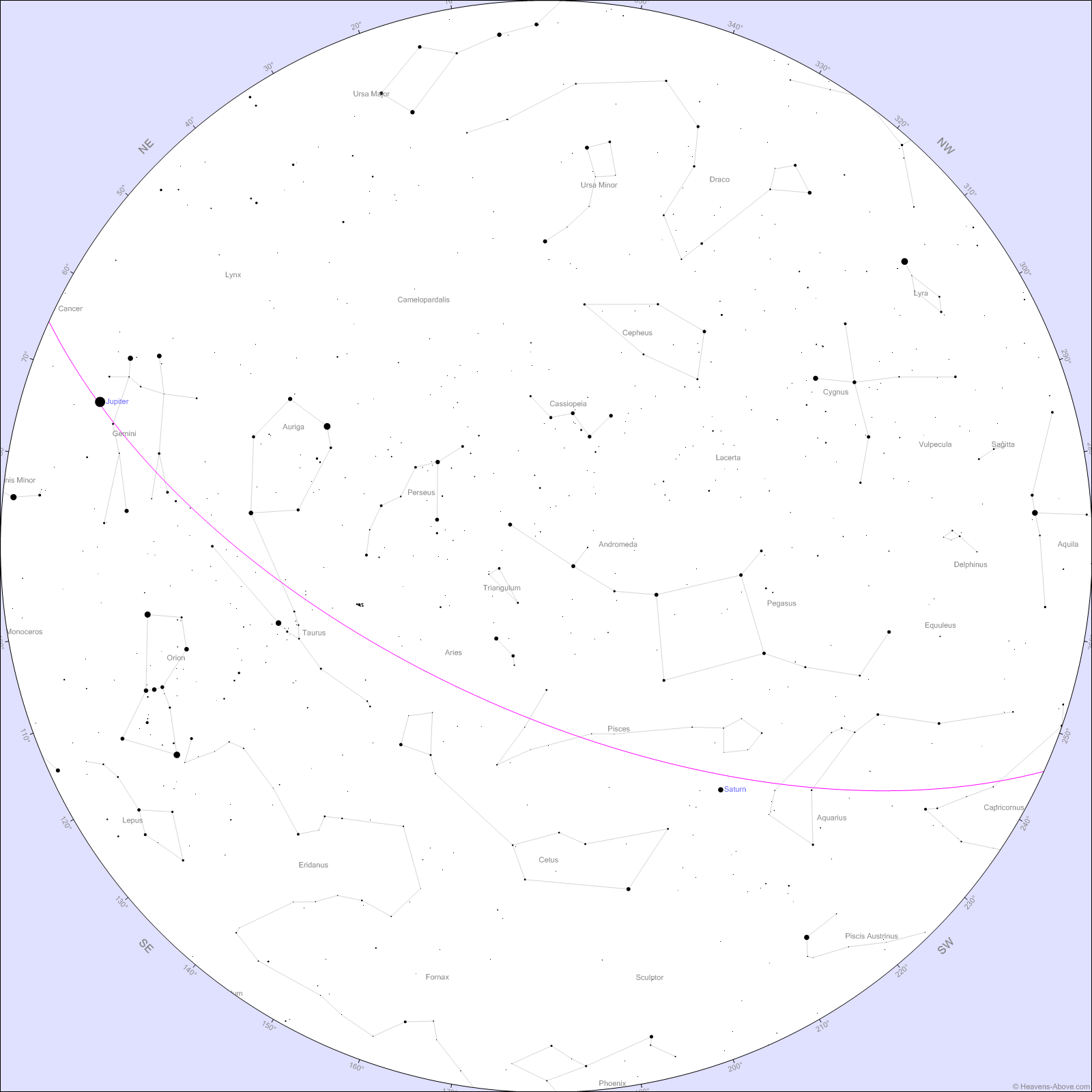
If you look toward the southeast after sunset, you’ll be greeted by Orion rising into prominence. Orion’s three belt stars form an easy visual anchor, and hanging beneath them is the Orion Nebula, one of the finest deep-sky objects visible to the naked eye from dark locations and absolutely stunning through binoculars or a small telescope.
Just above Orion sits Taurus the Bull, home to the Pleiades star cluster, also known as the Seven Sisters. This tight, glittering cluster is an ideal holiday target, bright, compact, and unmistakable. Binoculars really bring it to life, revealing dozens of stars packed into a small patch of sky.
Following Orion across the sky is Canis Major, marked by Sirius, the brightest star in the night sky. Sirius flashes low in the southern sky, often twinkling wildly as its light passes through thick layers of atmosphere, a beacon that’s hard to miss once you know where to look.
Turning northward, the Big Dipper rides low in the evening but climbs higher as the night goes on, serving as a reliable guidepost for finding Polaris, the North Star. Winter is a great time to revisit these familiar landmarks and notice how their positions shift over the course of the night.
The Moon this week cooperates nicely for stargazing, offering darker skies for much of the holiday period, perfect for spontaneous backyard observing sessions between gatherings, travel, or quiet evenings at home.
So whether you’re bundled up in the cold with a telescope, stepping outside with binoculars, or simply looking up while taking out the trash, this solstice week invites you to slow down and reconnect with the sky. The nights are long, the stars are bright, and the Sun, though at its weakest, has already begun its return.
This solstice week also gives us a few planetary highlights, quiet, steady lights that stand apart from the stars and reward even casual holiday stargazing.
The most commanding of these is Jupiter. You can’t miss it. Rising in the early evening and climbing higher as the night goes on, Jupiter shines brilliantly among the winter constellations, outshining everything around it. Through binoculars, you can usually spot its four largest moons lined up like tiny beads of light. With a small telescope, Jupiter resembles a miniature solar system all its own, complete with dark cloud bands stretching across its face.
Lower in the sky during the early evening is Saturn, glowing with a soft, golden hue. It doesn’t demand attention the way Jupiter does, but it rewards patience. Even modest telescopes reveal its rings, and there’s something especially fitting about seeing Saturn during the holidays, a planet that feels slow, ancient, and deliberate, quietly keeping time as the year comes to a close.
In the early morning hours, sharp-eyed observers may also catch Mercury low near the horizon before sunrise. It’s a challenging target, but spotting it feels like a small victory in the glow of dawn.
The Moon plays a supportive role later this week, returning to the evening sky as a thin crescent. Its modest presence means darker skies for much of the holiday period, perfect for stargazing without moonlight washing out the stars.
And while meteor activity is quieter now than earlier in December, patient observers may still catch an occasional Ursid meteor, streaking out from the northern sky, brief flashes of motion in an otherwise calm, frozen cosmos.
[TRANSITION FX]
I want to make a quick side note for anyone who’s enjoyed some of the bigger ideas we explored on Star Trails over the past month, subjects like time dilation, interstellar travel, near-light-speed propulsion, and the very human challenge of communicating with something truly alien.
If those topics lit up your brain like they lit up mine, you may want to check out the novel Project Hail Mary by Andy Weir. Weir is best known for The Martian, which took orbital mechanics, chemistry, and sheer stubborn problem-solving and turned them into a survival story. Project Hail Mary pushes those ideas much farther out beyond the solar system while still grounding its science in real physics and real consequences.
What makes the book especially fun for science-minded readers is how it treats big concepts not as abstract equations, but as lived experiences. Relativity isn’t just something that happens on a chalkboard. And communication across species isn’t solved with universal translators, but with patience, logic, and creativity.
So if you’ve enjoyed November’s deep dives into cosmic timescales, lonely distances between stars, and the strange limits imposed by physics, Project Hail Mary feels like a natural companion piece. It’s science fiction that respects science, and it’s a fun page-turner. And if you’ve never read The Martian, grab that one too. It’s also excellent.
Some listeners may recall I was planning to read Terence Dickinson’s Nightwatch some months back as part of a little Star Trails book club idea, and sadly, I haven’t read it yet. Just tonight I pulled it off the shelf, and hope to begin reading it soon.
[TRANSITION FX]
And finally, it is the holidays, so I wanted to extend a gift of sorts to listeners – it’s a little meta, but hopefully some of you will enjoy it. You’ve probably noticed I’ve been using more music in recent episodes. A lot of this music is original and some folks have asked about it.
In the past few weeks, I’ve been preparing some of these tracks for release. This culminated in assembling three albums worth of spacey music. Some of it you may have heard in recent episodes, some of it you’ll hear in upcoming ones. Some of it is just for fun.
So if you like planetarium music, or music inspired by artists like Tangerine Dream, Tycho, or Brian Eno, check out my new project, Liminal Horizon. There will be a link in the show notes, or you can just visit liminalhorizon.bandcamp.com. You can listen to these tracks absolutely for free right there on the web page, or in their app.
If you want to download the tracks, drop me a note on our website, startrails.show and I’ll send you a code you can use to download them for free. But really, just pulling up the Bandcamp page on a mobile device or computer will get the job done. This is music designed for stargazing, driving out to a dark site, or for background ambience while studying, writing, or coding.
The three collections of songs are thematically different: A Line Between Worlds features tunes dedicated to wonder and awe. The Continuum in Motion features slower, more contemplative tracks, and my favorite, The Passage Through Shadow, features darker songs with harder beats and aggressive sounds.
That’s going to do it for this quick holiday episode. I’ll see you in the new year!
[MUSIC]
If you found this episode interesting, please share it with a friend who might enjoy it. The easiest way to do that is by sending folks to our website, startrails.show. And if you want to support the show, use the link on the site to buy me a coffee. It really helps!
Be sure to follow Star Trails on Bluesky and YouTube — links are in the show notes. Until we meet again beneath the stars … clear skies everyone!
[MUSIC FADES OUT]
Support the Show
Connect with us on Bluesky @startrails.bsky.social
If you’re enjoying the show, consider sharing it with a friend! Want to help? Buy us a coffee! Also, check out music made for Star Trails on our Bandcamp page!
Podcasting is better with RSS.com! If you’re planning to start your own podcast, use our RSS.com affiliate link for a discount, and to help support Star Trails.
 Star Trails: A Weekly Astronomy Podcast
Leave a comment