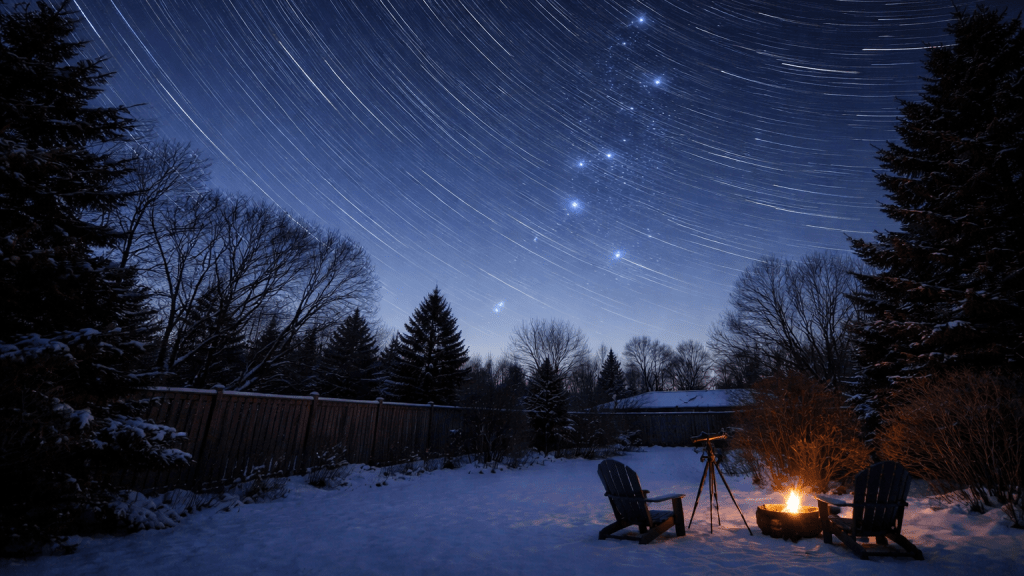
How to Begin (or Begin Again) With the Night Sky – Star Trails: A Weekly Astronomy Podcast
Episode 92
The first episode of a new year is a good time to slow down, zoom out, and reset. In this episode, we welcome new and returning listeners alike for a thoughtful reintroduction to stargazing, one that sets aside checklists, gear anxiety, and the pressure to “do it right,” and instead focuses on patience, curiosity, and learning the sky where you are.
Along the way, the episode explores the idea of the sky as a clock, the power of naked-eye and binocular observing, and the winter night sky anchored by Orion, Jupiter, and the Great Nebula.
It also branches into a backyard stargazer’s reading recommendation (Nightwatch by Terence Dickinson) and a fascinating moment from astronomy’s past, the long search for the nonexistent planet Vulcan, and how Einstein’s theory of general relativity finally explained Mercury’s strange orbit. This episode sets the tone for the year ahead: astronomy as a practice, not a performance.
Links
Transcript
Howdy, stargazers, and welcome to the first Star Trails episode of 2026.
If you’re new here, my name is Drew, and I’ll be your guide to the night sky, a place you can return to, again and again, all year long. And if you’ve been listening for a while, welcome back. This episode is for you too.
Every January, I like to do something a little different. Instead of jumping straight into a checklist of objects and events, we slow things down. We zoom out. We reset.
Maybe you received a telescope for Christmas, or maybe you happened to look up one evening and wonder, “what is that thing?” Either way, the beginning of the year is when a lot of people first feel the pull to look up, and it’s also when a lot of people quietly convince themselves they don’t know enough to do that “properly.”
Tonight is about undoing that idea.
Astronomy has a reputation problem. Somewhere along the way, it became associated with expensive gear, intimidating knowledge, and the sense that everyone else already knows what they’re doing.
But at its core, astronomy is much simpler than that.
Astronomy is standing still for a moment and noticing that something vast is happening above you, whether or not you understand all of it yet.
You don’t need permission to look at the sky. You don’t need credentials. And you don’t even need a telescope. You just need attention.
The sky has been here for your entire life. It will be here for the rest of it. And it doesn’t care if you miss a night, or a month, or a year.
This show exists because astronomy isn’t a race. It’s a relationship. And January is a very good time to begin one.
To begin, let’s take a look at one of the most useful ideas in astronomy, which happens to also be one of the simplest: The sky is a clock, a slow, reliable one that tells time in hours, seasons, and years.
If you step outside on a clear January evening, the sky isn’t random. It’s organized. Keep this basic idea in mind: Stars rise in the east. They drift across the sky, and they set in the west. just like the Moon and the Sun.
That motion isn’t the stars moving around us. It’s the Earth turning beneath them.
Over the course of a single night, the sky marks the passage of hours. Over the course of months, it marks the passage of seasons.
That’s why winter skies look so different from summer skies. Familiar constellations vanish, and new ones take their place.
Also January is a great time to learn about astronomy because the sky gets dark early, stays dark long, and doesn’t rush you. You don’t have to stay up late to learn it.
It’s kind of like the universe meets you halfway.
Let’s talk about naked-eye astronomy. Not as a beginner phase. Not as something you graduate from. But as the foundation of everything else.
Your eyes are extraordinary instruments, once you give them time.
When you step outside, your eyes need about twenty minutes to fully adapt to darkness. Bright lights reset that clock instantly. So, your phone is not your friend here. But once your eyes settle in, the sky begins to open up. Stars multiply and patterns emerge.
You’ll notice that some stars twinkle… and others don’t. That’s not a trick of your vision. It’s physics.
Stars twinkle because they’re incredibly far away, pinpoints of light distorted by Earth’s atmosphere. Planets don’t twinkle as much because they’re closer, and appear as tiny disks instead of points.
That single observation, twinkling versus steady, lets you identify planets without charts, apps, or guesswork. As you get more familiar with the sky, you’ll instinctively recognize the visible planets by their brightness and even color.
Binoculars, by the way, are not a compromise. They are one of the most powerful tools in astronomy. They are portable, intuitive, and perfectly matched to how humans naturally look at the sky. Right now, I consider myself a “binocular astronomer.” I don’t own a telescope at the moment, and I consider that a feature, not a bug.
If all you ever use are your eyes and a pair of binoculars, you’re doing real astronomy. And binoculars have advantages over scopes. You can just aim them up and scan around without messing with a tripod, a finder scope, eyepiece magnifications or polar alignments.
Grab a seat in a lounge chair and sweep across the sky. The sensation is that of flying through the stars. If you have a steady hand, you can even make out the moons of Jupiter in a nice pair of binoculars. Star clusters are a real pleasure and from a dark site, you’ll be able to see the bright core of the Andromeda Galaxy, its photons reaching our eyes after more than 2.5 million years in transit!
Then there are the stories of the sky: Constellations.
They’re how humans imposed meaning on randomness long before we understood stars as suns and galaxies as islands of light. Different cultures drew different shapes in the same sky, echoing their history and myths.
Modern star charts sometimes make constellations feel like tests, connect the dots correctly or you’ve failed. That’s the wrong mindset.
Constellations are anchors that give you a roadmap across the sky. There’s no right or wrong way to view them.
In January, there’s no better anchor than Orion, the legendary hunter. You’re probably familiar with the three bright stars in a row that form his distinct “belt.”
You don’t need to memorize his mythology. You don’t need to trace every star. You just need to recognize him as a landmark. Once you find Orion, the rest of the winter sky starts to make sense. The sky stops being a wall of lights and starts becoming a landscape.
That’s the moment astronomy becomes personal. We’ll talk more about Orion and his secrets in a moment.
Most of us live under light-polluted skies. That’s simply a fact of modern life. Light pollution limits what you can see, but it doesn’t erase the sky, and it’s not a reason not to look up. There’s a lot of astronomy that can be enjoyed under a compromised sky.
The Moon still commands attention. Planets still shine steadily. Bright stars still punch through the glow. You’ll see the larger, brighter constellations, like Orion and the Big Dipper.
Urban astronomy is still astronomy and if you wait for perfect darkness, you may never begin. If you learn the sky where you are, every improvement feels like a gift. When you finally venture out to a dark site, you’ll be even more in awe of what’s up there.
So, speaking of what’s overhead, let’s see what awaits us in this first full week of the new year.
Right now, the Moon is near full. It peaked as the January Full Moon, the Wolf Moon, around January 3, meaning it’s still bright and dominant in the early evening sky. That brightness will wash out fainter stars, but it’s also a striking sight all on its own, rising just after sunset and moving westward through the night.
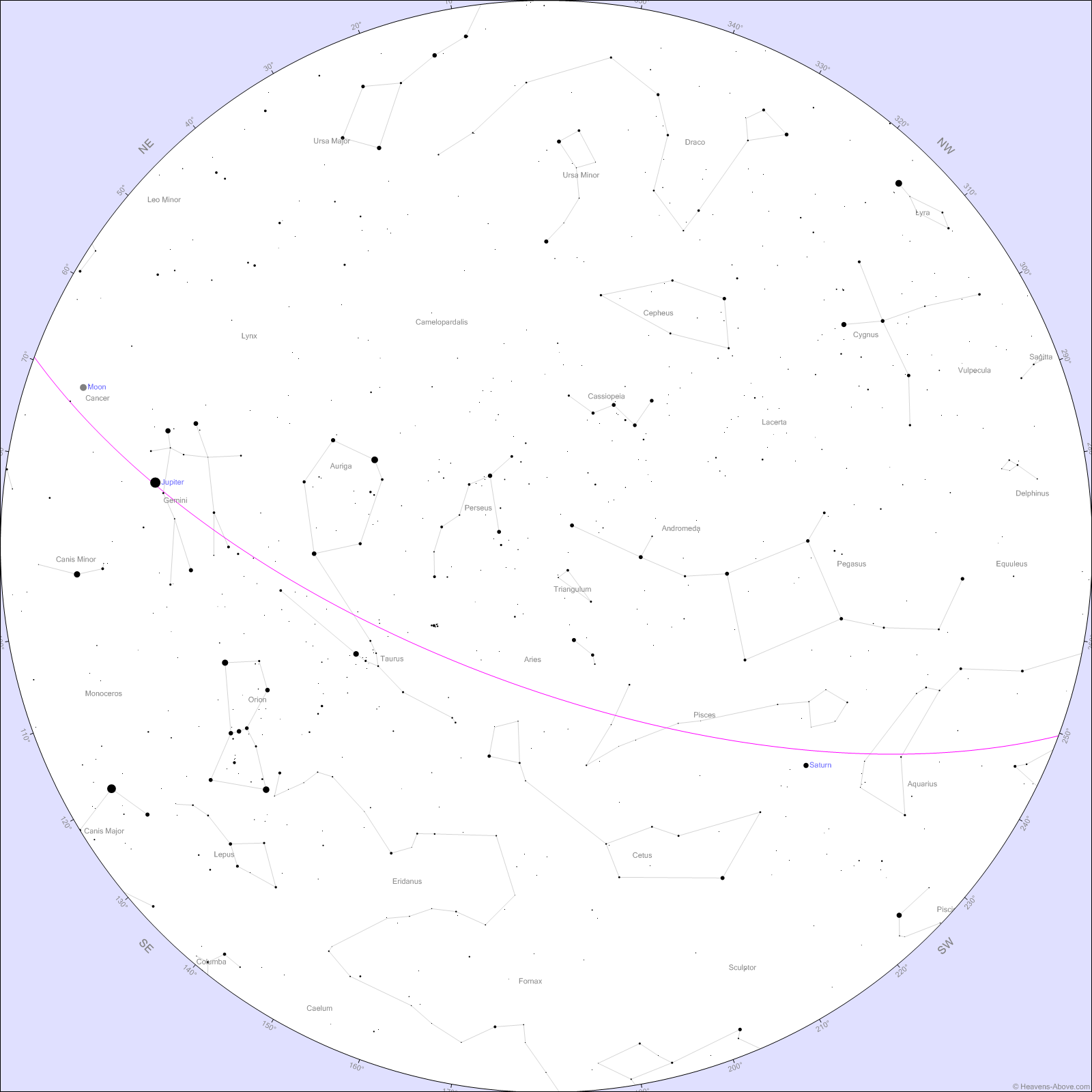
One of the easiest objects for new stargazers this week is Jupiter. It’s the brightest planet visible right now, rising soon after dusk and shining persistently through the night. Jupiter is approaching opposition on January 10, which means Earth is between it and the Sun, so it’s up all night, climbing high in the sky, and at its peak brightness for the year.
When you see a bright, non-twinkling “star” high in the southeast to south, that’s Jupiter.
If you have a telescope, even a modest one, Jupiter is a great first planet to explore. But, keep your expectations reasonable. It won’t look like a Voyager image. You should be able to discern a tiny disc, maybe with several cloud bands. It’s Galilean moons will be on either side of it, resembling a tiny solar system all by itself. You aren’t likely to see a lot of color, if any.
As with any telescopic observation, patience is key. As a beginner, lining up a scope on a planet for the first time is difficult, and can feel like an hour of frustration, punctuated by two minutes of wonder. I’ve always found it helpful to use a low magnification eyepiece that gives you a wider field of view, then step up to a more powerful magnification once you have your object in frame.
Not far from Jupiter, in the same area of the sky, you’ll also find the familiar twin stars Castor and Pollux of the constellation Gemini. Pollux sits a little closer to Jupiter in the sky, and together they form a neat visual triangle you can pick out on a clear night.
If you face south-southeast after sunset, you’ll see the familiar Winter Hexagon, an asterism made of very bright stars. It includes Sirius (the brightest star in the night sky), Betelgeuse in Orion, Aldebaran in Taurus, and Procyon near the horizon. These bright stars help your eye navigate without charts, and from their arrangement you can start to recognize the larger patterns of the winter sky.
Speaking of Orion, he’s unmistakable right now. Look for his three-star belt slanted across the late-winter sky. Just below and slightly to the left of Orion’s belt is Sirius, blazing brighter than anything else overhead.
If you’re a brand new observer, here’s something special to look out for once you’ve located Orion.
Hanging just below Orion’s belt, where his sword would be, you’ll find one of the most famous objects in the night sky: the Great Nebula in Orion.
On a dark night, with good eyesight, you may be able to see it with the naked eye as a faint, fuzzy patch, something that looks a little out of place among the pinpoints of stars. But if you have binoculars, this is where things get exciting.
Through binoculars, the Great Nebula blooms into view as a glowing cloud, soft, uneven, and unmistakably not a star. You’re looking at a vast stellar nursery, a region where new stars are actively forming, more than a thousand light-years away.
This is often the first deep-sky object people ever see, and for good reason. It’s bright. It’s easy to find. And it doesn’t require expensive equipment.
The first time you spot it, there’s a quiet realization that tends to follow: That fuzzy glow isn’t a smudge on the lens. It’s not an illusion. It’s a real place in the universe.
If astronomy ever stops feeling abstract, it’s usually right here, standing under Orion, looking at a cloud of gas and dust where stars are being born, with nothing more than your eyes or a simple pair of binoculars.
Another event happening this week is the tail end of the Quadrantid meteor shower. Its peak was just before January 4, and unfortunately the bright Moon will drown out many of the faint meteors this year, but if you’re in a very dark location with good eyes and patience, you might still glimpse a few shooting stars distributed around the sky. It just takes some patience.
So here’s my suggestion for 2026. And it’s not a resolution, but just something to practice: Once a week take some time to look up from the same place at the same time.
Look for one thing, maybe a star, a planet, the Moon, or a familiar constellation. Note how they shift night to night.
Over time, something subtle happens; the sky starts to feel familiar. You stop asking, “What am I supposed to see?” and start noticing what’s already there.
In the weeks ahead, we’ll return to our usual show rhythm, specific objects, events, and so on. But everything we do this year grows out of what we talked about tonight.
Astronomy is not a performance, and it’s not a race. The sky will be there tomorrow. The sky is patient, and it’ll wait for you.
Before we go, I wanted to mention some resources over at our website, startrails.show, in case you’ve never visited it. I’ve recently added some features you may find useful.
New and even returning listeners may enjoy the new “Start Here” page, where I’ve flagged some of my favorite must-listen episodes, along with tons of links and resources you might find helpful. I’ve included links to some of my favorite night sky apps, useful websites and more. If you’re just starting out, I think you’ll enjoy the Stellarium app. It’s basically a planetarium in your pocket, and their web application is very useful also.
Also, if you like to listen to music while you stargaze, check out my new music project, Liminal Horizon. It’s spacey ambient music designed for dark skies, and you’ve probably already heard some of it in recent shows. Click the “music” link in the site navigation up top to access it.
[TRANSITION FX]
Many, many episodes ago I floated the idea of a sort of, “Star Trails book club” and I selected the book, Nightwatch, by Terence Dickinson, for the discussion. Then about 6 months elapsed and I finally ordered the book. Then the book sat on my shelf for another 6 months. I nearly forgot about it.
Well, over the holiday break, I finally started reading it. I’ll have a lot more to say about it in an upcoming episode, but the big takeaway here is, you owe it to yourself to read this book if you’re interested in stargazing, and it makes a fine companion to this podcast, in fact, if this podcast were a class, I think I’d want Nightwatch to be its textbook.
And here’s why: The author, Dickinson, has crafted this book especially for backyard stargazers. There’s really no jargon in the book, no math, no complex explanations. It’s richly illustrated, and thumbing through it reminded me of the old National Geographic hardbound tome, Our Universe, which kept me in endless awe as a kid in the early 1980s.
Now, I’ve done more than 90 episodes of this podcast. I’m certainly no expert astronomer, but I like to think I’m somewhat informed of the subject matter. Still, every time I pick up Nightwatch, I learn something new, even in a book aimed at beginners.
Here’s an example: I didn’t know that our Sun is larger than about 90% of the other stars in our galaxy. Yet, nearly every star we see at night here on Earth with our naked eye, is much larger than our Sun. Because space is an infinitely large place, only the largest stars, the leviathans of the Milky Way, are the ones we can actually see.
And every chapter contains revelations like this.
In an age when reading a physical book seems like something from a bygone era, and night sky maps are available as augmented reality in a phone app, you might be wondering, why bother. But, the book is really that good. I’m feverishly assembling notes from my reading, and a full review is coming soon, but get a copy if you can. I think you’ll really find it helpful.
[TRANSITION FX]
Before I go, I’d like to point out a moment in astronomy that occurred around this time 166 years ago, back in 1860.
On January 2 of that year, a respected astronomer made an announcement that seemed, at the time, entirely reasonable.
The astronomer was Urbain Le Verrier, the same man who successfully predicted the existence of Neptune purely through mathematics. When Neptune was later observed almost exactly where Le Verrier said it would be, his reputation soared. He had found a planet without ever seeing it. We actually discussed this way back in episode 38, in a segment on orbital resonances.
So when Le Verrier claimed there was another planet, this one orbiting closer to the Sun than Mercury, people listened.
He called it Vulcan.
Astronomers had noticed something strange about Mercury’s orbit. Over time, the point where Mercury comes closest to the Sun, its perihelion, slowly shifts. That gradual rotation of the orbit is called precession. Most of Mercury’s precession could be explained by the gravitational pull of the other planets. But a small portion, about 43 arcseconds per century, remained unaccounted for.
Using Newtonian physics, the simplest explanation was another unseen planet tugging on Mercury. Just as Neptune explained Uranus’s odd motion, Vulcan would explain Mercury’s.
And for decades, astronomers searched.
Some observers reported fleeting sightings of Vulcan during solar eclipses. Others claimed to see tiny dark dots crossing the face of the Sun. Vulcan lived in that uncomfortable space between plausible and real—never fully confirmed, never fully dismissed. Remember, the area close to the Sun is notoriously difficult to observe, owing to the Sun’s glare and the compact orbit of objects there. That’s why we rarely catch Mercury in the sky, and when we do, it’s near the setting sun, low on the horizon.
The breakthrough came in 1915, when Albert Einstein published his theory of general relativity.
Einstein showed that gravity isn’t just a force between objects, it’s the warping of space and time itself. Near something as massive as the Sun, spacetime curves enough to subtly alter Mercury’s orbit. When Einstein ran the numbers, general relativity predicted exactly the missing amount of Mercury’s perihelion precession. No extra planet required.
Vulcan didn’t disappear because astronomers stopped looking hard enough. It vanished because the universe turned out to be stranger, and more elegant, than anyone had imagined.
Today, Vulcan survives only in fiction, most famously as the homeworld of Spock in Star Trek. But for a brief moment in history, it was a serious answer to a real problem.
That’s going to do it for this week. If you found this episode interesting, please share it with a friend who might enjoy it. The easiest way to do that is by sending folks to our website, startrails.show. And if you want to support the show, use the link on the site to buy me a coffee. It really helps!
Be sure to follow Star Trails on Bluesky and YouTube — links are in the show notes. Until we meet again beneath the stars … clear skies everyone!
Support the Show
Connect with us on Bluesky @startrails.bsky.social
If you’re enjoying the show, consider sharing it with a friend! Want to help? Buy us a coffee! Also, check out music made for Star Trails on our Bandcamp page!
Podcasting is better with RSS.com! If you’re planning to start your own podcast, use our RSS.com affiliate link for a discount, and to help support Star Trails.
 Star Trails: A Weekly Astronomy Podcast
Leave a comment