
Night of the Hunter: A Deep Dive into Orion – Star Trails: A Weekly Astronomy Podcast
Episode 93
This week we slow down and spend the night with one of the sky’s most iconic constellations: Orion. We’ll use the mighty hunter as a guide, learning how his stars can point the way to other landmarks in the winter sky, from blazing Sirius to Aldebaran and the Pleiades.
Along the way, we explore Orion’s rich mythology, his role in ancient cultures, and the remarkable deep-sky objects hidden within his outline, including stellar nurseries, dark nebulae, and the vast structures shaping this region of the Milky Way.
We also journey back thousands of years to ancient Egypt to examine the intriguing and controversial Orion Correlation Theory, which suggests a connection between the cosmos and the pyramids of Giza. What does the evidence really say, and why does Orion continue to draw humans into stories that link sky and stone?
To round out the episode, we’ll check in on the night sky for January 11–17, including the Moon’s phase, visible planets, and observing highlights, plus a look at recent space news featuring the discovery of a mysterious “failed galaxy” known as Cloud-9.
Transcript
Howdy stargazers and welcome to this episode of Star Trails. My name is Drew and I’ll be your guide to the night sky for the week of January 11th through the 17th.
This week, we’re going to focus on a single constellation, Orion, and explore how to use it as a signpost to the night sky. We’ll look at it’s lore, it’s relationship to ancient civilizations, it’s deep sky objects, stars, and it’s secrets.
We’ll also travel back thousands of years to Egypt, where an intriguing theory involving Orion and the pyramids has intrigued archaeologists and astronomers — and people like me — for ages.
Later in the show, we’ll take a look at this week’s sky, and go over some recent space news: the discovery of an unusual object astronomers are calling, “Cloud-9.”
Whether you’re tuning in from the backyard or the balcony, I’m glad you’re here, so grab a comfortable spot under the night sky, and let’s get started!
I know it sounds like a tagline or something — “tuning in from the backyard or the balcony” — but both of these locations are fine places to conduct astronomy from. Here at home, I keep a pair of binoculars at the ready, right beside my balcony door so I can slip out and do a little stargazing. I have a view to the south, so it’s great to catch the Moon making it’s way across the sky, and some prominent constellations.
Of course, the backyard is better, as it opens up the rest of the sky. But, whichever of these locations I choose, there is one constellation that stands above all in the sky, and that’s Orion, the mighty hunter, and likely one of the first groups of stars that fills observers with wonder, and he’s been doing that for millenia.
Orion is one of the oldest figures humanity ever traced into the stars. In Greek myth, he was a giant hunter, strong, confident, sometimes noble, sometimes reckless, depending on who’s telling the story. In some versions, Orion boasts that no beast alive can defeat him, earning the wrath of the gods. In others, he’s a tragic figure, killed by a scorpion sent by Gaia or Artemis, then placed in the sky as both a warning and a memorial.
Orion was a mirror, a way for ancient people to project ideas about strength, pride, punishment, and fate onto something vast and dependable.
In the night sky, the constellation depicts Orion mid-stride, frozen in an eternal hunt. One arm is raised, often imagined holding a club or bow, while the other carries a shield.
His belt, those three unmistakable stars, cuts cleanly across his waist, anchoring the entire figure. His shoulders and feet blaze with uneven intensity, giving the figure a sense of motion and imbalance, as if he’s caught in the act rather than posed for display. Orion doesn’t rest in the sky. He advances across it, rising in the east, dominating winter evenings, and eventually slipping away into daylight—forever chasing, forever just out of reach.
As a kid, I remember gazing at the three bright belt stars from the backseat of the car on rides home at night. Those three stars, in a nearly perfect line, all bright, seemed almost overbearing to the rest of the night sky. Why were they so prominent, and what did they mean? What were they trying to say, if anything?
It wasn’t long before I read a night sky guide and learned these were the three belt stars of Orion, or “Or-EE-on” as my child’s mind thought it was pronounced. It didn’t take long to realize Orion was a special constellation. This wasn’t just a random grouping of stars, and, unlike most of the constellations, it actually resembled what it was representing — if you kind of imagine it as a stick figure in the sky.
Digging deeper, I learned Orion was home to some of the most beautiful deep sky objects in the cosmos. Even today, when I look up at the winter sky, I first check on Orion.
So today, in keeping with our January plan aimed at new stargazers, we’re going to take a closer look at this iconic constellation. Orion isn’t just our destination. He’s our guide. He shows up clearly, early in the evening, at a time of year when many people are just beginning to look up again. You don’t have to hunt for him. He finds you.
And that alone makes Orion special. But Orion also does something else. Once you learn his shape, he teaches you how to move through the sky—how stars point to other stars, how patterns lead outward, how the night sky stops being a scatter of lights and starts becoming an organized place.
So let’s turn our gaze upward and look for Orion’s belt, that line of three bright stars, almost evenly spaced. Once you see it, you’ll never unsee it.
Follow the Belt downward, away from Orion’s shoulders, and your eye will land on Sirius. Sirius is the brightest star in the entire night sky, and it often flickers wildly near the horizon, flashing colors as Earth’s atmosphere bends its light. Many people mistake it for a planet. In reality, it’s simply close and luminous.
Congratulations. That’s a successful star-hop. You didn’t need a chart. You didn’t need an app.
Now follow the Belt in the opposite direction, upward, and you’re led toward Aldebaran, a warm, orange star marking the eye of Taurus the Bull. Keep going up, and you’ll arrive at the Pleiades, a small, misty clump of stars that people often mistake for the Little Dipper, because it does sort of resemble that shape. While you’re there, look at the Pleiades with your binoculars. It basically explodes with stars.
So following the same line, gave us two completely different destinations. And we can keep going.
Betelgeuse marks Orion’s shoulder, and glows with a deep reddish hue. Rigel, at the opposite foot, burns icy blue-white.
If you look at Orion’s upper body—his shoulders and raised arm—and extend that line upward, you’re led naturally toward the constellation Gemini. There, you’ll find the twin stars Castor and Pollux, sitting side by side like a pair of beacons. Once you know to look for them, Gemini becomes one of the easiest winter constellations to recognize, and it feels almost as if Orion is gesturing in their direction.
Orion can also help you complete one of the most useful shapes in the winter sky: the Winter Triangle. You already know one corner of it—Sirius. Another corner is Betelgeuse. Draw an imaginary line between those two, and the third point of the triangle appears almost automatically: Procyon, in the constellation Canis Minor.
Look downward instead, toward Rigel, and you’ll find something quieter. Just below is the constellation Lepus, the Hare, placed quite literally at the hunter’s feet. Lepus is fainter and easier to miss, especially from light-polluted skies, but Orion tells you exactly where to look.
And if you follow Rigel’s line away from Orion, the sky opens into something much larger: Eridanus, the River. It winds away in a long, meandering path across the sky, far larger than most people realize.
Star hopping away from Orion like this, turns the constellation into basically a roadmap for the sky. Suddenly, large swaths of the sky feel navigable and you’re well on your way to becoming a seasoned naked-eye observer.
Now, let’s turn our attention back to those three belt stars. They are: Alnitak, Alnilam, and Mintaka. Despite their neat alignment, they are separated by vast distances in space, with Alnilam being the most distant. That alignment is just a happy accident, and reminds us that that sky isn’t a flat plane, but these stars are at varying distances from us.
Hanging from the belt is Orion’s sword, and this is where the constellation quietly changes character. At the sword’s center lies the Orion Nebula, a vast stellar nursery visible even without optical aid under dark skies. Nearby is the Running Man Nebula, a faint reflection nebula shaped by young, energetic stars whose light is still carving paths through surrounding dust.
Deep inside the Orion Nebula is a group of stars that appear to have been violently ejected from a once-stable system thousands of years ago. Studies suggest a gravitational interaction or stellar collision flung these stars outward at high speed, leaving behind shock waves still visible today. Orion isn’t just birthing stars, it’s occasionally throwing babies out of its nursery!
Along the eastern belt star, Alnitak, sits the Flame Nebula, glowing with hydrogen excited by nearby stars, and just beside it, etched in silhouette rather than light, is the Horsehead Nebula—a dark knot of dust standing starkly against a luminous background.
Speaking of Alnitak, it’s not a single star at all but a multiple-star system, with at least three components. The primary star is a massive blue supergiant whose intense ultraviolet radiation sculpts the Flame Nebula and the background glow that allows the Horsehead Nebula to appear in silhouette. Without Alnitak’s violence, some of Orion’s most iconic sights wouldn’t exist.
While the Orion Nebula is visible to the naked eye, you’re going to need a good scope to see the Horsehead and Flame nebulae. These are rich targets for astrophotographers, and they come alive in brilliant oranges, reds and magentas when captured with long exposures.
Betelgeuse, at the shoulder, glows a deep orange-red and is one of the largest stars visible to the naked eye. It’s a red supergiant nearing the end of its life, swollen, unstable, and variable in brightness. Betelgeuse — and by the way, you can safely say it three times — holds one of Orion’s intriguing secrets.
Betelgeuse has long been suspected of having a companion, and recent observations suggest that this may actually be true. In 2022 through 2024, high-resolution imaging and modeling pointed toward a close, faint companion—likely a small star orbiting within a few astronomical units of Betelgeuse. This companion may help explain Betelgeuse’s strange behavior, including its dramatic dimming in 2019 and 2020, which was initially noted as a possible pre-supernova event. If confirmed, this would make Betelgeuse not just a dying star, but a binary system in its final act.
So, as it turns out one of the sky’s most famous “lonely giants” may never have been alone at all.
Across from it is Rigel, a blue-white star that outshines Betelgeuse in sheer luminosity, despite appearing similarly bright from Earth.
Sweeping across much of the left side of the constellation is Barnard’s Loop, an enormous arc of glowing gas, likely energized by ancient supernova explosions and massive stellar winds.
You aren’t able to see it unless you photograph this large swath of the sky; longer exposures bring it to light. Conceptually, it’s an important structure, giving us a window into a turbulent, ongoing process of stellar creation and destruction. Orion is considered one of the Milky Way’s great workshops, where stars are born, age, and tear their surroundings apart. Orion and its components form an active unified region, known as the Orion molecular cloud complex.
Zooming out a bit, the whole region is known as the Orion-Eridanus Bubble, which may have been carved out by supernovae some 2 million years ago.
As legendary as the hunter is, nothing lasts forever. Orion, as we know him, is living on borrowed time. The stars that define his shape are moving, and over tens of thousands of years, the familiar figure will stretch, skew, and dissolve. Betelgeuse will explode someday. Rigel will evolve. The belt will lose its alignment.
We’re going to take a quick break, but when we return, more on Orion and his relationship to humanity. We’re going to journey to the iconic pyramids of the Giza plateau in Egypt, where we’ll explore an intriguing concept called the Orion Correlation Theory. We’ll also check out this week’s sky and some recent astronomy news.
Stay with us!
Welcome back.
In addition to stargazing, an area I find endlessly fascinating is archaeology, more specifically, Egyptology. And even though I grew up reading books like Erich von Daniken’s “Chariots of the Gods,” I don’t think Egyptians built the pyramids with the help of aliens. They were, however, tuned into the sky, and maybe Orion had a larger impact on their culture than we think.
The Orion Correlation Theory proposes that the three main pyramids on the Giza Plateau were intentionally arranged to mirror the three stars of Orion’s Belt as they appeared in the ancient sky. It’s a relatively new theory, dating back to just 1989.
The core claims usually go like this:
The relative positions of the pyramids resemble the slight offset of the Belt stars. One pyramid is not perfectly aligned with the other two, just as one Belt star—Mintaka—sits slightly off the straight line formed by Alnitak and Alnilam. Some argue that this similarity is too precise to be coincidence.
The theory goes further, suggesting that the ancient Egyptians intentionally encoded a sky–earth correspondence, reflecting the heavens on the landscape. In this view, the Nile becomes a terrestrial analog of the Milky Way, and Giza becomes celestial geometry. Also, the Sphinx monument reportedly represents the constellation Leo, the Lion.
Some have theorized the layout of elements inside the pyramids — which were tombs — point directly to specific portions of the sky. Kind of like the markers at Stonehenge line up with solstices. The most well-known example is in the Great Pyramid, whose south access shaft allegedly points to Orion’s belt. After more than 4,000 years, Earth’s shifting axial precession has knocked off the alignment, if there ever really was one.
At its most ambitious, the theory claims these alignments reflect Orion’s position around 10,500 BCE, implying either extraordinary astronomical foresight or the inheritance of knowledge from a far earlier civilization.
Here’s where the theory gains much of its traction:
In ancient Egyptian cosmology, Orion was associated with Osiris, the god of death, rebirth, and the afterlife. Orion wasn’t just another constellation; he was a symbol of cosmic order and eternal return. Pharaohs were believed to ascend to the stars after death, joining the gods among the fixed lights of the sky.
So the argument goes: if you were going to encode immortality, cosmic order, and divine kingship into stone, why wouldn’t you choose Orion?
And yet, the theory has problems. First, the apparent alignment depends heavily on selective framing. Rotate the star pattern slightly, adjust scale, or choose which points to emphasize, and the match looks compelling. But when measured rigorously, the positional correspondence is approximate, not exact.
But the real kicker is this: There is no direct archaeological evidence that the pyramid builders intended such a correlation. No inscriptions. No diagrams. No textual references. The Egyptians left us an extraordinary written record, and nowhere do they say, “We built this to mirror Orion’s Belt.”
One of the more poetic extensions of the theory is the idea that the Nile represents the Milky Way, placing Giza as a kind of terrestrial cosmos. This notion feels mythically correct. But here again, the evidence is circumstantial, although seeing the Milky Way as a river of light, is a common occurrence in other cultures.
Humans are extraordinary pattern-recognition machines. We evolved to find structure in chaos because doing so kept us alive. That instinct doesn’t turn off when we look up, it intensifies. In Orion, ancient people saw continuity. Return. Order in a dangerous world.
When modern people see Orion mirrored in the pyramids, they feel a thrill that says: this mattered then, and maybe it still does now. That emotional response is real, even if the alignment wasn’t intentional.
Orion keeps appearing in theories like this because he is visually unavoidable. He’s bright. He’s geometric. He feels designed. That makes him a magnet for myth, speculation, and cosmic storytelling—now just as much as thousands of years ago.
In that sense, the Orion–Giza correlation is now another fascinating element of Orion’s mythology, even if it isn’t part of Egyptian engineering.
Let’s move on from the mysteries of ancient Egypt and into the certainty of this week’s night sky.
The Moon is in its waning crescent phase through this period. By week’s end it’s a very slim sliver, only about ~1–2 % illuminated, making it easy to observe without washing out fainter stars and deep-sky targets. The new moon will occur on the 18th, yielding the darkest skies of the month.
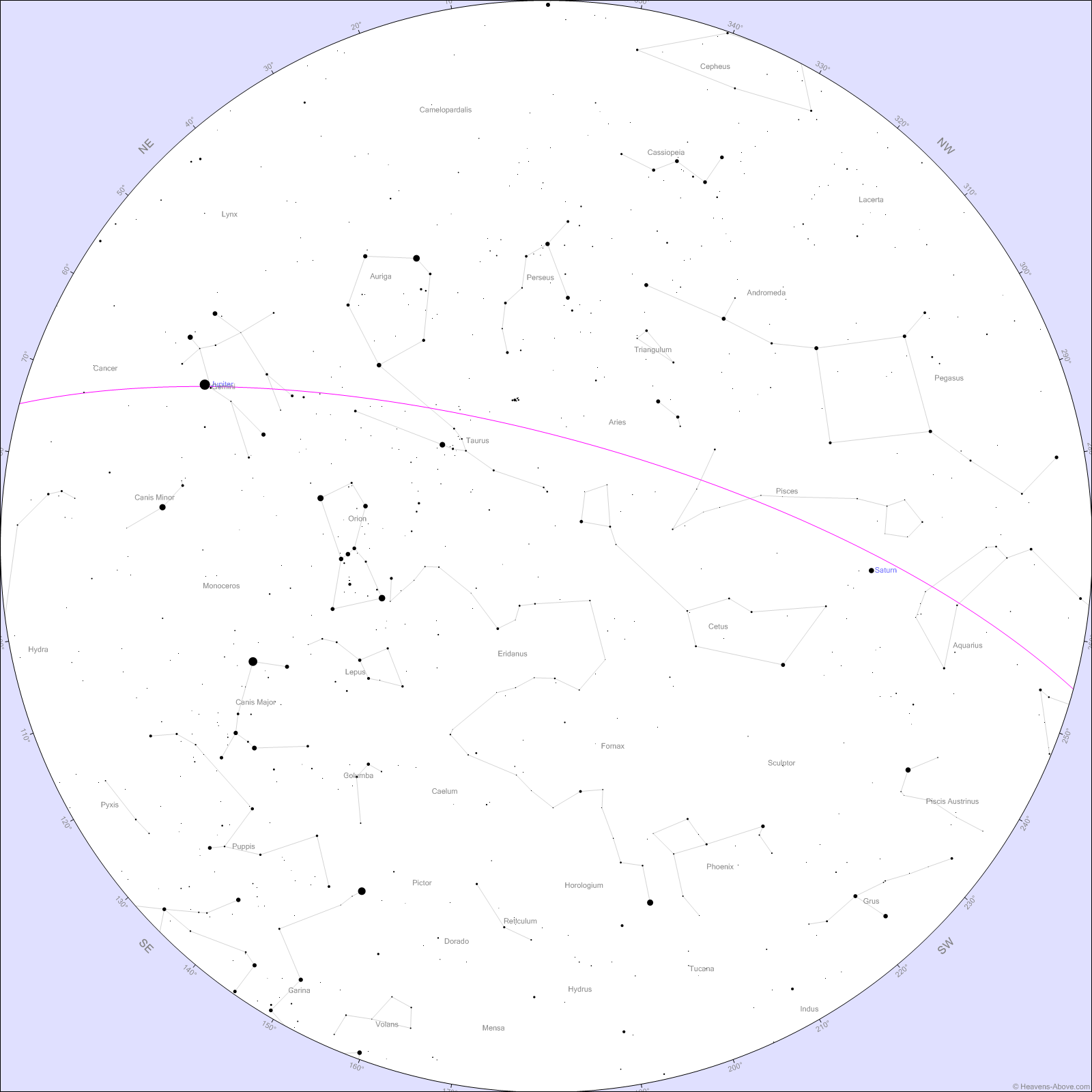
The two naked-eye planets dominating the sky right now are Jupiter and Saturn. Jupiter is the standout: it reached opposition last week, meaning Earth is directly between it and the Sun. It rises at sunset and stays visible all night long, shining exceptionally bright in the constellation Gemini.
Saturn is also visible low in the early evening sky in Pisces. It’s dimmer than Jupiter but still noticeable with the naked eye, especially earlier in the night before it dips toward the western horizon as January progresses.
Other naked-eye planets, Venus, Mars, and Mercury, are effectively out of view during this period because they’re near solar conjunction and lost in the Sun’s glare, so they don’t appear in the evening or pre-dawn sky.
The Beehive Cluster, Messier 44, becomes increasingly well placed later in the month after sunset, though it’s easier to catch a bit after January 17. Since the Moon is thin and dim this week, it’s a good time to appreciate rich star fields and open clusters, like the Double Cluster in Perseus or the Pleiades later in the evening.
Before we go, I wanted to mention a cool bit of space news that made the rounds a few days ago.
Scientists using the Hubble Space Telescope have announced the discovery of a curious new kind of object that’s being called Cloud-9—not because it’s happy, but because it’s unusual. This object, located about 14–16 million light-years from Earth near the spiral galaxy Messier 94, appears to be a cloud of gas dominated by dark matter but containing no stars at all. Researchers are referring to it as a “failed galaxy.”
Under most circumstances, when enough gas and dark matter collect together, gravity pulls the gas inward until it cools and forms stars. But Cloud-9 lacks any detectable stars—even deep observations with Hubble’s powerful imaging failed to reveal a stellar population within the cloud’s bounds, ruling out even faint, low-mass stars to very stringent limits. Instead, it’s rich in neutral hydrogen gas and appears to sit in a massive halo of dark matter—something on the order of billions of times the mass of the Sun.
Astronomers think Cloud-9 may represent a long-predicted but so far unseen class of objects known as Reionization-Limited H I Clouds or RELHICs. In cosmological theory, many dark-matter halos should exist that never managed to form stars, either because they were too small or because the conditions in the early universe prevented collapse and star formation. Cloud-9 may be the first clear observation of such an object, a relic of the early universe that never lit up with stars.
The discovery is exciting because it gives astronomers a rare new window into how galaxies begin, and how some never do, and it may help scientists better understand the role of dark matter in shaping the cosmos.
That’s going to do it for this week. If you found this episode interesting, please share it with a friend who might enjoy it. The easiest way to do that is by sending folks to our website, startrails.show. And if you want to support the show, use the link on the site to buy me a coffee. It really helps!
Be sure to follow Star Trails on Bluesky and YouTube — links are in the show notes. Until we meet again beneath the stars … clear skies everyone!
Support the Show
Connect with us on Bluesky @startrails.bsky.social
If you’re enjoying the show, consider sharing it with a friend! Want to help? Buy us a coffee! Also, check out music made for Star Trails on our Bandcamp page!
Podcasting is better with RSS.com! If you’re planning to start your own podcast, use our RSS.com affiliate link for a discount, and to help support Star Trails.
 Star Trails: A Weekly Astronomy Podcast
Leave a comment