Choreography of the Cosmos: Why the Sky Never Stands Still – Star Trails: A Weekly Astronomy Podcast
Episode 94
In this episode, we continue our January series for new stargazers by exploring one of the most quietly mind-bending truths in astronomy: everything is moving, including you. Even when you’re standing motionless in your backyard, you’re traveling through space at extraordinary speed, carried along by Earth’s rotation, its orbit around the Sun, the Sun’s journey through the Milky Way, and the motion of the galaxy itself.
From that realization, we peel back the layers of motion that shape the night sky. We explore why stars rise and set, why the Moon never shows us its far side, how planets appear to reverse course in retrograde motion, and why familiar constellations are only temporary arrangements. Along the way, we talk about tidal locking, libration, axial precession, stellar proper motion, and even the subtle wobble of the Sun itself around the solar system’s barycenter.
In the second half of the show, we turn our attention to the backyard with this week’s night sky report, featuring dark, Moon-free skies, brilliant Jupiter, Saturn in the southwest, a close Moon–Saturn–Neptune pairing, and excellent conditions for deep-sky favorites like the Beehive Cluster.
We also officially kick off the Star Trails Book Club, beginning with NightWatch by Terence Dickinson, one of the most beloved guides to the night sky ever written.
Transcript
Howdy stargazers and welcome to this episode of Star Trails. My name is Drew and I’ll be your guide to the night sky for the week of January 18th through the 24th.
This week we’ll continue in our series aimed at new astronomers, by exploring how the universe moves. It’s stranger than you think, and we’ll cover everything from the backward motion of planets, to the wobble that lets us glimpse a bit of the far side of the Moon from time to time.
Later in the show, we’ll take a look at what you can expect to see in the night sky this week, and we’ll officially kick off our Star Trails book club.
Whether you’re tuning in from the backyard orthe balcony, I’m glad you’re here. So grab a comfortable spot under the night sky, and let’s get started!
Step outside on a clear night. Let the air settle. No wind. No sound. No sense of movement at all. You’re standing perfectly still.
But you’re not.
Because right now, at this second, you’re moving at about a thousand miles per hour, because Earth is spinning. If you’re anywhere near the equator, you’re riding the fastest part of that spin.
At the same time, Earth is racing around the Sun at roughly sixty-seven thousand miles per hour. That’s one full orbit every year, an enormous curve traced through space that you never feel.
And the Sun itself, the anchor of our entire solar system, is orbiting the center of the Milky Way at around half a million miles per hour, carrying Earth, the Moon, and every planet along for the ride.
And even that isn’t the end of it. The Milky Way itself is moving through intergalactic space at well over a million miles per hour, drawn by the gravity of nearby galaxy groups.
So, depending on how you measure it, you can easily say you’re moving at more than a million miles per hour. You’re making Formula 1 champions like Lewis Hamilton and Max Verstappen look slow, just by standing still.
Of course, it’s all relative, because everything in the universe is moving. The universe doesn’t feel fast. But it is.
And once you understand that, the movement of the night sky starts to make a lot more sense.
So, let’s start with the motion you can actually see.
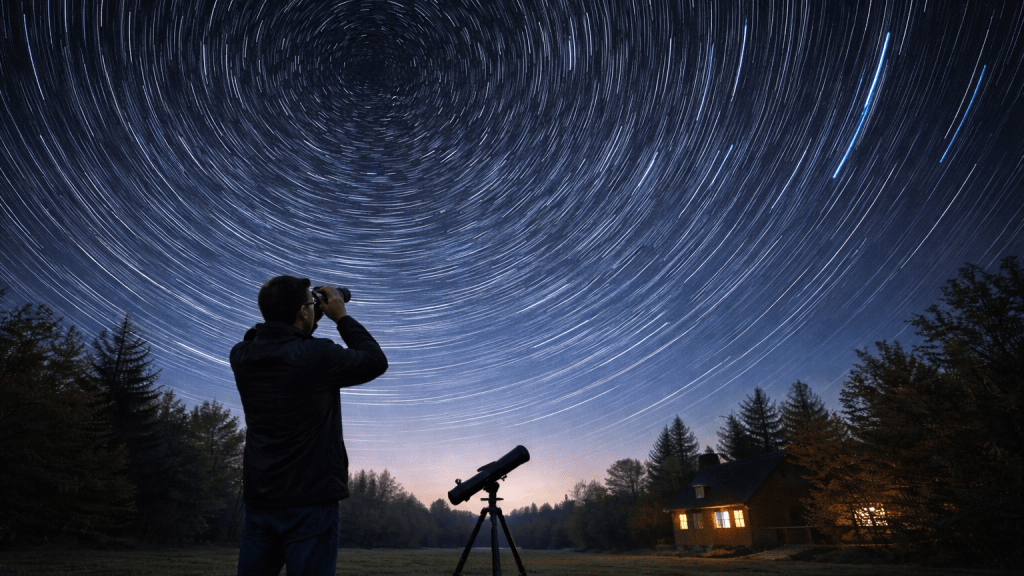
Over the course of an evening, stars rise in the east, arc across the sky, and set in the west. Orion climbs higher. Sirius flashes near the horizon. Everything seems to drift westward together.
This isn’t the sky moving; it’s Earth turning.
We’re standing on a rotating planet, and the sky is fixed far beyond us. As Earth spins, our view changes. If you sit outside long enough you can feel this motion intellectually. The stars aren’t sliding across the sky; you’re being carried beneath them.
This is the most immediate motion of the universe, and it’s the one backyard astronomers learn first. It’s also the reason time matters when you observe. Where something is at 8 p.m. is not where it will be at midnight.
We say this frequently: The sky is a clock. And it never stops ticking.
While the motion of the stars may seem imperceptible at a glance, if you’ve ever used a telescope, you’ve seen the motion firsthand. While you’re magnifying the view of a planet, such as Jupiter, you’re also magnifying the motion of the sky. If you’re using a telescope without a motor drive, you’ve no doubt been frustrated as you watched your target planet speed out of view, forcing you to re-frame it.
Even the light from the stars has to account for our motion.
As Earth moves through space, the direction starlight appears to come from is shifted ever so slightly in the direction we’re traveling. This effect is called aberration of starlight, and it’s subtle, only a tiny fraction of a degree.
A useful way to imagine it is walking through rain. Even if the rain is falling straight down, you tilt your umbrella forward because you are moving. Starlight works the same way. The stars aren’t changing position, but because Earth is racing along its orbit, the light reaches us at a slight angle.
What’s remarkable is that this effect was measured centuries ago. Long before spacecraft or satellites, astronomers noticed that star positions shifted in a way that could only be explained if Earth was moving through space.
In other words: the sky isn’t just telling us where things are. It’s quietly revealing how fast we’re going.
If Earth’s rotation explains the nightly motion, the Moon introduces complication.
The Moon doesn’t rise at the same time each night. It shifts eastward by about thirteen degrees every day, which means it rises roughly fifty minutes later from one night to the next. That’s why it sometimes appears in the evening sky, sometimes after midnight, and sometimes not at all.
Its phases are orbital geometry. As the Moon orbits Earth, we see different portions of its sunlit half. That slow, steady orbit shapes the rhythm of the month.
And the Moon’s orbit isn’t perfectly circular. When a full Moon happens near its closest point to Earth, it appears slightly larger and brighter, a so-called supermoon. When it’s farther away, it looks smaller and dimmer, and we call that a micromoon.
One of the most common things people hear about the Moon is that we always see the same face, as if the Moon has chosen a side and stubbornly refuses to turn around. But what’s actually happening is subtler, and more elegant.
The Moon does rotate. It just rotates at exactly the same rate that it orbits Earth.
This is called tidal locking, and it’s the result of gravity acting over enormous stretches of time. Early in its history, the Moon likely spun faster. Earth’s gravity raised tides in the Moon’s interior, not ocean tides, but solid-body distortions. Those tidal bulges created friction, and friction drains energy. Over millions of years, that process slowed the Moon’s rotation until it reached a stable state: one rotation for every orbit.
The result is synchronization. As the Moon goes once around Earth, it turns once on its axis. From our point of view, that means the same hemisphere always faces us.
And it’s worth pausing on a detail that often gets missed: tidal locking doesn’t mean the Moon doesn’t spin. If it didn’t rotate at all, we would see every side over the course of a month. The fact that we don’t is proof that it’s rotating perfectly in step with its orbit.
Even then, the story isn’t perfectly tidy. Because the Moon’s orbit is slightly elliptical and tilted, its rotation speed doesn’t match its orbital speed exactly at every point. That mismatch produces libration, a gentle rocking that lets us glimpse a little beyond the Moon’s edge over time. That’s why, across months, we can see about 59 percent of the Moon’s surface rather than the 50 you might expect.
So the Moon keeps one face toward Earth not because it’s frozen in place, but because it’s locked in a gravitational rhythm, rotating, orbiting, and wobbling just enough to remind careful observers that even the most familiar object in the night sky is still very much in motion.
Now let’s zoom out.
Over weeks and months, the entire night sky changes. Orion dominates winter evenings, but by late spring it slips away. Summer constellations take its place. By autumn, the sky feels unfamiliar again.
The stars aren’t leaving. We are.
As Earth orbits the Sun, our nighttime view points in different directions at different times of year. The stars behind the Sun in July are not the same stars behind it in January. Seasonal skies are a consequence of perspective, not disappearance.
And once you see that pattern, the night sky stops feeling like a puzzle and starts feeling like a landscape.
Some of the sky’s oddest behaviors come from relative motion.
Planets, for example, usually drift eastward against the background stars. But every so often, they slow down, stop, and move backward for a time. This retrograde motion baffled astronomers for centuries.
The planets aren’t reversing course. We’re passing them.
Earth moves faster on an inner track, like a car overtaking another on a highway. From our moving viewpoint, the slower planet appears to loop backward briefly before resuming its usual direction. It’s simply a matter of perspective.
Up to now, everything we’ve talked about happens on human timescales: hours, days, months, and years.
But the universe has slower motions too. Much slower.
Earth’s axis isn’t fixed. It wobbles, tracing a slow circle over about 26 thousand years. This motion, called precession, means the identity of the North Star changes over time. Polaris is only temporarily special. In the distant past, other stars marked north. In the far future, different ones will again.
Even Earth’s axial wobble isn’t perfectly smooth. On top of long-term precession is a smaller motion called nutation, a subtle nodding and jittering of Earth’s axis caused mostly by the Moon’s changing gravitational pull. As the Moon’s orbit tilts and shifts, Earth responds with a gentle shimmy layered over its larger wobble.
The key idea here is Earth doesn’t move in idealized curves, and it never has.
Even the Sun isn’t standing still.
Earth doesn’t orbit a perfectly fixed Sun. Instead, both Earth and the Sun orbit a shared center of mass called a barycenter, a point in space determined by their combined gravity. Most of the time, that point lies just outside the Sun’s surface, but it shifts constantly as planets move.
Add in massive worlds like Jupiter and Saturn, and the Sun begins to wobble, subtly, but measurably. This means the solar system doesn’t revolve around a motionless center. Everything is responding to everything else.
All the stars we see are also moving. They orbit the galaxy, drift relative to one another, and slowly change position against the background sky. This is called proper motion, and while it’s almost invisible over a single lifetime, it becomes obvious across centuries and millennia.
If you want proof that stars themselves are moving, and not just in some abstract, academic way, there’s a quiet little red star in the constellation Ophiuchus that tells the story better than any diagram. It’s called Barnard’s Star, and it holds a remarkable record: it has the fastest known proper motion of any star in the night sky.
Barnard’s Star drifts across the sky at about 10 arcseconds per year. That doesn’t sound like much, and visually, it isn’t, but over a human lifetime, its position shifts enough to be measured easily with modest equipment. Over a few centuries, it noticeably changes where it sits relative to neighboring stars. Given enough time, it will wander completely out of the familiar star patterns we use today.
What makes this especially striking is why it’s happening. Barnard’s Star isn’t unusually fast in an absolute sense, it’s just close, only about six light-years away. Its proximity makes it’s motion obvious. The stars are not fixed points. They’re travelers, and we’re watching them in the middle of their journeys.
Constellations feel eternal, but they aren’t. They’re temporary patterns—snapshots taken during a brief moment when star motions happen to line up in a familiar way. The sky we know is not the sky our distant descendants will see.
All of this motion—spins, orbits, wobbles, drifts—can feel overwhelming when you list it out. But here’s the quiet truth at the center of it all:
The sky looks stable because we are moving with it. We share Earth’s rotation. We share the Sun’s galactic orbit. We share our local neighborhood of stars.
And even at the largest scales, motion never disappears.
The Milky Way is not a rigid disk frozen in space. It flexes and stretches under the gravitational influence of nearby galaxies, especially the Andromeda Galaxy, which is slowly approaching us.
These galactic tides gently reshape stellar orbits over hundreds of millions of years. The same gravity that raises tides on Earth and locks the Moon to our planet also sculpts galaxies.
There’s one last wrinkle in all this motion.
When you look at the sky, you’re never seeing things as they are right now.
Moonlight is about one second old. Sunlight left eight minutes ago. The stars of Orion shine from hundreds or thousands of years in the past.
So all the motion we’ve been talking about, spins, orbits, wobbles, drifts, you’re watching it slightly delayed, stitched together from different moments in time.
Astronomy isn’t just the study of where things are. It’s the study of where things were, and how their motion reaches us across distance.
The night sky isn’t still. And once you understand that, every observation starts to feel less like confusion, and more like choreography.
After a quick break we’ll return with this week’s night sky report, and the first reading assignment for our book club. Stay with us.
Welcome back.
Tonight and over the coming week, a nearly absent Moon will make for some of the best dark-sky observing many of us get all winter.
We reach New Moon tonight, which means the Moon will be nearly invisible in the sky for several evenings around this date. With virtually no lunar glow to wash out faint objects, this is an ideal time to explore galaxies, nebulae, and star clusters with binoculars or a telescope.
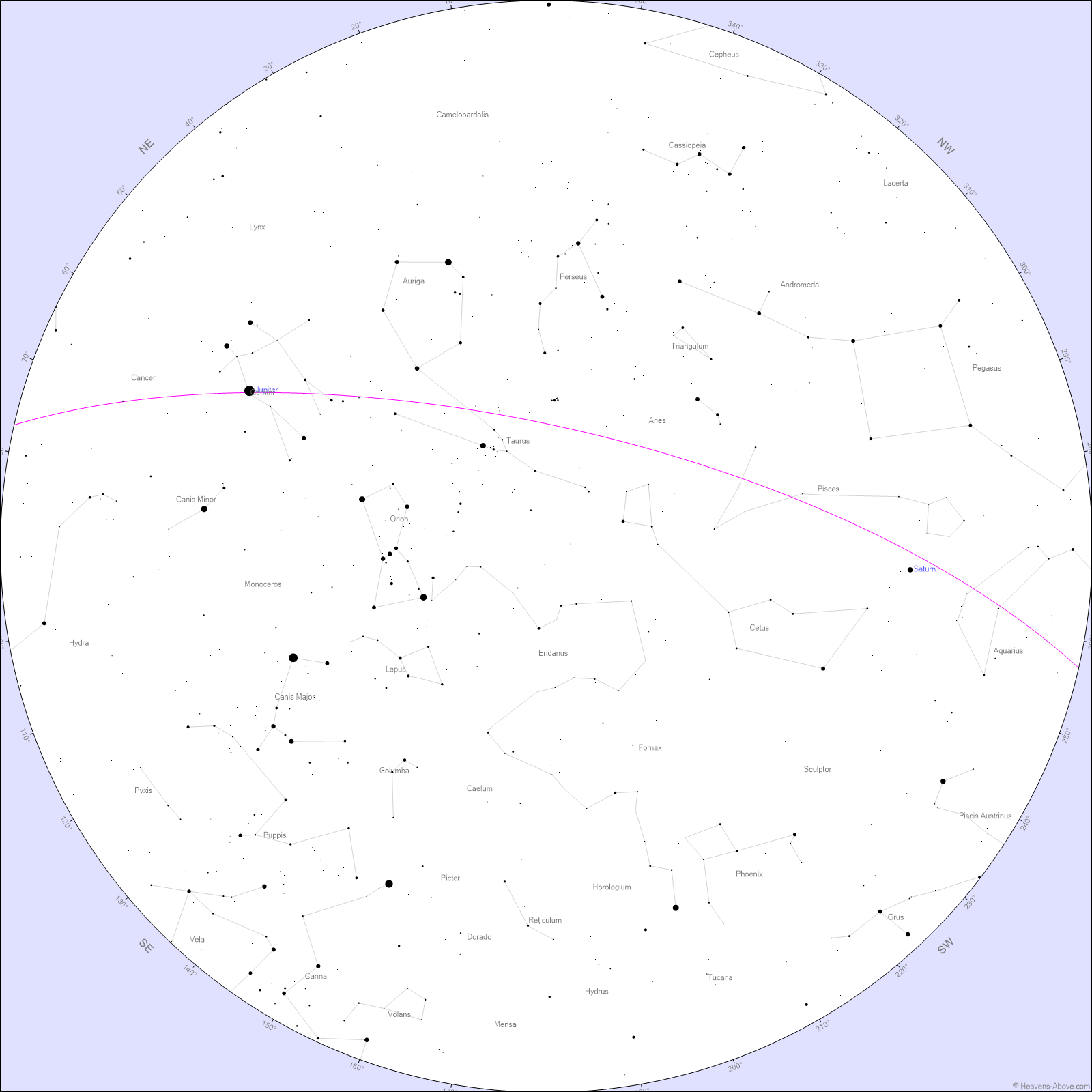
With the Moon out of the way early in the week, the planet Jupiter continues to dominate the night sky. Earlier in January, Jupiter reached opposition, meaning Earth passed directly between it and the Sun — and it will remain bright and prominent through late January. The gas giant rises around sunset and stays visible all night, climbing into the south and shining as one of the brightest objects in the sky. Even small telescopes and good binoculars can reveal its four largest moons and, under stable seeing, hints of cloud bands on its disk.
Not far behind Jupiter in the evening sky is Saturn, visible after sunset in the southwest. Through a small telescope, Saturn’s rings continue to be a delightful sight, though it will be lower in the sky than Jupiter.
On January 23, an attractive pairing awaits observers: the thin waxing crescent Moon will appear close to Saturn and Neptune in the western sky after sunset.
Saturn is, of course, bright enough to see with the unaided eye, and Neptune, much fainter, can be pulled out with binoculars or a telescope if you know where to look. An app like Stellarium can help you locate it precisely. This grouping makes a nice target for early evening observing as the Moon’s crescent returns.
This week also offers the chance to revisit some deep-sky favorites. The Beehive Cluster in Cancer is well placed in the eastern sky after dusk. This open cluster, also cataloged as Messier 44, is a beautiful sight in binoculars or a wide-field telescope, appearing as a misty patch of dozens of stars.
Also this week, if you’re using telescopes with tracking or a good star chart, you can enjoy fainter wanderers. Uranus remains a binocular object tucked near the Pleiades cluster, and Neptune will be easier to spot during the Moon–Saturn close approach on the 23rd — though both require optical aid and some patience.
Finally, take a moment to step back from specific targets and enjoy the winter Milky Way sprawling across the sky from Orion through Gemini and into Auriga and Perseus. With few nights this dark all month, the winter constellations and the rich patches of interstellar dust and starbirth regions around them are especially satisfying even through binoculars.
That’s a snapshot of what’s up this week. Bundle up, step outside early in the evening, and let your eyes adjust — the dark skies this week are a gift.
OK folks, the Star Trails book club is finally happening. If you want to follow along, you’re going to need a copy of NightWatch by Terence Dickinson. Make sure you get the fifth edition for the most up-to-date information, although I’m reading the fourth edition, which is accurate to 2025. I don’t think the stars on the included charts will have moved that much.
In our first show in February — two weeks from now — I’m going to talk about my favorite portions of the first three chapters. Chapter 1, Discovering the Cosmos, is a broad survey of the goals of the book. Chapter 2, the Universe in 11 Steps, sets up a fascinating discussion on the scale of the universe, and Chapter 3, Backyard Astronomy, really matches up well with the Star Trails philosophy, and is full of useful tips for navigating the sky.
I’ll offer up my thoughts in more detail on these sections and if you’ve read NightWatch, I’d like to hear your reflections also. Feel free to comment over at startrails.show.
That’s going to do it for this week. If you found this episode interesting, please share it with a friend who might enjoy it. The easiest way to do that is by sending folks to our website, startrails.show. And if you want to support the show, use the link on the site to buy me a coffee. It really helps!
Be sure to follow Star Trails on Bluesky and YouTube — links are in the show notes. Until we meet again beneath the stars … clear skies everyone!
Support the Show
Connect with us on Bluesky @startrails.bsky.social
If you’re enjoying the show, consider sharing it with a friend! Want to help? Buy us a coffee! Also, check out music made for Star Trails on our Bandcamp page!
Podcasting is better with RSS.com! If you’re planning to start your own podcast, use our RSS.com affiliate link for a discount, and to help support Star Trails.
 Star Trails: A Weekly Astronomy Podcast
Leave a comment