What a Star Is (and What It Isn’t) – Star Trails: A Weekly Astronomy Podcast
Episode 96
This week, we begin a month-long exploration of the most familiar objects in the night sky, and wonder why they’re still so often misunderstood.
In this episode, we take a deep dive into what a star really is, and just as importantly, what it isn’t. We’ll talk about how stars form, why they live such turbulent lives, how light escapes their interiors over immense spans of time, and why the stars we see from Earth are not representative of the galaxy as a whole.
Along the way, we’ll challenge common assumptions about color, brightness, and magnitude, explore the strange world of brown dwarves and “failed” stars, and reflect on why nearly everything around us exists because earlier generations of stars lived and died long before the Sun was born.
After the break, we turn our attention to the night sky for February 1st through the 7th. The week opens under the light of the full Snow Moon. We’ll talk about a close lunar encounter with Regulus in Leo, and a selection of star clusters and overlooked regions that still shine through imperfect conditions, including the Beehive Cluster, M67, Monoceros, and a charming little cluster in Orion known as “the 37.”
We also kick off the Star Trails book club with the first three chapters of NightWatch by Terence Dickinson. We’ll discuss why this classic guide remains so valuable, how different editions compare, and why books are still some of the best companions you can bring to the night sky.
Links
Transcript
Howdy stargazers and welcome to this episode of Star Trails. My name is Drew and I’ll be your guide to the night sky for the week of February 1st through the 7th.
This month, we’re turning our attention to the most familiar objects in the sky, and asking why they still surprise us. Stars are the first objects we learn to recognize and the last ones we stop questioning. They feel simple, steady, almost obvious. But they aren’t. Over the next few episodes, we’re going to stay with stars long enough for those assumptions to fall apart, and see what’s left when we stop treating them as scenery.
Later in the show we’ll cover the night sky for this week, and we kick off the discussion of the first three chapters of NightWatch, a book that makes an excellent companion to this podcast.
Whether you’re tuning in from the backyard or the balcony, I’m glad you’re here. So grab a comfortable spot under the night sky, and let’s get started!
I can almost hear the groans out there. Why stars, and why multiple episodes dedicated to them? Some of you may even remember episode 48, which was all about stars, and in fact, it’s one of the shows I recommend to new listeners.
Our discussion tonight will cover some similar, but different, ground. We’re going to challenge what you think you know about these building blocks of the universe, or at least reframe them in a way that encourages taking a fresh look at them.
Today’s show will cover what a star is, and what it isn’t. And over the next few weeks, we’ll dig deeper into the lives of stars, their connections to humanity, and their fantastic deaths. And finally, we’ll break out data, statistics and the random number generator to simulate the birth of half a million stars in our own little version of the Big Bang.
Star are anything but boring. We owe our existence to them. After all, and I’m quoting Carl Sagan here, “we are made of star stuff.”
When we talk about stars, we usually start with a definition. A star is a ball of gas. A star is powered by nuclear fusion. A star shines because hydrogen is being turned into helium in its core.
All of that is true, but it’s also an oversimplification.
A star isn’t an object in the way we normally mean that word. It’s more like a process. A temporary state. A long negotiation between forces that would very much prefer a different outcome.
At its heart, a star begins with failure.
In a stellar nursery, gravity pulls matter inward relentlessly. Gas collapses, compresses, heats. In most cases, that collapse never gets far enough to matter. Clouds fragment, disperse, or drift back into obscurity without ever becoming anything we’d recognize as a star.
But sometimes, rarely, that collapse doesn’t happen.
Pressure rises. Temperatures climb. Long before fusion ignites, a protostar is born: hot, dense, glowing not because it’s burning fuel, but because it’s falling inward. That phase can last millions of years, with gravity doing nearly all the work.
Only when the core reaches extreme temperatures does hydrogen fusion finally begin. At that moment, gravity is interrupted. Outward pressure pushes back. The collapse slows, not because it has failed, but because it has been delayed.
Fusion doesn’t create a star, so much as it delays the inevitable. A star is what happens when gravity is stopped, temporarily.
That balance is everything. If fusion weakens, gravity wins. If gravity is resisted too strongly, the star swells, sheds mass, or destabilizes. There is no permanent state here, only equilibrium held for a while.
That’s what a star is.
And it’s important to say what a star is not. A star is not stable.
We imagine stars as eternal, fixed points on the sky, but that stability is an illusion created by human lifetimes. Even the longest-lived stars are burning through finite fuel. Some burn recklessly fast. Others sip slowly, but none escape the clock.
We often describe stellar lifecycles as neat stages, and you’ve probably seen diagrams of this in books: birth, main sequence, giant, and remnant. It’s as if stars politely queue up and advance in order. But nature doesn’t respect our diagrams. Massive stars rotate violently. They lose material. They pulse. They interact with companions. Some skip stages. Some reverse course. Some collapse early. Many never follow the “standard” path at all.
The lifecycle we teach is an average, and most stars’ lives are messier and more complicated.
Here’s a wild fact: Most stars are not alone.
Solitary stars like our Sun are unusual. The majority of stars form in pairs or groups, and their neighbors matter. Companions exchange mass, distort orbits, and alter fates. Some of the most dramatic stellar events we know about, certain supernovae among them, simply cannot happen without a second star involved.
A star’s destiny is often shaped not just by what it is, but by who it lives with. Stars are social objects, yet we often regard them as solitary.
When a star does reach a relatively stable phase, what we call the main sequence, it sounds calm. Ordinary. Normal. But it isn’t. A star’s life is that of contained violence. Internal turmoil, energy constantly trying to shatter the grip of gravity.
Inside a main-sequence star, hydrogen nuclei are constantly fusing into helium under crushing pressure. Enormous amounts of mass are converted directly into energy every second. Gravity pushes inward. Fusion pushes outward. What we experience as starlight begins deep in the core, but it doesn’t escape easily.
A photon created there doesn’t travel straight to the surface. It ricochets. It’s absorbed and re-emitted, bounced and scattered again and again. That journey can take tens of thousands, even millions, of years. By the time that light finally escapes into space, the conditions that created it may no longer exist.
So a star’s glow is actually a slow leak, albeit, the mechanism that allows us to see them.
Now let’s talk about color.
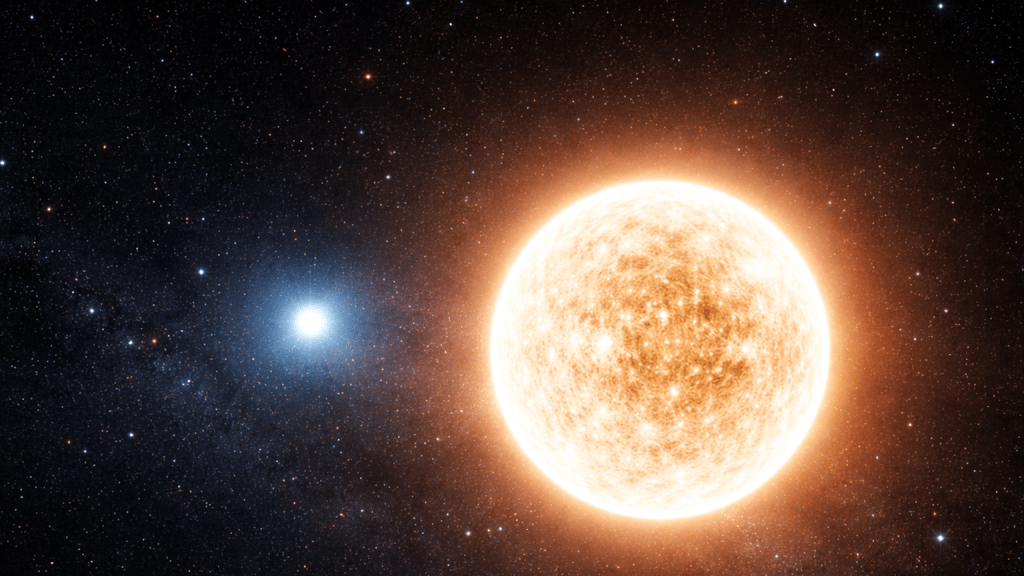
We say stars are blue, white, yellow, orange, or red, as if color were decoration. But color is diagnosis. A star’s color tells us its surface temperature. Blue stars burn hotter and faster. Red stars burn cooler and often far longer, or they are swollen giants nearing the end of their balance.
Here’s what often goes unsaid: human eyes are terrible tools for measuring stellar color. In low light, our color vision collapses. The atmosphere bends and splits starlight. Near the horizon, stars shimmer into rainbows. Sirius flashes blue, red, and green not because it’s changing, but because Earth won’t hold still.
Astrophotography has trained us to expect color, but much of what we “see” is interpretation layered atop reality, calibration, enhancement, long exposure, revealing truths our eyes were never built to perceive directly. The sky isn’t lying, but it isn’t being entirely honest either.
The same is true for brightness.
When we say a star is bright, we’re not describing the star itself. We’re describing a measurement. Astronomers use a system called magnitude, a backward scale where smaller numbers mean brighter objects and negative numbers mark the brightest of all. It’s and older system, refined mathematically, but still rooted in human perception.
You’ll often see stars categorized by magnitude. Historically, ancient astronomers cataloged stars down to about 6th magnitude, because that’s where stars stop being reliably visible to most people under natural skies. That’s why the original magnitude system ended there, it was literally the edge of human perception. In light polluted skies, we might be able to only see stars around magnitude 3. Binoculars can draw in more light, often allowing us to see stars at +9 or +10.
Magnitude doesn’t tell us how powerful a star is. It tells us how bright it appears from here on Earth. Brightness is a collaboration between energy output and distance, and we only experience the final result.
This is where our intuition really breaks down.
The stars that dominate our night sky, the ones we learn first, the ones with names, are not typical stars. They are either unusually luminous, unusually close, or both. They are giants, supergiants, or nearby standouts. These account for about 99% of the stars we see from Earth.
The vast majority of stars in the Milky Way are nothing like them.
Most stars in our galaxy are small, cool, dim red dwarfs. They burn slowly. They live for trillions of years. And from Earth, almost all of them are completely invisible. They don’t announce themselves. They don’t dominate constellations. They don’t shape mythology.
If you could somehow turn down the brightness bias of the sky, if you could see all stars equally regardless of distance, the familiar patterns would dissolve. The night would be flooded with faint, unassuming points of light.
And not every collapsing object even becomes a star as we know them.
Sometimes a cloud gathers enough mass to heat up and glow faintly, but never enough to sustain hydrogen fusion. These objects are called brown dwarves. They’re too massive to be planets and too small to be stars. Some briefly fuse a heavy form of hydrogen called deuterium, buying them a short-lived glow. Then gravity resumes its work, and they cool and fade.
Brown dwarves are not stars that died. They are stars that never quite lived.
You’ll sometimes hear Jupiter called a “failed star.” It isn’t. Jupiter never tried to ignite. Planets form differently, assembling piece by piece in a disk around a young star. Jupiter would need to be more than seventy times more massive to even approach fusion.
Brown dwarves remind us that star formation is not guaranteed. The universe produces many more almosts than successes.
Here’s another strange fact: We can’t actually observe stars directly. Every star in the night sky, except one, is an unresolved point of light. No surface detail. No texture. Just photons collected and interpreted.
Everything we know about stars comes from light, its brightness, its color, its spectrum, its variability, and from physics. Our Sun is the only star we can truly study. We observe it from Earth. From space. We send probes into its atmosphere. We watch its surface churn, flare, ripple, and erupt.
Then we take what we learn from the Sun and extend it, carefully, to every other star in the universe. Stars are not understood individually; they are understood statistically. The Sun is our Rosetta Stone.
Stars don’t exist just to shine. They exist to transform matter. Inside stars, simple elements are rearranged into more complex ones. And when stars die, sometimes gently, sometimes violently, they return that processed material to the galaxy. Every atom heavier than hydrogen and helium owes its existence to stars that lived and failed long before the Sun was born. Stars are not the universe’s final products. They are its workshops.
And that leads to the most important thing a star is not. A star is not the main character of the universe.
We build our stories around stars because we orbit one, because they light our nights, because they are visually generous. But stars are temporary features in a universe that prefers darkness, cold, and emptiness. They are brief leaks of energy in a cosmos otherwise content to coast.
That doesn’t make them insignificant. It makes them extraordinary.
And we happen to live during one of those pauses, on a planet warmed by a single star, surrounded by thousands more, most of which we will never see, all of which will eventually fail.
After a quick break we’ll return with this week’s sky report, and I’ll share my thoughts on the first three chapters in NightWatch. Stay with us!
Welcome back.
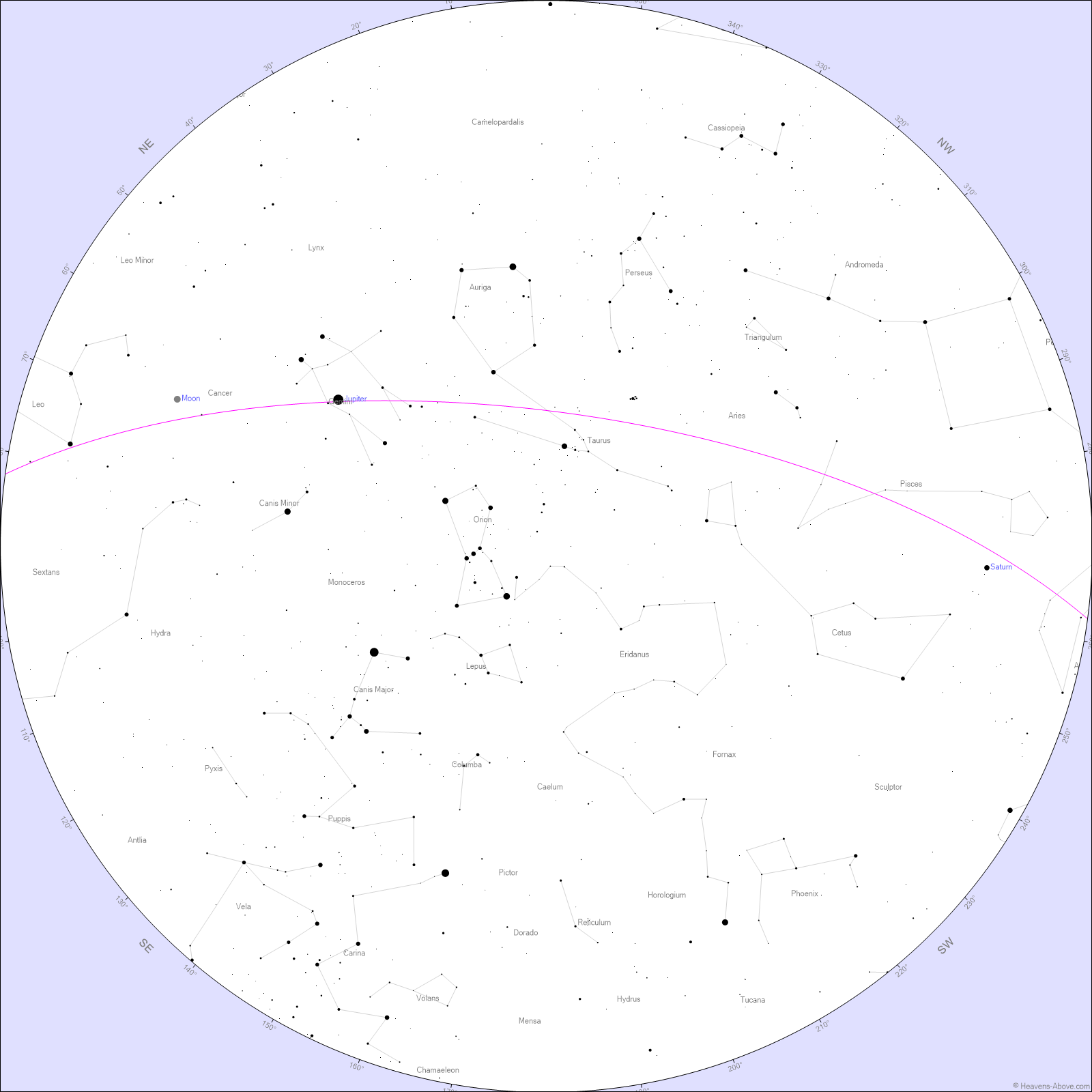
As we look at the sky tonight through the 7th, one of the first things you’ll notice is the full Moon — the Snow Moon — shining high and bright early in the week. The full phase occurs tonight.
This is the traditional Snow Moon. In much of the Northern Hemisphere, February is among the snowiest months of the year, so cultures from Native American tribes to colonial settlers used this Moon as a kind of natural calendar marker. It’s also been called the Hungry Moon, Bear Moon, Ice Moon, and other names rooted in the seasons and the challenges winter brings.
This full moon means faint deep-sky objects will be washed out. That said, bright targets like open clusters and contrasty stellar fields still hold up beautifully, and the Moon’s presence itself becomes part of the story.
An interesting moment coming right at the start of the observing window is the Moon’s close association with the bright star Regulus in Leo. Tonight and into the 2nd, the Moon sits near Regulus — so close that, from some parts of North America, it will even occult Regulus on the 2nd. Be sure to check in with an app like Stellarium to determine the exact time of the occultation. For instance, at my location, the right limb of the moon will just barely graze Regulus around 9 p.m.
As the week progresses, the Moon wanes to gibbous, which means later nights after moonset give cleaner views of star clusters and subtler features in the winter sky.
Planets this week are not the main attraction, but there are a couple worth noting. Jupiter is still visible in the early evening, shining brightly before it sinks toward the west. It’s past its best opposition views, but it’s still unmistakable and makes a good anchor point in the sky. Saturn is much fainter and lower, and really requires binoculars or a telescope to appreciate, but it’s there for patient observers.
Now, let’s talk about stars and clusters—especially the ones people tend to overlook.
High in the sky this week, you’ll find the faint constellation Cancer. Cancer doesn’t have any bright stars to announce itself, but it hides two excellent clusters that reward a slower look.
The first is the Beehive Cluster, also known as M44. To the naked eye under darker skies, it appears as a soft patch of light. In binoculars, it explodes into dozens of stars scattered across a wide field. This is one of those objects that feels more natural in binoculars than in a telescope, and it’s especially satisfying once the Moon has dipped lower in the sky.
Nearby is M67, a very different kind of cluster. M67 is older, tighter, and more subdued. It doesn’t jump out at you, but once you settle in, it feels dense and deliberate—almost like a fossil record of an earlier generation of stars. It’s an excellent contrast to the Beehive and a reminder that not all clusters tell the same story.
If you’re willing to move your gaze a little farther south, look toward Monoceros, the Unicorn. This is one of the most underappreciated winter constellations, largely because it’s faint and doesn’t resemble much of anything at first glance. But Monoceros is rich in star clusters.
One standout here is NGC 2244, the central cluster of the Rosette region. Even if the surrounding nebula is washed out by moonlight, the cluster itself is visible in binoculars or a small telescope as a loose grouping of young stars. This is a great object to revisit later in the month under darker skies, but it’s still worth finding now.
Back in Orion, but away from the famous nebula, there’s a small, charming cluster called NGC 2169. Through binoculars or a low-power telescope, its stars form a pattern that looks like the number “37.” It’s subtle and a little whimsical.
This is also a good week to simply wander star fields.
Spend some time around Procyon in Canis Minor, or scan the regions between Orion and Gemini. These areas don’t have marquee objects, but they’re full of subtle patterns, faint companions, and gentle color contrasts that are easy to miss when you’re always chasing famous targets.
Because the Moon is bright early in the week, think about timing rather than fighting conditions. Step outside before moonrise or stay out after it sets. Use binoculars. Let your eyes adapt. And don’t rush.
It’s time to discuss our first book club selection, NightWatch, by Terence Dickinson. I chose this book because it’s often recommended as a good starting point for beginner stargazers. That doesn’t mean seasoned observers can’t enjoy it. Every time I open it, I learn something new, and I’ve mentioned it before, but this book could be an accompanying text for this podcast because it’s really aimed at backyard binocular observers.
Before we go any further, it’s worth talking briefly about editions, because NightWatch has been updated several times over the years, and you may not all be reading the same one.
I’m personally working from the fourth edition, which technically only carries star charts through 2025. That’s still completely fine for what we’re doing here. The fundamentals haven’t changed, the sky hasn’t rearranged itself, and everything in these early chapters remains solid and relevant.
There is a fifth edition, and if you’re using that one, you’ll notice a few meaningful upgrades. The photography is more modern, with newer astrophotography replacing some of the older images, many of which, in earlier editions, were taken by Dickinson himself and definitely show their age. The fifth edition also expands coverage of the southern sky, which is valuable in general, even if we don’t spend much time there on this podcast. There’s also more material related to modern observing and imaging techniques, including astrophotography.
That said, for our purposes, especially these opening chapters focused on orientation, scale, and backyard observing, the fourth and fifth editions are philosophically identical. The words still land the same. The guidance still works. And the sky they describe is the same one above your head tonight.
So if you’ve got the fifth edition, great. If you’re working from the fourth, don’t worry, you’re not behind, and you’re not missing anything essential for this discussion.
This opening chapter, Discovering the Cosmos, is brief, but it’s doing something important. Dickinson makes it very clear that astronomy doesn’t begin with equations or equipment, it begins with attention. He frames astronomy as something you can do with your eyes alone, then gradually expands that to binoculars and telescopes without ever making the naked eye feel like a lesser option.
One line of thinking that really resonated with me is his idea that we’re all celestial tourists. And just like traveling somewhere new on Earth, the experience gets richer when you understand a little about where you are and what you’re looking at. You don’t need to be an expert, but knowing the lay of the land changes everything.
That philosophy should feel very familiar to Star Trails listeners. The goal isn’t to pile on jargon or technical baggage. It’s to untangle it, just enough, so the sky starts feeling accessible.
If Chapter One is an invitation, Chapter Two is perspective therapy.
This chapter, “The Universe in Eleven Steps,” walks outward from Earth in steps, each one expanding the scale by factors of a hundred, until you’re suddenly dealing with distances and sizes that stop making intuitive sense. And that’s the point. Dickinson is taking an honest look at the problem of scale in our universe, and how to begin to comprehend its vastness.
What really stands out here is how visual this chapter is. Even if you’re familiar with the structure of the solar system, the Milky Way, and beyond, seeing it laid out this way reminds you just how strange our situation is. We’re not at the center of anything. We’re not special in location. We’re riding along in a galaxy that’s one among billions.
By the time this chapter ends, you have a much better sense of where the night sky fits into the larger universe.
Now, this is where NightWatch really starts to feel like a companion to this podcast. Chapter Three, “Backyard Astronomy,” is densely packed, but it’s written with a light touch. It covers how the sky moves, why stars appear to rotate around Polaris, and how Earth’s rotation creates that slow celestial swirl we talked about earlier this year on the show.
One of my favorite sections is Dickinson’s discussion of measuring the sky using your hands, how a fist at arm’s length spans about ten degrees, and how your fingers can become a built-in ruler. This is such a simple idea, but it’s incredibly empowering once you start using it. Suddenly the sky feels measurable, navigable, and less abstract.
He also does a nice job showing how familiar constellations act as signposts. Using the Big Dipper to find stars like Arcturus, Vega, Deneb, and Regulus turns the sky into a map instead of a guessing game.
There’s also a subtle but important discussion of star brightness that ties directly into something we’ve talked about earlier in this episode: most of the stars we can see from Earth are not typical stars. They’re larger and more luminous than the Sun. And yet, the Sun itself is brighter and larger than more than ninety percent of the stars in the Milky Way.
This chapter also introduces constellations, explains why they’re named the way they are, and even includes a pronunciation guide—which, I’ll admit, was humbling. There are a few names in here I’ve been confidently mispronouncing for years.
Finally, Dickinson touches on the “stuff that moves” such as satellites, rocket bodies, and space stations, and reminds us that not everything crossing the sky is ancient or distant. Some of it is very much ours.
What I appreciate most about these opening chapters is that they don’t assume you’re starting from zero, but they are easy to understand, even if you are.
I also want to take a moment to say something in defense of books themselves. Like many of you, I tend to read books on a device these days. NightWatch is not available as a download. And that’s not a bad thing.
Astronomy is a field that moves quickly in some ways and incredibly slowly in others, and books like NightWatch sit right at that intersection. The technology changes. The photography improves. The charts get updated. But the sky doesn’t reinvent itself every year.
There’s something uniquely valuable about a well-designed astronomy book. It invites you to slow down, flip back a few pages, and let ideas settle.
That’s why NightWatch feels like such a natural fit for this show. It’s trying to teach you how to look, how to think, and how to stay curious. It’s exactly the right tool for the kind of astronomy we’re practicing here.
We’ll discuss the next two chapters two weeks from now. Chapter 4 is all about stars, which aligns nicely with this month’s theme. Chapter 5 is a discussion about stargazing equipment, and includes an honest and eye-opening discussion about the nature of telescopes. I think you’ll enjoy both sections. Also, the NightWatch website, nightwatchbook.com, contains additional content such as videos and links to online resources that complement the book. Check that out if you get a chance. And I don’t have any homework to give out or anything, but if you want to share your thoughts on this book, feel free to send me a note via the show website.
That’s going to do it for this week. If you found this episode interesting, please share it with a friend who might enjoy it. The easiest way to do that is by sending folks to our website, startrails.show. And if you want to support the show, use the link on the site to buy me a coffee. It really helps!
Be sure to follow Star Trails on Bluesky and YouTube, links are in the show notes. Until we meet again beneath the stars … clear skies everyone!
Support the Show
Connect with us on Bluesky @startrails.bsky.social
If you’re enjoying the show, consider sharing it with a friend! Want to help? Buy us a coffee! Also, check out music made for Star Trails on our Bandcamp page!
Podcasting is better with RSS.com! If you’re planning to start your own podcast, use our RSS.com affiliate link for a discount, and to help support Star Trails.
 Star Trails: A Weekly Astronomy Podcast
Leave a comment