The Quiet Majority of Stars – Star Trails: A Weekly Astronomy Podcast
Episode 98
This week we take a nerdy detour into the lives of stars by building a tiny simulated galaxy in Python. We form half a million stars, roll the clock forward 10 billion years, and discover something counterintuitive: nearly all of them are still shining. The stars that dominate our constellations, the bright, showy ones, are statistically the least likely to survive. The night sky, it turns out, is a biased sample.
From there, we leave the realm of statistics and tour a handful of “highlight reel” stars: neighbors like Proxima Centauri and Barnard’s Star, navigational royalty like Canopus, famous oddballs like Vega, and cosmic heavyweights like Antares and WR 104, the so-called “Death Star” that’s (probably) not aimed at us after all.
This week’s night sky lands in the sweet spot of the month: A New Moon on February 17 brings genuinely dark evenings, followed by a delicate crescent return. Watch the young Moon pass Saturn on February 19, with Mercury about five degrees south.
Finally, in our book club, we continue with Nightwatch by Terence Dickinson, covering Chapters 4 and 5. We talk old-school printed star charts, seasonal sky “guideposts,” why the Milky Way is a river of unresolved starlight, and Dickinson’s legendary warning about “Christmas trash scopes.”
Links
Transcript
Howdy stargazers and welcome to this episode of Star Trails. My name is Drew and I’ll be your guide to the night sky for the week of February 15th to the 21st.
This week we’re continuing this month’s star theme, but we’re taking a bit of a nerdy detour. We’re going to run some code that simulates a small galaxy containing a half million stars, then we’ll roll the clock forward to see what’s left after 10 billion years. The results are intriguing, and shed a little light on what our universe might look like billions or even trillions of years from now.
We’ll also set our sights on some of the infamous stars in our galaxy, from the closest ones, to the most deadly. Later in the show we’ll take a look at this week’s sky, and visit the next two chapters of Nightwatch in our book club segment.
This is a longer episode, so grab a comfortable spot under the night sky, and let’s get started!
We’re in the midst of our month of star-themed episodes, so I want to do a thought experiment, one that lets us zoom out far beyond any single star. Instead of talking about individual objects, I wanted to ask a broader question: If stars form and evolve the way we think they do, which ones actually survive long enough to still be shining today or even trillions of years from now? And what can we learn from the stars that have already died.
To explore that, I wrote a small Monte Carlo simulation in Python. Nothing exotic, just a deliberately simplified galaxy that follows a few well-established astrophysical rules, and then lets randomness do the rest.
Here’s how the experiment works.
First, we let stars form continuously over a span of ten billion years. That number wasn’t chosen at random. It’s roughly the age of the Milky Way’s disk, and it’s also about how long a Sun-like star spends on the main sequence. In other words, it’s a reasonable stand-in for the lifetime of a mature spiral galaxy up to the present day.
In the code, that simply means every star gets a random birth time somewhere between zero and ten billion years ago. Some stars are ancient. Some are newborn. Most fall somewhere in between.
Every star that forms is assigned a mass. This is the most important choice in the entire simulation, because mass controls almost everything about a star’s life—its brightness, its temperature, and especially how long it lasts.
We assign the mass randomly, but in accordance with some real-world parameters based on star formation — what astronomers call an “initial mass function.” We know most stars are small. Tiny red dwarfs dominate by sheer numbers. Sun-like stars are far less common. And massive, brilliant stars are extremely rare.
Once each star has a mass, we give it a lifetime using a simple rule of thumb: a star’s main-sequence lifetime scales roughly as its mass raised to the negative two-and-a-half power. In plain language, that means doubling a star’s mass shortens its life by more than half.
Small stars can last hundreds of billions of years, longer than the universe has existed so far. Sun-like stars live for about ten billion years. Massive stars may only last a few million years before collapsing or exploding.
With all this in mind, our simulation ran and created half a million stars, each with a birth time, a mass, and a fuel-limited lifespan.
Then, we fast-forward time. We stop the clock at ten billion years and ask one blunt question of every star: Are you still on the main sequence, or are you gone?
The answers surprised me the first time I ran it.
Out of five hundred thousand stars formed in this simulated galaxy, nearly ninety-eight percent are still alive after 10 billion years.
That alone runs against our instincts. Stellar death feels dramatic and common, but statistically, it’s rare. Most stars that ever form are long-term survivors.
In the sim, every tiny red dwarf survives. Every small, faint star just keeps going, barely noticing the passage of billions of years.
Sun-like stars mostly survive too. In our test, all stars below about one solar mass are still shining at the end.
But once we move above that, into brighter, more massive stars, survival drops off fast.
Only about half of stars between one and two solar masses make it to the present day. Among the bright, short-lived stars that dominate constellations, survival falls to just a few percent.
And among the most massive stars of all, those destined to explode or collapse, less than one percent are still around when we stop the clock.
And that leads to a grim conclusion: The stars that define the night sky are the least likely to still exist. We see their light because it takes thousands of years to arrive, but the stars creating that light, may be long gone.
The bright winter stars that feel timeless are anything but. They are rare, short-lived, and fleeting on galactic timescales.
Meanwhile, the stars that actually dominate the galaxy, the quiet, patient red dwarfs, are almost completely invisible to us, but they are still out there.
Now, because this is a Monte Carlo experiment, I didn’t stop there. I ran the entire simulation twenty different times, each with a different random universe. Different stars formed. Different massive stars lived and died. The details changed slightly. But the conclusion never did.
Across all twenty runs, the fraction of stars still alive after ten billion years was about ninety-eight percent, with only tiny variations from run to run. The numbers barely moved.
That tells us something important: this isn’t a fluke. It’s a structural feature of how stars work.
And we can take this one step further. For the stars that did die, the simulation also tracks what they leave behind. Once a star is marked as “dead” (meaning its age exceeds its main-sequence lifetime), the code classifies its remnant based on its initial mass. Stars below about 8 solar masses become white dwarfs, those between roughly 8 and 20 solar masses become neutron stars, and the most massive stars become black holes.
The overwhelming majority, more than ninety percent, become white dwarfs: stellar cores quietly cooling toward invisibility.
A much smaller fraction leave behind neutron stars, super-dense but tiny star cores. And only a tiny handful, just a couple hundred out of half a million, end their lives as black holes.
Which means something else quietly remarkable: Most stellar death is not explosive. The galaxy’s graveyard is mostly filled with embers, not fireworks.
So from a practical observing perspective, this explains something many stargazers eventually feel but rarely quantify: the night sky is a biased sample. It favors brightness, proximity, and youth. And from an analytical perspective, it tells us something deeper. When we talk about “average” or “typical” stars, we are almost never talking about the stars we can see.
There another interesting observation here that is a little shocking. And I can’t take credit for it. As I was writing this episode I shared this code with a listener — who just happens to be my brother-in-law, Chris — and he had a striking comment regarding the results.
You’ve heard me say the iconic Carl Sagan quote before: “We’re all made of star stuff.” But if we’re all made of elements from stars, and it’s only the much larger stars that go nova and eject heavy elements into the cosmos, then Chris says, “the stuff that makes us, has to comprise a vanishingly small amount of the available matter in the universe.”
And he’s right. We’re rare, because the atoms that make us are statistically rare, and life like ours couldn’t have existed in the early universe until those giant stars began seeding the cosmos with enough material to form rocky worlds and life itself.
We are the inevitable outcome of a universe that runs long enough for complexity to accumulate.
As always, if you’d like to run my little sim, or study the code, I’ll make it available at the show website. Just look for this episode’s show notes. Alternately, I’ll include a link that runs the code right in your web browser, in case you don’t have Python and the required libraries installed.
Now, let’s move from the realm of statistics, to some actual stars that deserve our attention. I’m just going to mention an extremely small sample of some of the interesting stars we can see right now. A highlight reel if you will.
We start with Proxima Centauri, the star closest to Earth besides out own Sun. Its name just means “the nearest,” and that alone earns it attention. Proxima is a small, faint red dwarf, loosely bound to the Alpha Centauri system. It flares violently, bathing its planets in radiation, yet it hosts at least one Earth-mass world in the so-called habitable zone. Our nearest stellar neighbor is still more than four light-years away. Close, astronomically speaking. Vast, emotionally speaking.
Then there’s Barnard’s Star. This one is famous for movement. Over the course of a human lifetime, Barnard’s Star visibly slides across the sky faster than any other known star. It’s likely more than ten billion years old, and it’s simply passing through our neighborhood. Barnard’s Star quietly shattered the illusion that the constellations are fixed. The sky moves. Just very slowly.
Now look south, to Canopus. This is the second-brightest star in the night sky, yet largely unfamiliar to northern observers, in fact it’s barely visible from where I live, and for those of you farther north, you may not be able to see it at all.
Canopus has guided sailors for thousands of years and is still used for stellar navigation by spacecraft today. Some months back a fan of the show mentioned to me that Canopus has a sci-fi connection. In the Dune saga, the ancestral home of House Atreides orbits Canopus. That choice isn’t accidental. Canopus has long carried associations of authority, navigation, and distant power. Thanks for bringing this one to my attention Mike!
Some stars earn attention not through proximity or brightness, but through reputation.
Vega looks calm, clean, and reliable, and for a long time, it was. Twelve thousand years ago, Vega was Earth’s North Star, and it will be again in the far future as our planet’s axis slowly wobbles. Even now, Vega spins so rapidly that it’s flattened, hotter at its poles than its equator.
Then there’s Antares. Its name means “rival of Mars,” and when it rises in summer skies, its red glow can fool the eye. Antares is a red supergiant nearing the end of its life, swollen and unstable, shedding mass into space. If it replaced our Sun, it would engulf the inner solar system.
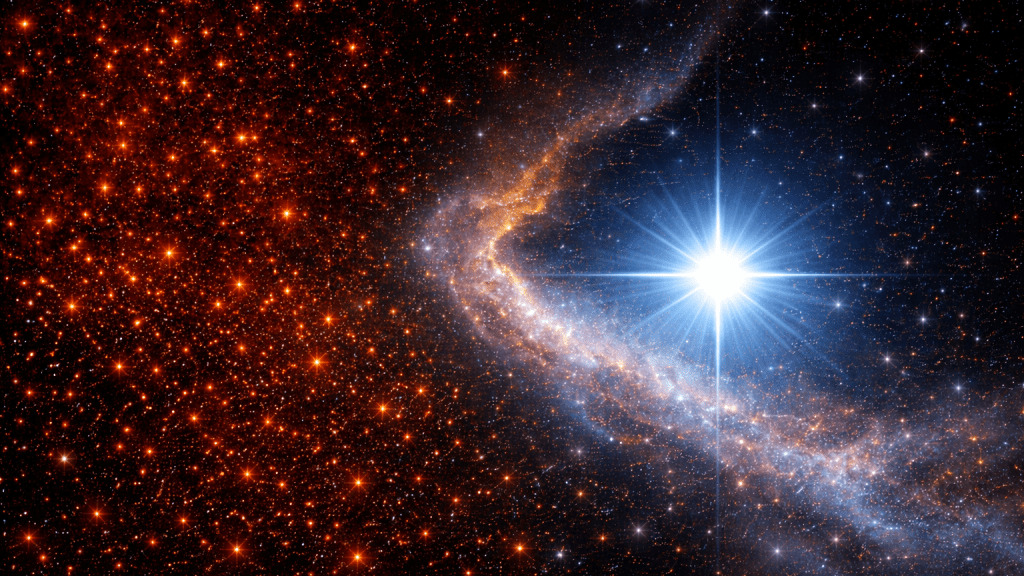
And finally, one that earns a more uneasy kind of fame: WR 104. This triple star system is more than 8,000 light years from Earth and it’s primary star is a Wolf–Rayet star, stripped of its outer layers and blasting material into space at extraordinary speed. It’s wrapped in a spiral of dust known as the Pinwheel Nebula.
The unease comes from orientation and the relatively close proximity. The axis of WR was thought to be pointed roughly toward Earth, meaning that if it were to explode as a gamma-ray burst it could have consequences far beyond its immediate neighborhood, within just a few hundred thousand years. This existential threat earned WR the nickname of “The Death Star,” although scientists now think the axial tilt doesn’t quite line up with our solar system. Looks like we might be safe.
Some stars don’t just age or fade. They collapse, harden, and cross into a different category of existence.
When a massive star runs out of fuel, gravity finally wins. The core implodes, protons and electrons are crushed together, and what’s left behind is an extremely dense neutron star. Some neutron stars spin, and when they do, things get strange.
A pulsar is a rotating neutron star that sweeps beams of radiation through space like a lighthouse. Each rotation sends a pulse toward Earth, which we receive at a regular interval. Some are so precise they rival atomic clocks.
One of the most famous is the Crab Pulsar, the leftover core of a star that exploded in the year 1054. That explosion was recorded by astronomers in China, Japan, and the Middle East, and visible in daylight for weeks. Nearly a thousand years later, the remnant is still spinning, broadcasting the death of a star across the galaxy.
And of course, the largest stars collapse into black holes, drawing in matter and energy that never escapes.
We’ll talk about stellar deaths in more detail in our next episode, but what’s important here isn’t just how violent these stars become. It’s that they’re normal outcomes. It’s what happens when gravity is allowed to finish the job.
After a quick break we’ll return with this week’s night sky report, and some thoughts on the next two chapters of Nightwatch. Stay with us.
Welcome back.
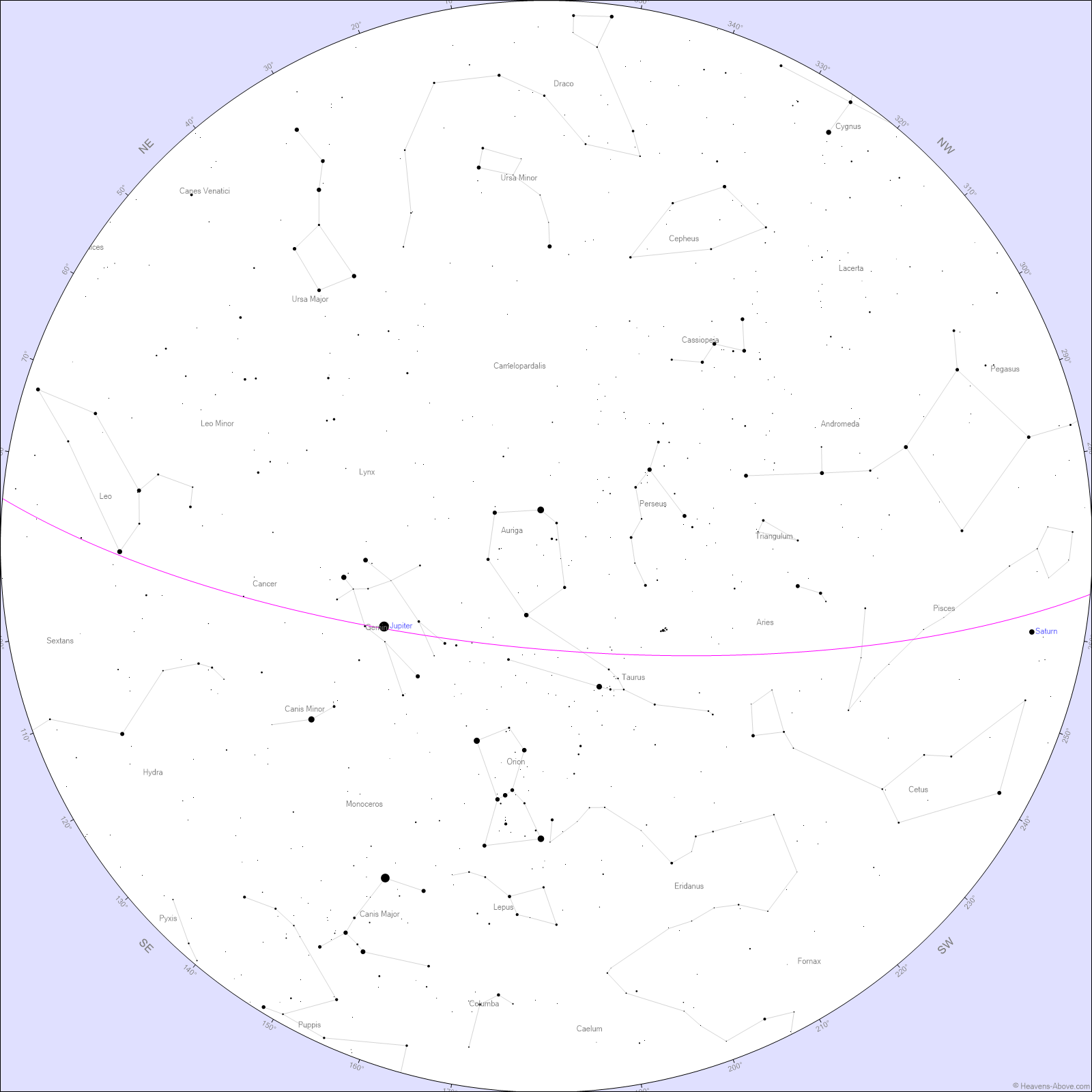
As we move into the middle of February, the night sky quietly gives us one of the best observing windows of the month. This week is defined by a disappearing Moon, a slow-motion gathering of planets, and a stretch of genuinely dark evenings that reward patience more than spectacle. This is not a week of fireworks. It’s a week of alignment, absence, and restraint.
Let’s begin with the Moon.
We reach New Moon on February 17, which places the darkest nights of the week right in the middle of this reporting window. Early in the week the Moon is a very thin waning crescent, rising late and staying mostly out of the evening sky. By the 17th, it’s effectively absent altogether, ideal conditions for deep-sky observing, galaxy hunting, and revisiting faint clusters that usually struggle against moonlight.
The Moon returns quickly but delicately. From February 18 through the 21st, a thin waxing crescent appears low in the western sky just after sunset. These early crescents are soft and understated, and under steady skies you may notice Earthshine, where sunlight reflected from Earth faintly illuminates the Moon’s darkened hemisphere.
A standout moment comes on the evening of February 19, when the young crescent Moon passes in close conjunction with Saturn. The pairing sits low in the west just after sunset.
Nearby, Mercury sits roughly five degrees to the south of Saturn. Mercury is climbing into one of its better evening appearances of the year, visible briefly after sunset if you have a clear western horizon. Binoculars can help, but the naked eye is often enough once you know where to look.
Venus, despite being the brightest planet in the sky, is passing very close to the Sun during this period. As a result, it’s largely lost in the glare and may be difficult or impossible to observe safely from most locations.
Higher in the sky, Jupiter remains the anchor of the evening. It’s visible as soon as the sky darkens and climbs into a commanding position in the southern sky as the night goes on. Jupiter stays up until after midnight, and even a small telescope will show its cloud bands and several of its moons shifting position from night to night.
Farther along the ecliptic, Saturn remains low in the west and increasingly difficult as the week progresses, but its encounter with the Moon on the 19th makes it worth the effort. Uranus is still accessible in the early evening near the Pleiades in Taurus, appearing as a faint, bluish-green point in binoculars or a small telescope.
With the Moon out of the way for much of this period, the deep sky quietly takes center stage.
The Pleiades are especially rewarding this week under moonless skies, revealing layers of stars in binoculars that are easy to miss when the Moon is brighter. Dark-sky observers may also want to use this stretch to hunt faint galaxies or revisit some of the clusters we’ve mentioned in the past few episodes.
This week in the Star Trails book club, we’re reading Chapters 4 and 5 of Nightwatch. Titled Stars for All Seasons, Chapter 4 is a meaty portion of the book that does a lot of heavy lifting.
At first glance, this chapter feels a little old-school. Dickinson spends a good amount of time with printed star charts, the kind you’d expect to see folded into the back of an astronomy book or laminated for use in the field. In an era of phone apps like Stellarium, these charts can feel quaint — almost ceremonial. But Dickinson makes a strong case for them.
Printed charts don’t kill your night vision. And most importantly, they force you to learn the sky rather than outsource it.
Interestingly, Dickinson introduces two kinds of star charts.
One set shows an average sky, not pristine, not heavily light-polluted, something close to what many backyard observers actually experience. The other set is more traditional: black on white, constellations connected by lines, labeled stars, and the ecliptic plane drawn across the chart to show where the planets travel. It’s much more detailed.
These charts aren’t meant to be memorized. And Dickinson is pretty clear about that. There’s simply too much information here to absorb in one pass. This is a chapter you come back to as your familiarity with the sky deepens.
One of the most striking explanations in this chapter comes when Dickinson talks about the Milky Way. When we look up and see that misty, cloud-like band, what we’re really seeing is perspective. We’re looking sideways through the disk of our own galaxy, into spiral arms packed with stars.
Those stars are so numerous, and so distant, that our eyes can’t resolve them individually. Instead, they blur together into that familiar river of light. The Milky Way isn’t a cloud at all, it’s a crowd.
Dickinson also does a nice job reminding us that brightness is deceptive.
Take Deneb, for example, one of the stars of the Summer Triangle. It may be one of the largest and most luminous stars in the entire Milky Way, but it’s more than 1,600 light-years away. Because of that distance, it appears dimmer than its closer companions Vega and Altair, even though it utterly dwarfs them in true size and power.
Throughout the chapter, Dickinson breaks the sky down by season, and one observation stood out to me: autumn.
According to Dickinson, autumn actually contains fewer distinctive star patterns than the other seasons. It’s not that the sky is empty but that it lacks the bold, obvious shapes we associate with winter or summer. He mentions the region called the Cetus Void, an area with no first- or second-magnitude stars at all.
Winter, on the other hand, often feels special to observers, but Dickinson points out something subtle: winter skies aren’t necessarily better for observing. What they do have is more bright stars, which gives the impression of richness and clarity. This is also where Dickinson emphasizes something many of us take for granted: Orion’s Belt.
Those three stars are actually unusual. Dickinson notes that they are the only example of three stars of that brightness appearing so close together in the sky. It’s not just iconic by tradition; it’s genuinely rare.
Finally, the chapter brings us back to the Milky Way, this time in winter.
The Milky Way appears dimmer in winter because of where we’re looking. In winter, our nighttime view points away from the galactic center, toward the outer edges of the galaxy, where stars are more sparsely distributed. It’s all about our orientation.
Nothing in the sky is static. The seasons don’t just change the weather, they change our angle on the universe. What we see depends on where we’re standing, and when we’re looking.
In Chapter 5, Observing Tools and Techniques, Dickinson shifts the focus away from charts and constellations to the actual tools of observation. And one of the first things he does is quietly de-center the importance of the telescope.
Dickinson spends a surprising amount of time reminding readers that astronomy doesn’t begin with magnification. It begins with patience, dark adaptation, and learning how your eyes work in low light. He makes a strong case for the naked eye and binoculars, not as beginner substitutes, but as serious observing tools that preserve context and teach you how the sky fits together.
There’s also a recurring theme of expectation management running through this chapter. Dickinson is very clear that the sky does not look like photographs. Nebulae don’t glow in color. Galaxies don’t leap out of the eyepiece. Most deep-sky objects are faint, subtle, and easy to miss unless you know how to look — and unless you accept them on their own terms.
And that leads directly into one of the most memorable parts of the chapter. But first, a personal anecdote, and I think many of you will be able to relate to this.
When I was in the 7th grade, I received for Christmas, a shiny new Jason refractor, which seemingly came with every bell and whistle possible. Except actually using it was beyond frustrating owing to a rickety tripod, wobbly mount, stiff focusers and a nearly useless finder scope. After weeks of practice, I was able to tease out decent views of Jupiter, Venus and Saturn, but not much else, and only after many minutes of frustration trying to acquire my targets.
Dickinson has a name for these cheap telescopes that flood big-box stores every holiday season. He calls them “Christmas trash scopes” because they so often sabotage a beginner’s first experience.
In many cases, the optics themselves aren’t terrible. The real problem is almost always the mount. These scopes are perched on shaky, underbuilt tripods that wobble when you touch them, vibrate when you focus, and refuse to stay pointed where you aim them. Add in low-quality eyepieces, and even bright objects become frustrating to observe.
This is why Chapter 5 keeps circling back to simplicity. A modest instrument on a solid mount — or even a good pair of binoculars — will almost always create a better experience than a flashy telescope that can’t hold still.
And Dickinson doesn’t exclude the use of so-called smart scopes, or go-to mounts. Interestingly, he said he once discouraged people from using them, but realized that in the interest of getting up and observing fast, particularly in areas with a challenging sky, these smart scopes can be a godsend.
This chapter provides an excellent survey of scope types: reflector vs. refractor, Dobsonian mounts vs. equatorial mounts, and so on, along with the pros and cons of it all. It’s quite a technical chapter, but essential reading if you’re looking to purchase an instrument.
If you have any thoughts on these chapters, please let me know over at the show website. I’d love to be able to share some of your reflections on a future episode. We’ll cover the next two chapters two weeks from now.
That’s going to do it for this week. If you found this episode interesting, please share it with a friend who might enjoy it. The easiest way to do that is by sending folks to our website, startrails.show. And if you want to support the show, use the link on the site to buy me a coffee. It really helps!
Be sure to follow Star Trails on Bluesky and YouTube — links are in the show notes. Until we meet again beneath the stars … clear skies everyone!
Support the Show
Connect with us on Bluesky @startrails.bsky.social
If you’re enjoying the show, consider sharing it with a friend! Want to help? Buy us a coffee! Also, check out music made for Star Trails on our Bandcamp page!
Podcasting is better with RSS.com! If you’re planning to start your own podcast, use our RSS.com affiliate link for a discount, and to help support Star Trails.
 Star Trails: A Weekly Astronomy Podcast
Leave a comment