Four Worlds, One Sun; Plus, a Total Lunar Eclipse – Star Trails: A Weekly Astronomy Podcast
Episode 100
In this milestone 100th episode of Star Trails, we bring the cosmos back home.
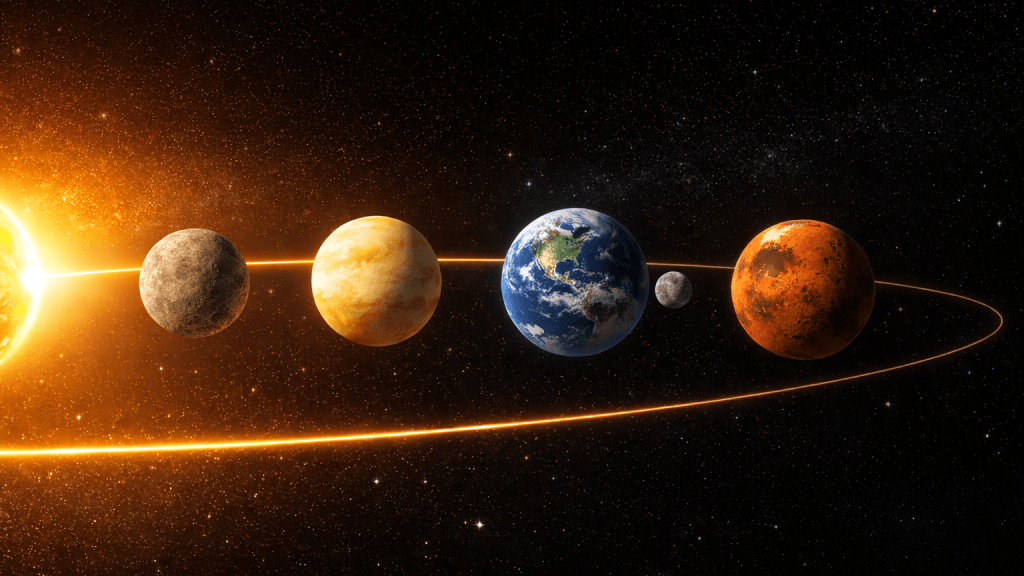
After months of exploring distant stars, nebulae, and black holes, March begins with a tour of our own neighborhood: Mercury, Venus, Earth, and Mars, four rocky worlds born from the same protoplanetary disk 4.5 billion years ago, yet shaped into radically different outcomes.
We’ll visit Mercury, the tiny planet that helped confirm Einstein’s General Relativity and inspired the hunt for a phantom world called Vulcan. We’ll step into Venus, Earth’s “twin” turned runaway greenhouse furnace, and then we’ll zoom out on Earth itself as if we’re alien astronomers reading its oceans, oxygen, and technosignatures from afar. Finally, we’ll head to Mars, a planet that once hosted flowing water, may have been habitable long ago, and still tempts us with the unresolved question of past life.
After the break, I nerd out about my electric car and trace an unexpected history of EVs in space, from the lunar rovers parked on the Moon to a Tesla Roadster orbiting the Sun.
In the sky report, the week’s headline event is a total lunar eclipse: the Full Worm Moon turns coppery red in Earth’s shadow, the only total lunar eclipse of 2026 visible across much of North America. Plus: Jupiter shines in the evening sky, and Mercury and Venus linger low in twilight.
Transcript
Howdy stargazers and welcome to this episode of Star Trails. My name is Drew and I’ll be your guide to the night sky for the week of March 1st through the 7th.
Believe it or not, but this is our 100th episode, and over the past few months, we’ve traveled far. We’ve talked about stars that will outlive our species. We’ve wandered through globular clusters and nebulae. We’ve stood at the edge of galaxies and contemplated black holes. But this month, we’re coming home.
Every object we’ll discuss in March is right here in our own solar system. Not light-years away. These are worlds we can see with our own eyes. And more than that, these are worlds we have visited.
Later in the show we’ll check in with this week’s sky, which features the only total lunar eclipse of the year, and we’ll take a quick look at electric cars in space.
Whether you’re tuning in from the backyard or the balcony, I’m glad you’re here. So grab a comfortable spot under the night sky, and let’s get started!
This month, we’re taking a closer look at our solar system. We’ll start with the inner planets, and move outward. Later in the month we’ll explore some of the wildest moons of our system, venture into the mysterious area beyond the outer planets. And we’ll take a special detour over to Pluto, the planet that went on trial and lost.
What I love about this month’s series is that humanity has orbited, landed on, driven across, drilled into, and photographed every planet we’ll talk about this month. That’s stunning if you stop and think about it.
So this week, we begin with the inner planets: Mercury, Venus, Earth, and Mars. Four rocky worlds with very different outcomes.
Let’s start with the smallest and maybe the oddest: Mercury.
Mercury is often overlooked. It’s tiny. It hugs the Sun. It never strays far from the horizon, and it’s notoriously difficult to observe.
But Mercury played a pivotal role in one of the greatest scientific revolutions in history.
For decades in the 19th century, astronomers noticed something odd about Mercury’s orbit. The point of closest approach to the Sun, its perihelion, slowly shifted over time in a way that Newton’s laws couldn’t fully explain.
The discrepancy was small. Just 43 arcseconds per century. Some astronomers proposed that an unseen planet inside Mercury’s orbit was tugging on it gravitationally. They even gave this hypothetical world a name: Vulcan.
Searches were conducted. Observations were claimed. Vulcan sightings were reported near the Sun’s glare during eclipses. But Vulcan didn’t exist.
Instead, in 1915, Albert Einstein showed that Mercury’s strange orbital precession wasn’t caused by an invisible planet. It was caused by the curvature of spacetime itself.
According to General Relativity, massive objects like the Sun warp the fabric of spacetime. Mercury, being so close to the Sun, moves through that warped geometry. Its orbit isn’t simply a Newtonian ellipse. It’s an ellipse slowly turning within curved spacetime.
Mercury helped prove that gravity isn’t just a force, but rather geometry. That’s an extraordinary legacy for a little planet most people struggle to find in twilight.
But Mercury is weird in other ways, too.
A year on Mercury, the time it takes to orbit the Sun, is 88 Earth days. But a single solar day, from one sunrise to the next, lasts 176 Earth days.
If you stood on Mercury’s surface, you would watch the Sun rise, pause, reverse direction slightly, then continue its path across the sky. The planet’s 3:2 spin-orbit resonance creates one of the strangest day-night cycles in the solar system.
And despite being the closest planet to the Sun, Mercury has water ice. Not oceans of course, but water ice trapped in permanently shadowed craters near its poles, where sunlight never reaches. So, the hottest world in the solar system harbors ice in eternal darkness.
As for exploration, Mercury has only been visited by a handful of spacecraft. NASA’s Mariner 10 flew by in the 1970s. Decades later, the MESSENGER mission orbited Mercury from 2011 to 2015, mapping its surface in detail and confirming the presence of that polar ice.
From Mercury, we venture out to Earth’s twin: Venus. Well, maybe it’s more of a fraternal twin, than identical.
Venus is nearly the same size and mass as Earth. It’s a rocky world wrapped in clouds. For much of the 20th century, science fiction writers imagined steaming jungles beneath those clouds. Swamps. Oceans. Maybe even life.
Instead, Venus turned out to be something far more unsettling. It’s a runaway greenhouse world.
Its thick atmosphere is composed mostly of carbon dioxide, with surface pressures about 90 times that of Earth. That’s like being nearly a mile underwater. The surface temperature hovers around 900 degrees Fahrenheit, and that’s hot enough to melt lead.
As for those clouds? They’re made of sulfuric acid.
Venus has a weird orbital quirk in that it rotates backwards. While most planets spin in the same direction they orbit the Sun, Venus spins retrograde. That means on Venus, the Sun rises in the west and sets in the east.
Also, it rotates extremely slowly. A single rotation of Venus takes about 243 Earth days. That’s longer than its year, which is about 225 Earth days.
If you stood on its surface, ignoring the fact that you’d be crushed and incinerated almost instantly, you would experience one of the strangest celestial rhythms imaginable.
And we’ve been there. The Soviet Union’s Venera program achieved one of the most remarkable feats in planetary exploration. In the 1970s and early 80s, several Venera landers successfully reached the surface of Venus. They transmitted data, and in some cases, images, before succumbing quickly to the heat and pressure.
The images they returned are eerie. A flat, rock-strewn landscape beneath a yellowish sky. The light filtered and distorted by thick atmosphere. A suffocating, alien stillness.
More recently, orbiters like NASA’s Magellan mission mapped Venus using radar, since visible light can’t penetrate the cloud deck. Radar revealed a world shaped by volcanism — vast lava plains, pancake domes, massive shield volcanoes.
We’re still not entirely sure if Venus is volcanically active today, but there have been hints. Sulfur dioxide fluctuations. Possible thermal anomalies. Venus may still be reshaping itself beneath those clouds.
Scientists see Venus as a cautionary tale for Earth. Two rocky planets, born from the same solar nebula, similar in size and composition, and yet they diverged dramatically. One became a world of oceans and life. The other became a greenhouse gas furnace wrapped in acid clouds.
And yet, in our twilight sky, Venus remains the brightest planet of all, serene and beautiful from a distance.
Now we arrive at a planet we think we know very well. Earth.
But let’s do something unusual. Let’s imagine we’re not standing on it. Let’s imagine we’re alien astronomers, observing this small blue world from dozens of light-years away. What would we see?
First, we’d notice the color. Earth is strikingly blue because liquid water covers about 70 percent of the surface. That water absorbs red wavelengths and scatters blue light back into space. To a distant observer, Earth’s spectrum would show strong signatures of water vapor in the atmosphere. That alone would be interesting.
But then the alien spectroscopist would notice something even stranger: Oxygen.
Earth’s atmosphere contains about 21 percent molecular oxygen, which is highly reactive. It doesn’t like to remain free in an atmosphere for long. It bonds, oxidizes, and disappears into rocks. For an atmosphere to maintain that much free oxygen, something must be replenishing it continuously. From a purely chemical perspective, Earth’s atmosphere is in disequilibrium.
An alien observer might detect methane alongside oxygen. Those two gases should rapidly react and cancel each other out. Yet on Earth, both persist. Of course, here on Earth, we know the explanation is biology.
Photosynthesis splits water molecules and releases oxygen as waste. Microbes, plants, forests, and plankton are all quietly altering the chemistry of an entire planet.
Then there’s the reflectivity pattern.
As Earth rotates, its brightness changes. Oceans reflect differently than continents. Cloud cover shifts. Seasonal variations alter albedo. Ice caps grow and shrink. An alien observer tracking the light curve might infer continents. Weather systems. Polar caps. They’d even detect our Moon.
Earth’s unusually large moon stabilizes the planet’s axial tilt. That stabilizes climate over long periods. From afar, the gravitational dance between Earth and Moon would reveal itself in subtle wobbles.
And then there are the unnatural signatures.
Over the past century, Earth has begun leaking radio signals into space. Television broadcasts. Radar pulses. Communication signals. A faint, expanding shell of electromagnetic noise roughly 100 light-years in radius.
And Earth has begun sending objects away from itself. We’ve placed satellites in orbit. We’ve sent probes to other planets. We’ve launched spacecraft that have exited the solar system entirely.
An while an alien astronomer wouldn’t know about our culture, our music, literature, or lifestyles, they’d still see spectral lines. And if they are conducting their own search for extraterrestrial intelligence, maybe they’d hear our radio waves.
The alien observers would certainly notice our Moon.
Among the inner planets, Earth is the only one with a truly large, gravitationally significant moon.
Mars has two small, irregular moons, Phobos and Deimos, which are likely captured asteroids.
But Earth’s Moon is enormous relative to its planet. It’s about one-quarter the diameter of Earth and more than one percent of Earth’s mass. That may not sound like much, but in planetary terms, it’s huge.
In fact, some astronomers describe the Earth–Moon system as a double planet.
The barycenter, the shared center of mass around which both Earth and Moon orbit, doesn’t sit at the exact center of Earth. It lies about 1,700 kilometers beneath Earth’s surface. Earth itself wobbles around this point as the Moon orbits.
Earth itself also does something subtle but important. It spins once every 24 hours. That rapid rotation helps generate a magnetic field through the motion of molten iron in its core. That magnetic field shields the atmosphere from the solar wind — preventing it from being stripped away over billions of years.
And that brings us to Mars, the red planet, that wasn’t as lucky as Earth in regards to its atmosphere.
From a distance, Mars looks almost like Earth. It has polar caps. Seasons. A 24.6-hour day, remarkably close to our own. A tilted axis produces familiar rhythms of spring, summer, autumn, and winter.
Mars is a world that seems to have started with potential. We see ancient river valleys carved into its surface. Delta formations where sediment once fanned outward into standing bodies of water. Minerals that form only in the presence of liquid water.
Billions of years ago, Mars almost certainly had flowing water on its surface. It had a thicker atmosphere. A warmer climate. And then something changed.
Mars is only about half the diameter of Earth. Smaller planets cool faster. As its interior cooled, Mars likely lost the dynamo effect that once generated a global magnetic field. Without that magnetic shield, the solar wind gradually stripped away much of its atmosphere.
The water didn’t simply vanish. Some escaped to space. Some froze underground. Some remains locked in polar ice.
What we’re left with today is a thin, cold atmosphere, less than one percent the pressure of Earth’s, and a landscape sculpted by wind and dust.
Mars may be the most explored inner planet after Earth. NASA’s Spirit and Opportunity rovers, solar-powered explorers, lasted far beyond their expected lifetimes. Opportunity operated for nearly 15 years. Curiosity and Perseverance, nuclear-powered rovers, continue to traverse ancient lakebeds and deltas, drilling into rocks that may preserve chemical traces of past habitability.
We’ve flown a helicopter, Ingenuity, in the thin Martian air. That alone sounds like science fiction. We haven’t sent humans to Mars, but we’re trying to and maybe one day we will.
There’s one more reason Mars continues to grip our imagination: The possibility that it once hosted life.
We know that early Mars had liquid water and for a period billions of years ago, Mars was likely warmer and wetter. On Earth, life appears very early in our geological record, almost as soon as conditions allowed it.
So scientists ask a simple question: if life arose quickly here, could it have arisen there? We haven’t found proof, but we’ve found hints.
In 1996, a meteorite from Mars, known as ALH 84001, made headlines around the world. Scientists announced that it contained tiny structures resembling fossilized microbes, along with chemical signatures suggestive of biological activity.
For a brief moment, it seemed possible that we had found evidence of past Martian life.
But over the following years, further analysis showed that those structures could be explained by non-biological processes. The consensus today is that the meteorite does not provide convincing evidence of life.
Since then, rovers have detected organic molecules in Martian rocks. But organic chemistry is not the same thing as biology. Methane has also been detected in trace amounts in the Martian atmosphere, intriguing, but still inconclusive.
All four worlds formed from the same protoplanetary disk 4.5 billion years ago. Same star. Similar materials. But over billions of years, tiny differences compounded.
The inner solar system is not a random assortment of rocks. It’s a long-running experiment in planetary evolution — four test cases, one Sun, and four very different outcomes. If you want to understand how fragile habitability is, you don’t need to travel light-years away. You only need to look next door.
After a quick break we’ll be back with this week’s night sky report and more … Stay with us.
Welcome back.
I hope you don’t mind if I take a moment to meander and maybe nerd out a bit.
The last time I bought a car was almost 15 years ago, and the hot tech of that era was built-in GPS navigation, backup cameras, and Bluetooth. These are things we just expect a new car to have nowadays. My little economy hatchback had none of that. Although I did pack a few amateur radio transceivers into it, earning it the nickname, “The Hamster,” among my friends.
Just as the universe is fumbling toward entropy, so was my old car. With many systems failing, I finally had to retire it last week. In the 15 years since The Hamster rolled off the assembly line, a lot has changed. In 2011 there were maybe three consumer electric cars and only society’s elite, or extreme early adopters drove them. Now, they’re everywhere and charging points are peppered throughout cities and along highways.
Electric is just another choice in the sea of automobiles. In recent years, they’ve become surprisingly affordable, particularly in the used market, where they currently represent some of the best value in the industry.
So, I decided my next ride would powered by electrons, and I’ve been in full-on geek mode ever since.
I chose a color similar to Neil Armstrong’s Marina Blue Corvette Stingray — and yes, that was absolutely on purpose. My new hatchback-on-steroids is fun to drive, but because a large part of the car is a high-voltage battery, you can also do some very practical things with it, like power equipment.
Imagine being at a dark sky site with your imaging rig plugged straight into your electric car. Maybe it gets cold, so you plug in a small space heater. When you get sleepy, power up the coffee maker. Meanwhile, a laptop hums quietly, guiding a telescope that’s tracking a galaxy millions of light-years away. No marine batteries, power inverters, or noisy generators. Just stored energy and silence. This is my observatory on wheels.
And it dawned on me that electric cars have been part of space travel for half a century. The first vehicles humans ever drove on another world were electric.
During the Apollo missions — beginning with Apollo 15 in 1971 — astronauts unfolded the Lunar Roving Vehicle from the side of the Lunar Module like some kind of cosmic origami. It ran on non-rechargeable silver-zinc potassium hydroxide batteries with four independent electric motors, one in each wheel. Top speed? 8 miles per hour. In this case, electricity was required because it couldn’t have burned fuel even if it wanted to — there’s no oxygen on the Moon.
Lunar astronauts logged nearly 60 miles on the lunar surface with their rovers. They collected samples, explored craters, and dramatically increased the scientific return of the missions. And when they left, they parked the rovers there. There are still three electric vehicles sitting quietly on the Moon.
Then there are the Mars rovers, which we’ve aleady mentioned earlier in this episode. While they weren’t made to carry humans, they are, in every meaningful way, electric cars operating on a different world.
And of course, there’s the slightly absurd case of the Tesla Roadster launched into space in 2018 during the first flight of SpaceX’s Falcon Heavy rocket. Instead of a dummy payload, they bolted a production electric sports car to the upper stage and sent it into orbit around the Sun. On the dashboard a sign read “DON’T PANIC,” a nod to writer Douglas Adams. David Bowie’s “Space Oddity” blasted through the speakers on loop, into the soundless vacuum of the cosmos.
There’s a mannequin in a space suit in the driver’s seat, nicknamed “Starman,” and the roadster is still orbiting the Sun to this day. You can track it’s location on web sites like Heavens Above, and it may wander the inner solar system for millions of years. That means the first production car to leave Earth was electric.
EVs may or may not be the future, depending on who you ask. But the truth is, they were humanity’s first off-world transportation, dating back to the Apollo era.
And so here I am, driving what feels like a spaceship on pavement, during a week when the Moon takes center stage. It feels strangely appropriate, so let’s get into it.
The month kicks off with a headline event: a total lunar eclipse.
The Moon begins the week waxing toward full. By the night of March 2nd into the early hours of March 3rd, it reaches Full Moon, traditionally known as the Worm Moon, named for the time of year when the ground softens and life begins to stir beneath the surface.
But this year, that full Moon won’t stay bright for long. In the early morning hours of March 3rd, the Earth will move directly between the Sun and the Moon, casting its shadow across the lunar surface. This is a total lunar eclipse, and it’s the only one in 2026 visible to much of North America and the Pacific region.
A lunar eclipse unfolds gradually. First, the Moon slips into Earth’s penumbra, a subtle shading that many observers won’t even notice. Then comes the umbra, the darker central shadow, and you’ll begin to see a distinct bite taken from the lunar disk. Over the course of a couple of hours, that bite grows until the Moon is fully engulfed.
Totality lasts just under an hour, about 58 minutes. Instead of disappearing, the Moon turns coppery red. This effect is caused by sunlight passing through Earth’s atmosphere, where it gets filtered and bent. Blue light scatters away while the longer red wavelengths continue on, curving into Earth’s shadow and softly illuminating the Moon.
The exact shade of red can vary. If Earth’s atmosphere is especially dusty, perhaps from volcanic eruptions or heavy pollution, the Moon can appear darker, even brick red. On a particularly clear year, it may glow more orange or copper.
You won’t need a telescope. In fact, lunar eclipses are best enjoyed with your own eyes. Binoculars can enhance the color contrast, but this is a naked-eye event. Once this eclipse passes, we won’t see another total lunar eclipse in North America until late 2028 or early 2029. So if skies are clear, this is one to check out.
You’ll want to use an app like Stellarium to track when the eclipse occurs in your area. Here in the southeast US where I’m located, the eclipse begins around 5 a.m. on the morning of the 3rd, very low on the western horizon, so it’s going to be a tough one for some of us to spot.
Now, while the Moon steals the spotlight this week, the planets are still putting on their quiet show.
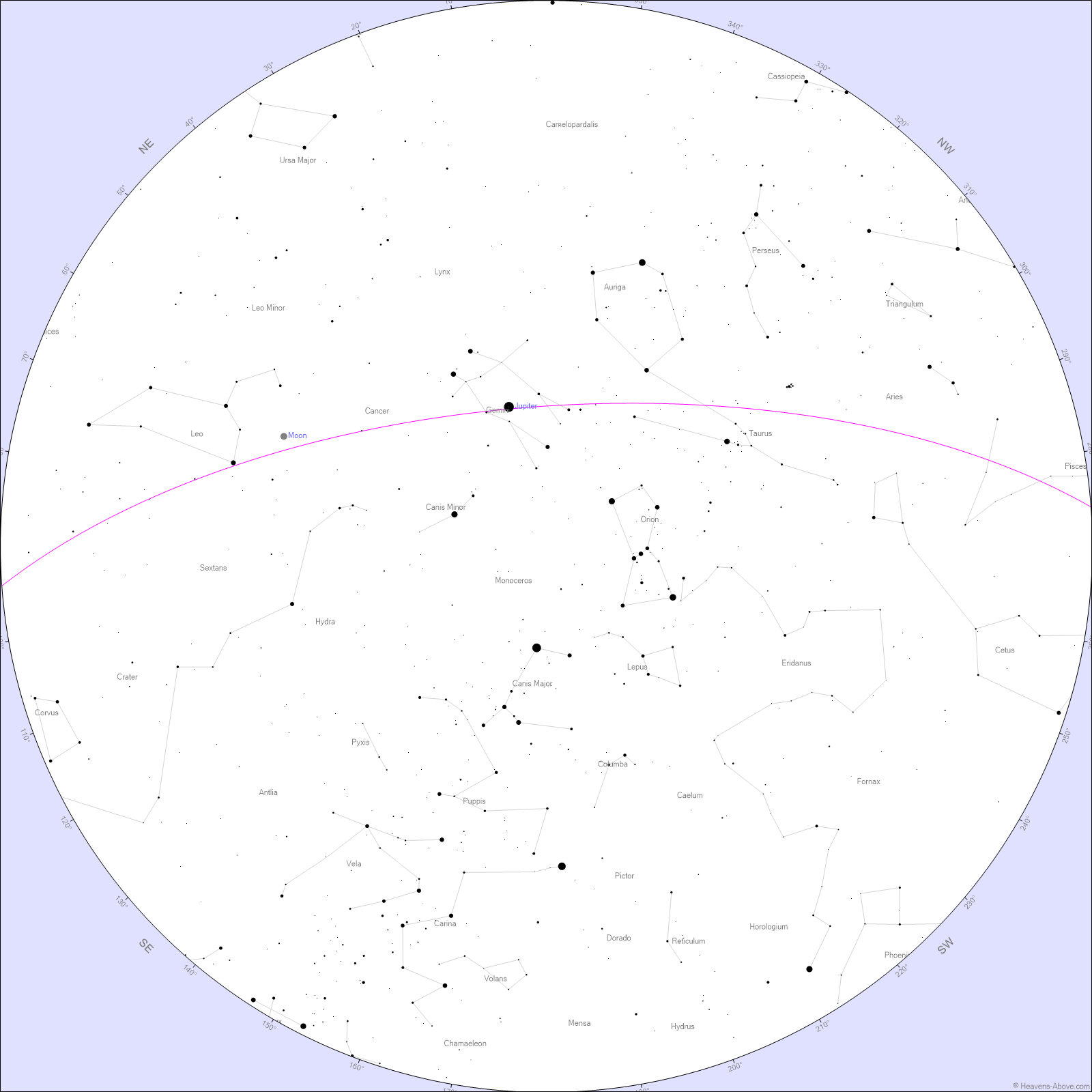
Jupiter shines brightly in the evening sky, still positioned among the stars of Gemini. It’s one of the brightest objects overhead after sunset, outshining nearby stars Castor and Pollux.
Low in the western twilight, Mercury lingers, but it’s a fleeting target. Around March 7th, it reaches inferior conjunction — passing between Earth and the Sun — which means it will be extremely difficult to see by week’s end. Catch it early in the week if you have a very clear western horizon.
Venus also glows in the dusk. Near the end of the week, it draws close to Neptune in a conjunction, though Neptune itself will require binoculars and very steady skies to glimpse.
I’d planned to get into the next two chapters of NightWatch in this episode, but let’s hold off on that discussion until next week. We’ll be discussing the outer planets in the next episode, so the chapter about the planets should fit nicely into our discussion.
That’s going to do it for this week. If you found this episode interesting, please share it with a friend who might enjoy it. The easiest way to do that is by sending folks to our website, startrails.show. And if you want to support the show, use the link on the site to buy me a coffee. It really helps!
Be sure to follow Star Trails on Bluesky and YouTube — links are in the show notes. Until we meet again beneath the stars … clear skies everyone!
Support the Show
Connect with us on Bluesky @startrails.bsky.social
If you’re enjoying the show, consider sharing it with a friend! Want to help? Buy us a coffee! Also, check out music made for Star Trails on our Bandcamp page!
Podcasting is better with RSS.com! If you’re planning to start your own podcast, use our RSS.com affiliate link for a discount, and to help support Star Trails.

 Star Trails: A Weekly Astronomy Podcast
Leave a comment