Beyond the Frost Line: The Giant Planets of Our Solar System – Star Trails: A Weekly Astronomy Podcast
Episode 101
This week we leave the rocky inner planets behind and journey into the deep cold of the outer solar system. From the storm-wracked atmosphere of Jupiter to the ringed elegance of Saturn and the mysterious ice giants Uranus and Neptune, these distant worlds reveal how strange and varied our planetary neighborhood truly is.
Along the way we explore how the solar system formed, why the inner planets are rocky while the outer planets became giants of gas and ice, and why the distant ice giants remain some of the least explored worlds we know.
Later in the episode we share a personal observing report after attempting to spot a SpaceX rocket launch from hundreds of miles away, offer up tips on how you might see one yourself, and we’ll walk through what’s visible in the night sky for the week of March 8–14.
We’ll also continue our NightWatch book club with Chapters 6 and 7, exploring the realities of visual astronomy and how patient observation reveals the subtle beauty of the deep sky.
Transcript
Howdy stargazers and welcome to this episode of Star Trails. My name is Drew and I’ll be your guide to the night sky for the week of March 8 through the 14th.
This week we continue this month’s exploration of our solar system, by leaving the warm terrarium of the inner planets, for the deep freezer of the outer planets. In these far reaches, our Sun is no longer a dominating presence, but a bright star among many, and the worlds we find here are as strange as they are lonely.
Later in the show I’ll report on my efforts to observe a recent SpaceX rocket launch; we’ll press forth into the next two chapters of NightWatch; and we’ll look at what you can expect to see in the night sky this week
Whether you’re tuning in from the backyard or the balcony, I’m glad you’re here. So grab a comfortable spot under the night sky, and let’s get started!
Tonight, we pick up where we left off in the last episode. The rusty deserts of Mars are fading in the rear-view mirror of our space ship, and the Sun begins to shrink, ever so slightly, into something less oppressive and more distant. Ahead of us lies the asteroid belt, not the chaotic pinball machine of science fiction, but a wide, mostly empty region stretching between Mars and Jupiter.
If you could stand on Ceres, the largest object there, now classified as a dwarf planet, you’d see a lonely landscape of ice and rock under a dimmer Sun. The belt contains millions of objects, yes, but they are separated by vast distances.
Once we clear that frontier, the solar system changes character. The outer planets are not simply bigger versions of the inner ones. They’re a different category of existence.
Jupiter announces itself long before you arrive. It is more massive than all the other planets combined, a gravitational monarch presiding over the outer solar system. It resides around 5 AU from the Sun, or, about 465 million miles.
Its diameter could fit more than 11 Earths across. Its volume could swallow more than 1,300 Earths whole. And yet it’s made mostly of hydrogen and helium — the same stuff as our Sun — just not quite massive enough to ignite nuclear fusion. Sometimes people call it a “failed star,” but that’s poetic shorthand. In reality, it would need about 80 times more mass to shine.
Jupiter’s atmosphere is a masterpiece of fluid dynamics. Cream and cinnamon-hued bands wrap around the globe, driven by jet streams moving hundreds of miles per hour. The Great Red Spot, a storm larger than Earth, has been raging for at least 350 years. It seems to be shrinking, but it’s still a planetary-scale hurricane that refuses to die.
Jupiter also radiates more heat than it receives from the Sun. Deep inside, gravitational compression slowly releases energy, as if the planet is still settling into itself.
And then there are the moons. Four of them were spotted in 1610 by Galileo Galilei — Io, Europa, Ganymede, and Callisto. Tiny moving points of light that quietly proved not everything orbits Earth. Not surprisingly, we refer to these as the Gallilean Moons, and even a small scope will reveal them from Earth.
Io is the most volcanically active world in the solar system. Europa likely hides a global ocean beneath its icy shell — twice as much water as all of Earth’s oceans combined. Ganymede is the largest moon in the solar system and has its own magnetic field. These aren’t just satellites. They’re worlds with interior lives.
We’ve explored Jupiter extensively. Pioneer 10 and 11 first passed by in the 1970s. Voyager 1 and Voyager 2 gave us the iconic images that have defined our view of Jupiter for four decades. Galileo orbited the planet for eight years in the 1990s and early 2000s. And today, Juno continues to dive over the poles, mapping gravity, magnetic fields, and peering deep beneath the clouds.
Now, let’s drift outward another 400 million miles to the ringed planet. Saturn feels like Jupiter’s refined sibling.
It is less massive, but visually unforgettable. Its rings stretch hundreds of thousands of miles wide, yet in places they are only tens of meters thick, thinner than a football field is long. They’re made of countless particles of ice and rock, each one following Kepler’s laws with quiet obedience.
Saturn’s density is so low that, in theory, it would float in water — if you had an ocean large enough to hold a planet.
Saturn deserves more than “it has rings.” That’s like introducing Jimi Hendrix by saying he “dabbled in guitar.” Let’s widen the lens.
First, Saturn is not just a smaller Jupiter. It’s structurally different in subtle but important ways. While both are gas giants composed mostly of hydrogen and helium, Saturn’s core is proportionally larger relative to its total mass. That may tell us something about how and where it formed in the early solar system. Planet formation models suggest Saturn may have grown more slowly than Jupiter, accreting gas after Jupiter had already become the dominant gravitational bully.
Now let’s talk about those rings in more depth — because they’re not permanent.
The rings are likely young on cosmic timescales. Current models suggest they may be only 100 to 400 million years old — possibly the remains of a shattered moon torn apart by tidal forces after wandering too close. That’s astonishing. When dinosaurs walked Earth, Saturn may have looked different in the sky.
The rings are organized into major divisions — A, B, and C rings — with the prominent Cassini Division separating A and B. That gap isn’t empty; it’s sculpted by gravitational resonances with Saturn’s moons. In other words, the moons are choreographing the rings. Tiny “shepherd moons” like Prometheus and Pandora actively confine ring material, preventing it from dispersing.
Even so, the rings are slowly dissolving. At current rates, they may vanish in 100 million years or so.
Saturn’s north pole hosts a bizarre, persistent hexagonal storm system — a six-sided jet stream first seen by Voyager and later studied in detail by Cassini. It’s not a trick of the eye. It’s a stable wave pattern in the atmosphere, larger than Earth.
Saturn currently holds the record for the most known moons — well over a hundred confirmed objects, though many are tiny captured rocks. Titan and Enceladus get the spotlight, but Iapetus is a wonder too — one hemisphere bright as snow, the other dark as coal. The yin-yang moon.
The real golden age of Saturn exploration came with Cassini–Huygens. For 13 years, Cassini orbited Saturn, transforming it from a distant ringed icon into a richly detailed world. It watched seasons change. It flew through the rings. It revealed Enceladus spraying plumes of water vapor from its south pole — evidence of a subsurface ocean. It delivered the Huygens probe to Titan, where it parachuted down through a thick orange atmosphere and landed on a surface shaped by methane rain.
Titan has lakes and rivers. Weather. Dunes. A hydrological cycle built not on water, but hydrocarbons.
When Cassini ended its mission in 2017, it deliberately plunged into Saturn’s atmosphere to avoid contaminating potentially habitable moons. A spacecraft choosing its own fiery end to protect alien oceans is poetic engineering.
Here the sunlight fades more dramatically. At Jupiter, sunlight is 25 times weaker than on Earth. At Saturn, it’s 100 times weaker. And then we reach the ice giants: Uranus and Neptune.
It’s wild to think that through most of my childhood, we didn’t have any detailed images of either of these worlds. All the books I grew up reading just featured artists’ renditions. And both planets today still remain some of the least imaged.
Of the two, Uranus is the real oddball.
It rotates on its side, tilted 98 degrees. It essentially rolls around the Sun. Its seasons last about 20 years each. For decades at a time, one pole faces the Sun in continuous daylight while the other endures unbroken darkness.
Its pale blue color comes from methane in its atmosphere, which absorbs red light and reflects blue. Beneath the atmosphere lies a mantle of super-pressurized water, ammonia, and methane ices. Some models suggest that under those immense pressures, carbon could crystallize into diamonds that rain downward through the interior. That remains a working hypothesis, but it’s consistent with high-pressure physics experiments.
Like Saturn, Uranus has a ring system, although they are very different in almost every way.
They were discovered in 1977 during a stellar occultation experiment. Astronomers were watching Uranus pass in front of a distant star. Instead of the star dimming once as the planet moved across it, it flickered multiple times before and after the main event. That meant something thin and structured was blocking the starlight. That “something” turned out to be rings.
Uranus’s rings are narrow, dark, and composed of relatively large particles mixed with radiation-processed material that makes them charcoal-colored. They don’t shine so much as they lurk.
There are currently 13 known rings, named mostly with Greek letters — alpha, beta, gamma, and so on — along with a few more recently discovered faint outer rings. Like Saturn’s, Uranus’s rings are shaped and maintained by shepherd moons.
Because the planet is tilted on its side, the rings are tilted with it. So from Earth, over decades, we see the ring system dramatically change orientation. Sometimes they’re wide open and visible. Other times we see them nearly edge-on and they almost disappear.
During Uranus’s equinox — which happens only twice every 84 Earth years — the Sun shines directly on the ring plane, producing unusual lighting effects and stirring up dynamic changes in the system.
Voyager 2 gave us our only close-up look in 1986, and at the time the rings looked simple and sparse. But modern observations from the Hubble Space Telescope and large ground-based telescopes have revealed faint dusty components and more complex structure than Voyager initially detected.
We’ve never orbited Uranus, and there’s never been a return mission. We know considerably more about it than we did before the Voyager flyby, but much of it has remained a pale turquoise mystery.
At nearly 2 billion miles away, the sun is just a bright point of light at Uranus. And Uranus moves slowly. It takes 84 Earth years to complete one orbit. That means since its discovery in 1781 by William Herschel, Uranus has only completed a little over two full orbits around the Sun.
Neptune lies even farther out, nearly 3 billion miles from the Sun.
It was the first planet discovered by mathematics before observation. Astronomers noticed irregularities in Uranus’s orbit and predicted another world must be tugging at it. They calculated where it should be. Then they looked, and in 1846, found it.
It takes Neptune 165 Earth years to complete one orbit. It completed its first full orbit since discovery in 2011.
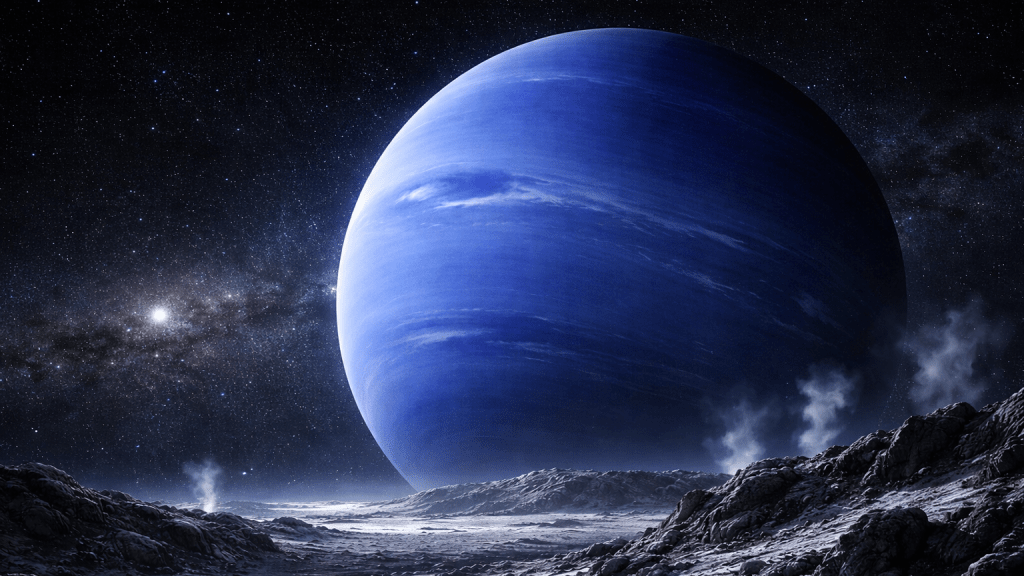
Neptune’s beautiful blue color comes from methane in its atmosphere, which absorbs red light and reflects blue. But it’s a deeper, more vivid blue than Uranus. That difference likely comes from subtle atmospheric chemistry and haze layers we still don’t fully understand.
Neptune is also wildly dynamic for such a distant, cold world. Its winds are the fastest in the solar system, reaching more 1,200 miles per hour. That’s supersonic, in a place where temperatures hover around minus 350 degrees Fahrenheit. Neptune radiates more heat than it receives from the Sun, much like Jupiter, its interior still warm from formation.
Triton is Neptune’s largest moon and likely a captured Kuiper Belt object. It orbits backward, which is a huge clue that it didn’t form alongside Neptune.
As for exploration, Neptune has been visited exactly once. Voyager 2 flew past in August 1989. It revealed the Great Dark Spot — a storm similar to Jupiter’s Red Spot — along with complex rings and Triton’s strange surface. After that brief encounter, Voyager kept going.
Since then? Telescopes, Hubble, ground-based observatories, and a lot of unanswered questions.
The outer planets hold most of the mass and angular momentum of our solar system. They sculpt cometary paths. They influence asteroid belts. They may have helped make Earth stable enough for life.
And yet, in terms of direct exploration, only Jupiter and Saturn have received sustained attention. Uranus and Neptune remain frontier worlds. There are serious proposals right now for a dedicated Uranus orbiter, but nothing has launched yet. In some ways, the outer solar system still feels like it’s stuck in the 1970s. And that’s astonishing.
When you step outside on this evening and see Jupiter and Saturn blazing in the twilight, you’re looking at a system of worlds we’ve actually visited. And beyond it lie two giants we’ve barely touched.
We’ve mapped Mars with rovers and drones. We’ve landed on comets. But the ice giants remain largely unexplored. That should humble us a little, and maybe excite us.
As we step back from this tour of the outer planets, it’s natural to ask a bigger question: why does our solar system look the way it does? Why are the worlds closest to the Sun small and rocky, while the outer planets are enormous spheres of gas and ice?
The answer goes all the way back to the birth of the solar system, about 4.6 billion years ago. At that time, the young Sun was surrounded by a vast rotating disk of gas and dust. Close to the Sun, temperatures were extremely high. In that hot inner region, only heavy materials like iron, nickel, and rocky minerals could condense into solid grains. Lighter substances—things like water, methane, and ammonia—remained vaporized. That meant the inner planets formed from relatively limited ingredients, building small, dense, rocky worlds like Mercury, Venus, Earth, and Mars.
Farther from the Sun, however, temperatures dropped dramatically. Beyond a certain distance—what astronomers call the frost line—water and other compounds could freeze into solid ice. Suddenly there was far more material available to build planets. With ice joining rock and metal, planetary embryos in the outer solar system could grow much larger. Once these growing worlds became massive enough, their gravity began pulling in the surrounding hydrogen and helium gas from the disk, ballooning into the giant planets we see today.
So the solar system naturally divided itself into two very different neighborhoods. The inner region gave rise to small terrestrial planets made mostly of rock and metal, while the colder outer region produced the giant planets—Jupiter and Saturn with their vast envelopes of hydrogen and helium, and Uranus and Neptune with interiors rich in frozen compounds like water, methane, and ammonia.
All the planets, in a way, represent the structure of the original disk that formed our solar system. It’s a fossil record of temperature, chemistry, and gravity written across billions of miles of space.
After a quick break we’ll be back to discuss what you can actually see in this week’s sky, and how to spot these distant giants for yourself. Stay with us.
Welcome back.
Before we get into this week’s sky, I have a quick observation report. Last week, a series of SpaceX launches were carried out from Cape Canaveral to deliver Starlink satellites into orbit. Some of these launches were in the evening or early morning, which means folks along the eastern seaboard, hundreds of miles away, can see them soaring into orbit if conditions are right.
These launches weren’t even on my radar until my brother-in-law, Chris, shared a post with me on Sunday afternoon. With nothing better to do, we decided to find a nice high elevation with an eastern view of the sky, bring out some binoculars, and see if we could spot a Falcon 9 rocket.
We arrived at the site around 9:40 for the nearly 10 p.m. launch. We both had the SpaceX live feed on our phones so we could hear the countdown and launch.
About 30 seconds after launch, looking south, Chris thought he spotted a red dot making its way upward and to the east. Then, we didn’t see anything. Some moments passed and then to the east and some 30 degrees off the horizon we spotted a bright, reddish object, which morphed subtly for a few seconds, then winked out as fast as it appeared.
It didn’t look like the plumes we normally associate with SpaceX launches. We think the significant cloud cover may have affected our view, but based on Chris’ initial observation and the direction it was heading, we’re pretty certain we saw the rocket, 20 stories of fire and fury climbing into space at 17,000 miles per hour.
Several days later, another Falcon took flight in the predawn hours, and local observers captured some really stunning images of the rocket’s plume as it blasted across the sky, backlit high in the sky by the Sun before it peeked over the horizon. Sadly, I wasn’t awake for that launch.
From now on, I’m going to make it a point to routinely check out what’s launching from the cape. Use a website like Spaceflight Now to see what’s on deck. I’ll include a link to that in the show notes. If there’s an evening or night time launch window, and you live in the viewable zone, it could make for a nice observation, or even a photo op.
Keep in mind, the Kennedy Space Center isn’t the only NASA launchpad. West coasters can try viewing rockets from Vandenberg Space Force Base in California.
Farther up the east coast, Wallops Flight Facility on the coast of Virginia is used for supply missions to the ISS. Alaska has a spaceport, and SpaceX’s private launch site is in South Texas. There are lots of options, so keep an eye on Spaceflight Now and maybe you can catch a launch from the cape, or one of these alternate locations.
Now, let’s see what’s in the sky above our own backyard this week.
First, a quick note about Daylight Saving Time. Clocks sprung forward one hour this morning. That pushes darkness later into the evening. Your best deep-sky observing window will now start later after sunset, even as overall night length slowly increases toward the spring equinox on March 20.
This week the Moon is in its waning gibbous to waning crescent phase. By March 14th it’s a thin crescent with about 20% illumination, perfect for viewing surface detail near the terminator with binoculars or a telescope.
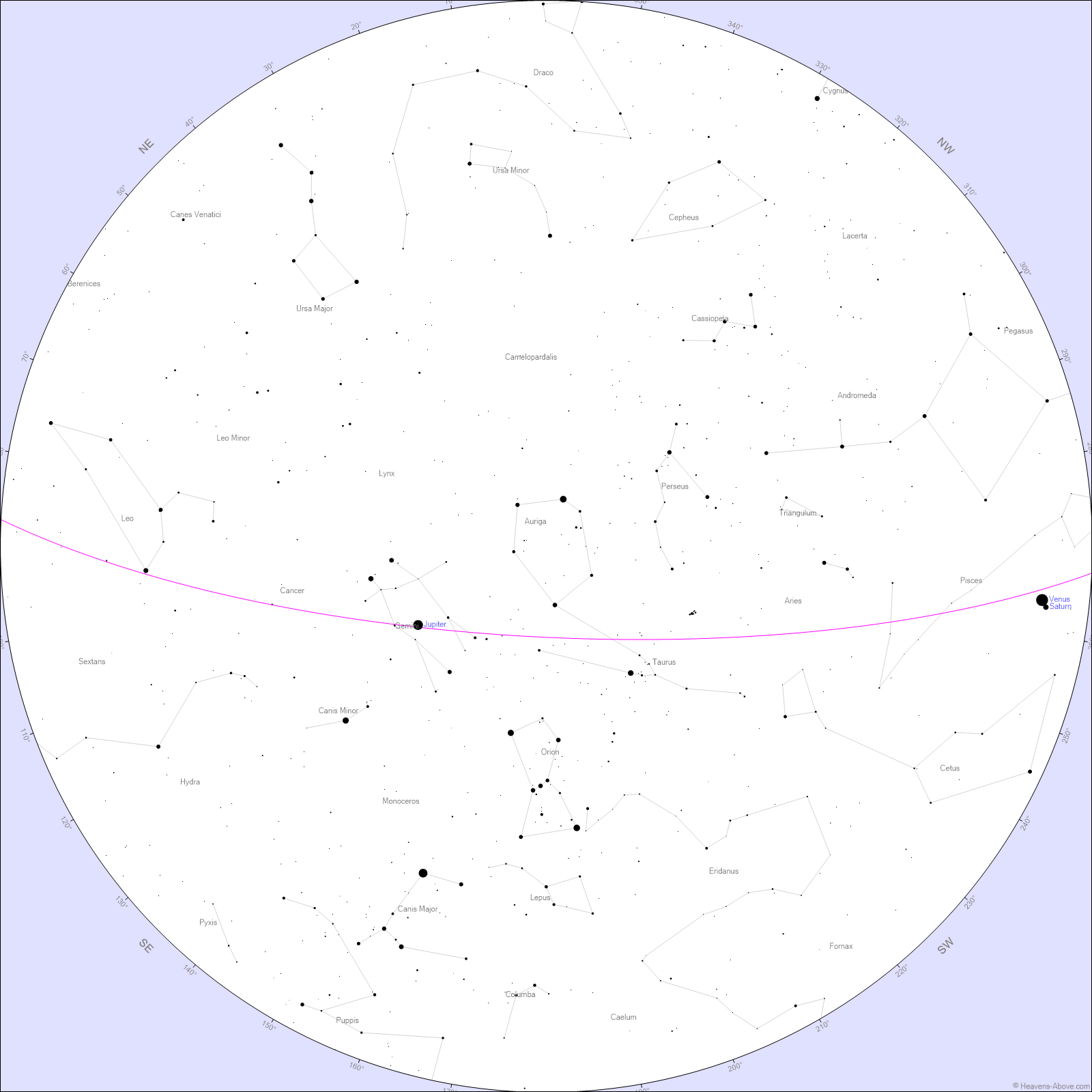
After sunset in the western sky, brilliant Venus dominates low over the horizon. It’s the brightest “star” you’ll see after dusk, and early in the week you might spot Saturn just above or beside it — a visual pairing that will linger near the western horizon for several evenings as the planets slowly separate. A pair of binoculars will show them together easily, and around March 8–9 that conjunction is tightest.
In the southern evening sky, high above the horizon, Jupiter shines like a beacon. It’s visible well after dark at this time of year and doesn’t set until the late night hours. Its steady, bright light makes it excellent for telescopic views — the Galilean moons and cloud belts are easy pickings.
Mercury will be very low after sunset early in this window and quickly lost to twilight glow; it re-emerges in the morning sky later in March. Mars remains too close to the sun for effective evening observing right now. Uranus is technically still placed in western Taurus and can be tracked down in binoculars or a small scope if the Moon hasn’t risen and your sky is dark, but Neptune is too close to conjunction with the sun to be seen this week.
Let’s talk deep sky objects. March evenings are rich with open star clusters and faint nebulae that reward patience and optics, especially once the Moon sets:
The Hyades Cluster near Aldebaran in Taurus is a sprawling, binocular-friendly grouping. Look for the broad “V” of stars that makes up the head of the Bull.
The Rosette Nebula and its embedded cluster in Monoceros is a favorite for long exposures and narrowband imaging. A pair of binoculars under dark skies will show the cluster, and a camera will begin to tease out nebulosity.
Beeswax-like clusters such as M44 in Cancer, the Beehive Cluster, sit higher in the late evening once the Moon dips below the horizon. They’re beautiful through small scopes and even in urban skies.
While there’s no major meteor shower peaking this week, a few minor streams may be detectable after midnight under truly dark skies.
Finally, don’t forget the spring constellations rising in the east late evening: Leo, with its graceful sickle and regal Regulus; and Cancer just above, home to loose stellar groupings. These aren’t the obvious Orion or Ursa Major, but they’ll reward listeners who take time with their charts and optics.
For this week’s book club segment, we’re looking at Chapters 6 and 7 of NightWatch, covering the deep sky and the planets.
And what I appreciate most about these chapters is that Terence Dickinson continues what he’s done throughout the book. He manages expectations. In Chapter 6, when he describes deep sky objects — galaxies, nebulae, globular clusters — he tells you plainly what they actually look like in the eyepiece.
They’re dim. Subtle. Often colorless. And that’s just how our eyes work.
Under low light, our eyes rely mostly on rod cells. Rods are incredibly sensitive to faint light, which is why they allow us to see those ghostly smudges in the first place. But rods don’t detect color well. The cone cells that do perceive color require much brighter light to activate.
So when you look at the Orion Nebula or the Andromeda Galaxy through a telescope, you’re not seeing the saturated pinks and blues of astrophotography. You’re seeing what the human visual system can gather in a fraction of a second.
A camera can collect photons for minutes. It can stack exposures for hours. Your retina resets continuously.
Dickinson explains this, and I think that’s crucial. I think new astronomers expect the sky to look like processed long-exposure images. But visual astronomy is quieter than that. It’s about contrast, texture, and shape. It’s about learning to recognize faint structure at the edge of perception.
And then he gives you something very practical: the maps.
The deep sky charts in Chapter 6 are clean, readable, and focused. They highlight specific objects. They indicate magnitude. They note what size instrument might be needed. They help you plan a session instead of overwhelming you with thousands of targets.
There’s something philosophical there. He’s not encouraging you to conquer the sky. He’s encouraging you to spend time with it.
Then in Chapter 7, when he turns to the planets, he does something similar. Again, he calibrates expectations.
Saturn will not look like a glossy NASA poster. Mars won’t resemble a spacecraft mosaic. Jupiter’s belts may be subtle. Features will shift from night to night.
But that’s the point.
Planets reward repeated observation. You begin to notice the tilt of Saturn’s rings changing over years. The shrinking and expanding of Mars’ polar caps. The steady dance of Jupiter’s moons. Patience is the key.
I think both of these chapters serve as nice companions to this podcast, especially the chapter on the planets, since we’re going to discuss our own solar system all month long. We mention deep sky objects on nearly every episode, and while smartphone apps and computer databases make it easy to locate and track these objects, those great maps included in NightWatch are helpful for planning, and laying out what’s what and where it’s located in relation to common constellations.
We’ll be back in two weeks with a discussion on the next two chapters.
That’s going to do it for this week. If you found this episode interesting, please share it with a friend who might enjoy it. The easiest way to do that is by sending folks to our website, startrails.show. And if you want to support the show, use the link on the site to buy me a coffee. It really helps!
Be sure to follow Star Trails on Bluesky and YouTube — links are in the show notes. Until we meet again beneath the stars … clear skies everyone!
Support the Show
Connect with us on Bluesky @startrails.bsky.social
If you’re enjoying the show, consider sharing it with a friend! Want to help? Buy us a coffee! Also, check out music made for Star Trails on our Bandcamp page!
Podcasting is better with RSS.com! If you’re planning to start your own podcast, use our RSS.com affiliate link for a discount, and to help support Star Trails.
 Star Trails: A Weekly Astronomy Podcast
Leave a comment