The Case of Pluto: Discovery, Demotion, and Redemption – Star Trails: A Weekly Astronomy Podcast
Episode 102
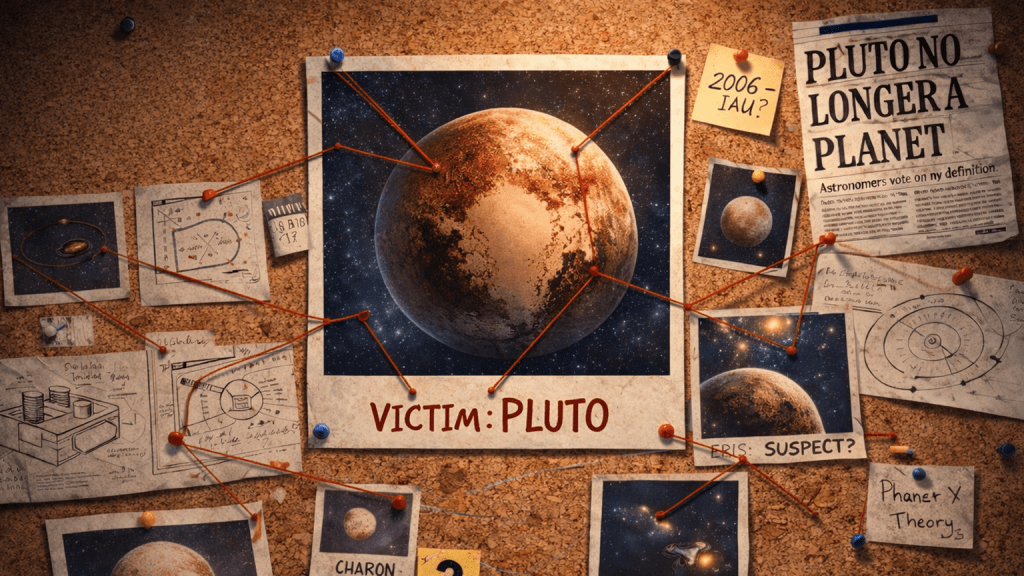
In 2006, a group of astronomers gathered in Prague and made a decision that shocked the world: Pluto was no longer a planet.
But the story of Pluto is far more complicated—and far more fascinating—than that single vote.
In this episode of Star Trails, we reopen the case. From Percival Lowell’s search for the mysterious “Planet X” to Clyde Tombaugh’s painstaking discovery using a blink comparator, we trace the strange history of the ninth planet. We’ll examine the discoveries that led to Pluto’s controversial demotion, meet the astronomers who helped redefine what a planet is, and follow NASA’s New Horizons spacecraft as it revealed Pluto to be a dynamic and surprisingly complex world.
Along the way we explore Pluto’s bizarre orbit, its giant moon Charon, its icy surface and hidden mysteries—and the poetic moment when the ashes of its discoverer finally returned to the distant world he found.
And later in the show, we step outside for a look at the night sky for the week of March 15–21, including dark skies near the new moon, the arrival of the vernal equinox, brilliant Jupiter in Gemini, and a few deep-sky treasures worth tracking down with your telescope.
Transcript
In August of 2006, a group of astronomers gathered in Prague to make a decision. A vote was taken. And with that vote… a planet died.
Pluto, the ninth planet many of us grew up memorizing in school, was suddenly gone. Demoted, reclassified, and stripped of its planetary status.
The story of Pluto has always been complex. This was a world predicted before it was seen… discovered by a farm boy who loved astronomy… and named by an eleven-year-old girl.
And decades after its supposed downfall… a spacecraft arrived to reveal something extraordinary.
Tonight we reopen the case.
My name is Drew, and this is Star Trails.
Howdy stargazers and welcome to this episode of Star Trails for the week of March 15th through the 21st.
This week we look at the discovery and life of our former ninth planet, Pluto, its murder nearly two decades ago, and its rebirth as one of the most intriguing outposts of our solar system. Later in the show we’ll see what’s happening in this week’s sky.
Whether you’re tuning in from the backyard or the balcony, I’m glad you’re here. So grab a comfortable spot under the night sky, and let’s get started!
Tonight we’re opening a case file. Not a criminal case, but a cosmic one. And this story has all the elements of a good mystery.
There are predictions. A long search. A young discoverer. A controversial trial. And, years later… an unexpected redemption.
So tonight, we’re going to investigate what might be the strangest planetary story ever told. The case of Pluto.
Our story begins in the late 1800s.
Astronomers studying the orbit of Uranus noticed something strange. The planet wasn’t exactly where it should have been. Its motion suggested that something unseen, something massive, was tugging on it from farther out in the solar system.
This had happened once before.
In fact, the planet Neptune had been discovered precisely this way, predicted mathematically before anyone ever saw it through a telescope.
So naturally, astronomers wondered: Was there another planet out there? One more world, lurking in the darkness beyond Neptune?
This hypothetical object became known as Planet X. And one man became obsessed with finding it. His name was Percival Lowell.
Lowell was a wealthy astronomer who founded the Lowell Observatory in Flagstaff, Arizona. Today the observatory is famous for one particular discovery, but in Lowell’s lifetime, it was built largely for a single purpose: To find Planet X.
Lowell calculated where this mysterious world might be hiding and began photographing regions of the sky, searching for something that moved against the background stars. But the task was enormous because the sky is vast. And the planet, if it existed, would be incredibly faint.
Lowell never found it. He died in 1916, and for a while, the case went cold.
More than a decade later, the investigation resumed. And the man who picked up the search was not a famous scientist. He was a farm kid from Kansas, named Clyde Tombaugh.
Tombaugh had grown up building telescopes out of spare tractor parts and studying the night sky from his family’s farm. He eventually sent detailed drawings of Mars and Jupiter to Lowell Observatory. The staff were impressed, so they offered him a job.
His task was simple: Photograph the sky and look for something moving. To do this, Tombaugh used a machine called a blink comparator.
If you’ve ever flipped between two nearly identical photos looking for the difference, you already understand the idea. Two photographic plates of the same patch of sky are placed into the machine. Then the device rapidly switches your view back and forth between them.
The stars remain fixed, but anything moving, a comet, an asteroid, or a planet, jumps back and forth. For months, Tombaugh stared into that machine, scanning thousands upon thousands of stars.
Then, on February 18th, 1930, he saw it. A tiny speck of light, not much larger than a speck of dust, moving between two photographs taken weeks apart.
Tombaugh had discovered a new world.
( Insert sound bite from Clyde Tombaugh )
The discovery electrified the world. Newspapers called it the ninth planet and suddenly, everyone wanted to name it.
Thousands of suggestions poured in from around the globe, but the winning idea came from an eleven-year-old girl in Oxford named Venetia Burney.
Her suggestion? Pluto: The Roman god of the underworld.
It was a perfect name. Pluto ruled a dark, distant realm far from the Sun. And the first two letters, P and L, also honored Percival Lowell, whose search had started the whole investigation.
Later that same year, Walt Disney introduced a new character: Mickey Mouse’s dog. His name… was Pluto. The cartoon dog was almost certainly named after the newly discovered planet that had captured the world’s imagination.
Not bad for a frozen world billions of miles away.
For decades, Pluto remained mysterious. First, it is incredibly distant. Its orbit takes it from about 2.7 to 4.6 billion miles from the Sun. One trip around the Sun takes 248 Earth years. Which means Pluto has not even completed a full orbit since the day it was discovered.
Its orbit is also tilted and elongated, unlike the nearly circular paths of the major planets. Sometimes Pluto actually comes closer to the Sun than Neptune. That happened from 1979 to 1999. Despite that overlap, the two worlds never collide because Pluto is locked in a 3-to-2 orbital resonance with Neptune.
Pluto is also tiny. It’s just 2,377 kilometers across, making it smaller than Earth’s Moon. Its surface is made of exotic ices, nitrogen, methane, and water ice, existing at temperatures around minus 375 degrees Fahrenheit or colder.
Astronomers quickly realized that Pluto was probably not the elusive Planet X. It simply doesn’t have enough mass to explain the strange motion astronomers saw in Uranus. And as it turned out, those orbital discrepancies were later traced to measurement errors. The mysterious planet Lowell predicted wasn’t actually necessary.
For much of the twentieth century, astronomers assumed Pluto was probably a cold, inactive world. A lonely outpost at the edge of the solar system. But then… another discovery complicated the story.
In 1978, astronomer James Christy noticed something strange while studying telescope images of Pluto. The planet appeared slightly elongated, almost as if there were a bump sticking out of one side.
At first he assumed it was an error in the image. But the bump kept appearing, and its position kept changing.
Christy realized what he was seeing. Pluto had a moon.
The moon was named Charon, after the ferryman of the dead in Greek mythology who carried souls across the river Styx to Pluto’s realm.
Charon turned out to be enormous relative to Pluto, about half Pluto’s diameter. So large, in fact, that the two worlds orbit a point in space between them, rather than Charon simply circling Pluto.
In some ways, Pluto and Charon are better described as a binary planetary system, and later observations revealed even more companions: Four smaller moons named Nix, Hydra, Kerberos, and Styx.
But by this point, astronomers were beginning to notice something else. Something that would eventually lead to Pluto’s downfall.
Beginning in the 1990s, astronomers discovered hundreds of icy bodies beyond Neptune. This region became known as the Kuiper Belt, and suddenly Pluto didn’t look so unique anymore.
It looked like one member of a much larger population of distant icy worlds. Then, in 2005, astronomers discovered an object called Eris, roughly comparable in size to Pluto.
And that forced a very uncomfortable question. If Pluto is a planet, should Eris be a planet too? And if Eris is a planet, how many more planets might we find out there? Dozens? Hundreds? Maybe more.
In 2006, the International Astronomical Union convened a meeting in Prague to settle the issue. Astronomers debated a deceptively simple question. What is a planet?
After deliberation, a new definition was adopted. To qualify as a planet, a body must orbit the Sun, be round due to its own gravity… and clear its orbital neighborhood of other objects.
Pluto failed that last requirement. It shares its region of space with many Kuiper Belt objects.
And so the verdict came down. Pluto was no longer part of the starting lineup. It was reclassified as a dwarf planet.
And many astronomers supported the decision.
Among the most visible voices explaining the change to the public was astrophysicist Neil deGrasse Tyson, who had already removed Pluto from the planetary lineup at the Hayden Planetarium years earlier.
But the astronomer who calls himself the real “Pluto Killer” is Mike Brown of Caltech. Brown had spent years surveying the outer solar system and was convinced that Pluto was not a unique planet but simply the largest known member of a much bigger population of icy bodies beyond Neptune.
As his team began discovering more and more large Kuiper Belt objects, Brown openly argued that astronomers would eventually have to face a choice: either accept dozens of new planets, or rethink Pluto’s status entirely.
For many Pluto fans, Tyson became the public face of the decision, but Brown’s discoveries were what truly pushed the debate to its breaking point.
( Insert sound bites from Mike Brown and Neil deGrasse Tyson )
Clyde Tombaugh passed away in 1997. But his connection to Pluto didn’t end there.
When NASA launched the spacecraft New Horizons in 2006, the very same year Pluto was demoted, a small portion of Tombaugh’s ashes was placed aboard the spacecraft.
Nine years later, that spacecraft arrived at Pluto, symbolically carrying its discoverer to the world he had found. Few scientists in history have ever traveled, at least in spirit, to visit their own discovery.
When New Horizons flew past Pluto on July 14th, 2015, the images it sent back stunned the world. Pluto was not a frozen relic. It had towering mountains made of water ice, vast glaciers of frozen nitrogen, a thin blue atmosphere. And a giant heart-shaped plain.
Pluto even has a strange seasonal atmosphere made mostly of nitrogen. As the dwarf planet moves farther from the Sun, that atmosphere can actually freeze and fall back to the surface like frost. Some scientists even think Pluto may hide a subsurface ocean beneath its icy crust.
Against all expectations, Pluto appeared geologically active, dynamic, and alive with strange processes scientists are still trying to understand. For a world barely half the size of Earth’s Moon, it turned out to be astonishingly complex.
( Insert sound bite from NASA administrator )
Today, the verdict of 2006 still stands: Pluto remains officially classified as a dwarf planet.
Every February, hundreds of people travel to northern Arizona to celebrate Pluto at the place where it was discovered, the historic Lowell Observatory. The event is called the I Heart Pluto Festival, and it’s part science conference, part community celebration, and part love letter to a distant world.
Visitors attend astronomy lectures, telescope demonstrations, and talks from planetary scientists. There are art exhibits, science presentations, and even a pub crawl through downtown Flagstaff where astronomers give short talks about Pluto between stops.
( Insert possible sound bite from festival )
It may sound unusual but it speaks to something deeper. Pluto’s discovery in 1930 was one of the great moments in American astronomy, and the city of Flagstaff still takes pride in being the place where a faint speck of light first revealed a new world.
If there’s one lesson here, it’s this: Pluto was never the end of the solar system. It’s the first visible member of an entire neighborhood we hadn’t discovered yet. That neighborhood is the Kuiper Belt, a vast disk of icy leftovers from the era when the planets were forming about 4.5 billion years ago. The belt begins just beyond Neptune, roughly 30 astronomical units from the Sun, and extends outward at least to 50 AU and probably farther.
Pluto is the first house on the street leading out into the suburbs of our solar system. The front porch of the Kuiper Belt perhaps.
The real mystery is how many more worlds are still waiting to be found. And that makes Pluto less like a fallen planet… and more like the cosmic welcome sign to an undiscovered country.
After a quick break I’ll tell you what you can expect to see in this week’s night sky. Stay with us.
Welcome back.
Now that we’ve closed the case file on Pluto, let’s turn our attention to the sky above us this week.
Mid-March is a beautiful time for backyard astronomers. Winter’s constellations are slowly slipping westward, the first hints of spring are rising in the east, and the night sky itself feels like it’s in the middle of a seasonal hand-off.
So if you’re stepping outside this week, here’s what you can expect to find.
Let’s begin with the Moon. It’s moving through its waning crescent phase during most of this week. You’ll see it rising in the early morning hours, appearing as a delicate curved sliver before sunrise. The New Moon arrives at week’s end, leading to inky dark skies suitable for deep sky observation.
And March 20th brings another milestone. That’s the Vernal Equinox, the official beginning of spring in the Northern Hemisphere.
On this day, the Sun crosses the celestial equator, and day and night become nearly equal in length. Astronomically speaking, it also means the night sky is beginning its seasonal transformation. Winter constellations like Orion and Taurus are drifting westward, while the stars of spring begin climbing into the eastern sky.
If you live somewhere with reasonably dark skies, this week offers a wonderful opportunity to spot something many observers have never seen before: The zodiacal light.
About twenty minutes after sunset, look toward the western horizon. Under dark conditions you may notice a faint triangular glow rising upward along the path of the planets. This ghostly pillar of light is sunlight reflecting off millions of tiny dust particles that fill the inner solar system, leftovers from comet tails and asteroid collisions.
March is one of the best times of year to see it because the angle of the solar system’s plane is steep against the evening horizon near the spring equinox. If you’ve never seen it before, it looks almost like a faint, tilted beam of twilight reaching up into the stars.
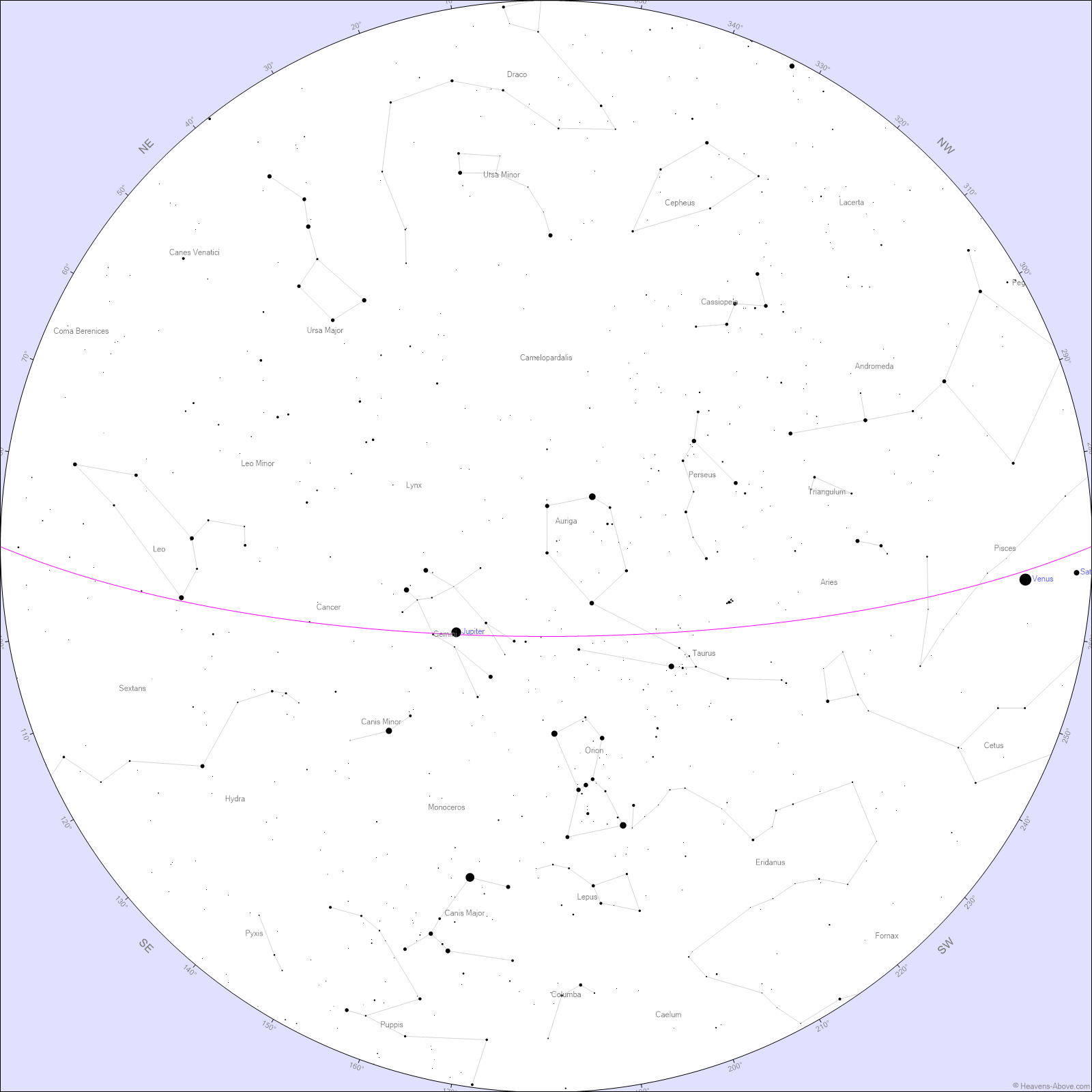
This week also offers several planets to explore. First up is Jupiter, which remains one of the brightest objects in the night sky this month. It shines prominently in the constellation Gemini, easily visible in the evening and remaining high in the sky for much of the night.
If you step outside after sunset, Jupiter will likely be the first planet your eye catches. Its brightness is startling.
Lower in the western sky, you may still catch Venus in evening twilight, though it sets fairly quickly.
Saturn has been slipping toward the Sun’s glare and is becoming difficult to observe now, lingering very low near the horizon shortly after sunset. With binoculars or a telescope, you can also try tracking down Uranus, which sits in the constellation Taurus not far from the famous Pleiades star cluster. Through binoculars Uranus appears as a tiny aquamarine star among the surrounding field.
Meanwhile, rising in the east are the stars of spring.
Look for the constellation Leo, which contains the bright star Regulus marking the heart of the celestial lion. Leo is home to one of the most rewarding regions of the sky for telescope observers: the Leo Triplet, a small group of galaxies known as M65, M66, and NGC 3628.
Under dark skies, even modest telescopes can reveal these three distant islands floating together in space, 35 million light-years away.
If you’re feeling adventurous, try hunting down one of the sky’s more unusual deep-sky objects.
The Eskimo Nebula, also known as NGC 2392, sits in the constellation Gemini, not far from Jupiter.
This object is a planetary nebula, the glowing shell of gas expelled by a dying star.
Through a telescope it appears as a small bluish disk, and with larger instruments observers often notice a fuzzy halo that gives it the appearance of a face framed by a parka hood. Hence the nickname: the Eskimo Nebula.
And somewhere far beyond the reach of backyard telescopes, Pluto continues its slow journey around the Sun. We actually discussed how to view Pluto back in episode 74, so if you have access to a massive telescope, a camera, and very dark skies, go for it.
That’s going to do it for this week. If you found this episode interesting, please share it with a friend who might enjoy it. The easiest way to do that is by sending folks to our website, startrails.show. And if you want to support the show, use the link on the site to buy me a coffee. It really helps!
Be sure to follow Star Trails on Bluesky and YouTube — links are in the show notes. Until we meet again beneath the stars … clear skies everyone!
Support the Show
Connect with us on Bluesky @startrails.bsky.social
If you’re enjoying the show, consider sharing it with a friend! Want to help? Buy us a coffee! Also, check out music made for Star Trails on our Bandcamp page!
Podcasting is better with RSS.com! If you’re planning to start your own podcast, use our RSS.com affiliate link for a discount, and to help support Star Trails.
 Star Trails: A Weekly Astronomy Podcast
Leave a comment