Moons: The Solar System’s Secret Worlds – Star Trails: A Weekly Astronomy Podcast
Episode 103
The most intriguing places in our solar system might not be planets at all. This week we turn our attention to some of the most fascinating and unusual worlds in our solar system: its moons.
For most of human history, we assumed moons were quiet, lifeless companions like our own. But as spacecraft ventured deeper into the outer solar system, a very different picture emerged.
Some moons erupt with volcanoes. Some hide vast oceans beneath miles of ice. Some have weather, rivers, and lakes, made not of water, but methane. And a few of them may have the ingredients necessary for life.
We’ll explore these strange worlds, from Io and Europa to Titan and Enceladus, and take a closer look at what makes them so dynamic. Along the way, we’ll revisit Pluto and its surprisingly complex family of moons, and consider why the outer solar system is teeming with these objects while the inner planets remain mostly bare.
Finally, we’ll step outside for a guided tour of the night sky for the week of March 22–28, including a waxing crescent Moon, brilliant Venus in the evening sky, Jupiter and its Galilean moons, and the arrival of spring’s galaxy season. We’ll also check in on our book discussion with a look at Chapters 8 and 9 in Nightwatch.
Transcript
Howdy stargazers and welcome to this episode of Star Trails. My name is Drew and I’ll be your guide to the night sky for the week of March 22nd to the 28th.
This week we’re continuing our exploration of our own cosmic neighborhood by taking a look at some of the most unique moons in the solar system, and which ones of those might have the right conditions to develop life.
Later in the show we’ll take a look at this week’s sky, and pick up the next two chapters of our book club selection, Nightwatch.
Whether you’re tuning in from the backyard or the balcony, I’m glad you’re here. So grab a comfortable spot under the night sky, and let’s get started!
I need to start this week’s show by first thanking our listeners.
I received some interesting feedback concerning last week’s Pluto episode, everything from a wonderful poem about Pluto sent in by a listener, to a handful of folks who mentioned Pluto as being their favorite planet. Some folks just enjoyed the story. At this point I think it’s safe to say Pluto is as much of a cultural object as it is an astronomical one. And we’re not done with Pluto yet. More on that later in this show.
Another listener who is currently vacationing in New Zealand, sent me a slew of night sky images from down under — including one of my favorite objects, the Large Magellanic Cloud — plus a very bright image of the Milky Way’s core, and, an upside-down rendition of Orion. It’s kind of weird seeing Orion standing on his head.
As always if you want to contact me, just use the form over at startrails.show. With that, let’s get into our main topic this week.
When most of us hear the word “moon,” we think of a very specific place. A gray, cratered world hanging quietly in our night sky. Airless. Silent. Unchanging. And for most of human history, that was our template. If you’d asked someone what a moon was, they would have described something very much like our own.
And in many ways, our Moon is extraordinary.
It likely formed when a Mars-sized world slammed into the early Earth, sending debris into orbit that eventually coalesced into the Moon. It’s unusually large for a rocky planet, so large that the Earth–Moon system almost behaves like a binary pair. Its gravity stabilizes Earth’s tilt, helping keep our climate relatively steady over long periods of time. And of course, it’s the only world beyond Earth where human beings have ever set foot.
But for all its importance, our Moon also gave us the wrong idea.
Because when we finally began exploring the outer solar system, we discovered that moons are not all like ours. Not even close.
In the late 1970s, the Voyager spacecraft flew past Jupiter and Saturn and sent back images that changed everything. Suddenly, moons weren’t just dead rocks orbiting distant planets.
They were worlds. Some of them violent. Some of them dynamic. And some of them are possibly habitable.
A moon is simply a natural satellite, anything that orbits a planet or dwarf planet. But maybe that’s a little too straightforward.
Some moons are bigger than planets, for example Ganymede and Titan are both larger than Mercury. Some systems behave like binary worlds, think Pluto and Charon. Some moons may have formed like planets, just in orbit around another world, while others were wanderers captured by gravity.
Rings and moons are related. Inside a certain distance, known as the Roche limit, material can’t clump together into a moon, so it forms rings instead. In fact, if an object goes beyond that limit, it’s likely going to break apart because of the planet’s gravity.
Saturn is the king of the rings of course, but Jupiter, Uranus and Neptune all have wispy ring systems. And there are shepherd moons around these systems that gravitationally keep the ring systems in check.
Outside the Roche Limit, rings can eventually coalesce into moons. So in a sense, rings are moons that never formed, and nearby moons are rings that “finished the job.”
There’s a great diversity in moon types just in our solar system.
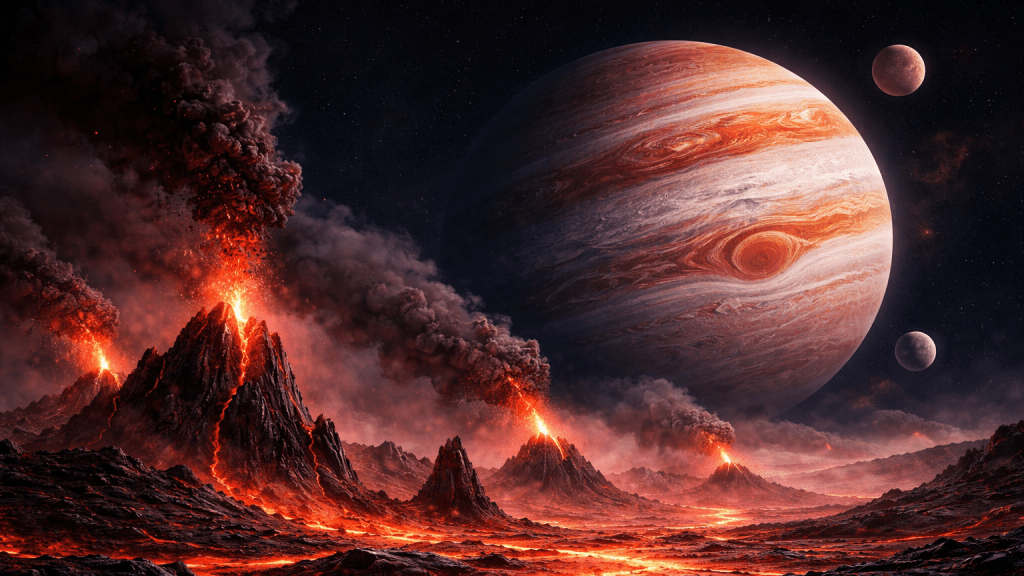
Take Io, one of Jupiter’s moons. It’s the most volcanically active world in the entire solar system. Its surface is constantly being reshaped by eruptions, lava flows, sulfur plumes, landscapes that look more like a fever dream than a place in space. And the reason is gravity. Jupiter’s immense pull stretches and squeezes Io over and over again, generating heat inside the moon. A process called “tidal heating.”
That same process leads us to something even more remarkable. Because if tidal forces can generate heat, they can melt ice. And if they can melt ice, they can create oceans. Hidden ones.
Europa, another of Jupiter’s moons, looks like a frozen world. Its surface is smooth, bright, and crisscrossed with long fractures that resemble sea ice on Earth. But beneath that icy shell, scientists believe there is a global ocean, possibly deeper than all of Earth’s oceans combined.
We haven’t seen that ocean directly. Instead, we’ve detected it through a kind of cosmic detective work. The surface geology suggests movement. Magnetic measurements from the Galileo spacecraft indicate a conductive, likely salty layer beneath the ice. Models of tidal heating show there’s enough energy to keep water liquid. So, all signs point to an ocean in the dark.
And Europa isn’t alone.
At Saturn, a tiny moon called Enceladus shocked scientists when the Cassini spacecraft discovered geysers erupting from its south pole, jets of water vapor and ice blasting into space. Cassini flew through those plumes and detected salts, organic molecules, even hydrogen, evidence that this water has been in contact with rock deep below the surface.
In other words, Enceladus has an ocean. And it’s leaking into space.
Then there’s Titan. Titan is something else entirely. It’s larger than the planet Mercury, and has a thick nitrogen atmosphere, denser than Earth’s in some ways, and a surface shaped by weather, clouds, rain, rivers, lakes. But the liquid isn’t water. It’s methane and ethane. Titan is a world where it rains hydrocarbons and rivers carve through landscapes of ice as hard as rock.
And we’ve been there. In 2005, the Huygens probe parachuted through Titan’s orange sky and landed on its surface, the most distant landing humanity has ever achieved. It sent back images of an eerie landscape. Rounded “stones” of water ice scattered across what looked like a dried riverbed.
And beneath Titan’s crust, there may be yet another hidden ocean.
Jupiter’s Ganymede, the biggest moon in the solar system, is larger than the planet Mercury. If it and Titan were orbiting the Sun instead of gas giants, we’d be calling them planets.
Ganymede has its own magnetic field and It’s the only moon we know of that does. Beneath its surface may lie multiple layers of ocean, stacked between sheets of ice like a planetary layer cake.
Callisto, also a Jovian moon, is heavily cratered and ancient. It too may also hide a deep ocean beneath its battered exterior.
And farther out, orbiting Neptune, is Triton, a strange, icy world that likely didn’t form around Neptune at all. It was probably captured from the Kuiper Belt. It orbits backward, against the rotation of the planet, and Voyager 2 observed nitrogen geysers erupting from its surface. Even at the edge of the solar system, moons are active.
And then there are the quieter, lesser-known worlds.
Mimas, a small moon of Saturn, looks like the Death Star from Star Wars, dominated by a massive impact crater, but recent evidence suggests it may have a, guess what, hidden ocean beneath its icy shell.
Iapetus is split dramatically in two, one hemisphere bright as snow, the other dark as coal, creating one of the starkest contrasts in the solar system. Miranda, a moon of Uranus, looks like it was shattered and reassembled, with cliffs and terrain so bizarre that it defies easy explanation.
And out at Pluto, Charon (or is it pronounced “Kahran”), is so large relative to Pluto that the two orbit a point in space between them. The New Horizons flyby in 2015 revealed vast canyons and signs of ancient geological activity.
In addition to Charon, Pluto has four irregular, tiny moons, making it complex six-body system.
They don’t behave like our Moon, or even like most of the large moons of Jupiter and Saturn. Instead of being tidally locked, some of them tumble unpredictably. Their rotations are influenced by the constantly shifting gravitational pull of both Pluto and Charon. It’s a dynamically messy system.
We’ve talked about some of the most well-known moons in this episode, but here are a couple of really weird ones you might not know about:
Hyperion orbits Saturn and resembles a sponge or a piece of coral drifting through space. Its surface is covered in deep, sharp-edged craters, giving it a porous appearance. But the truly strange part is its motion, and this is a trait it shares with some of Pluto’s moons.
It’s not tidally locked, and tumbles around Saturn in an unpredictable way. If you were standing on Hyperion (which would be… complicated), Saturn wouldn’t rise and set in a regular way. It would drift unpredictably across the sky.
Another excellent oddball is Phoebe, also a moon of Saturn. I’m beginning to think Saturn is the most fun place to be in the solar system; it has everything, rings, weird moons and more.
Anyway, Phoebe orbits Saturn backward, much like Triton does around Neptune. So, it didn’t form with Saturn, and like Triton, it’s possibly a relic from the Kuiper Belt. It’s dark, irregular, and ancient. A fossil from the early solar system, just hanging out in Saturn’s orbit.
Before we drift away from Saturn, I have to mention Janus and Epimetheus. These two moons share nearly the same orbit and every few years when they get near each other they effectively swap places. These are called “co-orbital” moons.
And what I mean by swapping places is this: One moon orbits closer to the planet than the other. When they approach one another a gravitational dance takes place between the two and one assumes the closer inner orbit, trading places with the other, now pushed to the outer track. And they do this repeatedly.
I didn’t forget about Mars: It has Phobos and Deimos, two little rocky potatoes that were likely captured by the Martian gravity. In other words, they didn’t form alongside Mars the way our Moon formed alongside Earth. Our Moon is the only large moon of the inner solar system, which makes us quite an outlier.
The outer planets are moon machines. Jupiter now has more than 90 known moons; Saturn, more than 140; and Uranus and Neptune both have dozens. Astronomers think the difference in numbers between the outer and inner planets is similar to why the outer planets are so much larger.
The inner solar system was hotter when it formed. Close to the Sun, lighter materials like water ice and gases couldn’t condense easily. That left mostly rock and metal. Out beyond the frost line, ices could form. And ice is abundant. That gave the outer planets far more raw material to build not just planets, but entire systems of moons.
Also, since the outer planets are enormous, their gravity is strong enough to capture passing objects, and hold onto large numbers of moons.
None of this explains why Pluto, smaller even than our Moon, somehow has five moons of its own. Well, the moons of Pluto and Earth may actually share an origin story. Earth’s Moon is likely the result of a giant impact, which is a rare and chaotic event. Pluto’s moons may have also formed from such an impact. A collision early in Pluto’s history would have thrown debris into orbit, which later coalesced into Charon and the smaller moons.
Mercury and Venus may have once had moons, but over billions of years, gravitational interactions with the Sun could have destabilized those systems, causing moons to either crash into the planet or escape.
So the outer solar system ends up looking like a kind of miniature solar system factory, with planets surrounded by their own collections of worlds. While the inner solar system is comparatively sparse.
I remember reading in Carl Sagan’s Cosmos years ago, that there could be multiple places to sustain life in our solar system. Not just Earth and Mars. Of course Sagan was including many of the moons in the outer solar system that had been recently discovered.
The possibility that some of these moons might be habitable, not on the surface or in sunlight, but beneath the ice, is a fascinating one.
On Earth, we’ve discovered ecosystems thriving in complete darkness, deep in the ocean, powered not by sunlight but by chemical energy from hydrothermal vents. If similar environments exist on Europa or Enceladus, warm water interacting with rock on the ocean floor, then the basic ingredients for life may be present.
Liquid water. Energy. Chemistry. Everything life as we know it needs.
And here’s the part that changes how we think about the universe. When we search for habitable worlds, we tend to look for planets like Earth, rocky, sitting at just the right distance from their star. But our own solar system is telling us something surprising.
Moons, warmed by gravity instead of sunlight. Oceans hidden beneath ice. Small, distant worlds orbiting giant planets, their oceans circulating quietly in the dark. These moons are intriguing areas for future exploration. Remember, many of these moons have only been seen once, during the Voyager flybys of the 1980s.
There’s a lot more science to learn. Future missions such as Europa Clipper, which was launched in 2024, is designed to study the subsurface ocean of Europa. And Dragonfly is expected to launch in 2028 on a mission to Titan. It’s a robotic helicopter designed to fly on Titan where it will study habitability and chemistry.
And of course, NASA is making plans to return to our Moon with the Artemis program, with a landing scheduled for 2027.
We have one more episode about our solar system to close out March. Next week we journey into the Kuiper Belt and beyond.
After a quick break we’ll be back to cover this week’s night sky. Stay with us.
Welcome back.
Let’s step outside now and take a look at this week’s sky.
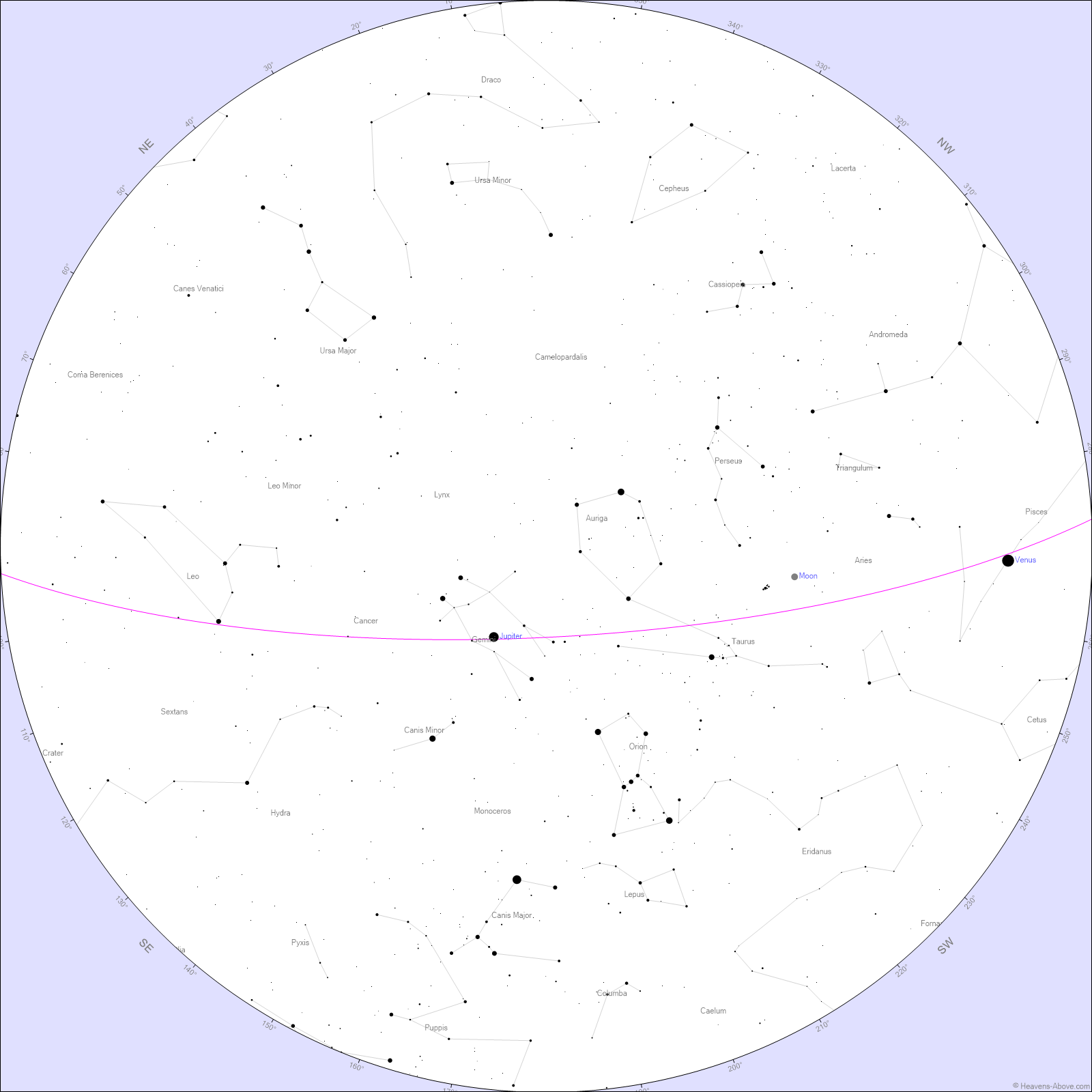
We’re coming off a new moon, which means this is one of the best weeks of the month for deep sky observing. As the week begins, a delicate waxing crescent Moon hangs low in the western sky just after sunset, growing a little fuller each night.
By midweek, the Moon reaches first quarter, appearing half-lit, and on the evening of March 26th, it forms a nice pairing with Jupiter in the constellation Gemini.
This is a great time to notice something subtle, earthshine. That faint glow illuminating the dark portion of the crescent Moon is actually sunlight reflected off the Earth.
Now, let’s talk planets.
The standout this week is Venus, blazing in the western sky just after sunset. It has reemerged as the “Evening Star,” shining brighter than anything else in the night sky except the Moon.
You’ll find it low in the west, lingering for over an hour after sunset. If you catch it with a small telescope, you may even notice it showing a crescent phase, much like a tiny version of the Moon. I’ve been seeing Venus on my evening walks lately, and its brightness is so startling I have a hard time looking away. It’s one of my favorite sights in the night sky.
Higher up, dominating the evening sky, is Jupiter. It’s bright, steady, and unmistakable. Look at it in a telescope and you’ll see it flanked by the moons we’ve been discussing this week: Io, Europa, Ganymede, and Callisto. You’ll see them change position from night to night and sometimes they render shadows on the Jovian surface.
If you’re up early, there’s a more subtle challenge waiting for you.
Late in the week, Mercury begins to peek into the pre-dawn sky, very low on the horizon before sunrise. It’s not an easy target, but if you have a clear eastern horizon and a bit of patience, you might catch it briefly before the Sun washes it away.
Now, this is the time of year astronomers quietly get excited about. Spring brings what’s known as galaxy season.
As the Milky Way dips below the horizon in the evening, we’re looking past the plane of our galaxy into deep space. And that means galaxies… lots of them.
In the constellation Leo, you can find the Leo Triplet, three galaxies interacting with each other across millions of light-years. In Ursa Major, near the Big Dipper, look for M81 and M82, a pair of galaxies, one graceful and spiral, the other ragged and explosive.
And if you sweep your telescope toward Virgo and Coma Berenices, you’ll begin to encounter entire fields of galaxies, faint smudges of light, each one a vast island universe.
For something a little more low-key, try tracking down the Coma Star Cluster in Coma Berenices, a loose, delicate scattering of stars that’s best seen with binoculars under dark skies.
Or, if you’re feeling ambitious, hunt down the “Ghost of Jupiter” nebula in Hydra, a faint planetary nebula that resembles a pale, ghostly disk.
And finally, take a moment this week to simply look up without a plan.
Find Orion setting in the west, slowly leaving our evening skies. Look overhead to Gemini, with Jupiter shining among the twin stars Castor and Pollux. And rising in the east, you’ll begin to see the constellations of spring, Leo, Virgo, and Boötes, taking their place.
We’re slowly creeping towards the end of our book club selection, Nightwatch, and there are just a few chapters left in the book. Chapters 8 and 9 bring us back to something familiar: our own Moon, and its relationship with the Sun. These are two very short chapters and I’m not sure if they offer much to experienced observers, but since our topic this week was all about the moons of our solar system, it seemed appropriate to talk about them in this episode.
Chapter 8 is all about observing the Moon and the Sun. These two familiar objects are easy to take for granted, but endlessly rewarding if you spend a little time with them at the eyepiece.
The Moon, especially, is one of the best targets for backyard astronomy. Even a small telescope will reveal an incredible landscape of craters, mountain ranges, and vast lava plains known as maria. One of the best times to observe is along the line between light and dark, called the terminator, where shadows stretch across the surface and give those features depth and texture. This chapter also include some nice maps of the Moon’s surface.
Chapter 8 also encourages something we don’t talk about often: observing the Sun. Now, this comes with an important caveat: You must use proper solar filters. But when you do, even a modest telescope can reveal sunspots, those dark, shifting regions tied to the Sun’s magnetic activity. With specialized equipment, you can even see solar prominences, massive arcs of plasma rising from the Sun’s surface.
Then in Chapter 9, we move into eclipses. These are the moments when the Sun, Earth, and Moon align just right to create something extraordinary. A solar eclipse happens when the Moon passes in front of the Sun, casting its shadow on Earth. A lunar eclipse occurs when Earth moves between the Sun and the Moon, and our shadow darkens the lunar surface.
Total solar eclipses, in particular, have captivated people throughout history. Entire cultures have formed around them, what the book refers to as an “eclipse cult,” traveling across the globe to stand in the narrow path of totality, where day briefly turns to night.
Lunar eclipses are more common, and a bit more forgiving. You don’t need special equipment to enjoy them, and they often turn the Moon a deep, coppery red as Earth’s atmosphere filters sunlight into the shadow.
You can refer to the tables in this chapter to discover when the next eclipses are happening.
We’ll wrap up our discussion on the remaining chapters of Nightwatch in two weeks. We’re almost done! If you’re a newer observer and you’ve made it this far in the book, then your knowledge of the night sky and how to view it has increased exponentially since we began this journey.
That’s going to do it for this week. If you found this episode interesting, please share it with a friend who might enjoy it. The easiest way to do that is by sending folks to our website, startrails.show. And if you want to support the show, use the link on the site to buy me a coffee. It really helps!
Be sure to follow Star Trails on Bluesky and YouTube — links are in the show notes. Until we meet again beneath the stars … clear skies everyone!
Support the Show
Connect with us on Bluesky @startrails.bsky.social
If you’re enjoying the show, consider sharing it with a friend! Want to help? Buy us a coffee! Also, check out music made for Star Trails on our Bandcamp page!
Podcasting is better with RSS.com! If you’re planning to start your own podcast, use our RSS.com affiliate link for a discount, and to help support Star Trails.
 Star Trails: A Weekly Astronomy Podcast
Leave a comment