The Edge of the Solar System – Star Trails: A Weekly Astronomy Podcast
Episode 104
This week we leave the familiar planets behind and venture into the farthest reaches of our Solar System, into regions where the Sun’s influence begins to fade and the boundaries of our cosmic neighborhood grow uncertain.
We explore the Kuiper Belt, a vast disk of icy remnants left over from the formation of the planets, and travel even farther into the mysterious Oort Cloud, a distant, spherical halo of objects that may extend halfway to the nearest stars. Along the way, we uncover the discoveries that reshaped our understanding of the Solar System, from the first detection of Kuiper Belt objects to the controversial reclassification of Pluto after the discovery of Eris.
We also follow the journey of the Voyager spacecraft, now drifting through interstellar space yet still deep within the Sun’s extended domain, and examine the ongoing search for the elusive Planet Nine, a world that may exist only as a gravitational whisper in the darkness.
And then there are the visitors: interstellar objects like ʻOumuamua and 2I/Borisov, fragments from other star systems passing briefly through our own.
In this week’s night sky report, we look ahead to the April 1 Full Moon, known as the Pink Moon, and highlight what you can still observe under bright moonlight, including Jupiter, several star clusters, and a beautiful close pairing of the Moon and Regulus.
Transcript
Howdy stargazers and welcome to this episode of Star Trails. My name is Drew and I’ll be your guide to the night sky for the week of March 29th through April 4th.
This week we leave the familiar planets behind and journey into the farthest reaches of our Solar System, where the Sun’s influence begins to fade and the boundaries of our cosmic neighborhood grow uncertain. We’ll explore the Kuiper Belt, a vast disk of icy remnants from planetary formation, and venture even farther into the mysterious, unseen Oort Cloud, a distant spherical halo that may stretch halfway to the nearest stars.
Later in the show we’ll take a look at what you can expect to see in this week’s night sky.
Whether you’re tuning in from the backyard or the balcony, I’m glad you’re here. So grab a comfortable spot under the night sky, and let’s get started!
Over the past several weeks, we’ve taken a journey through our Solar System. We’ve stood on the scorched surface of Mercury, drifted through the thick clouds of Venus, and looked back at our fragile home from orbit. We’ve explored the red deserts of Mars, crossed the asteroid belt, and marveled at the immense presence of Jupiter and Saturn. We reached the outermost planets, and we’ve looked at some of the strange moons that orbit them.
For much of human history, that’s where the story ended. When Johann Gottfried Galle first observed Neptune in 1846, it marked the boundary of the known Solar System. Even after Clyde Tombaugh discovered Pluto in 1930, astronomers still thought in terms of planets, isolated worlds, spaced out across an otherwise empty void.
But tonight, we’re going beyond that idea. Because the Solar System doesn’t end with Neptune. In many ways, that’s just where it begins to get strange.
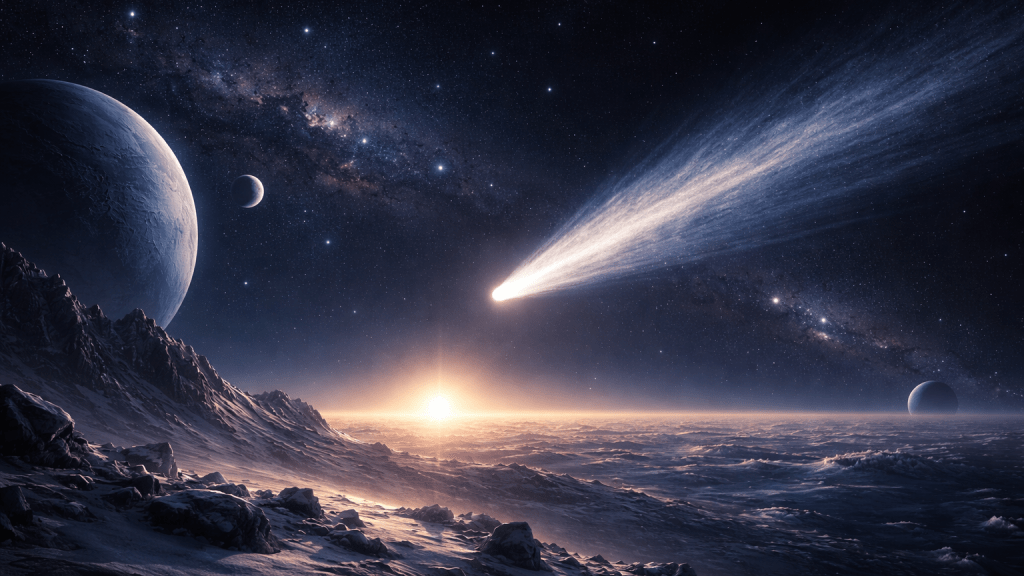
Just beyond Neptune’s orbit lies a vast and dimly lit region known as the Kuiper Belt. This is not a place of dominant planets, but a wide, flattened disk of icy debris stretching from about 30 to 50 astronomical units from the Sun. Out here, sunlight is faint, temperatures hover just above absolute zero, and the pace of motion slows to something almost imperceptible. Every now and then it sends us a short period comet, like Halley’s Comet, for example.
These distant regions are not random collections of objects. They’re time capsules. When the planets formed billions of years ago, gravity gathered material into worlds like Earth and Jupiter, but not everything was used. What remained was scattered outward, pushed into distant orbits by the giant planets, where it has remained largely unchanged ever since. The Kuiper Belt is not just a region, it’s a preserved record of the Solar System’s formation, a construction site that was never finished.
The idea of such a region didn’t always exist. In 1951, astronomer Gerard Kuiper proposed that leftover debris might exist beyond Neptune, though he believed it may have dissipated over time. For decades, the idea remained theoretical.
It wasn’t until 1992 that astronomers finally confirmed this distant region was real. Working at the University of Hawaii, David Jewitt and Jane Luu spent years patiently scanning the sky, searching for something incredibly difficult to detect. These objects are small, dark, and move very slowly against the background stars. Night after night, they compared images, looking for a faint point of light that shifted just enough to reveal itself.
And then, they found it.
A tiny object, now known as 1992 QB1. It wasn’t a planet, and it wasn’t a comet. It was something new, the first confirmed member of what we now call the Kuiper Belt.
That discovery changed everything. It meant that Pluto was not an outlier. It was part of a vast population of distant worlds. Alongside it are other distant bodies like Haumea and Makemake, each with its own strange characteristics.
In the years that followed, astronomers discovered more and more of these objects, until it became clear that the outer Solar System was not empty at all. It was crowded.
Among the astronomers leading that exploration was Mike “Pluto Killer” Brown. In the early 2000s, Brown and his team began discovering large objects in the Kuiper Belt, worlds that rivaled Pluto in size. Then, in 2005, they found something even more provocative: Eris.
Eris is slightly more massive than Pluto and travels in a distant, elongated orbit that carries it far beyond Pluto’s path. At times, it is more than twice as far from the Sun as Pluto. Its discovery raised a difficult question: If Pluto is a planet, then what is Eris? Another planet? The tenth? Or had we misunderstood Pluto all along?
What followed was one of the most public debates in modern astronomy. In 2006, the definition of a planet was formally revised, and Pluto was reclassified as a dwarf planet. Mike Brown took the fall as “the man who killed Pluto,” but in reality, he didn’t take anything away. He revealed something larger. The Solar System didn’t really lose a planet. It gained an entire new region of worlds.
But even the Kuiper Belt is not the edge.
The idea of something even farther out came from a different mystery. In 1950, Dutch astronomer Jan Oort studied the paths of long-period comets, those rare visitors that appear suddenly and may not return for thousands of years.
Their orbits didn’t make sense. They weren’t confined to the mostly flat plane of the Solar System. Instead, they approached from every direction, above, below, and at every angle imaginable.
Oort realized these comets must originate from a spherical distribution of objects, not a disk. He proposed the existence of a vast, distant cloud of icy bodies surrounding the Sun in all directions, so far away that they are only loosely bound by its gravity. A passing star, or even the gentle tidal forces of the Milky Way, could disturb one of these objects and send it falling inward, where we would briefly see it as a comet.
We have never directly observed this cloud. No telescope has imaged it. And yet, every long-period comet we see points back to its existence.
Today, we call it the Oort Cloud.
Some astronomers believe there may even be a denser inner region, sometimes called the Hills Cloud, hidden within the larger structure. Taken together, this region may extend tens of thousands of astronomical units from the Sun, perhaps even approaching halfway to the nearest star.
At that distance, our Sun is no longer a dominant presence. It becomes just another point of light in the sky.
When we see a comet from Earth, we’re seeing something ancient, a fragment of the early Solar System, preserved in deep freeze for billions of years, now briefly illuminated by the Sun before returning to the darkness.
When I first began this series, I specifically wanted to highlight places that humanity has physically explored. And believe it or not, space probes are in the Oort Cloud right now.
Of course I’m talking about the two spacecraft launched in 1977: Voyager 1 and Voyager 2.
These are the most distant objects ever created by human hands. They passed the planets, crossed the Kuiper Belt, and entered interstellar space, moving beyond the Sun’s heliosphere, that’s the region dominated by the solar wind.
Now nearly one light day away, they are deep within the broader domain of the Oort Cloud.
Out there in the darkness, the Voyagers are not just drifting silently, they’re still working. Both spacecraft continue to send back data about the environment beyond the heliosphere, measuring cosmic rays, magnetic fields, and the faint plasma that exists between the stars.
If the distance from the Earth to the Sun were reduced to a single inch, the outer edge of the Oort Cloud would lie nearly a mile away. By that scale, the Voyagers have barely begun the journey. They’ve left the Sun’s bubble, but not the Sun’s backyard.
Even out here, the story is not complete.
Astronomers have found hints that something else may be lurking in the outer Solar System. Planet Nine is a proposed world, inferred from the unusual clustering of orbits among distant Kuiper Belt objects. If it exists, it could be several times the mass of Earth, orbiting hundreds of astronomical units from the Sun, taking tens of thousands of years to complete a single orbit.
It’s never been seen. Its existence is written only in the motions of other objects. But the search for this hidden world is happening right now. Astronomers are actively looking.
New observatories, like the Vera C. Rubin Observatory in Chile, are beginning to scan the sky with unprecedented depth and precision, searching for faint objects that drift slowly against the stars. At the same time, scientists are combing through infrared data, looking for the faint heat signature of a distant, unseen planet.
Others are refining the mathematics itself, tracking distant Kuiper Belt objects and asking whether their strange orbits truly point to something massive, or whether we are being misled by the limits of our observations.
And then there are the visitors. One of them, 2I/Borisov, made waves in the news last year as the first confirmed interstellar comet.
2I/Borisov and another visitor, 1I/ʻOumuamua, discovered in 2017, are objects that do not belong to our Solar System at all. They arrived from elsewhere, passing briefly through our neighborhood before continuing their journey through the galaxy.
They don’t orbit the Sun. They arrive, pass through, and they vanish.
If we can detect fragments from other star systems drifting through ours, then somewhere out there, other systems may be doing the same, watching a chuck of our Solar System drift through their domain.
At some point out there, it becomes difficult to say where the Solar System ends and where interstellar space truly begins. The boundary isn’t a sharp line, but a gradual fading, a transition from the Sun’s influence to the wider gravitational currents of the Milky Way.
So as we close out this journey, it’s worth remembering that the Solar System is not a fixed map of planets. It is a vast and evolving structure, shaped by gravity, time, and chance. For centuries, we believed the planets were the whole story. Then we discovered the Kuiper Belt. Then we inferred the Oort Cloud. And now, we continue searching for worlds we cannot yet see.
After a quick break we’ll be back to cover this week’s night sky. Stay with us.
Welcome back.
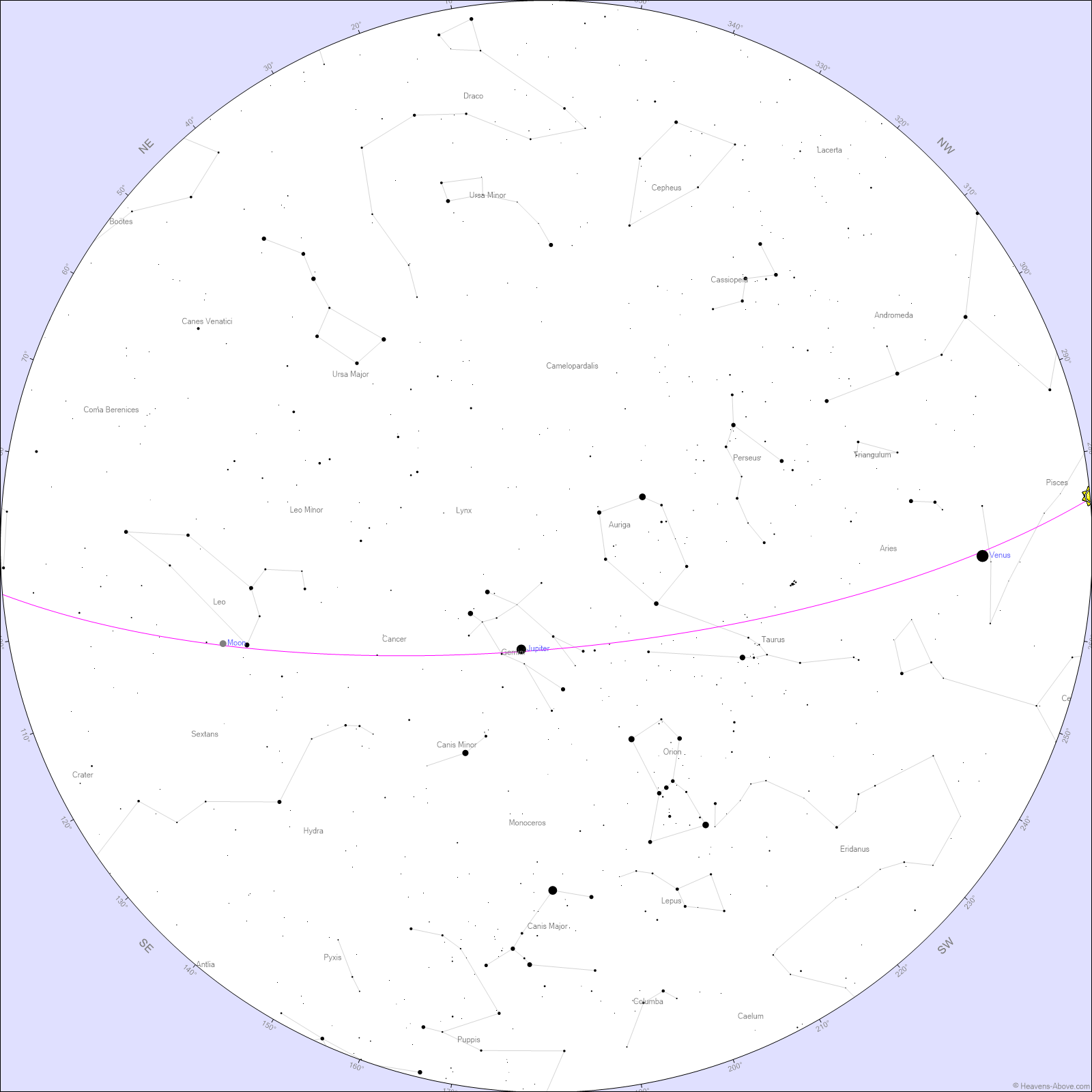
We’re entering this week under a bright and increasingly dominant Moon. After reaching First Quarter back on March 25, the Moon is now waxing toward fullness, culminating in a Full Moon on April 1. This week’s Full Moon is known as the Pink Moon, not for its color, but for the flowers that bloom beneath it, marking the quiet return of spring. It’s also known as the “Egg Moon,” as it’s linked to fertility and renewal.
Early in the week you’ll still have some decent dark-sky windows after sunset, but as we move closer to midweek, moonlight will begin to wash out fainter objects. So if you’re planning any deep sky observing, earlier in the week is your best bet.
Tonight, on March 29, the Moon passes extremely close to Regulus, the heart of the constellation Leo. In some parts of the world, like Europe, observers will even see an occultation, where the Moon passes directly in front of the star, causing it to disappear and reappear abruptly.
Here in North America we won’t witness the occultation itself, but it’s still a nice pairing that’s easy to spot shortly after sunset in the western sky, a bright Moon sitting right next to one of the spring sky’s most recognizable stars.
Planet-wise, we’ve got a few good targets this week. Jupiter is the star of the show. It’s bright, unmistakable, and well-placed in the evening sky, sitting high after sunset and lingering for hours. Venus is visible low in the western sky just after sunset. It’s brilliant, but it doesn’t stick around long, so you’ll want a clear horizon and good timing.
Uranus is still technically visible in Taurus, though you’ll need binoculars or a small telescope to pick it out. Mercury and Mars are mostly lost in the Sun’s glare this week, making them difficult to observe.
With the full Moon this week, a lot of deep sky objects may be off the table, so let’s look at some that punch through the bright moonlight.
Globular clusters are fantastic in moonlight because they’re dense and bright. Seek out Messier 3 in Canes Venatici. It’s one of the brightest globulars in the northern sky and resolves into stars in small scopes. It will be high enough for comfortable observation this week.
Messier 35 is a bright open cluster near the foot of Gemini. It looks good in binoculars and it’s visible in the early evening.
Open clusters like the Beehive Cluster in Cancer remain beautiful even under a bright sky, appearing as a soft scattering of stars in binoculars. And if you look west early in the evening, the Orion Nebula is still visible, glowing faintly in the sword of Orion. Even with the Moon nearby, it remains one of the most rewarding objects you can observe.
We’re in the home stretch in our book club selection. Next week we’re going to wrap up the final chapters in NightWatch.
And looking deeper into April, we’re going to get a little meta and turn away from the objects in the sky, to the processes and tools scientists actually use to study them. We’re going to talk about observatories, the scientific method, how data is collected, used and analyzed, and in general, peel back the curtain on the machinery behind the study of space.
That’s going to do it for this week. If you found this episode interesting, please share it with a friend who might enjoy it. The easiest way to do that is by sending folks to our website, startrails.show. And if you want to support the show, use the link on the site to buy me a coffee. It really helps!
Be sure to follow Star Trails on Bluesky and YouTube — links are in the show notes. Until we meet again beneath the stars … clear skies everyone!
Support the Show
Connect with us on Bluesky @startrails.bsky.social
If you’re enjoying the show, consider sharing it with a friend! Want to help? Buy us a coffee! Also, check out music made for Star Trails on our Bandcamp page!
Podcasting is better with RSS.com! If you’re planning to start your own podcast, use our RSS.com affiliate link for a discount, and to help support Star Trails.
 Star Trails: A Weekly Astronomy Podcast
Leave a comment