Photon by Photon: A Journey Through Observatories – Star Trails: A Weekly Astronomy Podcast
Episode 105
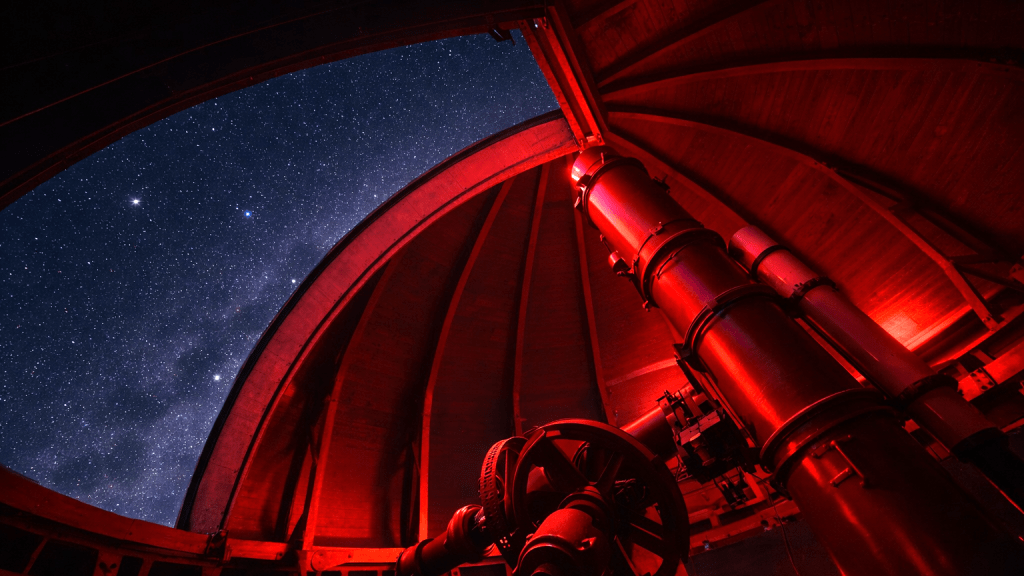
This week we step inside one of astronomy’s most iconic spaces: the observatory.
Drew visits Melton Memorial Observatory and sits down with director Martin Bowers to explore what a nearly 100-year-old, urban observatory still offers today. From public viewing nights to hands-on learning, we look at how these classic domes continue to connect people with the night sky, even under city lights.
Then, we zoom out to the bigger picture.
From Mount Wilson Observatory and Palomar Observatory to Mauna Kea Observatories and Paranal Observatory, we trace how observatories evolved from simple telescopes into powerful instruments that reshaped our understanding of the universe.
All of it built on a simple idea: gathering light, photon by photon.
Plus, a quick look at what’s in the night sky for the week of April 5th.
Links
Transcript
Howdy stargazers and welcome to this episode of Star Trails. My name is Drew and I’ll be your guide to the night sky for the week of April 5th through the 11th.
This month we’re going to explore of the scientific processes we use as astronomers. We’ll discuss how data is collected and used, and how computers and programming are part of that. And to kick off the month, we have a different sort of show on tap this week: I’m going to interview the director of a local observatory to spark our discussion on visual astronomy.
Later in the show I’ll discuss some of the famous observatories around the world and their discoveries. Also, we’ll check in with this week’s sky.
Whether you’re tuning in from the backyard or the balcony, I’m glad you’re here. So grab a comfortable spot under the night sky, and let’s get started!
Since Galileo created his telescope in the early 1600s, the observatory, that is, a building containing a telescope, has been one of the primary tools for studying the night sky. Eventually radio telescopes would enter the picture, along with space telescopes that far exceed the capabilities of their terrestrial brethren. Even so, the classic, domed observatory is still what comes to mind for many of us when we think of astronomy.
As a kid who enjoyed stargazing, my parents would often drive me past the Melton Memorial Observatory on the campus of the University of South Carolina in Columbia, in hopes of seeing the telescope inside peeking out of the dome’s shutter. While I never spotted any astronomy in progress, the observatory represented a long-term goal for me.
Eventually I would attend school here, and when I arrived that fall, the first class I signed up for was astronomy. It would be a few more months before I managed to get into a lab class inside Melton.
In November of 1993, I finally entered the observatory, and a childhood dream was realized when I peered at the Moon through the main telescope, which is painted in garnet red to match the university’s colors.
Of course, reality doesn’t always match expectations. When I was a kid, I didn’t really understand how bad light pollution could be, because I didn’t live in a major metropolitan area. Once at school, I was disappointed to learn that we weren’t going to be peering deep into space, because light pollution here is quite severe.
Yet Melton Observatory still stands and more importantly, is still used today, its classical architecture a nod to historic campus observatories dating back hundreds of years. So I decided to contact Melton’s director and learn more about the nearly 100-year-old observatory, and how the community uses it today.
Here’s my interview with Director Martin Bowers:
Drew: Right now I’m in Melton Memorial Observatory on the campus of the University of South Carolina, and I’m joined by observatory director Martin Bowers. Welcome to the show.
Martin: Thanks for having me.
Drew: Thanks for being on here. So this observatory has been around for nearly a century. What’s the story behind how it was built?
Martin: Well, my understanding is that Doctor Melton was the president of the university from 22 to 26, and he felt the need to have a real observatory because at that time they had a telescope, but they’d have to set it up and put it away every time they used it, because they didn’t have a true observatory. And that’s a lot of work.
I know as an amateur observer myself with my own equipment. When I do imaging especially, that’s a lot of work. So he said, we’re going to teach astronomy. We need a proper observatory. But coming up with the money even 100 years ago was a problem for a new building. So he convinced a good friend, an alumnus named Edwin Seibels, to donate the bulk of the money.
And they built this building and dedicated it in 1928. But unfortunately, Doctor Melton had passed away before it was completed, so Mr. Seibels dedicated it in memoriam of his good friend, Doctor Melton.
Drew: And that’s why we call it the Melton Memorial Observatory.
Martin: Exactly.
Drew: So the question I’m sure everybody wants to know is what kind of gear is in Melton?
Martin: Well, we still have I my understanding is the original telescope and mount. It’s a 16 inch Cassegrain, very long focal length I think is focal ratios F16. So it does really well on planets and craters on the moon. But that’s our primary scope. We also have a number of portable telescopes. Usually we set up a couple of Celestron C8 eight inch Schmidt-Cassegrains as well.
Drew: How did you become the director of this observatory?
Martin: Well, I was actually a member. I’m a member of the Midlands Astronomy Club. I’ve been doing this now for eight years. And so eight years ago, the club was contacted by one of the astronomy professors who said, hey, we we need someone to serve as the director. And so I, applied for the job because it sounded fun.
Drew: So the university reached out to the club and said, do you have anybody who could?
Martin: Yes. And there are several members of the club who have served stints in this role. Before. And they were helpful at resources because I had to ask them what was going on. So they were very useful assets for me.
Drew: I find Melton really interesting because like a lot of universities years ago, they would build their observatories right here on the campus, and we’re in the middle of a major metropolitan area. So clearly this isn’t an ideal place for an observatory. But what role does a historic observatory like this play in the community?
Martin: Yeah, yeah, our light pollution is pretty dreadful. It just a few years ago, they upgraded all the street lights on campus and used brighter ones. They made it worse, but we could still see bright objects. It serves a role, as is part of the science outreach. I mean, I think that’s why the university wanted to keep it going with the public viewing sessions, which we hold every clear Monday night, and we invite the public and we get a lot of outsiders come in and we we also get contacted throughout the year by different schools and scouting groups and other organizations wanting to, private tours and so we do our best to meet that need as well.
Drew: Well, it’s it’s a beautiful building and it looks like a classic observatory when you see it. It’s very striking. And you want to stop and know, hey, what goes on inside of there?
Martin: Yes, it is the best part of the fun. It is a really cool old building. Often I’ll have students come through here and they’ll say, you know, I’m a senior. I’ve walked by this building for four years. I thought it was just some kind of monument. I didn’t know it was in use.
Drew: Right, right. You know, and the other interesting thing is this being an urban observatory, it’s not even the only one of its kind within about a two mile radius, if you go down the road a little bit. The state museum has the Boeing Observatory, which is another really nice facility in the midst of light pollution.
Martin: Yeah, yeah. They also have an old telescope. They have an old Alvin Clark refractor. And my understanding is it was originally owned by Columbia University long ago, and it had been mothballed for a long time, and somehow they convinced them to donate it. They received a a donation of a lot of classic old telescopes. It’s really a really cool exhibit that they have there, right?
Drew: And I know you mentioned this before, but even though we are in this heavy urban area, there are still things that are worth looking at. I’m sure the moon, the planets. What do people enjoy looking at? Even in these types of urban environments?
Martin: Well, of course we always do. Planets. I think the most interesting is Saturn is worth people’s reaction. Because one thing I’ve learned, there are a lot of people who come here, and it’s the first time they’ve ever looked through a telescope. And I forget that sometimes that are people who’ve just never had that opportunity. And when we had Saturn up more than one night there, there are students that say, oh, wow, you can see the rings, right?
That can’t be real. They didn’t know that you could do that, that they thought you needed a space telescope or some mountain top, massive instrument to see the rings of Saturn. Like, no, you can see it in a small telescope and it’s beautiful.
Drew: Yeah. One of my favorite stories from history is, you know, Galileo building his own telescope and drawing Saturn with rings. So even in the in those times, we’ve been able to see that. And but people don’t realize that today, do they?
Martin: Yeah. There’s a lot of folks who haven’t had that opportunity to look through a telescope. So I think that’s part of the purpose of the campus for the Arts and Sciences is to educate people about science, you know, to promote, you know, scientific knowledge and understanding. The universe is amazing. It’s beautiful. Right. There’s a lot to learn. This is a lot. We’re still learning. And it’s fun. It’s beautiful. Come have a look.
Drew: What can people expect when they come on a Monday night?
Martin: Well, so of course we just had a time zone change. So when that will move our our starting time back to 9 to 11. But we have a two hour viewing window and we always try to find at least three different objects. So we’ll put the big scope on on you know whatever’s good. Right now Jupiter is good.
Or sometimes we’ll put it on the moon. And then we have two stations that will set up on two other objects. The Orion Nebula is still up. So that’s that’s where to look. You can see the trapezium and you can see some of the nebula around it. But we invite people to come up, have a look.
I have some great student assistance to help run some of the instruments. And we invite people to have a look, discuss. Some people like to stay and talk and they have questions and they want to discuss it.
Drew: We kind of touched on this before when you were saying people looking at Saturn, what sorts of reactions do you see from people the first time they look through some of these telescopes here?
Martin: Well, you know, it’s funny because, anyone who does imaging learns to avoid the moon because when the moon’s up, it’s like it lights up the sky, but craters on the moon are an easy target. And and they’re actually quite pretty. And, there are a lot of folks, they look at craters on the moon. They’re just blown away. They had no idea you could. They thought you had to be in orbit around the moon to see something like that. And Saturn and Jupiter are always beautiful as well. Some people are just stunned that some people said, that’s not real. You’ve got a sticker in there like, you can’t be, you can’t be looking at it.
And I have to say, no. You see that bright light right there? That looks like a bright star. That’s Saturn. You’re looking at it.
Drew: That’s incredible. You really do forget that the people maybe don’t think about these things. And they, like you said, they assume you have to have Hubble or Voyager Two or something to see these places. Yeah. Since the inception of Melton, have there been any big research projects, big discoveries made here?
Martin: I don’t know if they’ve had any discoveries with data collected from here. I do know at one time they’ve had different student projects. There was a, some kind of spectroscope that someone made trying to get stellar spectra. I’ve worked with some students doing special projects like a variable star study, building a light curve. Okay, stars. But I don’t know of any new discoveries made from data here.
I do know some of the faculty are very actively involved in research and get time on the Hubble or the Webb telescope as part of their research projects. So there is active research done by some of the faculty members, but I’m not aware of any data taken from this instrument that went into a study. But there could have been.
Drew: You know, you kind of mentioned it just then. You said some of the faculty out here are using some remote observing or Hubble or Webb or, you know, Atacama, places like that. What is the value of a hands on, like in-person facility like this today?
Martin: You know it. It’s interesting. I had this discussion with some of the professors here, the astronomy professors that professional astronomers don’t do hands on because they they just submit a proposal, they get time, and then someone mails them a pointer to their data. Here’s how you download your data. But there is value in hands on, I think. I think that’s still useful.
It’s helpful to understand how the sky moves, how objects move within it, how the telescope works, and to learn your way around the sky. And the best way to do that is to get get down and dirty, get your hands on a scope and start pointing it and right through it. And I think there’s still value in that.
And certainly from a hobbyist point of view, just appreciating the beauty and wonder of of the sky and the objects in it. Getting personally involved by actually operating the telescope is a part of that, that it’s just it helps you become connected to it.
Drew: If someone listening wants to start observing, what what should they do?
Martin: You know, I get that question a lot because especially a common problem is you get a parent who has a child who’s very interested in astronomy, and they want to buy a telescope for them. And the problem is, if you go too cheap, you’ll get an instrument that’s so frustrating to use. You’ll just crush the joy out of your budding young scientists.
And you don’t want to spend a lot of money on a scope that maybe they’ll use a few times and then lose interest. So the best advice is join the local astronomy club. Locally. The Midlands Astronomy Club is here in Columbia. There you’ll meet a bunch of enthusiasts who are very knowledgeable users with a lot of telescopes.
You can go to their star parties, look through their equipment and get an idea of what how much things cost, how they work, what you think might be useful for you. Some people never even buy their own telescope. They just go to the club and look through the club scopes and come to our Milton, Monday night public viewing events. And we’ll show you some views through scopes and talk to you about it. There are a lot of options. It all depends how much money you’re willing to spend. And like I say, the best way is to get into it with the club and or come to our meetings.
Drew: You spend a lot of time helping people out here and introducing them to the universe. So what do you think astronomy does to the way people see their place in the in the world?
Martin: Well, you know, it’s funny you were talking about, you know, Galileo and in the early days of telescopes today, what we know is that the universe is vastly stupefying. Immense. Much bigger in its extent than our predecessors could have possibly imagine. And we’re learning it’s filled with amazing things. Just and they’re beautiful. And it’s part of the wonder to understand just how enormous, incredibly, enormously huge the universe is and how beautiful it is and, and all the things we’re still learning about it.
That’s part of the joy and wonder of I mean, that’s why it’s been a hobby for me is it’s exciting, it’s beautiful and, it’s fun. And so that’s why I do it. And, this what I’d like to share with our guests. Hey, look at something amazing.
Drew: I love that, Martin. Thanks so much for being on the show. This has been enlightening and it’s always a pleasure to come visit Melton.
Martin: You’re welcome. Any time, you and your listeners to come to the Melton Observatory on a clear Monday night, we post our status every Monday morning on the Melton Facebook page. Okay, going to be open or not based on, you know, the weather or any other events going on.
Drew: Appreciate it. Thank you.
Martin: Yes, sir.
I’d like to thank Martin Bowers for giving us that interview, and I’ll include links in the show notes if you happen to find yourself in Columbia, SC on a Monday evening and want to come visit Melton.
After a quick break I’ll be back to discuss some historic observatories and their discoveries, and we’ll check in with this week’s night sky. Stay with us.
Welcome back.
Before we had massive domes perched on mountaintops, before we had radio dishes the size of stadiums, and before we sent telescopes into orbit, astronomy was a much simpler, and much more personal, endeavor.
In 1609, Galileo Galilei pointed a small, handmade telescope toward the night sky, and everything changed. He saw mountains on the Moon, proving it wasn’t a perfect celestial sphere. He discovered four moons orbiting Jupiter, showing that not everything revolved around the Earth. And he observed the phases of Venus, which supported the idea that planets orbit the Sun.
With a device no more powerful than a modern pair of binoculars, Galileo helped overturn centuries of belief. And for a long time, astronomy stayed close to that spirit. Small telescopes. Individual observers. Handwritten notes and sketches.
But as our questions about the universe grew bigger, our tools had to grow with them.
By the 17th and 18th centuries, dedicated observatories began to appear, places like Paris Observatory and Royal Observatory Greenwich.
Astronomers used them to map the sky, track planetary motion, and even define time itself. The line running through Greenwich became the Prime Meridian, the reference point for global navigation.
And as telescopes improved, observatories became more ambitious. Bigger lenses and larger mirrors. Eventually, these quiet domes would reshape our understanding of the cosmos.
Let’s take a quick tour of a few of the heavy hitters.
High above Los Angeles sits Mount Wilson Observatory, and this place fundamentally changed how we see the universe. In the 1920s, astronomer Edwin Hubble used the 100-inch Hooker Telescope here to prove that “spiral nebulae” weren’t clouds inside our galaxy, they were entire galaxies of their own.
That one discovery expanded the universe overnight. And it didn’t stop there. Hubble also discovered that galaxies are moving away from us, which means the universe is expanding. That realization is the foundation of modern cosmology.
A few decades later, just down the road, Palomar Observatory took things even further.
Its 200-inch Hale Telescope was, for a long time, the most powerful telescope on Earth. Palomar helped map the large-scale structure of the universe, contributed to the discovery of quasars, those bright, distant objects powered by supermassive black holes, and played a role in refining how we measure cosmic distances.
For much of the 20th century, if something big was discovered in astronomy, there’s a good chance Palomar was involved.
On the summit of a dormant volcano in Hawaii sits one of the best observing sites on Earth: Mauna Kea Observatories. This is home to some of the most advanced telescopes ever built, including the Keck Observatory.
From here, astronomers have studied the atmospheres of distant exoplanets, measured the motion of stars orbiting the black hole at the center of our galaxy, and pushed deeper into the early universe than ever before.
It’s one of the places where modern astronomy is happening right now.
And then we left Earth entirely. The Hubble Space Telescope removed the atmosphere from the equation. Hubble gave us the Deep Field images, revealing thousands of galaxies in what looked like empty patches of sky.
It helped determine the age of the universe, refine the expansion rate, and gave us some of the most iconic images ever taken. For many people, Hubble made the universe feel real.
High in the Atacama Desert, one of the driest places on Earth, sits Paranal Observatory.
This is home to the Very Large Telescope, operated by the European Southern Observatory. Here, astronomers combine multiple telescopes to act like one giant instrument, allowing them to peer deeper into space with precision.
From Paranal, we’ve studied distant galaxies, explored the structure of the Milky Way, and even helped image exoplanets around other stars.
All the observatories we’ve mentioned in this episode are for visual astronomy, stargazing photon by photon. We’ll get into radio astronomy and other methods of data collection later this month.
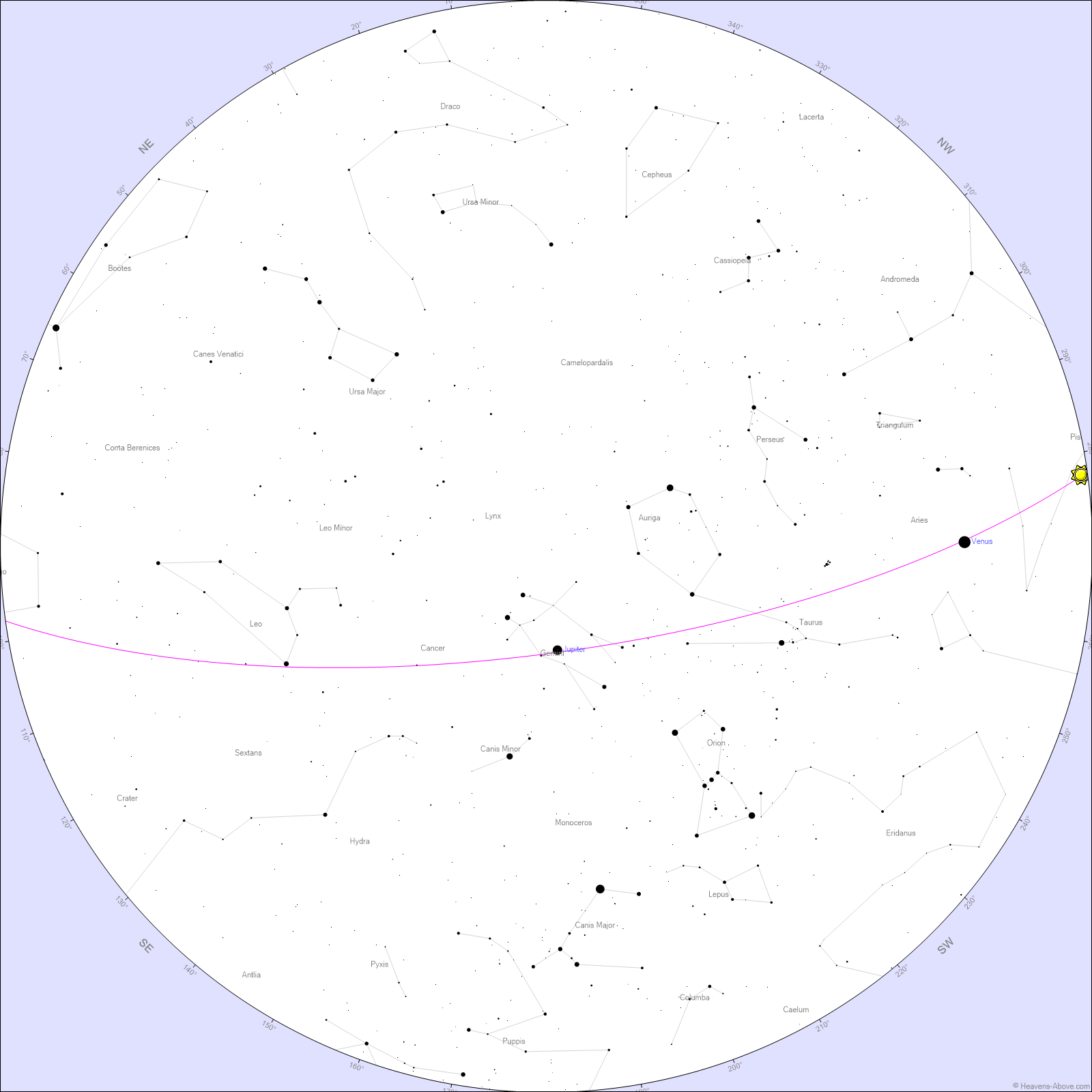
This week, the Moon starts off bright as a waning gibbous, washing out much of the sky early on, but night by night, it rises later and fades, giving us gradually darker skies as the week goes on.
In the evening, you can’t miss Venus, blazing in the western sky after sunset. It’s the brightest object out there by far. Jupiter is still hanging on in the southwest, almost directly overhead.
If you’re up before sunrise, Mercury, Mars, and Saturn are in a tidy line, but they’re sitting very low on the horizon and clustered near the morning sun, so they’ll be a bit of a challenge.
Overhead, we’re now fully in the spring sky. Leo is prominent, with its bright star Regulus, while Virgo begins to rise later in the evening. Cancer sits between them, faint, but home to one of the best binocular targets in the sky. That’s the Beehive Cluster, also known as Messier 44, an excellent target this week, especially with the bright Moon early on.
You can also try for the globular cluster M3, and later in the week, as skies improve, galaxies like M81, M82, and even the Whirlpool Galaxy, M51, come into reach.
And there’s a bit of a wildcard this week, a potential comet, C/2026 A1, may be visible low in the western sky just after sunset. As always with comets, your mileage may vary. This one is really dim right now, at magnitude 13.6, and it’s a sungrazer, so it’s going to hang close to the sun. If it survives its journey around the Sun it could brighten dramatically. Check an app like Stellarium for the exact location. We’ll be keeping an eye on it in the coming weeks.
That’s going to do it for this week. If you found this episode interesting, please share it with a friend who might enjoy it. The easiest way to do that is by sending folks to our website, startrails.show. And if you want to support the show, use the link on the site to buy me a coffee. It really helps!
Be sure to follow Star Trails on Bluesky and YouTube — links are in the show notes. Until we meet again beneath the stars … clear skies everyone!
Support the Show
Connect with us on Bluesky @startrails.bsky.social
If you’re enjoying the show, consider sharing it with a friend! Want to help? Buy us a coffee! Also, check out music made for Star Trails on our Bandcamp page!
Podcasting is better with RSS.com! If you’re planning to start your own podcast, use our RSS.com affiliate link for a discount, and to help support Star Trails.
 Star Trails: A Weekly Astronomy Podcast
Leave a comment