Space Oddity: The Harmony of Isolation – Star Trails: A Weekly Astronomy Podcast
Episode 106 (Bonus)
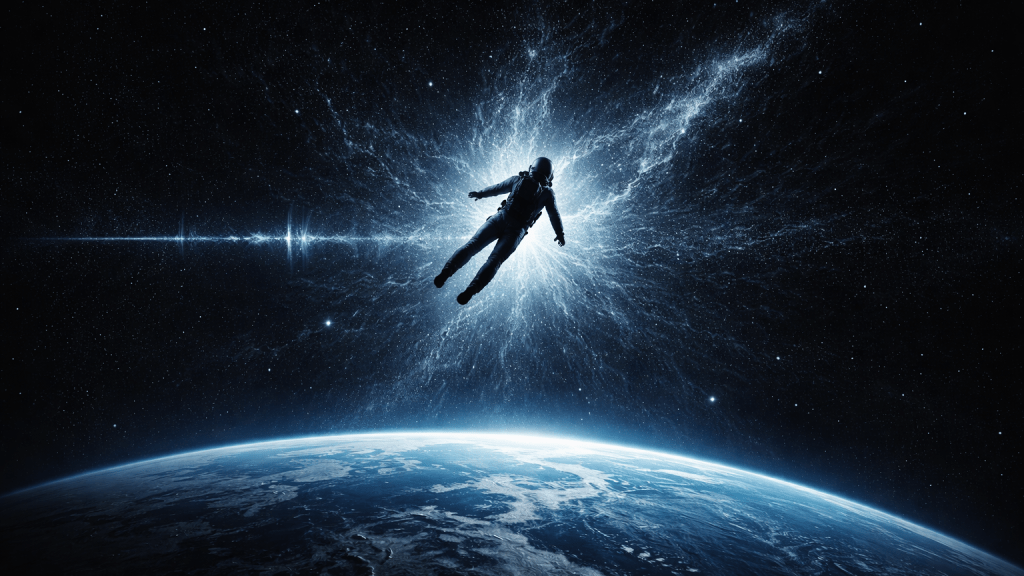
What makes a song feel like space? In this special bonus episode of Star Trails, we take a deep dive into the song “Space Oddity,” not just as a piece of music, but as a story of distance, disconnection, and drift.
Released in 1969 at the height of the space race, Bowie’s breakout hit arrived alongside humanity’s first steps on the Moon. The BBC even used it during their coverage of the Apollo 11 Moon Landing, a strange pairing for a song about an astronaut who never makes it home.
But the real story of Space Oddity goes deeper. Through subtle harmonic shifts, borrowed chords, and unconventional production techniques, the song itself begins to drift, mirroring the fate of its protagonist, Major Tom.
We’ll explore: How the song quietly abandons its musical “home,” why instruments like the Mellotron and Stylophone create a sense of distance, the role of stereo mixing, reverb, and tape-era studio tricks in shaping its sound, and how Bowie’s use of characters allows the story to resonate on a deeper level.
Along the way, we trace the song’s journey beyond Earth itself, including Chris Hadfield’s performance aboard the International Space Station.
More than 50 years after its release, Space Oddity remains a haunting reflection on what it means to leave home, and what happens when you don’t come back.
Links
- David Bowie – Space Oddity (Official Video)
- David Bowie – Starman (Official Video)
- David Bowie – Ashes to Ashes (Official Video)
- David Bowie – Life On Mars? (Official Video)
- David Bowie – Blackstar (Official Video)
- Def Leppard – Space Oddity
- The Flaming Lips – Space Oddity
- Chris Hadfield – Space Oddity
- 2001: A Space Odyssey – 50th Anniversary (70mm 4k restoration Trailer)
- The “Bowie” Stylophone
- Arturia Mellotron V
- BBC Apollo coverage
- Episode 106 on YouTube
Transcript
Howdy stargazers and welcome to this special episode of Star Trails. My name is Drew and I’m going to do something a little different today. I’m going to discuss a song that’s been stuck in my head for weeks now.
If you recall a few episodes back, I mentioned the first production car in space was a Tesla Roadster that SpaceX launched into a giant heliocentric orbit. In the seat was “Star Man,” a mannequin wearing a space suit, and the song “Space Oddity” by David Bowie, was playing on a loop.
And since that episode, that song has been playing on a loop in my head. I’ve played along with it on my guitar, I’ve listened to alternate versions of it, I’ve studied covers of it by well-known artists, I’ve been absorbed in its history and disturbed by the story it tells. I’ve tried to learn how it was made, and last night, I even played it on a ukulele at a weekly jam session I attend.
I’ve always admired this song, along with many others in Bowie’s catalog, but it wasn’t until recently that I really listened to it from both a narrative and harmonic perspective. And the more I learned about this song — it’s history and usage through the years, and its connection to space exploration, which, existed from the moment it was released — I just enjoy it even more.
So in this episode I’m going to break down 1969’s “Space Oddity,” David Bowie’s very first hit song.
— “Space Oddity” intro —
This isn’t just a story about an astronaut. It’s about drifting, physically, musically, and emotionally.
To properly investigate it, we need to set the scene. “Space Oddity” was released in 1969, right in the hottest stretch of the space race.
In 1961, Russian cosmonaut Yuri Gagarin became the first man in space, famously musing about Earth’s blue color from orbit. Not long after, Alan Sheppard became the first American in space, and the race was on. Just eight years later, the United States was preparing for something that seemed impossible, landing a man on the Moon.
The previous year, Stanley Kubrick’s 2001: A Space Odyssey was released, a slow-burn science fiction epic about a rogue AI and mankind’s evolution from club-wielding early primates, to a spacefaring civilization.
And even the title Space Oddity feels like a response to it. Not an “odyssey,” as in a grand, heroic journey… but something strange.
These world events, and especially the movie, were factors that inspired Bowie to write “Space Oddity,” a sparse, psychedelic folk song about an astronaut, Major Tom, who achieves orbit and the fame that goes with it. Yet, something on his mission goes awry, and he helplessly watches Earth as he drifts away in space, presumably lost forever.
Major Tom muses: “Planet Earth is blue, and there’s nothing I can do.”
And that might be one of the most quietly devastating lines ever written about space.
Like a stage play or film, the song follows a three-act structure. We start from an orderly place: The control room of a launch facility.
“Ground control to Major Tom … Take your protein pills and put your helmet on.”
This is clinical, Apollo-era optimism. Major Tom is established as the hero. A countdown to liftoff quietly begins, providing a counterpoint to the top line lyric melody. If you’re listening to the stereo version of the song, the countdown happens in your left channel, while Bowie’s vocals occupy the right channel.
In fact, in the stereo version, all the elements of this song are hard-panned left and right, which was a common technique of the era. Listen to some early Beatles in stereo, and in headphones, you clearly hear all the vocals shoved to one channel with most of the music in the other. It’s an over-exaggeration of the stereo field, which was a somewhat new technology in the 1960s. More on this in a bit.
In Act II, Major Tom has achieved orbit and “the papers want to know whose shirts you wear” which I interpret as Tom achieving fame for his accomplishment. People are obsessed with him, much in the way celebrity reporters ask film stars “who they are wearing” at red carpet events.
And now it’s time for Major Tom to take his space walk, to “leave the capsule” if he dares. However, something is wrong. Tom says he’s “floating in a most peculiar way” and the “stars look very different.”
There’s a shift in the song’s tone here:
— “For here am I sitting in my tin can…” —
A guitar solo seems to send us farther into space, and when we return to the story, Major Tom is 100,000 miles away, virtually half-way to the Moon. He makes a final plea:
— “And I think my spaceship knows which way to go…” —
Meanwhile, ground control is panicking:
— “Your circuit’s dead, there’s something wrong…” —
In the final act, Major Tom seems strangely at ease with his predicament. Now he’s floating far above the Moon, watching Earth from afar:
— “Planet Earth is blue…” —
A cacophony of instruments and noise rises and eventually fades out as the song ends. And I’m immediately reminded of the ending of 2001: A Space Odyssey, when Dr. Dave Bowman takes a trippy journey through space and time before his transformation into the Star Child.
That story alone is eerie and melancholy… but what makes it really unsettling is everything happening underneath it.
“Space Oddity” mostly orbits around the musical key of C major, but Bowie tosses in some gimmicks that make the song feel quite unstable.
Without getting too far down into a music theory rabbit hole, let me explain what I mean by the song’s key. Songs generally revolve around a tonal center. Especially pop songs, which often circle through the same three or four chords.
Chords are derived from the musical key the song is written in. So imagine sitting at a piano and pressing only the white keys. Congratulations, you’re playing in the key of C, which has no sharp or flat notes.
To form chords we look at the major scale of C, which is only seven notes, starting with C, D, E, and so on, until we circle back around to C again, now an octave higher.
C being the first note in the scale, means we can use it as the root note of the I-chord, which is C major.
— Guitar plays C major —
Let’s go a few notes up to E. This is the third note in the C major scale, which means it’s a minor chord. Here’s the melancholy E minor.
— Guitar plays E minor —
In the opening verse, Bowie alternates between the C and E minor chords, which, from the outset, produces a feeling of drift, or oscillation.
As we move deeper into the verse Bowie moves to A minor, but steps slightly outside the key and plays a D7 with F# as the bass note. That 7-chord imparts a certain bluesy or twangy sound here. The real outlier is the F# for the bass note — remember, C has no sharps or flats.
— Guitar plays D7/F# —
Bowie includes additional chords that aren’t strictly diatonic — meaning, they aren’t part of the key of C. These are called borrowed chords, since we’re taking them from adjacent keys, and some examples of this include moves from F major to the borrowed F minor during the verses:
— Guitar plays F to F Minor —
And there’s a B flat, just a step lower than C, that introduces the “Planet Earth is blue” line:
— Guitar plays Bb / Am / G / F —
And then there’s this great transitional chord progression:
— Guitar plays C F G A A —
That ends in two strums of A major — also a borrowed chord.
The reason I’m harping on these borrowed chords is because they make the song feel emotionally unsettled. When you hear one, it feels familiar, but just slightly off. These borrowed chords aren’t mistakes. They’re used intentionally, like the music itself is stepping outside its comfort zone. And that mirrors what’s happening in the story. Major Tom leaves the safety of Earth, and the unstable harmony follows him.
There’s another huge musical decision here: Major Tom doesn’t go home in the end… and neither does the music.
And what I mean by that is the song doesn’t neatly resolve back to its tonal center of C major. Pop songs generally wrap up by returning to their I chord. For example, here’s a simple progression that goes home at the end:
— Guitar plays C G Am F C —
“Space Oddity” doesn’t do that. In the ending “freak-out” section it seems to leave the key of C altogether, drifting to D major and finally to E major. That leaves us feeling stranded as the music fades out. That is a very intentional songwriting decision.
I’d also like to take a moment to discuss instrumentation and production.
Listen closely to the opening moments and see if you can hear a buzzing, organ-like drone under the guitar chords.
— Intro with Stylophone—
That weird sound is Bowie playing a Stylophone, a handheld synthesizer that was marketed to children. It came out just a year before this song, so it was a new, futuristic instrument. It kind of sounds like a buzzing radio here. By sliding the instrument’s stylus over the metal keyboard on top, you can produce eerie wah-wahs and squeals.
Interestingly, Bowie was a big fan of the Stylophone, and you can even buy a new iteration of it with a Bowie theme, including instructions for how to play several songs, “Space Oddity” is one of them, of course.
As the song builds, another high-tech instrument of the time can be heard. Listen to the wall of symphonic strings here:
— Mellotron section —
That’s not a string quartet. That’s a Mellotron, an early keyboard instrument that doesn’t generate sound like a synthesizer, but plays back actual recordings on strips of magnetic tape. Every key triggers a real violin, or a choir, but it sounds frozen in time and mechanical. And because it’s tape-based, it’s never perfectly stable. The pitch wobbles slightly, the timing isn’t exact, and if you hold a note long enough, it just runs out. That gives it a ghostly quality, like something from beyond trying to reach you from far away.
You’ve probably heard songs featuring the Mellotron. It was famously used for the flute sounds at the beginning of “Strawberry Fields Forever” by the Beatles:
— Snippet of “Strawberry Fields” intro plays —
A real Mellotron is expensive, but I have a couple excellent simulations of it here on my production machine. There’s just something about those sounds, recorded long ago, that’s so haunting. This particular emulation I’m playing is made by Arturia and features actual sounds recorded from a vintage Mellotron:
— I demo the string sound —
In “Space Oddity,” this sound fits perfectly. It doesn’t feel grounded or alive, it feels distant, fragile… like a signal drifting through space, slowly fading as it goes.
The recording process also contributes to the song’s ethereal quality.
There’s a generous use of reverb and echo, which pushes sounds away, making them feel distant, like they’re floating in a vast space.
There’s also subtle tremolo on the electric guitars, a gentle pulsing in the volume, that keeps sustained sounds from ever feeling completely stable. And then there’s the stereo mix. I already mentioned how the Instruments are panned hard to the left or right, but here it creates something more psychological. Instead of a cohesive band, you hear elements separated, almost isolated from each other.
Together, all these subtle choices are doing some real world-building.
So, what actually happens to Major Tom? Well, no one really knows, because Bowie keeps things deliberately ambiguous. This isn’t a song so much about an astronaut, as it is about isolation and emotional disconnect. Tom no longer feels connected to our world.
Maybe it’s a meditation on the price of fame itself, being adored by the planet, but feeling withdrawn and alone.
The question that comes to mind is, did Major Tom willingly send himself adrift into the void, because he seems at peace with the consequences. Another idea is that maybe he experienced some version of the Overview Effect — that feeling astronauts report after seeing the Earth from afar. It’s the realization that Earth is a fragile place, that humanity’s problems are small and insignificant, and the sobering realization that our world is a very, very small place in an expanding universe.
We can find more clues to the song’s meaning scattered throughout Bowie’s five-decade-long career.
“Ashes to Ashes” is considered something of a sequel to “Space Oddity,” largely owing to a line in its chorus, which asserts, “Major Tom is a junkie”:
— “Ashes to Ashes” sample —
I personally don’t like the idea of Major Tom as an addict, but this is what Bowie has given us.
I prefer the song “Star Man,” which, in my opinion, sounds like the true sequel.
— Star Man chorus drop in —
Consider this interpretation: Major Tom disappears, and like Bowman in 2001, he returns in an evolved form, the Star Man. However, Bowie never canonized that.
“Star Man” is on the Ziggy Stardust album, so it’s more related to the narrative arc of Ziggy Stardust, the rock musician from Mars.
But again, there’s the idea of isolation. The Star Man would like to meet us, but he’s afraid humanity isn’t ready for him.
Bowie loves to create these characters in his songs, Ziggy, Major Tom, Aladdin Sane, the Thin White Duke, and so on. Major Tom could be Bowie. Maybe Major Tom becoming a junkie, is Bowie being self-referential about his own drug problems.
However you want to frame it, it’s interesting to see how many space references Bowie peppers throughout his work. Aliens are messengers. Space is otherness, and contact is dangerous.
And right up to the end, Bowie was singing about space. His final album, Blackstar, was released in 2016 just before his death. It’s abstract, symbolic, almost ritualistic, but filled with cosmic imagery — stars, voids, death and transformation. It feels like crossing into something unknowable, and Bowie, near death, literally was.
— Sample from Blackstar —
“Space Oddity” has been covered by a variety of artists through the years, including a note-for-note rendition by Def Leppard that even places the sounds in the stereo field exactly like the original.
— Sample from Def Leppard version —
One of my favorite renditions is by The Flaming Lips, who lean hard into the psychedelic aspect:
— Sample from Flaming Lips version —
But “Space Oddity” has achieved a cultural status that goes beyond rock music. It began life that way.
In 1969, the BBC used it as background music for its coverage of the Apollo 11 moon landing. It seems they didn’t pay much attention to the lyrics. It was selected simply because it sounded “spacey.” Even Bowie was nervous about its use, fearing that if something went wrong on the mission, his song would be forever linked to a tragedy.
Decades later, the song found its way into orbit. Astronaut Chris Hadfield recorded the first music video in space aboard the International Space Station, playing “Space Oddity” on a guitar and singing a modified version of Bowie’s lyrics. This time, the astronaut makes it home.
— Sample from Hadfield’s version —
And now, more than 50 years after the last crewed missions to the Moon, a new chapter has begun.
As I’m recording this episode, four astronauts are on a journey deeper into space than any human has travelled before. The Artemis II mission will loop around the Moon and return to Earth, splashing down in the Pacific Ocean. It’s our first manned moonshot since 1972.
I don’t know if they’re listening to “Space Oddity,” but they’re following a path first taken by Apollo 11 in 1969, the same year the song was released.
I suspect we’ll still be listening to this song even 50 years from now. There’s a certain irony in it: A song about drifting into the void of space… somehow reminds us what’s at stake here on Earth.
— “Freakout section” fades out —
— Star Trails end theme begins —
Well folks, I think I’ve finally purged this tune out of my own head, but I apologize if it’s stuck in yours now. Thanks for taking this journey with me. If you have any thoughts on this song or the episode, be sure to leave me some feedback over at the show website, startrails.show.
If you found this episode interesting, please share it with a friend who might enjoy it. The easiest way to do that is by sending folks to our website. And if you want to support the show, use the link on the site to buy me a coffee. It really helps!
Be sure to follow Star Trails on Bluesky and YouTube — links are in the show notes. Until we meet again beneath the stars … clear skies everyone!
Support the Show
Connect with us on Bluesky @startrails.bsky.social
If you’re enjoying the show, consider sharing it with a friend! Want to help? Buy us a coffee! Also, check out music made for Star Trails on our Bandcamp page!
Podcasting is better with RSS.com! If you’re planning to start your own podcast, use our RSS.com affiliate link for a discount, and to help support Star Trails.
 Star Trails: A Weekly Astronomy Podcast
Leave a comment