Summer’s Starry Nights, a Nova Watch, and Planetary Adventures – Star Trails: From Backyard Astronomy to Cosmic Wonder
Episode 24
This week we journey through the night sky for the week starting July 7th. As the moon transitions from its New Moon phase to the First Quarter, we’ll revel in the darker skies perfect for stargazing. We’ll also look at three more summer constellations: Scutum, Pegasus, and Cetus, uncovering their notable stars, clusters, and deep sky objects.
We’ll discuss how to use averted vision to enhance viewing of dim objects, and we’re keeping an eye on T Coronae Borealis, a star that may go nova this summer!
We also share practical tips for new astronomers, focusing on what to expect when observing planets through a small telescope.
Links
Transcript
Hey there, star gazers! Welcome back to another episode of Star Trails. I’m your host, Drew, and I’m thrilled to have you join me as we explore the wonders of the night sky for the week starting July 7.
This week, we’ll continue learning about the summer constellations, and some lesser-known deep sky objects, like the Blinking Nebula. Plus, for our new astronomers, we’ll discuss what to expect when observing the planets in a small telescope. So find a comfortable spot under the stars, and let’s dive in!
Coming off of last week’s New Moon, we’re still enjoying darker skies as the Moon waxes through its crescent phase to the First Quarter, which arrives at the end of the week on July 13.
Planetary observation is still mostly for early risers this week. Mercury and Venus are migrating out of the Sun’s glare and you may be able to catch them just after sunset. Venus follows just behind the sun, with Mercury not far behind it. Look very low on the western horizon for both.
Mars, residing in Aries, will be visible with a magnitude of nearly 1. It rises in the eastern sky very early in the morning around 2:40 AM. Jupiter, shining brightly at a magnitude of nearly -2 in the constellation Taurus, is a treat for night owls. It rises in the eastern sky around 3:40 AM.
Saturn remains a best-bet. It will be in Aquarius at a magnitude of around 1. It rises in the south-east just before midnight and ends up high in the sky by the break of dawn, making it a great target for those who enjoy late-night or early-morning stargazing.
Uranus, at a dim magnitude of 5.8 will require binoculars. Look for it in Taurus rising in the eastern sky around 3 a.m. Neptune is a challenge for those with telescopes. It rises in the southeast in Pisces around 1 a.m.
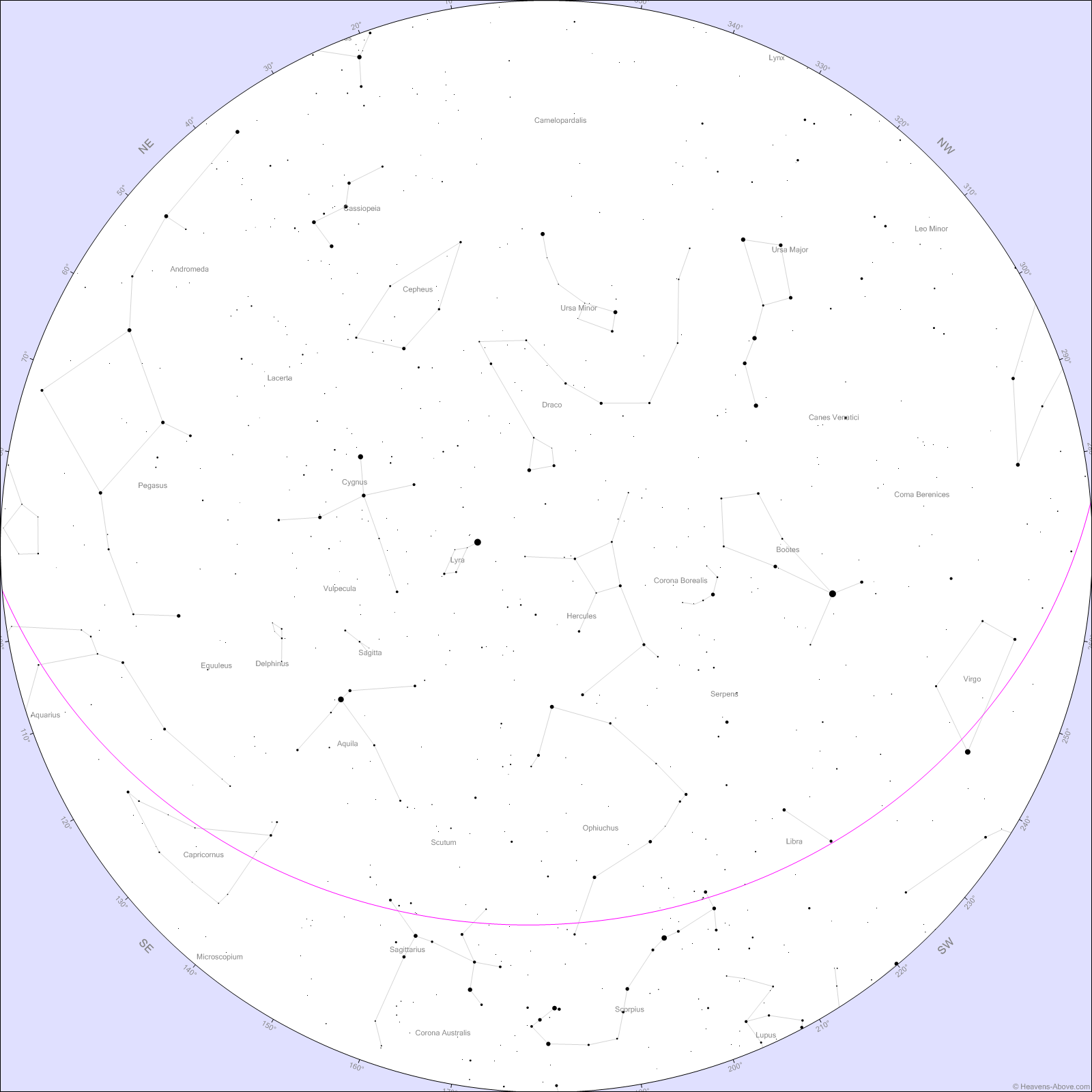
This week, we’re diving into three more fascinating constellations that you can spot this time of year: Scutum, Pegasus, and Cetus.
First up, we have Scutum, Latin for “shield.” This small but significant constellation was created by the astronomer Johannes Hevelius in the 17th century and is one of the few constellations named after an inanimate object. If the name Hevelius sounds familiar, it’s because we mentioned him a few episodes ago – he was responsible for naming the constellation Vulpecula, the Little Fox.
Scutum is home to some remarkable stars and celestial objects. The brightest star in Scutum is Alpha Scuti, a giant star located approximately 174 light-years from Earth. Although it’s not particularly bright compared to other stars, it marks an important point in this constellation. Another noteworthy star is Beta Scuti, a variable star whose brightness changes over time.
Interestingly, Scutum is also home to some of the most massive stars known, including stars in the cluster Westerlund 1. This cluster is one of the most massive young star clusters in the Milky Way and contains some of the largest stars ever discovered, such as Westerlund 1-26, a red supergiant with a radius over 1,500 times that of the Sun. Westerlund 1 also hosts numerous other massive stars, including blue supergiants and Wolf-Rayet stars, which are among the hottest and most luminous stars in the galaxy.
One of the highlights of Scutum is the Wild Duck Cluster, M11. This stunning open cluster is filled with young, hot stars and is located about 6,000 light-years away. It’s one of the richest and most compact open clusters known, making it a spectacular sight. Another open cluster in Scutum is M26, which, though more subdued than M11, is still a great target for amateur astronomers with binoculars or small telescopes.
Scutum is also home to one of the densest parts of the Milky Way, making it a fantastic area for exploring the star fields and clusters with a telescope.
Next, let’s gallop – or flap – over to Pegasus, the winged horse. This large constellation is easily recognizable by the Great Square of Pegasus, an asterism formed by four bright stars.
The brightest star in Pegasus is Enif, an orange supergiant located about 690 light-years from us, and it’s known for its occasional outbursts, where it brightens significantly. Another key star is Markab, which is one of the stars forming the Great Square. Markab is a blue-white subgiant about 133 light-years away.
Pegasus contains some fascinating deep sky objects as well. One of the most notable is M15, a globular cluster estimated to be around 12 billion years old. M15 is packed with stars and is a great sight through a telescope. Another impressive object is NGC 7331, a spiral galaxy often referred to as a twin of the Milky Way. Located about 40 million light-years away, it’s a beautiful target for astrophotography.
The Great Square of Pegasus is an excellent starting point for amateur astronomers to find their way around the sky. It’s a prominent feature that makes Pegasus one of the easiest constellations to spot.
Lastly, we’ll dive into the depths of the sea with Cetus, the whale or sea monster. This constellation is one of the largest in the sky and has some fascinating features.
One of the most famous stars in Cetus is Mira, also known as Omicron Ceti. Mira is a variable star, meaning its brightness changes over time, with a period of about 332 days. At its brightest, Mira is visible to the naked eye, but at its dimmest, you’ll need a telescope to spot it. The brightest star in Cetus is Deneb Kaitos, or Beta Ceti, a giant star located about 96 light-years away.
Cetus also hosts some remarkable deep sky objects. M77, a spiral galaxy about 47 million light-years away, is one of the brightest and most massive galaxies visible in amateur telescopes. It’s also home to an active galactic nucleus, indicating a supermassive black hole at its center. Another interesting object is NGC 246, known as the Skull Nebula. This planetary nebula, located about 1,600 light-years from Earth, is a spooky sight.
Cetus is associated with the myth of Perseus and Andromeda. In the story, Cetus was the sea monster sent to devour Andromeda before Perseus saved her. This mythological connection adds an extra layer of intrigue to this already fascinating constellation.
This week, we’re setting our sights on some deep sky objects that often fly under the radar but are no less spectacular. You’ll want your telescope for these.
First up, we have the Saturn Nebula, also known as NGC 7009. This planetary nebula is located in the constellation Aquarius and gets its name from its striking resemblance to the planet Saturn, with its elongated shape and ring-like structure. Discovered by Sir William Herschel in 1782, this nebula is around 5,200 light-years away from us. Through a telescope, you’ll notice its bright blue-green disk, a testament to the ionized gasses glowing brightly as the central star sheds its outer layers. It’s a beautiful sight and a great challenge for amateur astronomers.
Next, let’s turn our scopes to NGC 6826, famously known as the Blinking Planetary Nebula, located about 2,200 light-years away in the constellation Cygnus. This intriguing nebula gets its nickname from a visual phenomenon where it seems to “blink” in and out of view when observed directly or with averted vision.
When it comes to stargazing, especially when observing faint objects, this technique can be a game-changer. Averted vision is an observation method where you look slightly to the side of an object rather than directly at it. This may seem counterintuitive at first, but it works because of the way our eyes are constructed.
Our eyes have two types of photoreceptor cells: rods and cones. Cones are concentrated in the center of our vision and are responsible for color perception and sharp details but are not very sensitive to low light. Rods, on the other hand, are more sensitive to dim light and are located around the periphery of our retina. By using averted vision, we are utilizing the rod cells, which are more efficient at detecting faint objects in low light conditions.
The Blinking Planetary Nebula is a perfect example of where averted vision comes in handy. When you look directly at this nebula, its central star is so bright that it can overwhelm the more diffuse surrounding nebula, making it seem to disappear. This is where the “blinking” effect comes into play.
To properly observe it, look away from the central star and shift your gaze slightly to the side. You should notice the nebula’s fainter, extended regions become more visible while the central star appears to dim. This makes the nebula “blink” into view.
Finally, let’s explore NGC 6934, a globular cluster in the tiny constellation Delphinus. Unlike the more famous globular clusters like M13 in Hercules, NGC 6934 is a bit more of a challenge but equally rewarding. This cluster lies about 50,000 light-years away and contains hundreds of thousands of stars tightly packed into a spherical shape. Through a moderate-sized telescope, you can resolve individual stars on the periphery of this dense cluster.
Elsewhere in the cosmos, don’t forget to keep an eye on “The Blaze Star,” T Coronae Borealis, a recurrent nova. July is an ideal time to keep a watch on this star, as it’s located high overhead this month in the constellation Corona Borealis, or the Northern Crown.
T Coronae Borealis, or T CrB, has gone nova twice before, once in 1866 and again in 1946. There are only five known nova stars in our galaxy, making its impending nova a rare treat.
Recent observations of T CrB have revealed increasing brightness and changes in its spectral lines, which could indicate a nova is imminent. When that happens its brightness will increase dramatically, making it easily visible to the naked eye – about the same brightness as Polaris, the North Star. Its current magnitude is too low to be observed with the naked eye.
Keep an eye on updates from sources like NASA and the American Association of Variable Star Observers (AAVSO) for real-time information on the nova’s progress. We provided more information on this star back in episode 21, so check that out in case you missed it.
After a quick break, we’ll talk about what you can realistically expect to see in a telescope when observing planets. If you’re in the process of buying a scope, you may find this information useful, so stay with us!
[Ad spot, RSS.com]
Welcome back. Today, we’re diving into a topic that excites me and many other stargazers: the visible planets. In nearly every episode I mention using a telescope to observe them. But what do they actually look like through the eyepiece? Later I’ll offer up some scope suggestions and observation strategies.
Let’s start with the innermost and smallest planet. Mercury is quite challenging to observe because it’s often low on the horizon and close to the Sun. When you do get a glimpse, it appears as a small, bright disk. Depending on its position, you might see it in a crescent or gibbous phase, but surface details are generally not discernible.
Next up is Venus, our neighboring planet. Venus shines brightly and is relatively easy to spot. Through a telescope, it exhibits phases similar to the Moon, ranging from a thin crescent to a full disk. Its thick cloud cover means surface details remain hidden, but the changing phases offer an ever-evolving view.
Moving on to Mars. Mars appears as a reddish disk, and when it’s close to Earth, during opposition, it reveals more details. With a small to medium telescope, you can observe dark surface markings, the polar ice caps, and occasionally, dust storms sweeping across its surface.
Now, let’s talk about Jupiter, one of the most rewarding planets to observe. Jupiter presents a large disk with noticeable banding. The two main equatorial cloud belts are usually visible, and if you’re lucky, you might catch a glimpse of the Great Red Spot, a massive storm larger than Earth. Additionally, Jupiter’s four largest moons—Io, Europa, Ganymede, and Callisto—appear as bright points of light and can be seen moving in their orbits over the course of a few hours.
And then there’s Saturn. Saturn’s breathtaking ring system makes it a stunning sight in any telescope. Even a small telescope will reveal the rings, and with a medium telescope, you might observe the Cassini Division, the gap between the rings. Saturn’s largest moon, Titan, can also be seen as a bright point nearby. The planet itself shows a muted yellowish hue with some banding across its surface.
Uranus appears as a small, bluish-green disk. Although surface details are not visible, its distinct color can be discerned. With steady atmospheric conditions, you might spot some of its larger moons, adding to the viewing experience.
Neptune is similar in appearance to Uranus but appears smaller and dimmer due to its greater distance from Earth. It shows up as a small, blue disk with no visible surface details. However, its largest moon, Triton, can be seen with a medium telescope under favorable conditions.
Now, here are some tips for observing planets. Observation when the atmosphere is calm, known as good seeing conditions, is crucial for clear views. You’ll experience better seeing when planets are farther off the horizon, where Earth’s atmospheric turbulence can impact the view.
Using higher magnifications can help reveal more details, particularly on Mars, Jupiter, and Saturn.
Colored filters can enhance contrast and bring out more details, such as surface markings on Mars or cloud bands on Jupiter.
Finally, viewing planets at opposition, when they are directly opposite the Sun in the sky, provides the best views due to their proximity to Earth.
So, what types of telescopes are ideal for planetary viewing? Refractor telescopes are great due to their high contrast and sharp images. A refractor with an aperture of 80mm to 120mm is ideal for beginners.
Maksutov-Cassegrain telescopes, known for their excellent optics and compact design, offer crisp, detailed views of the planets. A Maksutov-Cassegrain with an aperture of 90mm to 127mm is a good choice.
Schmidt-Cassegrain telescopes provide good all-around performance, with an 8-inch Schmidt-Cassegrain being popular for exploring both planetary and deep-sky objects. Finally, while traditionally used for deep-sky observing, Dobsonian telescopes with an aperture of 6 to 10 inches can provide stunning planetary views, especially under good seeing conditions.
Each type of telescope has its strengths, and your choice might depend on factors such as portability, ease of use, and budget.
Let’s delve a bit deeper into the types of filters that can enhance your planetary viewing experience. Using colored filters can significantly improve the contrast and detail visible on planets, making your observations even more enjoyable. I’ll include a link in the show notes that describes in detail filters for planetary viewing, but here’s a broad overview:
First, red filters are particularly useful for observing Mars. They enhance the contrast of surface features such as dark maria and polar ice caps. A red filter can also help to cut through the glare of the Martian surface, revealing more subtle details.
Blue filters can be useful for observing Jupiter and Saturn. On Jupiter, a blue filter can bring out details in the cloud belts and the Great Red Spot. On Saturn, it enhances the contrast of the rings and the planet’s atmospheric bands. Blue filters are also helpful for viewing Venus, as they can reduce the brightness and reveal cloud patterns in its thick atmosphere.
Green filters work well on both Mars and Jupiter. On Mars, it can improve the visibility of polar ice caps and surface frost. For Jupiter, a green filter enhances the contrast of the cloud belts and helps to highlight the Great Red Spot.
A yellow filter is beneficial for observing Mars, Jupiter, and Saturn. On Mars, it enhances the visibility of surface features. On Jupiter, it increases the contrast of the cloud belts and the Red Spot. On Saturn, a yellow filter helps to bring out details in the rings and the planet’s atmospheric bands.
Finally, let’s not forget the neutral density filter. This filter is essential for observing the Moon and bright planets like Venus and Jupiter. It reduces the overall brightness without altering the colors, providing a more comfortable and detailed view. This is especially useful when the planets are at their brightest, making the observation less straining on the eyes.
Experimenting with different filters will help you discover the best views of each planet. Remember, the right filter can transform your stargazing experience from good to truly spectacular. I’ll include a link to a guide on using filters in the show notes.
That’s it for today’s episode of Star Trails.
Before you go, I invite you to check out our weekly e-mail newsletter on Substack, where you can receive night sky reports and astronomy news that we don’t always mention on the podcast. It’s completely free, and a great supplement to the podcast.
We’re also on Mastodon @star_trails and we’d love to hear from you. I’ll include links to both services in the show notes. Also, remember our website, startrails.show, where you can find all our episodes, including transcripts.
Until next time, keep looking up and exploring the night sky. Clear skies, everyone!
Support the Show
Join us on Substack to get the weekly night sky report as a newsletter, and additional astronomy news. Also, connect with us on Mastodon @star_trails.
If you’re enjoying the show, consider sharing it with a friend! Want to help? Buy us a coffee!
Podcasting is better with RSS.com! If you’re planning to start your own podcast, use our RSS.com affiliate link for a discount, and to help support Star Trails.


Leave a Reply