The Perseids Meteor Shower, a Conjunction, and the Summer Triangle – Star Trails: A Weekly Astronomy Podcast
Episode 25
Join us for the week of July 14 to July 20. In this episode we dive into the Summer Triangle and discover the myths and scientific marvels behind the stars Vega, Altair, and Deneb. Learn how to spot these celestial gems along with other deep sky objects in the summer sky.
Get up early for the conjunction of Uranus and Mars on July 15. Also, this month marks the start of observation for the dazzling Perseid meteor shower, which is always an anticipated astronomical event. We talk more about meteor showers and how to view them in the second half of the episode.
Transcript
Hello, star gazers! Welcome to another episode of Star Trails. I’m Drew, your guide to the cosmos for the week starting July 14 to July 20. This week we’re focusing on the Summer Triangle, and later in the show, we’ll highlight one of the year’s best meteor showers, the Perseids.
Summer is here, and temperatures have been approaching 100 degrees and we’ve had daily afternoon storms at my home location. It goes without saying that astronomy during the summer months can be challenging. The nights are shorter, reducing the window for observation. Heat can cause discomfort and attract insects. The high humidity in many regions can lead to hazy skies, making it difficult to see faint objects.
Also, our favorite planets seem to be at their best in the early morning hours, and that makes observation tough for those of us who have to get up early for work. However, the rewards of seeing the Milky Way, the deep sky objects of summer, and events like meteor showers make it worth the effort, so stick with it, and hopefully it’s cooler where you are than it is here.
The week begins with the Moon in its First Quarter phase, gradually waxing towards a Full Moon, which will occur on July 21. This means we’ll have a waxing gibbous moon dominating the evening sky throughout this week, slightly obscuring the faintest stars and deep sky objects.
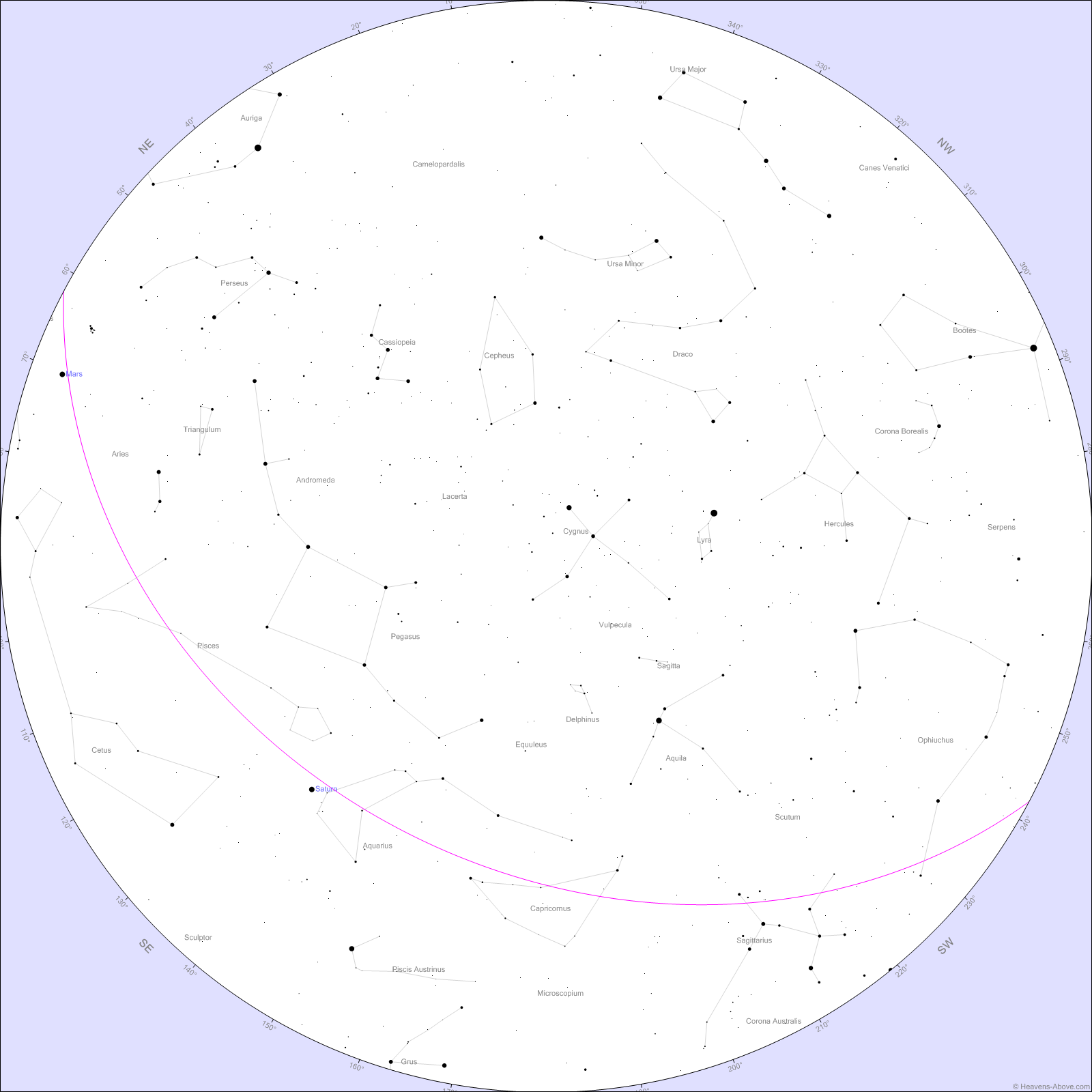
For our planet watchers, Uranus and Mars will be in conjunction this week. Look for the pair on July 15 after 3 a.m. Mars, at a magnitude of 0.9, will pass close to Uranus in the constellation Taurus. The planets will be visible high above the eastern horizon about an hour before sunrise. You’ll need at least a pair of binoculars to see Uranus, which clocks in at a dim magnitude of 5.8. It will be directly above Mars, less than half a degree away. To put that into perspective, if you hold your fist out at arm’s length against the sky, it will span roughly 10 degrees.
If you’re having trouble locating Mars, look for the “tiny dipper” shaped Pleiades cluster and Mars will be the red star about 10 degrees to the right. If you have your binoculars out, be sure to look at the Pleiades itself, as it’s a serene blue open cluster that’s always a treat up close.
Jupiter will be nearby, lighting up the constellation Taurus at a magnitude of -1.9. You can’t miss it, just to the left of Aldebaran.
This week, Saturn is still at the kneecap of Aquarius. You’ll be able to spot it rising just before midnight at about the same brightness as Mars. Saturn will end up high in the sky by the pre-dawn hours. Neptune is also in the vicinity, about 15 degrees to the left of Saturn, hanging out in Pisces. As always, you’ll need a telescope to catch it.
Mercury and Venus are still very near the sun. You may be able to spot Mercury low on the western horizon just after sunset. Venus will likely be lost in the sun’s glare this week.
Let’s talk about one of the most prominent asterisms in the summer sky. The Summer Triangle, made up of the bright stars Vega, Altair, and Deneb, has been known to various cultures throughout history. For instance, in ancient China, Vega was part of the Weaving Girl constellation, symbolizing a princess who weaves the Milky Way. Altair was the Cowherd, representing her lover. This myth is celebrated during the Qixi Festival, similar to Valentine’s Day.
Vega, or Alpha Lyrae, is the fifth brightest star in the night sky and the second brightest in the northern celestial hemisphere, after Arcturus. It’s been extensively studied and serves as a baseline for calibrating the brightness of other stars. Interestingly, Vega will become the North Star around 14,000 AD due to the precession of the equinoxes, as Earth’s rotational axis changes over millennia.
Altair, or Alpha Aquilae, is one of the closest stars visible to the naked eye, at only 16.7 light-years away. It rotates incredibly fast, with an equatorial speed of approximately 286 kilometers per second, causing it to be significantly flattened at the poles.
Deneb, or Alpha Cygni, is one of the most luminous stars known, with an absolute magnitude of -8.4, making it around 200,000 times more luminous than the Sun. Despite being approximately 2,600 light-years away, it appears bright because of its immense luminosity. Deneb is also a prototype for a class of pulsating stars known as Alpha Cygni variables.
Each star in the Summer Triangle is part of a larger constellation with its own rich mythology and fascinating features. Lyra, which contains Vega, is home to the famous Ring Nebula, a planetary nebula that can be seen with a small telescope. Aquila, Altair’s constellation, represents the eagle that carried Zeus’s thunderbolts in Greek mythology. Cygnus, known as the Swan, is home to several interesting deep sky objects, including the Cygnus X-1 black hole and the North America Nebula.
The Summer Triangle is situated along the Milky Way, making it an excellent region for exploring the dense star fields of our galaxy. On a dark, clear night, the Milky Way appears as a luminous band stretching across the sky, filled with stars, nebulae, and clusters.
During the summer months, the Summer Triangle rises in the eastern sky after sunset and remains visible throughout the night. It is an excellent guide for locating other stars and constellations. Using the stars of the Summer Triangle, you can find other interesting objects. For instance, following the line from Deneb to Altair points towards the constellation Sagittarius, where the center of the Milky Way resides.
In addition to the well-known objects of summer, here are three lesser-known deep sky objects that are visible right now:
The Dumbbell Nebula (M27) is located in the constellation Vulpecula, just south of the Summer Triangle. The Dumbbell Nebula is one of the brightest planetary nebulae in the night sky. It appears as a small, glowing apple core through binoculars and reveals its double-lobed structure with a telescope. This nebula, formed from the outer layers of a dying star, is about 1,360 light-years away from Earth.
The Coat Hanger, also known as Brocchi’s Cluster, is an asterism situated in the constellation Vulpecula. It gets its name from its distinctive shape, resembling an upside-down coat hanger. The Coat Hanger is best viewed with binoculars, which will reveal its straight line of stars forming the hanger’s bar and a hook-like cluster of stars at one end. This arrangement of stars makes it a fun target for casual stargazing.
The Eastern Veil Nebula (NGC 6992) is part of the larger Veil Nebula complex in the constellation Cygnus. The Eastern Veil Nebula is a remnant of a supernova explosion that occurred around 10,000 years ago. This faint nebula can be observed with a telescope under dark skies, where you’ll see its delicate, wispy filaments stretching across the sky. The entire Veil Nebula complex spans an area of about 3 degrees in the sky, making it an excellent subject for wide-field astrophotography.
We’re going to take a quick break, and when we return, we’ll discuss meteor showers, including one of the most active, which begins this month. Stay with us!
Welcome back.
This week, we’re diving into meteor showers, with a special focus on the upcoming Perseids.
Meteor showers occur when Earth passes through the debris left behind by a comet. These tiny particles, called meteoroids, enter our atmosphere at incredibly high speeds and burn up, creating the bright streaks of light we call meteors. If any of these meteoroids are large enough to survive their fiery journey through the atmosphere and land on Earth, they become meteorites.
There are several well-known meteor showers that grace our skies each year. The Perseids, Geminids, and Leonids are among the most famous. The Perseids, which we’re focusing on today, are particularly beloved for their bright and numerous meteors. They originate from the comet Swift-Tuttle and are best seen in the northern hemisphere.
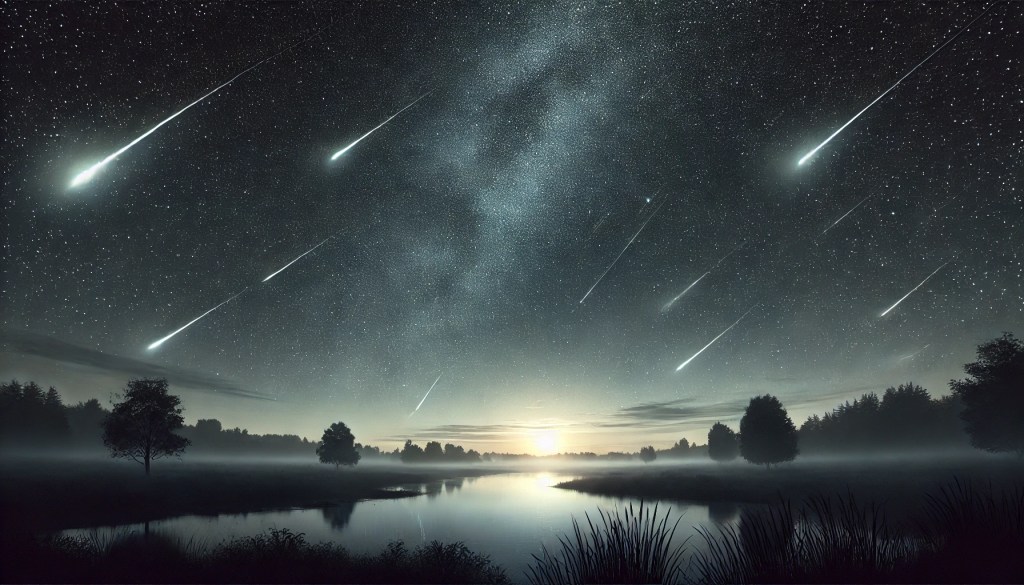
The viewing period for the Perseid meteor shower starts tonight and peaks around August 12. The best time to view the Perseids is after midnight, away from city lights where the sky is darkest. Find a spot with a clear view of the sky, and let your eyes adjust to the darkness for about 30 minutes for the best viewing experience.
One of the best things about meteor showers is that you don’t need any special equipment to enjoy them. Just your eyes and a bit of patience. Lie back on a blanket or a reclining chair, and look up. Meteors can appear anywhere in the sky, though they will seem to radiate from the constellation Perseus, which rises in the northeast. Bring along some snacks, a warm drink, and maybe a friend or two to share the experience.
As meteoroids enter Earth’s atmosphere, they travel at speeds of up to 70 kilometers per second. The friction between the meteoroid and the air causes the meteoroid to heat up and glow, creating the bright trail we see. Larger meteoroids can produce fireballs, which are incredibly bright meteors that can light up the entire sky for a few moments.
Although we call them “showers” the reality is that meteors won’t be coming down like rain drops. The Perseid meteor shower typically produces an average rate of 50 to 100 meteors per hour during its peak under optimal conditions. However, this rate can vary depending on factors such as the observer’s location, light pollution, weather conditions, and the phase of the moon. During the peak night, if you’re in a dark location with clear skies and minimal light pollution, you could potentially see around 60 to 70 meteors per hour.
This year August 12 is predicted to be the peak night, meaning you should stay up late on August 11, and wait until the moon sets just after midnight for ideal viewing.
Meteor showers have fascinated humans for centuries, inspiring myths and legends around the world. In ancient times, meteors were often seen as omens or messages from the gods. In some cultures, it’s believed that wishing upon a shooting star can make your dreams come true. So, while you’re out there watching the Perseids, don’t forget to make a wish!
Before I close this episode, I have to take a moment to mention one the most significant moments in the history of space exploration, that occurred this week back in 1969.
July 20 is the 55th anniversary of the Apollo 11 Moon landing. On this day, astronauts Neil Armstrong and Buzz Aldrin became the first humans to walk on the Moon, while Michael Collins orbited above in the command module.
Between 1969 and 1972, there were six successful manned moon landings, with a total of twelve astronauts walking on the lunar surface. Apollo 11 continues to inspire new generations, as we plan to return to the Moon in coming years with the Artemis project.
That’s it for today’s episode of Star Trails. Before you go, I invite you to check out our weekly e-mail newsletter on Substack, where you can receive night sky reports and astronomy news that we don’t always mention on the podcast. It’s completely free, and a great supplement to the podcast.
We’re also on Mastodon @star_trails and we’d love to hear from you. I’ll include links to both services in the show notes. Also, remember our website, startrails.show, where you can find all our episodes, including transcripts.
Until next time, keep looking up and exploring the night sky. Clear skies, everyone!
Support the Show
Join us on Substack to get the weekly night sky report as a newsletter, and additional astronomy news. Also, connect with us on Mastodon @star_trails.
If you’re enjoying the show, consider sharing it with a friend! Want to help? Buy us a coffee!
Podcasting is better with RSS.com! If you’re planning to start your own podcast, use our RSS.com affiliate link for a discount, and to help support Star Trails.
 Star Trails: A Weekly Astronomy Podcast
Leave a comment