One Year of Star Trails: A Journey Through the Cosmos and Time – Star Trails: From Backyard Astronomy to Cosmic Wonder
Episode 50
This week marks a special milestone for Star Trails — our one-year anniversary! Join us as we reflect on the origins of the show, its experimental beginnings, and the journey that has brought us here.
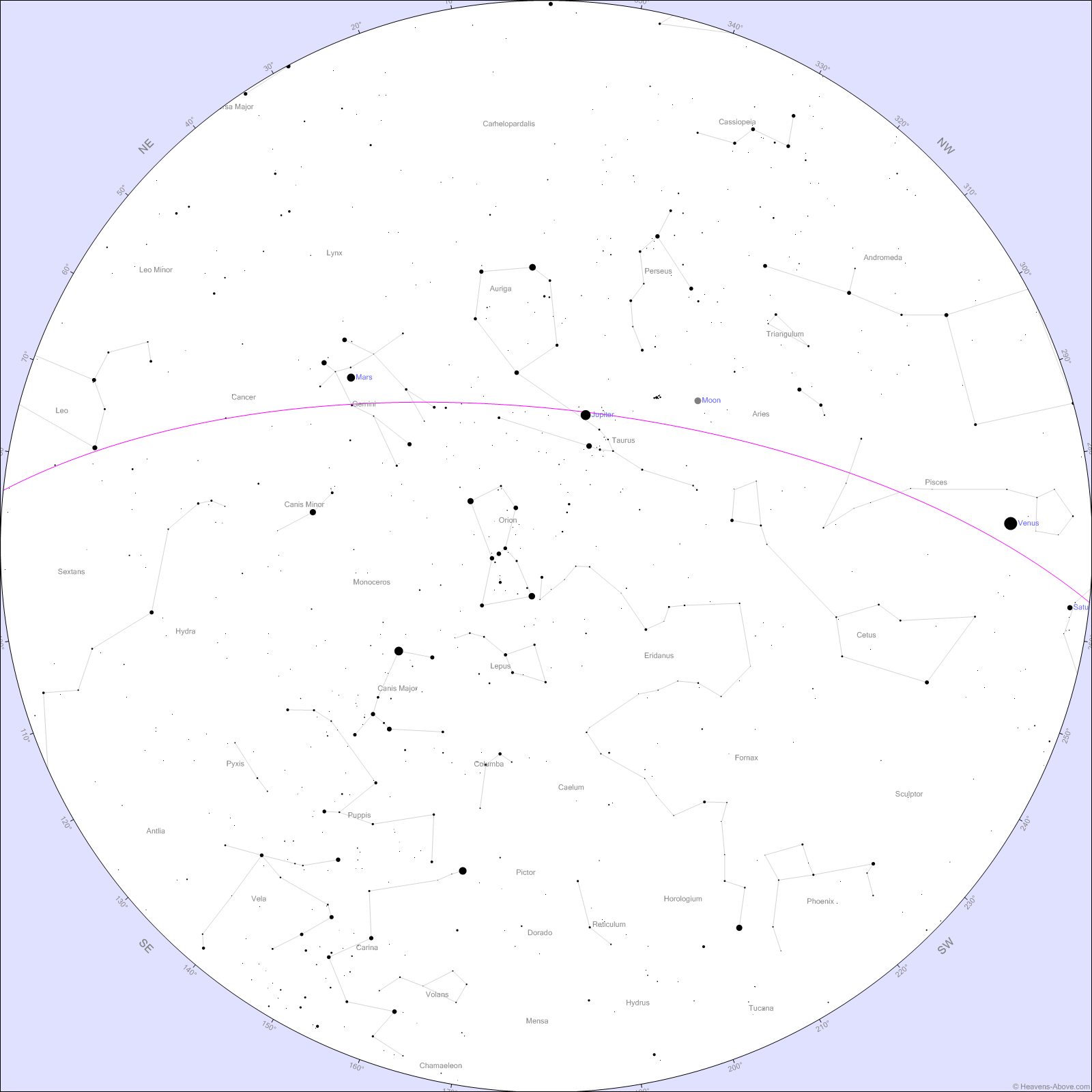
As usual, we’ll start with what you can see overhead this week, including the Moon’s waxing phases, planetary highlights like Venus, Mars, Jupiter, and Saturn, and notable celestial alignments featuring the Pleiades, Aldebaran, and the First Quarter Moon.
Then, we’ll explore the deep sky with two constellations that deserve more attention: Auriga, home to the beautiful open clusters M36, M37, and M38, and Lynx, where we’ll track down the fascinating globular cluster NGC 2419, also known as The Intergalactic Wanderer.
We’ll end with a mind-expanding journey through Carl Sagan’s Cosmic Calendar, a thought experiment that compresses the 13.8-billion-year history of the universe into a single calendar year.
Transcript
[MUSIC]
Howdy stargazers and welcome to this episode of Star Trails. I’m Drew, and I’ll be your guide to the night sky for the week starting February 2nd through the 8th.
This week is special, as it marks the one year anniversary of the Star Trails podcast. Later in the show, I’ll talk about why I started the show and what the future may hold. Plus, we’ll explore Carl Sagan’s concept of a cosmic calendar, in which the entire timeline of the universe is compressed into a span of a year to give us a framework for understanding the vast scale of the universe.
We’ll start with what you can see from your backyard this week, so, grab a comfortable spot under the night sky, and let’s get started!
The Moon will be in a waxing phase throughout the week, gradually increasing in brightness each night. On February 2nd and 3rd, the waxing crescent Moon will be visible in the early evening, setting a few hours after the Sun. This is a great time to observe the Moon’s delicate crescent shape, as well as the “earthshine” effect — where sunlight reflects off Earth and faintly illuminates the darkened portion of the lunar surface.
On February 5th, the Moon will reach its first quarter phase, appearing as a perfect half-illuminated disk in the evening sky. This phase offers excellent contrast along the terminator, the dividing line between light and shadow, where craters and mountain ranges stand out sharply.
By the end of the week, the Moon’s waxing gibbous phase will dominate the night sky. It will be bright and high in the sky for most of the night, making deep-sky observations more challenging but providing clearer views of the Moon’s craters and maria through a telescope.
Venus remains a dazzling beacon in the western sky after sunset. As one of the brightest objects in the sky, it’s impossible to miss, shining like a brilliant diamond just above the horizon.
Mars is still making its way through Gemini in the west. It reached opposition a few weeks back, so it’s still big and bright in the sky. A telescope may reveal surface details and polar ice caps under good conditions.
Jupiter dominates the sky from up high. It’s nearly directly overhead after dusk and visible until about 2 a.m. Even a modest telescope will reveal its cloud bands and its four largest moons, which change position from night to night.
Saturn is also visible, though lower in the western sky after sunset. The ringed planet is slowly sinking toward the horizon, so this will be one of the last good months to observe it before it disappears from view for a while. Through a telescope, Saturn’s rings and its largest moon, Titan, make for a stunning sight.
There are a few interesting alignments to watch for this week.
On February 5th, the First Quarter Moon will appear close to Jupiter and Aldebaran, the bright orange star marking the eye of Taurus. The Moon will also pass near the Pleiades star cluster, offering a beautiful celestial grouping visible to the naked eye or through binoculars. On February 6th, the Moon will form a striking line with Jupiter and Aldebaran.
Look high in the sky to observe both events.
[Transition FX]
This week, we turn our attention to two constellations: Auriga, the Charioteer, and Lynx, an often-overlooked but rewarding constellation for deep-sky observers.
First, let’s start with Auriga, which is almost directly overhead and easy to spot thanks to its brightest star, Capella. Capella is the sixth-brightest star in the night sky and has a beautiful golden hue. But beyond this prominent beacon, Auriga is home to a trio of remarkable open star clusters that make for excellent binocular and telescope targets.
M36 is sometimes called a miniature version of the Pleiades. This young cluster contains hot blue-white stars that sparkle against the blackness of space.
M37, is the richest and brightest of Auriga’s open clusters. It stands out with its densely packed core and a single reddish giant star near its center, adding a splash of color to the grouping.
Finally, M38, has an intriguing “X” or “starfish” shape when viewed through a telescope, making it a rewarding target for deep-sky observers.
Now, for something a little more challenging, we turn to Lynx, a faint constellation that stretches between Auriga and Ursa Major. While it doesn’t have any particularly bright stars, it holds one of the most intriguing deep-sky objects in the sky: NGC 2419, also known as The Intergalactic Wanderer.
This globular cluster is incredibly distant—about 300,000 light-years away — making it one of the most remote star clusters associated with the Milky Way. Unlike most globular clusters, which orbit relatively close to the galactic center, this one takes such a long time to complete its orbit that some astronomers originally believed it might not belong to the Milky Way at all. Through a medium to large telescope, it appears as a faint, compact sphere of stars.
As always, try to observe from a dark-sky location for the best views, and let your eyes adjust for at least 15 minutes to catch the faintest details these celestial wonders have to offer.
[Transition FX]
I’d like to take a moment to thank the listeners of Star Trails, because this week marks the one-year anniversary for the podcast. I’m not sure how time flew by that quickly – it’s sort of like orbiting a black hole and returning to Earth to find years have passed in the blink of an eye. But here we are, entering the show’s second year.
When I began this endeavor, I decided that I would produce it for a year, and at the end of that period, see how things were going. If there was growth, I’d continue on. Strangely, we’ve picked up listeners across the globe, and growth has been slow but steady. I’m about halfway to a milestone goal of 1,000 listeners per month, so I plan to keep plugging away in hopes of reaching that benchmark one day.
If you’ll allow me, I’d like to take a moment to discuss the show’s experimental origins – because the early weeks of the show were a little, well, strange.
I’d also like to highlight a few of the things I think the show did well over the last year, which was just an incredible year for amateur astronomers, from surprise solar storms and auroras, a dramatic solar eclipse, to a crazy comet. Thanks to these events, we had no shortage of good content over the last year.
Star Trails was born in January 2024 one evening while I was out on one of my daily evening walks. I simply looked up at the field of stars above and wondered what was visible that night. That triggered a memory from decades earlier, when I would stay up late on Saturday nights to catch Jack Horkheimer’s “Star Hustler” segment on PBS.
As a kid growing up in the 80s, there was no Internet, no astronomy apps, and no real content on TV aimed at aspiring astronomers – except “Star Hustler,” which was a brief program, five minutes or so, that ran at the end of the broadcast day. On the show, Jack would preview the night sky for the week ahead, offering up basic astronomy topics and news of special events, such as Halley’s Comet. Star Trails shamelessly copies this format.
So after the burst of inspiration from my late night walk, I decided to create an experimental micro-podcast about astronomy that was produced automatically via a series of python scripts, programming APIs, large language models and even AI voice generation. My goal was to be largely hands-off in the process, and if I was the only person listening, then hey, at least I’d know what was in the night sky that week.
As a podcast editor, former newspaperman, and overall computer geek, I knew this was possible. Some folks in the podcast world were already experimenting with workflows to accomplish fully automated podcasts.
However, I ran into issues immediately with this approach: Above all, every AI model has issues with accuracy. Simply asking ChatGPT for next week’s moon phases and visible planets almost always produces a response that is incorrect. No matter how authoritative and confident its response sounds, it’s generally wrong. Even the new hot AI, DeepSeek, fails at this.
With rigorous prompting, you can achieve success, but it would get these basic facts wrong so often, that I felt compelled to write a Python script to pull the correct moon phase and visible planet information. By the way, if anyone is interested in this, look into the library called “Python Ephemeris” which enables you to do astronomical predictions with relative ease.
Anyway, I hoped to then feed the output of my python program into an AI to write my podcast script. The results, while now accurate, felt somewhat bland and uninspired.
So, I started writing the episodes myself.
Around this time, AI-generated voices were making some waves in the podcast space. I’d found some voices that sounded remarkable, and I made the decision to use the AI voice service, Eleven Labs, to read my scripts. Early tests shared with friends seemed successful, as no one seemingly realized they were listening to a computer-generated voice.
I produced a handful of shows using this voice, so if you go back and listen to the earliest episodes, you’ll hear a very different sounding “Drew.”
Initially I wanted to use a generated voice for practical reasons: One, speed of production, and two, audio quality. I’ve never been happy with the sound of my home studio, and I’m not a fan of my own voice either. Using a service that can read a script and not make mistakes would certainly boost productivity. Plus, with some programming, I could get closer to the dream of automating aspects of the show’s production.
Again, my plans went awry. The AI voice struggled with certain pronunciations, particularly star names. I can’t recall how many times I had to experiment just to get the AI to say “Pleiades,” “Virgo,” or “Aldebaran” properly. So, this was neither convenient, nor fast.
Plus, I thought about my own podcast listening habits, and realized that I personally wouldn’t want to listen to a podcast that was narrated by a machine. So, I decided to narrate the show myself, first, recording in a walk-in closet at home, and since late last year, I’ve been recording in a podcast studio downtown, which is a free service provided by our library.
Initial episodes were very short, as I only intended this to be a 5-minute experience, like the original “Star Hustler” series. The problem I ran into was repetition. The same planets, constellations, deep sky objects and so on, would be mentioned repeatedly from week to week, so there needed to be additional information to keep the show fresh.
I decided to add on a more general segment that deals with astronomy 101 topics and other subjects of interest. In many cases, I think these segments are more interesting and informative than the weekly sky report.
So my experiment to create an automatic podcast about the night sky essentially failed before liftoff, but that’s not a bad thing because I think I’ve landed in a good place – and that’s a handcrafted show built around a passion for a hobby, not soulless algorithmic output.
Plus, an AI could never generate my favorite episode from last year. That was episode 41, a Night at a Star Party. I spend a lot of time in my professional life telling stories with video, but the idea of a pure, audio essay covering my local club’s seasonal star party, was something I was eager to produce.
I’d planned to cover the star party in spring of last year, but the event was canceled owing to weather conditions. I couldn’t try again until our fall star party some months later, but in the end, I think it was worth the wait, and the episode captured the camaraderie of the event in a unique way.
I also receive good feedback from listeners when I speak about my personal experiences and observations. I tried to report on some of the amazing auroras last spring that lit up the skies down south. Also, I went out and tried to photograph a few supermoons, and I spent a few nights chasing Comet C/2023 A3, Tsuchinshan-ATLAS, among others.
Sometimes it’s hard to make time to simply look up, but when the sky is clear, it’s almost always worth it, and I do enjoy sharing my bumbling efforts with listeners.
As we go forward into this second year of production, I’m trying to find ways to further diversify the content and subject matter. I’ve been considering a move into video for a while, but for now, I think we’ll remain audio-only. To do video properly, would require resources and time beyond my means at the moment, particularly in the art and animations that I’d need for each show.
Visit startrails.show and leave a comment if you have any recommendations for how I can achieve this, or if this is something you’d even be interested in.
[Transition FX]
As we celebrate one year of Star Trails, let’s take a moment to zoom out — way out — and look at where we fit in the grand story of the cosmos.
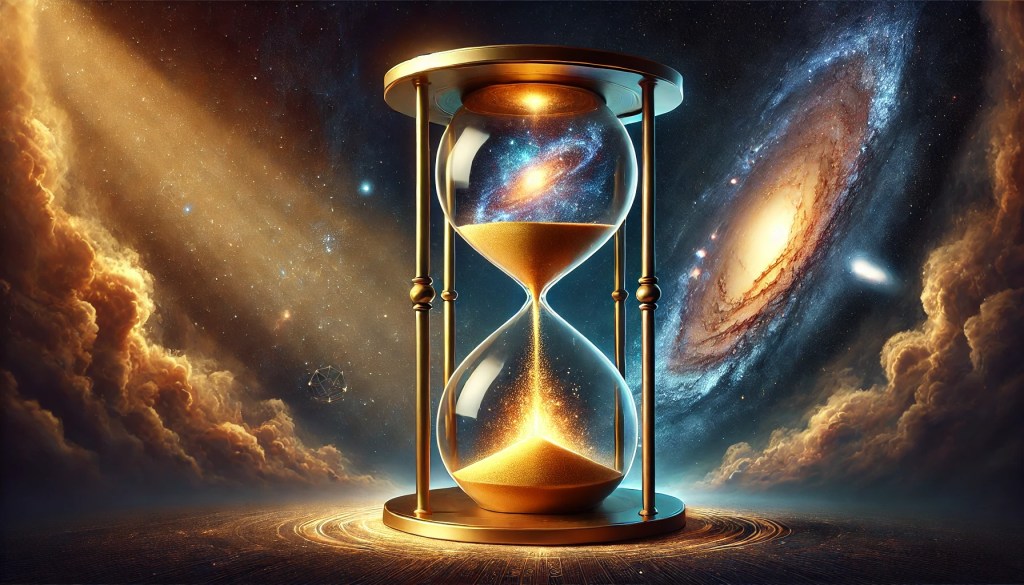
Imagine condensing the entire 13.8-billion-year history of the universe into a single calendar year. This thought experiment is what Carl Sagan called the Cosmic Calendar, a way to help us grasp the staggering scale of time.
In this model, the universe begins in a brilliant flash on January 1st—the Big Bang. In an instant, space and time come into existence, expanding at an unimaginable rate. The first subatomic particles emerge, and within minutes, simple atoms like hydrogen and helium form. But for a long time, the universe is a dark, hot soup of particles.
It isn’t until late January that the first stars begin to shine, ending the cosmic ‘dark ages.’ These stars burn hot and fast, living and dying in massive explosions that forge heavier elements—carbon, oxygen, iron—the building blocks of everything to come.
As these early stars explode, their remnants gather into swirling collections of gas and dust, forming the first galaxies. By early March, our own Milky Way galaxy is taking shape, a faint, developing spiral in a vast and growing cosmic ocean.
Throughout March, April, and May, galaxies are colliding and merging, forming immense clusters and superclusters. Black holes grow at their centers, shaping the evolution of entire galaxies. The chemistry of the universe is becoming richer, with heavier elements seeding future planets and, one day, life itself.
By June, our galaxy is a dynamic place, filled with young and ancient stars alike. But our Sun? It doesn’t exist yet. Many generations of stars have lived and died, creating the ingredients needed for planets like Earth. The stage is being set, but our solar system is still billions of years away.
Then, in early August, something remarkable happens—our Sun ignites. A vast cloud of gas and dust collapses under gravity, forming the familiar fiery sphere at the heart of our solar system. Around it, a swirling disk of leftover material begins clumping together, forming the first rough outlines of planets.
By mid-August, these young planetary bodies are colliding and reshaping themselves, forging the rocky worlds and gas giants we know today. Earth is still a molten, hostile landscape, bombarded constantly by asteroids and comets.
Finally, on September 6th, Earth itself is born. At this point, it’s a seething, volcanic world with no breathable atmosphere, no oceans—just a fiery, chaotic planet in the making. Over the next few days, the Moon forms, likely from a massive collision between Earth and a Mars-sized object. This impact sets our planet spinning and tilts its axis, giving us the seasons we experience today.
Just more than two weeks later, on September 21st, something extraordinary happens — life appears. The first single-celled organisms emerge in the oceans, setting off a slow but profound chain of evolution. These microscopic life forms will dominate the planet for billions of years, gradually transforming Earth’s atmosphere by producing oxygen.
Yet, for all of October and November, life remains simple—just bacteria and other single-celled organisms. The planet itself undergoes dramatic changes: continents drift, volcanoes erupt, and ice ages come and go. But for now, there are no plants, no animals, no complex ecosystems—just tiny, unseen life quietly reshaping the world.
By mid-December, Multicellular life emerges and simple sea creatures begin appearing in Earth’s oceans. Some days later, The first fish evolved, followed by land plants. A few more days pass and amphibians crawl onto land; reptiles evolve. Dinosaurs appear on December 26th and rule the planet for millions of years.
Then, on December 30, a giant asteroid strikes Earth, wiping out the dinosaurs.
On the very last day of this theoretical Cosmic Calendar, human ancestors finally appear in the late afternoon. As the hours tick down, early humans learn to make tools, harness fire, and form civilizations. And then, in just the last 14 seconds before midnight, recorded history begins—every empire, every discovery, every moment of art and science that defines our world today.
Everything we’ve experienced from the Renaissance to the Space Age all happens in the last fraction of a second before the New Year.
In this vast cosmic timeline, our existence as a species is barely a blink. But that blink represents something greater: We are the universe becoming aware of itself, gazing at the stars, asking questions, and celebrating the wonders of the cosmos. At the end of the day, that’s what Star Trails is all about.
[MUSIC]
If you found this episode useful, let me know, and feel free to send in your questions and observations. The easiest way to do that is by visiting our website, startrails.show. This is also a great way to share the show with friends. Until next time, keep looking up and exploring the night sky. Clear skies, everyone!
Support the Show
Connect with us on Mastodon @star_trails or on Bluesky @startrails.bsky.social
If you’re enjoying the show, consider sharing it with a friend! Want to help? Buy us a coffee!
Podcasting is better with RSS.com! If you’re planning to start your own podcast, use our RSS.com affiliate link for a discount, and to help support Star Trails.


Leave a Reply