The Snow Moon & The Pale Blue Dot: A Cosmic Perspective – Star Trails: A Weekly Astronomy Podcast
Episode 51
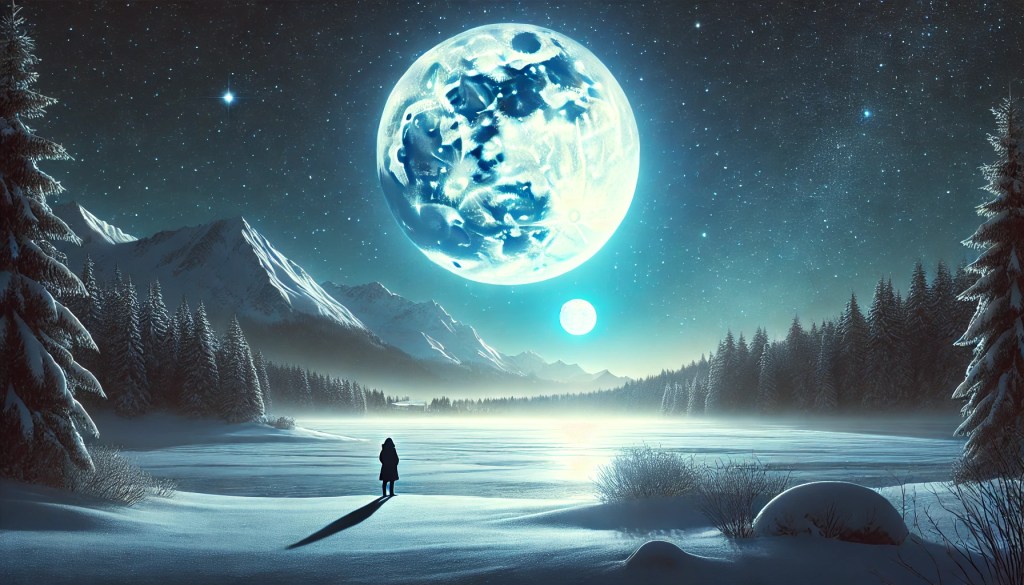
This week on Star Trails we explore the Snow Moon, February’s luminous full moon, and uncover the fascinating folklore behind its many names. Then, we turn our gaze to some lesser-known wonders—Camelopardalis, the Giraffe, and Monoceros, the Unicorn—two faint but remarkable constellations hiding celestial treasures.
Later in the episode we roll back the clock to February 14, 1990, and revisit one of the most profound images in human history: The Pale Blue Dot. From billions of miles away, Voyager I captured Earth as a mere speck—a poignant reminder of our fragile existence in the vast cosmos.
Finally, we zoom out, exploring the staggering scale of the universe—from our solar system to the edge of the observable universe, where galaxies form a cosmic web stretching beyond imagination.
Transcript
[MUSIC]
Howdy stargazers and welcome to this episode of Star Trails. I’m Drew, and I’ll be your guide to the night sky for the week starting February 9th through the 15th.
This week we’re rolling back the clock to 1990, when Voyager 1 looked back and captured i’s final series of images – a poignant family portrait of our solar system. Also, in last week’s episode we examined the scale of time as it relates to the vast age of our universe. This week, we’re bringing the nearly unimaginable size of our universe into perspective.
But first, let’s start with what you can see from your backyard this week, so, grab a comfortable spot under the night sky, and let’s get started!
Tonight the Moon will be in its Waxing Gibbous phase, about 90% illuminated. This phase continues until the Full Moon on February 12th, known as the “Snow Moon.” We’ll end the week in a Waning Gibbous phase.
The Snow Moon is the traditional name for the full moon that occurs in February. The name originates from Native American, Anglo-Saxon, and European folklore, recognizing February as the month with the heaviest snowfall in the Northern Hemisphere. In many regions, February is the coldest and harshest time of the year, making the Snow Moon a fitting title for this celestial event.
Interestingly, this moon took on some unique names in other cultures. It’s been called the “Hunger Moon” by many Native American tribes, particularly the Algonquin, because harsh winter conditions made hunting difficult, leading to food shortages. For similar reasons, it’s also known as the “Bony Moon” or “Little Famine Moon” in some Indigenous cultures.
Some tribes, such as the Cree, call it the Bear Moon, because February marks the time when bear cubs are typically born in their dens.
While this moon will wash out dimmer objects this week, the planets are still putting on a show.
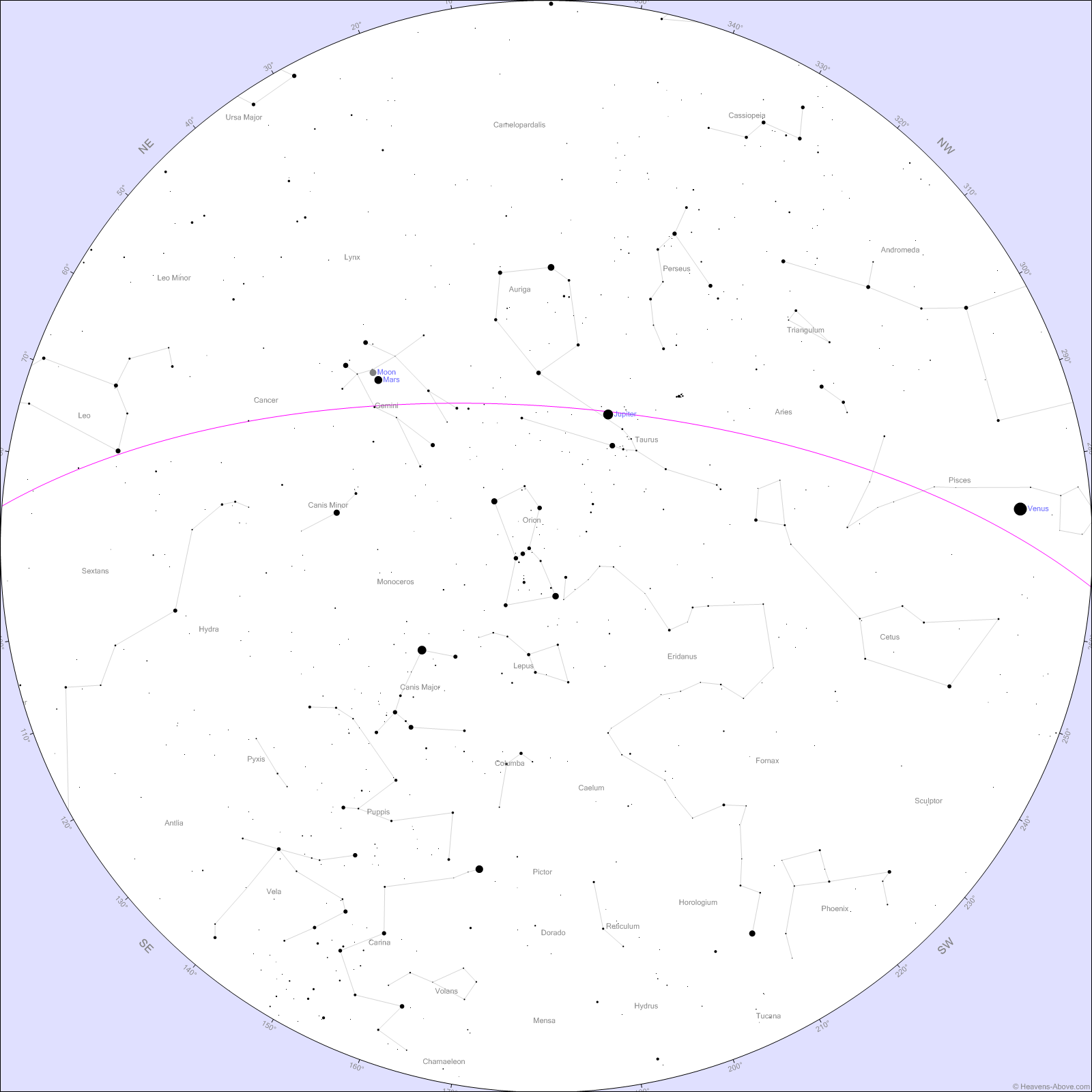
Venus shines brilliantly in the western sky after sunset. It will reach its peak brightness on the 16th, making it a stunning evening star throughout our week.
Mars is visible in the evening sky, and will have a close encounter with the Moon tonight. Look towards the east after sunset to witness this conjunction near the twin stars of Gemini, Castor and Pollux.
Jupiter continues dominating the early evening sky. It can be seen high overhead after sunset, and it’s visible until the early morning.
Saturn is still visible in the western sky after sunset, but it’s gradually descending towards the horizon. It will become more difficult to observe in the coming weeks.
[Transition FX]
I always like to make note of some of the lesser-known constellations – we’ve covered winter favorites like Gemini and Orion extensively in recent episodes – so this week I thought we’d look at two whimsical constellations,Camelopardalis and Monoceros.
Camelopardalis, the Giraffe, is a large but faint constellation that sprawls across the northern sky. Despite its size, it has no particularly bright stars, making it difficult to spot with the naked eye. Its name comes from the Latin words for “camel” and “leopard,” as ancient observers thought giraffes resembled a mix of these two animals.
This constellation is home to NGC 2403, a spiral galaxy that resembles a miniature version of the Andromeda Galaxy. This galaxy is around 8 million light-years away and is visible in small telescopes.
Binocular observers may want to track down Kemble’s Cascade, a string of stars forming a diagonal line.
Across the sky we find Monoceros, the Unicorn, a dim but fascinating constellation located between Orion, Canis Major, and Gemini. It was first documented in the 17th century and lacks bright stars, making it challenging to locate without a star chart.
This constellation is home to the Rosette Nebula. This massive region of ionized hydrogen gas is home to a young open cluster of stars. It’s best seen with astrophotography or large telescopes, but a faint glow can sometimes be seen through binoculars.
This region also contains the Christmas Tree Cluster, an open star cluster shaped like a holiday tree. Also, be on the lookout for Beta Monocerotis: A triple-star system that can be resolved in a small telescope.
Although the bright moon this week may hamper observations, these two constellations offer up some nice targets when skies are darker.
[Transition FX]
Do you remember where you were on February 14, 1990? I was a freshman in high school. Maybe some of you weren’t born yet. On that date, Voyager 1 took a “family photo” of our solar system? While many folks were celebrating Valentine’s Day, for those who look up to the cosmos, that day marked something truly extraordinary: humanity captured an image that changed how we see ourselves.
The image is a mosaic of our solar system. One frame in particular would go on to become iconic: the Pale Blue Dot. From a distance of about 3.7 billion miles, Earth appeared as a tiny speck, less than a pixel in size, suspended in a beam of scattered sunlight. It showed how small and fragile our planet looked—just a faint dot adrift in the vast cosmic ocean.
The idea for the image was proposed by Carl Sagan, who believed this portrait of our solar system could be a profound reminder of our place in the cosmos. In his now-famous words, Sagan described Earth as ‘a mote of dust suspended in a sunbeam,’ reminding us that everything we’ve ever known—all of human history, every triumph and tragedy—has unfolded on that tiny dot.
On Valentine’s Day, 1990, as Voyager 1 prepared to leave the solar system, NASA engineers sent a command to the spacecraft to turn its camera around and take one last look back, capturing six of the solar system’s planets: Venus, Earth, Jupiter, Saturn, Uranus, and Neptune. Mercury was too close to the Sun to be seen, and Mars didn’t make the cut due to unfavorable lighting conditions.
The Sun itself had to be carefully managed in the image to avoid damaging Voyager’s sensitive camera. This resulted in an unintended consequence: Earth appeared in a ray of scattered sunlight—a cosmic coincidence that gives the photo an almost spiritual quality.
Earth is tiny in this mosaic—barely larger than a 10th of a pixel in the rendering. From a distance of 3.7 billion miles Voyager’s camera had to use a narrow-angle lens and extreme precision to even spot Earth in the void.
The photo was taken with three color filters: blue, green, and violet. These were combined to create the final image, but even with the filters, the result wasn’t about vibrant detail—it was about perspective. Earth’s faint presence emphasized just how vast and dark space truly is, with our home planet adrift in an endless void.
The full ‘family portrait’ also holds symbolic weight. It’s the only time in history that we’ve captured an image of the solar system in this way. By 1990, Voyager 1, now years past its mission to study Jupiter and Saturn, was speeding out of the solar system at nearly 40,000 miles per hour, and this was its final look back before its camera was permanently turned off to conserve power.
While the “Pale Blue Dot” is the most famous image from the mosaic, each frame in the mosaic tells a story. Saturn, for instance, appeared as a soft golden orb surrounded by its majestic rings. Jupiter, with its immense size, dominated its frame. And Neptune and Uranus, captured as faint, icy-blue dots, hinted at the mysteries of the outer planets.
Today, Voyager 1 is the farthest human-made object from Earth, carrying its golden record as a message for any intelligent life it might encounter. And yet, its most powerful legacy might be that small image of Earth.
[TRANSITION FX]
With that, let’s take a journey—from our tiny corner of the solar system to the edge of the observable universe, and learn more about scale and the vastness of our galaxy and the universe itself.
Before we start, let’s talk about why scale is so important. Imagine the Sun is the size of a grapefruit. If that’s the case, how far away do you think Earth would be? At this scale, Earth would be a tiny grain of sand about 50 feet away. That’s the length of a school bus! And Neptune, the farthest planet from the Sun, would be a marble 1,500 feet away, a little more than a quarter of a mile!
This analogy shows just how much empty space there is in our solar system. And believe it or not, this is just the beginning of the story. The universe is so vast that even astronomers struggle to wrap their heads around it. So, let’s start small and work our way up.
Let’s begin close to home—our solar system. At the center is the Sun, a star so massive that it makes up 99.8% of the solar system’s total mass. It’s about 864,000 miles across. That’s so big you could fit 1.3 million Earths inside it!
The Earth orbits the Sun at an average distance of 93 million miles. We call this distance one astronomical unit, or AU. But here’s where it gets wild: Neptune, the farthest planet from the Sun, is 30 AU away. That’s 2.8 billion miles!
And here’s another way to think about it: light from the Sun takes 8 minutes to reach Earth. But it takes more than 4 hours to reach Neptune. That means when you look at Neptune through a telescope, you’re seeing it as it was 4 hours ago. And that’s just within our solar system!
Now, let’s zoom out a bit. The nearest star to our Sun is Proxima Centauri, part of the Alpha Centauri system. It’s 4.24 light-years away. That’s 25 trillion miles!
To put that in perspective, if the Sun were a grapefruit in New York City, Proxima Centauri would be another grapefruit in Los Angeles. That’s how much empty space there is between stars.
And Proxima Centauri is just our next-door neighbor. Our galaxy, the Milky Way, contains 100 to 400 billion stars, and it’s about 100,000 light-years across. Our solar system is located in one of the Milky Way’s spiral arms, about 27,000 light-years from the galactic center.
If the Milky Way were the size of a football field, our solar system would be a tiny speck on the 10-yard line.
Of course, the Milky Way is just one galaxy among billions. Our nearest galactic neighbor is the Andromeda Galaxy, which is 2.5 million light-years away. That means the light we see from Andromeda today left around the time early humans were first walking the Earth.
Andromeda is part of a small group of galaxies called the Local Group, which includes about 54 galaxies. But even the Local Group is just a tiny part of a much larger structure called the Virgo Supercluster, which contains more than 100 galaxy groups and spans 110 million light-years.
And here’s the kicker: the Virgo Supercluster is just one of countless superclusters in the universe. These superclusters form a vast cosmic web, with galaxies strung along filaments like pearls on a necklace. The scale is almost impossible to comprehend.
Now, let’s zoom out even further—to the observable universe. This is the part of the universe we can see from Earth, and it’s about 93 billion light-years across. Scientists think the universe is around 13.8 billion years old, so how can the universe be 93 billion light-years across?
That’s because the universe is expanding. Space itself is stretching, carrying galaxies along with it. So, the light from distant galaxies has traveled much farther than we might expect.
The observable universe contains an estimated 2 trillion galaxies, each with billions or even trillions of stars. If the observable universe were the size of Earth, the Milky Way would be the size of a postage stamp.
Here’s something to ponder: When astronomers look at the most distant galaxies, they’re seeing them as they were billions of years ago, not long after the Big Bang. One of the most humbling images in astronomy is the Hubble Deep Field. In 1995, the Hubble Space Telescope pointed at a tiny, seemingly empty patch of sky—about the size of a grain of sand held at arm’s length. What it revealed was astonishing: thousands of galaxies, each containing billions of stars. And that’s just in one tiny corner of the sky.
Another mind-boggling fact: our galaxy, along with countless others, is being pulled toward a mysterious region called the Great Attractor, located about 220 million light-years away. We don’t fully understand what’s causing this gravitational pull, but it’s a reminder of how much we still have to learn about the universe.
But even with modern tools like Hubble, the true scale of the universe is almost beyond comprehension. And that’s part of what makes astronomy so awe-inspiring. The fact that we can observe, measure, and even begin to understand the scale of the universe is a testament to human curiosity and ingenuity, and helps connect us in a very real way to the rest of the cosmos.
[MUSIC]
If you found this episode useful, let me know, and feel free to send in your questions and observations. The easiest way to do that is by visiting our website, startrails.show. This is also a great way to share the show with friends. Until next time, keep looking up and exploring the night sky. Clear skies, everyone!
Support the Show
Connect with us on Mastodon @star_trails or on Bluesky @startrails.bsky.social
If you’re enjoying the show, consider sharing it with a friend! Want to help? Buy us a coffee!
Podcasting is better with RSS.com! If you’re planning to start your own podcast, use our RSS.com affiliate link for a discount, and to help support Star Trails.
 Star Trails: A Weekly Astronomy Podcast
Leave a comment