When Galaxies Collide – Star Trails: From Backyard Astronomy to Cosmic Wonder
Episode 111
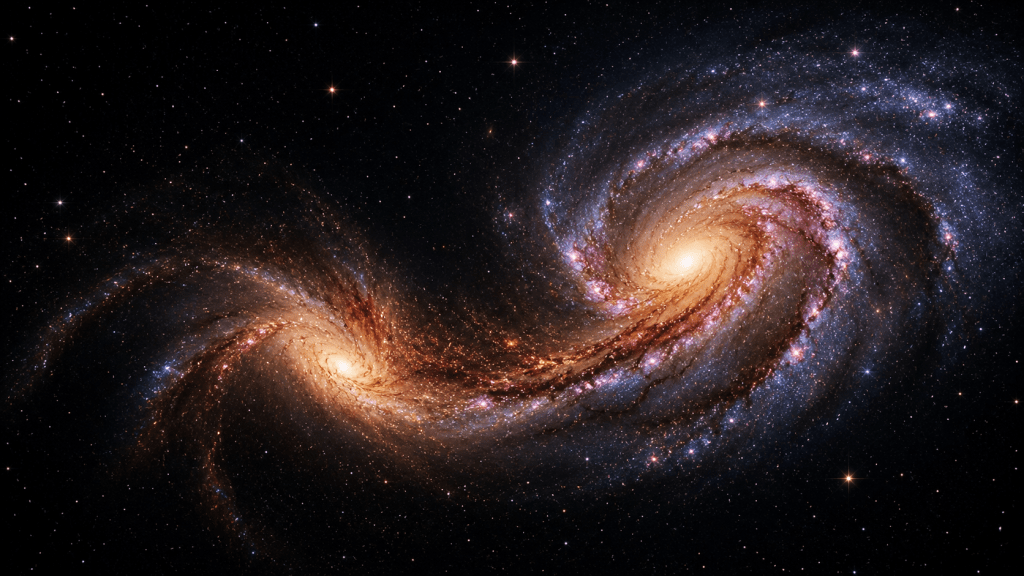
This week we continue our month-long journey through the world of galaxies, but this time, we move beyond what galaxies are and explore what galaxies actually do. It turns out these vast islands of stars are anything but static. They collide, merge, exchange gas and dust, fling stars into deep space, and sometimes grow by consuming smaller neighbors in a process astronomers call galactic cannibalism.
We begin close to home with the Sagittarius Dwarf Spheroidal Galaxy, a hidden companion galaxy currently being torn apart by the gravity of our own Milky Way. From there, we travel some 70 million light-years away to the spectacular Antennae Galaxies, where two spiral galaxies are locked in a slow-motion collision that is both destructive, and strangely creative.
Along the way, we recall my recent conversation with astrophysicist Enrique López Rodríguez to explore the possibility of magnetic bridges and “superhighways” carrying gas, dust, and charged particles between galaxies, raising the astonishing possibility that the raw ingredients of future planets may sometimes originate far beyond their home galaxy.
And finally, we return to the question we teased last week: What about us? Is the long-predicted collision between the Milky Way and the Andromeda Galaxy still inevitable? New observations from Hubble Space Telescope and Gaia suggest the answer may be far less certain than we once believed.
We’ll also check in with this week’s night sky, and wrap up our discussion of NightWatch.
Transcript
Howdy stargazers and welcome to this episode of Star Trails. My name is Drew and I’ll be your guide to the night sky for the week of May 10th to the 16th.
This week, we continue our journey through the world of galaxies, not by asking what galaxies are… but by asking what galaxies actually do. We’ll explore how galaxies collide, eat smaller neighbors, fling stars into the darkness between galaxies, and even exchange material across intergalactic space. Along the way, we’ll revisit the evolving story of the Milky Way and the Andromeda Galaxy, and discover that what many of us thought was our galaxy’s inevitable fate, may not be written in stone after all.
Later in the show, we’ll wrap up our long-delayed Star Trails book club discussion of NightWatch, and we’ll step outside together for this week’s night sky report, where a waning Moon gives way to darker skies, spring galaxies overhead, and a predawn meeting between the Moon, Mars, and Saturn.
Whether you’re tuning in from the backyard or the balcony, I’m glad you’re here. So grab a comfortable spot under the night sky, and let’s get started!
Before we kick off this week’s discussion, I wanted to back up and revisit something from last week’s episode. A listener mentioned to me that he was surprised to learn the Milky Way is a barred spiral galaxy, as opposed to a “normal” spiral.
Many of us may have had the same thought, because I distinctly remember seeing artists’ illustrations of it in books through the years: The Milky Way as a graceful pinwheels of stars and dust, none featuring a central bar.
This isn’t a false memory, because the bar at the center of our Milky Way is fairly recent discovery.
Astronomers suspected the Milky Way might be barred as early as the 1960s, based on stellar motions and radio observations of gas near the galactic center. But because we live inside the galaxy, and because the galactic core is buried behind thick dust clouds, it’s incredibly difficult to map our own structure directly.
The real breakthrough came with infrared observations, especially from the Spitzer Space Telescope. Infrared light can penetrate dust far better than visible light, allowing astronomers to see through the crowded core. By the mid-2000s, Spitzer’s GLIMPSE survey helped confirm that the Milky Way contains a large central stellar bar, making the “barred spiral” classification much more secure.
In my chat with this listener, we both wondered how something like a straight bar shape could be formed in space. It turns out cosmology is weirder than I thought.
Bars do seem to arise from gravity and rotation, but in a novel way. Over time, if a galactic disk becomes unstable, stars can begin settling into elongated orbits near the center. Instead of orbiting in a neat circular path, many stars begin moving in coordinated stretched paths. If enough stars start moving in these long narrow orbits, a bar pattern eventually emerges.
And it’s not just decorative. These bars act like gravitational conveyer belts, channeling gas inward toward the galactic center, which can trigger star formation, feed the central black hole, and further shape spiral arms. The bar becomes one of the engines that helps a galaxy evolve.
Spiral and barred spirals are two of the main galaxy types. Both feature a flat rotating disc, spiral arms and ongoing star formation. Barred spirals are different in that the spiral extend from the bar, rather than the central disc. And we think about two-thirds of the spiral galaxies in the nearby universe have bars, making them more common than plain spirals.
These grand design spirals are quite different from the other galaxy types we see.
Elliptical galaxies resemble eggs in space. They tend to have older stars, very little gas and dust, and little new star formation. The two satellite galaxies we see in images of Andromeda are good examples of these.
Then we have irregular galaxies, which defy any firm categorization. They can be distorted by gravity, rich in star formation, and are chaotic or asymmetric in appearance. Our satellite galaxy, the Large Magellanic Cloud is a good nearby example.
With that, let’s turn to this week’s main topic, because these galaxies aren’t just out there looking pretty. On the contrary, they can be quite violent.
As we closed the last episode, I left you with a teaser. One day, perhaps four, five, or even ten billion years from now, our own Milky Way may have a close encounter, or even a full collision, with our giant neighboring galaxy, Andromeda.
Galaxies aren’t isolated objects. They move. They evolve. They interact. They steal from one another. They fling stars into deep space. They exchange matter across unimaginable distances. And sometimes, in the glacial language of gravity, they consume one another entirely.
When we look at those breathtaking images released by NASA, the European Space Agency, or the Hubble Space Telescope, galaxies often appear peaceful. Elegant pinwheels of starlight, suspended in darkness, frozen in time, as though they’ve always existed in exactly the shape we see them now. But that image is misleading.
Galaxies are dynamic ecosystems, vast gravitational cities made of hundreds of billions of stars, clouds of gas, dust rich in heavy elements, dark matter halos we cannot directly see, and invisible magnetic structures threading through it all. And like cities, or perhaps like civilizations, galaxies have histories. They grow. They change. They carry scars. And one of the strangest things astronomers have discovered is that many of the largest galaxies in the universe appear to have grown not just by forming stars, but by consuming smaller galaxies around them.
Astronomers call this galactic cannibalism. And as dramatic as that sounds, it’s not that rare. Our own galaxy is doing it right now.
Orbiting the Milky Way is a small companion called the Sagittarius Dwarf Spheroidal Galaxy, and it wasn’t even discovered until 1994. Think about that for a moment. We’ve studied the sky for thousands of years. We’ve charted constellations, built observatories, landed on the Moon, and sent probes beyond the outer planets. And yet an entire neighboring galaxy remained hidden from us until the 1990s.
That’s because Sagittarius lies almost directly behind the crowded and dusty central regions of our own galaxy, hidden among the star clouds of the Milky Way’s core, essentially camouflaged by our own structure.
The Sagittarius Dwarf is a small, faint, ancient kind of galaxy known as a dwarf spheroidal. It’s only about ten thousand light-years across, tiny compared to the Milky Way’s hundred-thousand-light-year span, and it contains mostly older stars, with very little fresh gas or active star formation left.
If the Milky Way is a great ocean liner crossing a dark cosmic sea, Sagittarius is more like a small raft that wandered too close and got sucked into the ship’s propeller. And over billions of years, the Milky Way’s gravity has been pulling it apart, slowly stretching it, star by star, until those stars begin to drift free of their home.
Today, astronomers can actually trace those lost stars. They form what’s known as the Sagittarius Stream, enormous rivers of stars wrapping around the Milky Way like ghostly ribbons, some of them looping around our galaxy multiple times. These stars once belonged to Sagittarius. Now they’ve become part of our galaxy’s halo, their original home slowly being dismantled around them. And the story gets even stranger.
Data from the Gaia mission suggests that Sagittarius may have plunged through the disk of the Milky Way multiple times in the distant past, and those encounters may have sent ripples through our galaxy itself, waves of stars moving up and down through the galactic disk, almost like dropping a stone into a pond. So this little galaxy isn’t just being destroyed by the Milky Way. It may have left scars on our galaxy in the process.
And if you want to see what a larger galactic collision looks like, astronomers don’t have to rely on simulations or theory. We can actually see it happening. About seventy million light-years away, in the direction of the constellation Corvus, lies one of the most spectacular galactic train wrecks in the observable universe: the Antennae Galaxies.
These are two spiral galaxies, once separate, now locked in a gravitational encounter that has been unfolding for hundreds of millions of years. And if you’ve ever seen an image of them, the name makes sense. Gravity has stretched their spiral arms outward into enormous tidal tails, vast streams of stars, gas, and dust extending hundreds of thousands of light-years into intergalactic space. Distances so vast the human mind almost refuses to process them.
And yet what’s happening inside those galaxies may be even more beautiful than the destruction we can see from the outside. It’s hard to believe, but when galaxies collide, stars almost never hit each other directly. The space between stars is simply too immense. Instead, gravity reshapes everything else.
Clouds of hydrogen gas collide. Dust compresses. Regions collapse under their own weight. And suddenly, in the middle of all that chaos, new stars begin to form. The Antennae Galaxies are, in many ways, a giant stellar nursery where entire clusters containing millions of newborn stars are being ignited in a beautiful paradox: Creation born directly from destruction.
But stars aren’t the only things galaxies exchange. When galaxies interact, entire clouds of gas can be pulled loose. Dust rich in carbon, oxygen, silicon, and iron, the elements forged in ancient stars, can be flung far beyond the visible boundaries of a galaxy. And woven invisibly through all of it are magnetic fields.
Galaxies possess magnetic fields stretching across thousands, and sometimes tens of thousands, of light-years. These invisible structures help guide charged particles, influence the movement of gas, and may even help determine where future generations of stars are born.
A few weeks ago here on Star Trails, we had the privilege of speaking with astrophysicist Enrique López Rodríguez, whose work is helping astronomers map these invisible magnetic structures. And it turns out those magnetic fields may extend even beyond the galaxies themselves.
Right here in our cosmic neighborhood, the Large and Small Magellanic Clouds appear to be connected by something called the Magellanic Bridge, a stream of gas, dust, young stars, and possibly a shared magnetic field stretching roughly seventy-five thousand light-years through intergalactic space.
And farther out, in violent mergers like the system known as Arp 220, astronomers, including Dr. Rodríguez himself, have found evidence of what some researchers have described as a magnetic superhighway. Invisible structures guiding gas, plasma, dust, and charged particles through the wreckage of colliding galaxies.
Since these structures are called superhighways, I was curious to understand exactly how fast material could be racing along them. If you recall Maxwell’s equations, magnetism does propagate at the speed of light. But in general, matter following a magnetic field gets nowhere close to the speed of light.
For example, in Arp 220, some of the outflowing material was measured at around 1 million miles per hour. That sounds fast, and it is, but it’s only about 0.17% of the speed of light. That’s nowhere near relativistic.
However things get more interesting at the quantum level. Individual particles, especially cosmic rays like electrons or protons, can move much faster, sometimes very close to the speed of light. And they spiral around magnetic field lines in corkscrew-like paths.
And that leads to one of my favorite thoughts in this entire series. We often say, as Carl Sagan famously reminded us, that we are made of star stuff. But on the largest scales, some of that star stuff may not even be native to its own galaxy. The iron in a future planet, the carbon in some distant atmosphere, the silicon in an alien mountain range, may have begun its journey in the death of a star a long time ago, in a galaxy far, far away. My apologies to George Lucas.
If gas and dust can be bounced out of a galaxy, it only makes sense that stars can suffer the same fate. Some stars are flung outward by gravity itself, accelerated by galactic mergers, tidal interactions, or close encounters with supermassive black holes.
Astronomers call some of these hypervelocity stars. They are moving so fast they can escape their galaxies entirely. Imagine a star born beneath the glow of billions of neighboring suns, spending millions or billions of years as part of a galactic family, only to be thrown clear of its home forever, exiled into the darkness between galaxies.
Which brings us back to the question we teased last week. What about us? What about the Milky Way and Andromeda? Even if you think heard this story before, listen on, because the science is changing.
For decades, astronomers believed the ending was already written. In roughly four to five billion years, the Milky Way and Andromeda would collide, merge, and eventually become one giant galaxy, sometimes nicknamed Milkomeda.
It was one of those cosmic facts people repeated with absolute confidence. But science kept observing. And newer measurements from Hubble and Gaia have changed the story. That collision may no longer be inevitable. Right now, some of the best models suggest something closer to a fifty-fifty chance over the next ten billion years. And I love that. Because it reminds us, even on the scale of galaxies, the future may still be unwritten.
Will Andromeda collide with us? Will it pass close enough to tear at our spiral arms before drifting away? Or will gravity eventually pull both galaxies into one final, slow-motion embrace?
The truth is, we’re still learning. But if that collision does happen, the night sky of some unimaginably distant future Earth, or whatever remains of it, would be extraordinary. Andromeda would slowly grow larger over millions of years, eventually spanning huge portions of the sky.
Spiral arms would stretch. Stars would be flung into intergalactic space. Clouds of gas would collapse into new generations of suns. And at the hearts of both galaxies, two supermassive black holes, would begin an even slower dance, spiraling toward one another over hundreds of millions of years until, eventually, they too may merge.
After a quick break we’ll be back with this week’s sky, and we’ll wrap up our book club discussion on Nightwatch. Stay with us.
Welcome back.
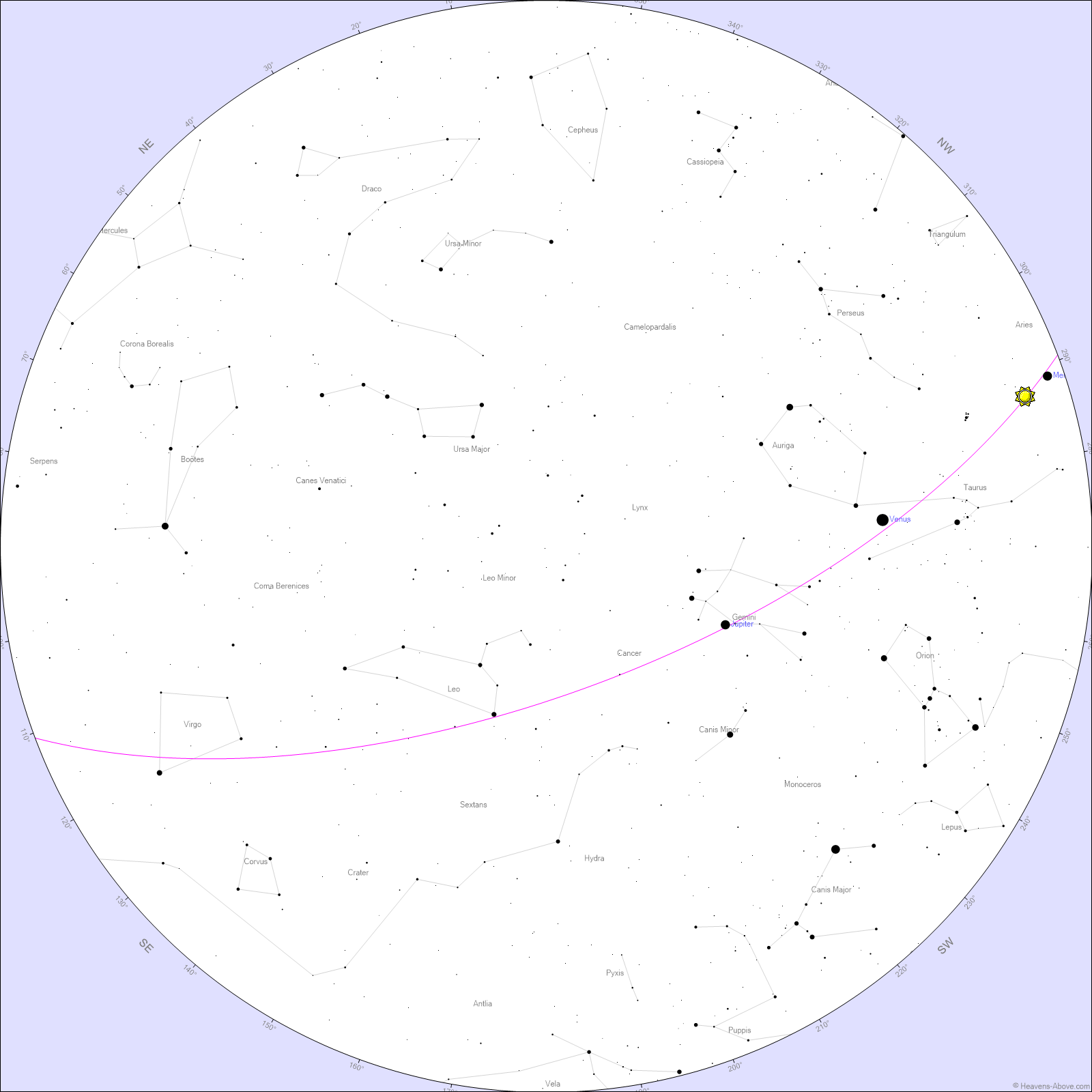
As we move into this week, the Moon is finally beginning to get out of our way, and for deep sky observers, that’s always welcome news. We begin the week just after last quarter moon, so each night the Moon will rise later and appear thinner, slipping into a graceful waning crescent as the week unfolds. By the evening of May 16th, we arrive at new moon, giving us some of the darkest skies of the month. If you’ve been waiting for a serious observing session, this is your window.
Planet-wise, the western sky after sunset remains home to a nice pairing. Venus is still dominating the early evening, shining like an unmistakable beacon in the twilight. Its brightness literally stopped me in my tracks last night.
Nearby, Jupiter is also hanging in the western sky, lower now than it was earlier in the season, but still bright enough to command attention. The two giants are slowly drawing closer together as the month progresses, making for a lovely naked-eye scene if you catch them shortly after sunset. Farther along in the week, before dawn, both Mars and Saturn begin to creep back into view for early risers, sitting low in the eastern sky as morning twilight approaches.
Now let’s talk deep sky, because with darker skies returning, this is a wonderful week to revisit some of spring’s lesser-talked-about treasures.
First, point your scope toward the constellation of Coma Berenices and seek out the Black Eye Galaxy, Messier 64. Through a modest backyard telescope, it appears as a soft oval glow, but with larger aperture and dark skies, you may begin to notice the feature that gives it its name—a dark dust lane crossing one side of the galaxy’s core, almost like a cosmic bruise. This galaxy lies roughly 17 million light-years away and is one of spring’s most underrated galaxy targets.
Next, if you’re looking for something a little more challenging, turn toward the constellation Canes Venatici and find the Whirlpool Galaxy. We’ve touched on galaxy structure recently, but if this week’s episode is about what galaxies do, M51 feels especially appropriate. This famous interacting galaxy pair is one of the clearest examples of a spiral galaxy being gravitationally influenced by a companion. Under dark skies, even smaller telescopes may reveal its bright core and companion galaxy, while larger scopes can tease out hints of the spiral arms.
For something a little different, try the Owl Cluster in the constellation Cassiopeia, also nicknamed the E.T. or Dragonfly Cluster. This isn’t a galaxy, but a nice open cluster that can be fun for beginners. Two brighter stars form what looks like glowing eyes, with fainter stars creating wings or outstretched arms depending on your imagination.
And if you’re out very late this week, or up before dawn under truly dark skies, something else begins to return, the bright core of the Milky Way itself. By mid-May, especially near new moon, the summer Milky Way starts climbing in the southeastern sky during the pre-dawn hours. This is one of the first real hints that summer observing season is on the way, and if you’re far from city lights, you may begin to notice those rich star clouds, dark dust lanes, and the crowded regions near the constellations Sagittarius and Scorpius beginning to reappear.
As for special events this week, the Eta Aquariid meteor shower, born from the debris of Halley’s Comet, peaked last week, but don’t give up just yet. A few stragglers may still be visible before dawn during the early part of this week, especially now that the Moon is becoming less intrusive. These meteors tend to be swift and graceful, entering Earth’s atmosphere at around 65 kilometers per second.
And one final celestial treat this week comes before dawn on the morning of May 13th. If you’re willing to set the alarm a little early and find a clear eastern horizon, you’ll be rewarded with a beautiful little planetary gathering. A thin crescent Moon, just a delicate sliver of light, will appear beside Saturn and Mars in the morning twilight. All three objects should fit comfortably in binoculars, making for a lovely little cosmic tableau. Saturn will shine with a steady golden light, Mars with its softer reddish glow, and between them, the fading crescent Moon, quietly escorting both planets into the dawn.
As we close out our journey through NightWatch, the final chapters of the book feel like an invitation to stop studying the sky and begin building a personal relationship with it.
In Chapter 10, Comets, Meteors, and Auroras, author Terence Dickinson shifts our attention away from the fixed architecture of the night sky, and toward something more fleeting. A meteor flashing overhead and vanishing in an instant. A comet slowly brightening over the course of weeks, sometimes becoming a binocular object, and occasionally, if we’re lucky, a naked-eye spectacle.
And then there are auroras, perhaps the most emotional of all, where the sky itself seems to come alive. One of the things Dickinson does beautifully here, and he’s always been good at this throughout NightWatch, is reminding readers that not every astronomical experience requires gear. No telescope. No tracker. Sometimes your own eyes are enough. In a hobby that can occasionally become obsessed with equipment, I found that refreshing.
Now, I need to make a small confession here. I own the 4th edition of NightWatch, not the newer 5th edition, which means I actually missed out on some of the expanded astrophotography material in Chapter 11, particularly the newer contributions from astrophotographer Alan Dyer. And honestly, that’s a little painful, because from everything I’ve seen, the astrophotography updates in the new edition look excellent.
But even so, the photography sections in the edition I do own still reveal something important about the philosophy of this book. Dickinson and Dyer don’t treat astrophotography as some elite branch of astronomy reserved for people with observatory domes and five-thousand-dollar mounts. Instead, they present it as a natural extension of observing itself. You begin by looking up. Then maybe you put a camera on a tripod. Then perhaps you try a star tracker. Then one day, before you know it, you’re collecting photons from a galaxy twenty million light-years away.
And then we arrive at Chapter 12, Wonders of the Southern Heavens. After spending so much time helping northern observers learn their sky, Dickinson essentially says, “Now imagine an entirely different one.” Here we leave behind familiar northern anchors like Ursa Major and Cassiopeia, and instead travel far below the equator to encounter sights many of us in North America may never see firsthand. The Crux. The Large Magellanic Cloud. The Small Magellanic Cloud. Entire star fields and celestial landmarks that, to many of us, feel almost mythical. There are entire celestial cultures and perspectives waiting beyond our own horizon.
And before I wrap up this little book club, I do have one personal criticism, though perhaps that’s too strong of a word. I’ve said throughout this series how much I adore the photography, the illustrations, the charts, and the overall design of NightWatch. It’s a beautiful book. But there’s a practical part of me that wishes I could read it electronically. I’d love to have a Kindle version. I’d love to pull it up on my laptop while traveling, or read it in bed without needing to spread the book across a table under a bright reading lamp.
Of course, the irony is that one of the reasons an electronic version probably doesn’t translate easily is precisely because the physical book is so visually rich. The star charts, the photographs, the illustrations, they’re part of the experience. You spread it out. You flip back and forth. You compare charts. You lose yourself in the imagery.
I don’t have any ideas for future book club selections, but if this is something anyone would like me to continue, shoot me a message over at the show website and we can discuss it. I’ve always wanted to read Wrinkles in Time by George Smoot. It’s a book about cosmology, by one of the physicists who won a Nobel Prize studying the cosmic microwave background. If that sounds intriguing to you, let me know!
If tonight’s episode sparked your curiosity, or maybe gave you something new to think about the next time you look up, I’d be honored if you shared Star Trails with someone who might enjoy the journey. You can always find the latest episodes, show notes, and extras at startrails.show.
And if you’d like to help support the show, there’s also a little “buy me a coffee” link on the site. It genuinely helps keep these stories coming.
Be sure to follow Star Trails on Bluesky and YouTube — links are in the show notes. Until we meet again beneath the stars … clear skies everyone!
Support the Show
Connect with us on Bluesky @startrails.bsky.social
If you’re enjoying the show, consider sharing it with a friend! Want to help? Buy us a coffee! Also, check out music made for Star Trails on our Bandcamp page!
Podcasting is better with RSS.com! If you’re planning to start your own podcast, use our RSS.com affiliate link for a discount, and to help support Star Trails.


Leave a Reply