
Where the Milky Way Begins… and Ends – Star Trails: From Backyard Astronomy to Cosmic Wonder
Episode 110
This week, we begin a new month-long journey into one of the most awe-inspiring subjects in astronomy: galaxies.
We start close to home by exploring our own galaxy, the Milky Way, and asking a deceptively simple question: where does a galaxy actually end? Along the way, we’ll explore spiral arms, dark matter, supermassive black holes, the hidden structure of our galactic halo, and the faint ghostly glow of Integrated Flux Nebula, dust clouds illuminated by the combined light of billions of stars.
We’ll also discover why our solar system doesn’t align with the Milky Way the way you might expect, how astronomers mapped our galaxy from the inside using radio waves, and what the night sky might look like if the Milky Way simply vanished.
Later in the episode: I report on a backyard observation of Amazon’s recent Leo satellite launch, plus, this week’s night sky highlights, the Eta Aquariid meteor shower, Jupiter and Saturn, and a trio of deep-sky galaxies perfect for spring observing.
Transcript
Howdy stargazers and welcome to this episode of Star Trails. My name is Drew and I’ll be your guide to the night sky for the week of May 3rd to 9th.
This month we’re launching into a new topic: Galaxies. These are among the grandest structures in the universe, and perhaps the most complex. We’ll begin by examining the one we live in, the Milky Way.
Later in the show we’ll take a look at this week’s night sky, and I’ll share a quick observation report from a recent rocket launch I saw.
Whether you’re tuning in from the backyard or the balcony, I’m glad you’re here. So grab a comfortable spot under the night sky, and let’s get started!
Tonight, we’re going to try to do something that sounds simple at first, and then becomes increasingly difficult the longer you think about it. We’re going to try to find the edge of the Milky Way.
And as straightforward as that sounds, it leads us into one of the more unsettling realizations in astronomy, because the deeper we go, the harder it becomes to answer a question that feels like it should have a clean, satisfying solution: Where does a galaxy actually end?
If you step outside on a clear, dark night, far from city lights, you can see the Milky Way stretching across the sky as a faint, luminous band, a kind of celestial river made up of countless unresolved stars, soft and diffuse.
For most of human history, that glowing band was the galaxy, a feature of the sky rather than a place within it, something distant and decorative rather than something we were embedded inside.
But what we now understand is more disorienting, because that pale streak of light is not above us at all, it surrounds us, envelops us, and defines our position within a vast rotating system of stars, gas, and dust.
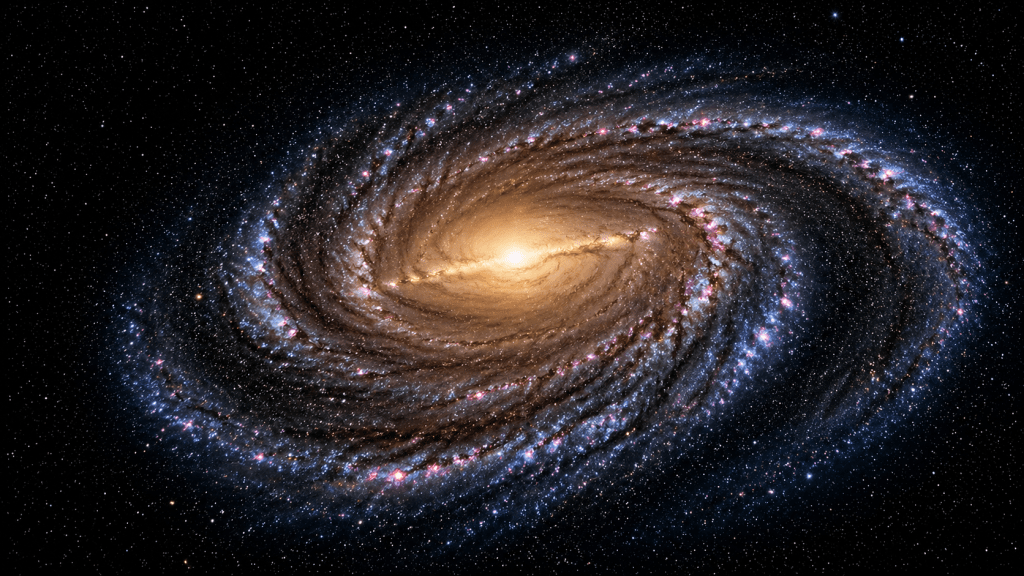
The Milky Way is what astronomers call a barred spiral galaxy, a structure that, if viewed from far enough away, would resemble a flattened disk with a bright central bar of stars stretching across its core, from whose ends long, sweeping spiral arms extend outward in graceful arcs, not as solid structures, but as regions where stars, gas, and dust are more concentrated.
Those spiral arms exist because of something called Density Wave Theory, which describes them not as fixed collections of stars, but as moving waves of higher density, something like cosmic traffic patterns through which stars and gas pass over time, so that the bright, blue stars we associate with spiral arms are really just temporary highlights, forming and fading as material moves through these regions. Also, the Milky Way is still making stars, forming roughly one to two solar masses worth of new stars every year, mostly within the spiral arms.
Our solar system lies in a minor spur known as the Orion Arm, about 26,000 light-years from the galactic center, orbiting at roughly 500,000 miles per hour. One trip around the Milky Way takes about 225 million years. To put that into perspective, the dinosaurs lived and died just in the last galactic year.
At this point, it’s tempting to assume something that feels almost obvious.
If the Milky Way is a flattened disk, formed by the rotation of a massive cloud of gas over billions of years, and if our solar system is also a flattened disk, formed by the rotation of a much smaller cloud of gas and dust, then surely those two disks should line up.
You might expect the planets to orbit along the same path traced by the Milky Way in our sky, as if the solar system were simply a smaller version of the galaxy itself. But that’s not what we see.
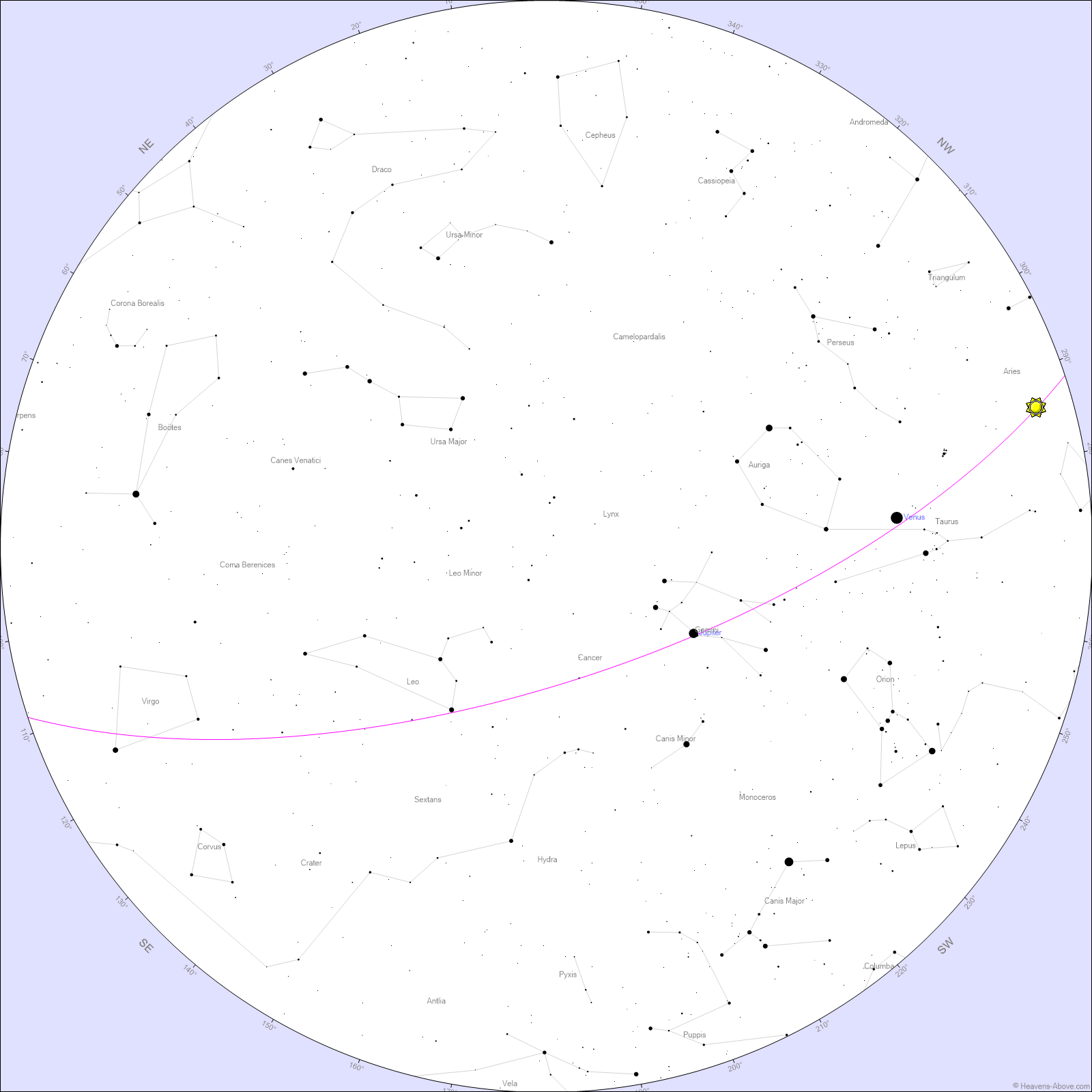
Instead, the path of the Sun, Moon, and planets, the line we call the ecliptic, cuts across the Milky Way at a steep angle, tilted by roughly sixty degrees relative to the galactic plane.
And the reason for that turns out to be surprisingly simple.
The Milky Way’s flat shape is the result of its overall angular momentum, inherited from the enormous cloud of material that formed the galaxy billions of years ago, causing everything within it to settle into a rotating disk that shares a common orientation.
But the solar system formed much later, from a relatively small, localized pocket of gas and dust within that much larger galaxy, and that local cloud did not have to align with the galaxy as a whole.
It had its own motion, its own rotation, and its own history, shaped perhaps by nearby stellar explosions, turbulent gas flows, or gravitational interactions, collapsing into a spinning disk with an orientation that was essentially independent of the Milky Way’s structure.
So what we’re left with is a kind of cosmic misalignment. The Milky Way defines one plane, the structure of the galaxy itself. The solar system defines another, the orbital plane of the planets. And those two planes intersect near Sagittarius and Gemini.
So even though we’re embedded within the Milky Way, we’re not aligned with it.
And at the center of all of this, hidden behind dense clouds of gas and dust, lies something even more mysterious: a supermassive black hole known as Sagittarius A*, containing about four million times the mass of our Sun.
It’s worth noting that this is not unusual; most large galaxies appear to host similar black holes at their centers, and while these objects can have dramatic effects on their immediate surroundings, heating gas, launching energetic outflows, and in some cases powering intensely bright galactic cores, they are not what holds the galaxy together.
The overall structure of the Milky Way is governed by the combined gravity of its stars and, even more significantly, by an enormous halo of unseen matter extending far beyond what we can see.
Of course, we’ve never actually seen the Milky Way from the outside. Every image you’ve ever seen of our galaxy, those beautiful spiral illustrations with glowing arms and a bright central bar, are reconstructions, built from decades of observation, mathematics, and careful inference.
Because we’re embedded inside the disk itself, our view is obscured by enormous clouds of interstellar dust that block visible light, especially toward the galactic center. So to map our own galaxy, astronomers had to learn to see it in other ways.
Using radio telescopes, they tracked clouds of neutral hydrogen gas emitting at a wavelength of 21 centimeters, a natural radio signal produced by hydrogen atoms throughout the galaxy. By measuring subtle shifts in that signal, a phenomenon known as the Doppler effect, astronomers could determine which gas clouds were moving toward us, which were moving away, and how fast.
Over time, that allowed us to build a three-dimensional map of the Milky Way, while never actually leaving it.
With that picture in mind, a rotating disk, spiral arms as density waves, a hidden central black hole, we can begin our journey outward.
Imagine rising slowly above the plane of the galaxy, watching as the dense band of stars begins to thin, the structure softening as you leave behind the bright cohesion of the galactic disk and enter a more diffuse region known as the stellar halo, populated by older stars and ancient globular clusters, some of which, like Omega Centauri, may in fact be the remnants of smaller galaxies that were pulled apart and absorbed long ago.
And here, as the stars grow fewer and the sky begins to open up, something unexpected happens.
We expect the light of the galaxy to fade cleanly into darkness.
But it doesn’t quite do that.
Because out here, in regions that appear almost empty, there exists something so faint that it escaped detection for most of human history: a diffuse network of dust clouds known as Integrated Flux Nebula.
These clouds do not emit their own light, nor are they illuminated by a single nearby source, but instead glow faintly by reflecting the combined light of the entire Milky Way, the integrated output of billions of stars scattered across space and gently revealed through long-exposure astrophotography.
In recent years, photographers have begun capturing these structures in remarkable detail, particularly in regions near the north celestial pole around Polaris, where what once appeared to be empty space now reveals subtle, smoky textures, evidence that even far from the bright disk, the galaxy’s presence is still being felt.
And then we reach another layer entirely.
Because beyond the stars, beyond the halo, beyond even this faint reflected glow, there exists something much larger that we cannot see at all.
Surrounding everything we’ve described is a vast halo of Dark Matter, whose presence is inferred through observations like the Galaxy Rotation Curve, which reveal that stars orbit the galaxy at speeds that cannot be explained by visible matter alone.
This invisible structure may extend out to nearly a million light-years, far beyond the visible boundaries of the Milky Way, complicating any attempt to define where the galaxy truly ends.
Astronomers sometimes use a concept called the Virial Radius to approximate a boundary, marking the region where the galaxy’s gravity dominates over the expansion of the universe, but even this is more a useful definition than a physical edge.
And so, eventually, we leave the galaxy behind.
We move out into a universe that, on the largest scales, is organized into a vast network known as the Cosmic Web, where galaxies gather along filaments that stretch across space, surrounding enormous regions known as Cosmic Voids, expanses that can span hundreds of millions of light-years and contain very little at all.
From within one of these voids, the universe would not appear rich or crowded, but distant and quiet, with only a few faint galaxies scattered across an otherwise overwhelming darkness.
And now, for one final shift in perspective.
Imagine returning to Earth, standing beneath the night sky, and removing one thing: The Milky Way. If we could somehow erase it, there wouldn’t be much of anything in our night sky, because everything we see in the night sky, save for some very distant and bright objects, are part of our home galaxy.
All the stars we see in our night sky are in the Milky Way. If we could somehow lift our solar system out of the Milky Way and plop it down by itself into empty space, we’d see our Sun and Moon, and our planets, and whatever other objects are passing by, comets, asteroids, and so on. Maybe even a wandering star that’s been ejected from another system.
We’d be able to trace the faintest hints of neighboring galaxies within the Local Group, like Andromeda, one of the most distant objects we can see with the naked eye. But mostly, the sky would be very empty.
So where does a galaxy begin, and where does it end? The answer is that it doesn’t, at least not in the way we expect.
A galaxy is not a sharply bounded object, but a gradual transition, a region where matter becomes more concentrated, then less so, then less still, until it blends into the larger structure of the universe.
It’s not unlike our own solar system in that regard. We once thought it ended somewhere around Pluto’s orbit, but we now know there is a vast region of smaller objects, the Kuiper Belt, farther out, tracing the outer disc of the solar system. Farther still, we’re enveloped by the bubble of the Oort cloud, which may extend half way to the nearest stars. In space, large areas don’t just end abruptly, they gradually fade away.
Our galaxy is a system shaped by motion and gravity, containing spiral waves of stars, a hidden central black hole, ancient stellar remnants, invisible halos of dark matter, and even the faint echo of its own light reflected in distant dust.
Next week, we’ll take this one step further, because galaxies aren’t still. They move, they interact, and sometimes, they collide. Our home, the Milky Way is already on a path toward becoming something entirely new.
After a quick break we’ll be back with a brief observation report, and a look at this week’s night sky. Stay with us.
Welcome back.
I have another rocket launch observation to report. And this time, I didn’t bother driving around to find a good observing location. I simply stepped out on the rear balcony of my house.
Around 8:50 p.m. on the evening of April 27, an Atlas V rocket lifted off carrying Amazon’s latest batch of Leo satellites, part of the company’s growing low Earth orbit broadband constellation, formerly known as Project Kuiper.
Launching from the Cape Canaveral Space Force Station, the rocket followed a standard ascent profile, placing its payload into orbit roughly 280 miles above Earth, where the satellites will gradually spread out and integrate into the growing constellation.
Following the live broadcast, about two minutes after launch and looking east, I first spotted the rocket just above the treeline as a bright, reddish point of light with a distinct conical plume trailing behind it. The rocket was traveling northeast, steadily climbing in elevation as it moved leftward across my field of view. Over the course of a minute and a half, the object maintained a smooth, continuous trajectory, gradually dimming before finally winking out. Through binoculars the trailing plume became more pronounced, giving the object a comet-like appearance.
I talked about how to spot rocket launches back in episode 101, so be sure to check that out if you missed it, particularly if you live near the east or west coast of the US, where launches may be more common than you think.
As we step into the first full week of May, the night sky carries the lingering glow of the recent Full Moon, and that brightness will shape much of what we can see overhead in the days ahead.
The Full “Flower Moon” peaked on May 1, and now, as we move into this week, the Moon begins to wane, rising later each night and gradually surrendering the evening sky back to the stars.
Early in the week, you’ll find a bright waning gibbous Moon dominating the late evening and overnight hours, washing out fainter objects but offering excellent opportunities to explore lunar features, craters, maria, and mountains along the terminator.
By the end of the week, on May 9, the Moon reaches its last quarter phase, rising around midnight and leaving the early evening skies noticeably darker.
This week also brings one of the quieter but more elegant meteor showers of the year: the Eta Aquariids, debris left behind by none other than Halley’s Comet.
The shower peaks in the early morning hours around May 5, with activity stretching a few days on either side. These meteors are fast, streaking into Earth’s atmosphere at high velocity, often leaving persistent glowing trails. But there’s a catch.
The waning gibbous Moon will still be fairly bright during peak mornings, so the best strategy is to head out before dawn, place the Moon behind a tree or building, and let your eyes adjust to the darker portions of the sky.
Even under less-than-perfect conditions, you might catch a handful of those quick streaks just before sunrise.
In the early evening sky, Jupiter continues to hold court as the brightest planet visible after sunset, shining prominently in the western sky and slowly descending toward the horizon as the week progresses.
It’s one of those reliable anchor points, easy to spot even in twilight, and a great target for binoculars or a small telescope, where you can begin to pick out its Galilean moons.
Meanwhile, if you’re willing to wake up early, the pre-dawn sky is beginning to wake up as well.
Saturn is rising earlier each morning, becoming easier to spot low in the eastern sky before sunrise, hinting at its return to prominence in the coming months.
This is one of those transitional periods, where the evening sky is slowly losing its brightest planets, and the morning sky is quietly preparing to take over.
As the week progresses and the Moon begins to rise later, the sky slowly opens up again—revealing some of the deeper, more distant structures that define this time of year.
And in keeping with our theme tonight, this IS galaxy season.
If you’re looking for something bright and relatively easy to track down, start with the Sombrero Galaxy, Messier 104, low in the constellation Virgo. Even under moderate moonlight, its bright central core can punch through the glow, appearing in a small telescope as a compact, luminous oval.
With a bit more aperture or darker skies, you may begin to notice its defining feature: a dark lane of dust slicing cleanly through the galaxy, giving it that iconic, hat-like appearance. It’s one of those objects that feels structured, symmetrical, and strangely precise.
Now, if you want something that connects directly to what we talked about earlier in the show… something that helps you visualize the Milky Way from the outside, turn your attention toward the faint constellation Coma Berenices and seek out the Needle Galaxy, NGC 4565.
This is a spiral galaxy seen perfectly edge-on. In other words, you’re looking at a galaxy much like our own, but from the outside, stretched into a thin, delicate line of light with a dark band cutting through its center.
And when you see it, even faintly, something clicks. That narrow sliver of light is what the Milky Way would look like to a distant observer.
And then there’s our “wow” object for the week. High in the evening sky, in the constellation Canes Venatici, lies the Whirlpool Galaxy, Messier 51. This one is a little more challenging, especially earlier in the week with the Moon still bright, but as the skies darken toward the weekend, it becomes a rewarding target.
Through a small telescope, it may appear as a faint, misty patch with a brighter core. But under steady skies and with a bit of patience, you may begin to notice something remarkable. A second glow nearby, its companion galaxy.
These two galaxies are locked in a slow gravitational interaction, their mutual pull distorting their shapes and enhancing the spiral structure we see.
I have one more bit of housekeeping before I sign off this week. I, once again, apologize for abandoning our book selection. Next week I hope to wrap up my commentary on the final chapters in Nightwatch. We’re right near the end, with chapters 10, 11, and 12.
That’s going to do it for this week. If you found this episode interesting, please share it with a friend who might enjoy it. The easiest way to do that is by sending folks to our website, startrails.show. And if you want to support the show, use the link on the site to buy me a coffee. It really helps!
Be sure to follow Star Trails on Bluesky and YouTube — links are in the show notes. Until we meet again beneath the stars … clear skies everyone!
Support the Show
Connect with us on Bluesky @startrails.bsky.social
If you’re enjoying the show, consider sharing it with a friend! Want to help? Buy us a coffee! Also, check out music made for Star Trails on our Bandcamp page!
Podcasting is better with RSS.com! If you’re planning to start your own podcast, use our RSS.com affiliate link for a discount, and to help support Star Trails.

 Star Trails: A Podcast About Cosmic Wonder
Leave a comment