A Black Hole Is Pointing at Us – Star Trails: From Backyard Astronomy to Cosmic Wonder
Episode 109
In this episode we step behind the scenes of modern astronomy to explore a side of the universe you can’t see, at least not directly.
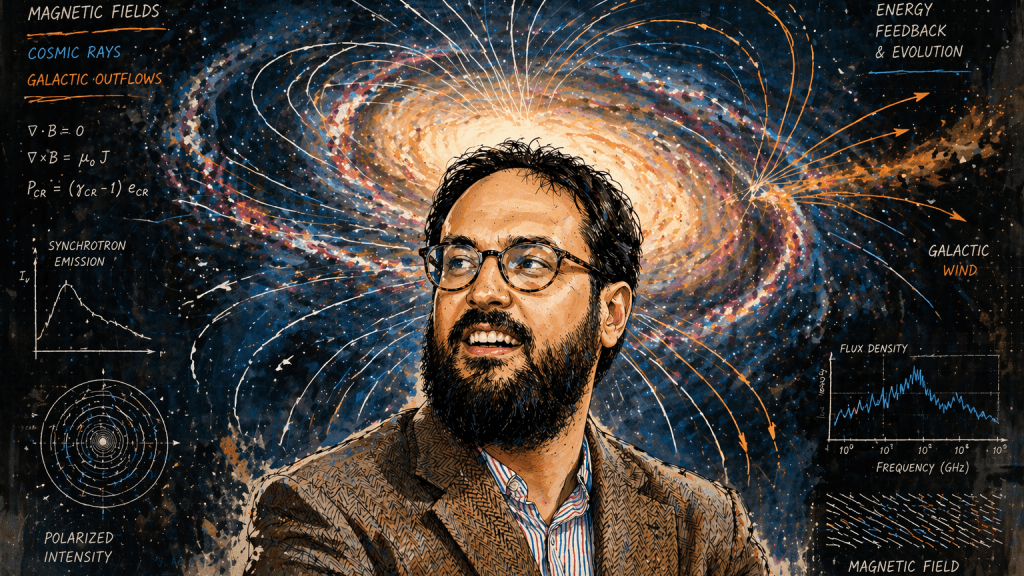
We sit down with Professor Enrique López Rodríguez, an extragalactic astronomer at the University of South Carolina and one of the leading researchers in the United States studying magnetic fields in galaxies.
The conversation also dives into the complex behavior of supermassive black holes, some actively feeding and driving powerful outflows, others surprisingly quiet, and how these cosmic engines influence the evolution of entire galaxies.
Along the way, we’ll look at how modern astronomy is mapping the hidden forces that connect the universe.
And later in the show, we return to something a little closer to home with this week’s night sky, featuring the rising Flower Moon, bright evening planets, and a deep-sky tour through one of the richest regions of galaxies visible from Earth.
Links
Transcript
Howdy stargazers and welcome to this episode of Star Trails. My name is Drew and I’ll be your guide to the night sky for the week of April 26 to May 2nd.
This week, we’re exploring a side of the universe you can’t see, at least not directly. I sit down with Professor Enrique López Rodríguez, one of the leading researchers in the United States studying magnetic fields in galaxies, to talk about the invisible structures that shape the cosmos.
Later in the show we’ll take a look at this week’s night sky.
Whether you’re tuning in from the backyard or the balcony, I’m glad you’re here. So grab a comfortable spot under the night sky, and let’s get started!
We tend to think of galaxies as massive collections of stars, bound by gravity, pinwheeling through space. But beneath that visible structure, there’s something else at work: Invisible magnetic fields, stretching across thousands of light-years, that are quietly shaping how galaxies evolve, how stars form, and even how material moves from one galaxy to another.
In fact, as you’re about to hear, galaxies don’t exist in isolation at all. They can exchange material across vast distances, guided along these magnetic pathways.
And at the centers of many of these galaxies are supermassive black holes, some actively consuming matter and blasting energy back into space, and others, surprisingly, almost dormant. As if they’ve simply shut down.
In this episode we’ll step behind the curtain and meet one of the researchers helping us understand the hidden structure of the universe.
Today’s guest is Professor Enrique López Rodríguez, an extragalactic astronomer at the University of South Carolina and one of the leading researchers in the United States studying magnetic fields in galaxies.
Originally from the Canary Islands, his work focuses on how these invisible fields influence the evolution of galaxies, the behavior of supermassive black holes, and the flow of matter across cosmic scales.
He’s led major international research efforts, including a NASA SOFIA legacy program to map magnetic fields in nearby galaxies, and has published nearly 90 peer-reviewed papers in journals like The Astrophysical Journal, Monthly Notices of the Royal Astronomical Society, and Nature Astronomy.
And as you’ll hear, his work is helping us uncover a part of the universe that may be shaping our reality.
Here’s my interview with Professor Rodríguez:
Drew: Enrique, thanks for taking the time to speak with me today and welcome to the show.
Enrique: Well, thank you for having me.
Drew: Tell me a little bit about yourself. How did you get into astronomy?
Enrique: Okay. I’m originally from Spain, the Canary Islands. These small islands close to south Morocco. The islands are volcanic in the same way that you think about Hawaii to the US, the Canary Islands to to Spain. And these islands are very famous in astronomy because we have an international observatory. Their largest telescope in the world is in the Canary Islands.
Enrique: So therefore, we have a really good sky that really, really got the skies. I was also very lucky. The, the university in my hometown have astrophysics, degree. So I then had to move, because I was not able to go anywhere, because my family didn’t have enough resources to send me to another school. So then I did my bachelor’s in the Canary Islands, and then a one of my, professors told me about these, exchange of grad students from the Canary Islands to the University of Florida.
Enrique: Lucky me. The chair of the Department of astronomy in the U. Of Florida was from Spain. So I have, phone call, with him. And then I think a month later, I was in Florida just, doing the Ph.D., there.
Drew: Well, so you come by it, honestly, you had very dark skies growing up, and it inspired you.
Enrique: Yeah, yeah, yeah, that was a very, very interesting there.
Drew: Well, let’s get right into it. You’re an extra galactic astronomer. Can you tell us what that means? Because that is a fascinating term.
Enrique: Yeah. So I’m basically I study the galaxy evolution. So I’m interested in to know how galaxies form. What are the compositions and then how they evolve from the beginning of the universe to nowadays.
Drew: How did you get into that? That is a very specific field.
Enrique: So when you think about the universe, the main amount common objects besides stars are galaxies. And then we always hear from the news or when you read books about the universe is expanding Einstein. They have their general relativity. They explain the whole universe. Like okay, so this is interesting. But what is inside of this universe? And we know we we see people here, we see cars.
Enrique: We see stars. We see the planets. But then you start getting more interestingly what is beyond that? And you see that beyond the solar system is more stars and beyond more stars. Is that all inside of object that we call galaxies that are all gravitationally bound by the motion of stars orbiting around the center of the galaxy? And then when you go beyond, then you see there is no a single galaxy that we live is like thousands of them nearby to the Milky Way.
Enrique: You go a little bit larger and zoom out and okay, so several trillions of galaxies moving inside of space and they’re all moving away are like, okay, now I want to know about this. So like, I want to know about the big picture of how these even form our galaxy. The same. They are not why they they are different and what they make them different.
Enrique: And then how galaxies collide to each other, or how they destroy each other, how they form. And then I get into a rabbit hole. I’ve been in the rabbit hole for the past 20, 30 years. Until now.
Drew: And that rabbit hole is the study of how magnetism affects galaxies. Correct?
Enrique: Yeah, exactly. So, exactly. So then you have another level here. So normally when we observe a galaxies or the universe that are around us, we observe the radiation, the photons emitting from, from these stars, for example, by electromagnetism, tell us that you have charged particles, moving those charged particles generate a magnetic field, and those magic fields cannot be destroyed because monopoles don’t exist.
Enrique: So then you kind of destroy the only thing that you can do is amplify them, meaning that you have more magic field lines per volume, or you can dissipate them. And that means that you spread the magic field in that larger volume, but you cannot completely destroy them. So that means like, okay, so you if we are in, permitted magnetized universe, what is the effect of these magic field?
Enrique: So how they magic will affect the formation of stars? How affect the dynamics of the or the gas? How affect the creation of supermassive black holes. So I got more interesting to that. So they because you have the connection between physics that you can explain in the lab by magnet and you put the, the item, dust around and then you also connect the astronomy, say like how stars form.
Enrique: And then I been for the past 15 or 20 years. Try to estimate what is the effect of magic fail in the dynamics of the gas into supermassive black holes in the center of galaxies, or in the formation, and looks like that they’re very, very, very tiny energy of magnetic fields, but they’re extremely important to explain how stars form, for example.
Drew: Well, and you mentioned that yourself, galaxies are these groups of stars bound together by gravity. And in astronomy we talk about gravity all the time. And gravity’s not that I can do it, but relatively simple to calculate. If you know the mass of something. How do you calculate magnetism from afar like this.
Enrique: Right? Yeah. So exactly what? Gravity is the one that governed the whole formation of stars. For example, you have a mass and gravity make them to collapse. Okay. So now how do you measure magnetic fields. So we don’t we cannot send, magnetometer anywhere. So what we observe is the effect o matic fields, a material. For example, let’s say that you have electron.
Enrique: An electron is a charged particle with negative, charge. So you have a magnetic field. Those electrons need to move along the metric field orientation. So have a specific trajectory. And these electrons are spinning around the nomadic field. So then we can measure that direction or the electrons that give you a specific signature and dramatic wave. And then measuring that signature that we call polarization, we can say, okay, this electron is no freely moving in space in moving along some direction.
Enrique: And then we can infer the metric for the strength and the orientation. Okay. This is one way. And then the other way that I’m using for the past ten years I use dust and Das is organic compounds, made of carbon, nitrogen, oxygen, silicates and iron. And these compounds are like micrometer size.
Drew: Okay.
Enrique: And because they have iron, they align with the local magnetic field. Let’s imagine that you have a lot of, rice grains and they are elongated. Right. And these a rice, grains have items, inside. So then if you put a magnet around, they will all align with the local magnetic field. And this is exactly what are observing in very far away galaxies.
Enrique: I see, like all this test align with local magnetic field.
Drew: This reminds me of, of course, the elementary school science experiment. You put a magnet down and put a piece of paper on it, put some iron filings and you see the pattern of the magnet.
Enrique: Exactly, exactly, exactly. You don’t you don’t see the magic field. You see the effects. Automatic fill in matter. Okay. And these, these iron that you mention is exactly what I observe in, in galaxies.
Drew: And how are you observing that from so far away these days?
Enrique: Grains have a very interesting property. So their micrometer size. Okay. Why? They they are very close to stars. They stars are radiating, energy mainly in the optical and ultraviolet. Okay. And then these tax grains absorb all that radiation. When the absorbing, they get, heated. So then they have some temperature. If you have a temperature, then they are emitting radiation.
Enrique: Okay. Because this is a black body, radiation. So then if we emit they, they emit radiation. The only thing that we need to do is to build an instrument. They sensitive to that specific temperature. Okay. And then we can observe the radiation from those dust grains.
Drew: Fantastic. And what instruments are you using to accomplish this?
Enrique: Yeah. So many years ago, I used to work for NASA. So it’s a project called Sofia. So the Stratospheric Observatory for funding for astronomy. So we had an instrument called homeless. And this is to make you very, very sensitive to cold temperatures. With this instrument, we put it in the back of a Boeing 747, very highly modified Boeing 747.
Enrique: Okay, all German engineering, because the Germans had the great engineers that collaborate with NASA. And then we used to fly, 45,000ft over the sea level. And the reason is because you need to go outside of the thermosphere.
Drew: Okay.
Enrique: And and cheaper than sending a spacecraft. Right. Right. So then we had this new instrument, which they know that works, so you cannot send it to space. It’s, all exploratory work. And the idea was to exactly observe my dick fills in the universe. So we put it in the back of the Boeing 747. We flew into the sphere like, a few hundred times, and then we took a observations of nearby galaxies.
Enrique: Since day one, we start tracing my nose. My dick fills a larger scale. So we see that this very tiny fraction like micrometer size, are able to, dust grains are able to provide us the information of metric fields of several thousands of light years. So we are doing macroscopic physics to get microscopic tracer automatic fills.
Drew: Speaking of working for NASA, I’ve seen your name attached to some images that I’ve seen on NASA’s website, and I believe these are the images that show a galaxy. And you can almost see those magnetic lines that are sort of superimposed on on that and that. So that data collection you’re talking about is how you produce those images.
Enrique: Yeah, exactly. So I have a program called salsa where it’s coming from my Spanish, heritage. It I like to call salsa. Say, the Sofia survey for a true maker magnetism. I got observations, archival observations previously done by by NASA in the optical to see the the stars in the job, to see the deformation in the infrared, to see the dust and combine them all real observations.
Enrique: And then on top of that, I put the matic fill orientation. It looks like, the starry night of Van Goch. They had right away. You can see, for example, the galaxies spiral, you see spider matic fear. And then you see the spiral, is more chaotic. Exactly. In the region that you have a star formation. So now you have basically you say, oh, something going on here.
Enrique: So why I don’t see this spiral. And then you go further and say, oh, the star formation is dangling or disturbing the magic field. And now, like, all right, so there should be a relationship between how the star formation is doing in the interstellar medium with what we know with a when I’m a dark film.
Drew: Well, I’m, I love that you mentioned Van Gogh because when I looked at those, I thought they do look like artwork. I don’t know if you’ve ever thought about it, but you should blow some of these things up and do it in a gallery exhibition.
Enrique: I should, I should, yeah, you should do that one. When? Yeah, I need to.
Drew: Do that because they’re really beautiful images. And of course the galaxies themselves are beautiful. But then being able to see that dynamic of the magnetism that you’ve traced on there, it’s really incredible. And you’re right, they follow the spirals and well, well, that that’s a good place to talk about talking about centers of galaxies because that’s something you specialize in as well.
Drew: Right.
Enrique: Yeah. So what we can do is we can observe galaxies, the like, for example, spiral galaxies, they’re very quiescent with their very, normal. Normal between quotation mark. And then we know that you have a spirals and they no matter formation and these you can use it as, as a sample, as a control sample.
Enrique: And then from there you can get more exotic, meaning you can go to galaxies that has a lot of, ETA formation and is, creating a lot of supernovae, explosions in the sky when you compare with the spiral trying to have a spider matic field, now you have the matic fade to be push away from the galaxy.
Enrique: And I was like, whoa, okay, so you have ten, 20 supernovas that is exploding in the center of the galaxy. And they not only pushing dust and gas outside the galaxy, it’s also dragging them away from the galaxy. And now, like, okay, now in all the galaxies also the surrounding environment. Mother galaxy is also magnetized. Oh, like all right.
Enrique: Okay, now we know that you have magic fields in the in the galactic medium. And again you have charged particles. They have to move through those magic fields so they can move freely. So now we we know that we can we can trace in the magic field. We know how the material flow from galaxy to galaxy, that one way, then you can get more exotic torque and then you can get galaxies merging.
Enrique: And you have two galaxies in interaction. And they’re like, okay, how the interaction make the is what happened when I met the create. And when do you see these, interacting galaxies. Maybe they grab one of the spiral arms and stretch and compress and then you see them magic Quill also, stretching and compress. And you have, like, a bridge between those two galaxies with a very a strong magnetic field connecting both of them.
Enrique: And that means that if you want to transfer material from one to another, galaxy need to go through those magnetic fields. Mandatory, to so they can now go on more freely and then fall using gravity. You just they have to move there is gravity is taking place, but they had to move through those lines.
Drew: That is incredible. That there are those connections. Because I’m imagining we’re talking about very, very long distances between the two. But yet they make that connection.
Enrique: Exactly. Yeah. I mean, we’re talking about well, I mean, our Milky Way, the galaxy. The only thing is like 15 parsec or so in, in size, I don’t know, 30,000 light years or something like that, around there. So these two galaxies are like ten, 20 kilo parsec away from each other. And now you’re talking about a metric.
Enrique: Feel like connecting both of them or the size of the Milky Way.
Drew: Wow. That’s incredible. Some of your more recent stuff is about the idea of these galactic outflows. Is that the process you were describing just then about how they they travel between galaxies on these these waves of magnetism?
Enrique: Yeah. Right. So exactly. So this is light and galaxies. And then there are some galaxies that we call active galactic nuclei. So AGN and these galaxies are powered by accretion onto a supermassive black hole. And this is where my thesis, was about. So my thesis was about trying to trace the magnetic field surrounding supermassive black holes.
Enrique: So the reason behind that is because every single model that explained how matter going to a black hole requires the need of a medic field, but has not been observed yet. And then like, okay, if there is some material, maybe this test, I can trace the magic field using this test. And I’ve been doing that for the past 20 years or so.
Enrique: I trace the magic field. So you have the supermassive black hole. You have material in a disk orbiting around the black hole, and the material is highly magnetized. And I trace the magnetic field. And I’m measuring the metric field that looks like a donut shaped like a, like a, like a.
Drew: Like a donut.
Enrique: Like a donut. Exactly. So, but then when we see these nuclei, we see that they added that also expelling a lot of material. And this is pillar material we call it outflows. And the black hole. We always say the black hole is a nothing can escape the black hole. But actually the black hole cell very inefficient, eaters of matter.
Enrique: So I actually like 90% of the material that go into the black hole goes away in the form of energy. And so only ten or less than 10% go inside of the black hole. And that 90% of energy need to be released somehow. And that somehow is due to magic fields. So you can imagine, for example, solar flares in the sun.
Enrique: Yeah. And then it’s a lot of satellite. I try to figure out how the sun is expelling a lot of, plasma. And then when you see the very detailed images, you see some kind of like arcs. So they’re called a flare, and these arc are arch, and then these arc, kind of like break and then release the, the energy.
Enrique: Those arcs are created by magic fields.
Drew: I feel like I remember seeing that. Yeah. The, the little loops that appear on the sun surface are created by magnetism.
Enrique: Exactly. And those loops open like break and they release the energy. This is exactly what happened in the disks around supermassive black holes. You have these loops, on top of the disks. And then the these, had the loops, the loop break and then release energy. And that’s what we call outflows. Okay. So and then those outflows of course are a, a have a lot of energy going out.
Enrique: And you have a supermassive black hole. You have a lot of energy. You have a lot of magnetic fields, you have a lot of mass. And that a outflows can do a few things. One is that they don’t have enough energy to leave the galaxy and then fall back into the galaxy, and then you fit again the black hole, or can go into the intergalactic medium.
Enrique: So I’m very interested to know how these outflows evolve as a function of the power of the galaxy.
Drew: It’s amazing to think that they can actually escape the gravity of a galaxy like that. How do you how does that happen? Do you think?
Enrique: Well, there’s a lot of energy being released, like a lot of it. So then they have all, what is the velocity that you push into the system at the beginning? When they release and they hit a velocity larger than the gravity. Okay, velocity, gravity than the gravity. So then they can escape. I mean, we can send, I mean, you know, the same, but we can send, rockets to the moon, right?
Enrique: So we put a lot of energy in the back of a rocket to push it out. So you can imagine a very extreme cases scenario that you have a supermassive black hole with a lot of radiation. Some sometimes you push a lot of material away and have enough energy to leave the gravitational potential.
Drew: Okay. And that energy, just like you said, it just dissipates into the into space or it gets grabbed by something else.
Enrique: Yeah. Yeah, exactly. Can go into the into the intergalactic medium, the medium between galaxies. If you have enough energy or can travel a little bit above and below the disk and then fall back due to the gravity and, and larger distances from the.
Drew: Galaxy, and you’ve track this at the supermassive black hole at the center of our galaxy. Correct?
Enrique: Yeah. Yeah, I do our own galaxy, but our own galaxy has, black hole. There’s no accreting any material. So is it basically that, there the ratio is no material surrounding the black hole. Maybe in the past, the black hole’s very active. And then it was like, pushing into material. But right now it’s just they’re quiet, very quiet, and there’s some material around.
Enrique: But he’s not really going into the black hole, at all.
Drew: That’s amazing that, you know, black holes. Once upon a time being these theoretical objects. And now you can look at them and say, well, this one’s not as active as this one is, and this one is doing more than that one. That’s incredible. I’ve always been curious. So we think most galaxies have a black hole at the center in some cases.
Drew: Is that what force that creates the spiral shape of the galaxy itself? You think?
Enrique: Yeah. So we think that most of the galaxies, if not all, has a supermassive black hole in the center. Supermassive means ten to the 6 to 10 to the nine times the mass of the sun. So you have a, million times of a few billion times the the mass of the sun, inside of the in the center, the other middle of the galaxy, of a size that can fit inside of the of the solar system.
Enrique: So this is the size of the supermassive black hole. Okay. So this, black hole has, gravitational is fear, so meaning, like, how far away do you need to be in order not to be affected by the by the gravity. And that that is only the very, very central part of the galaxy. So even though we see a spiral galaxies, these spirals are not spiraling around because of the black hole.
Enrique: It’s spiraling around because of the angular momentum of the other disks. So let’s say, for example, you have a spherical cloud that’s a spherical cloud collapse. And when they collapse have some rotation. And then form a disk. And that this is that rotating. And that’s the reason why we see the spiders moving. But they had nothing to do with their with the black hole.
Drew: So it’s not like this, this science fiction visualization of a black hole out there swirling around like a, like everything’s swirling down a drain. It’s not like that.
Enrique: Yeah. In the central part of the galaxy. Yes. In in an hour. And our distance from the center of the galaxy, we don’t we have no relative with that.
Drew: Okay. Yeah. That’s fascinating stuff.
Enrique: Even though we are not affected by the gravitational potential of the galaxy, the dynamics of the galaxy or the evolution of the galaxy depends of what happened with the black hole. So the black hole is active accreting matter. So that means a lot of energy being released. So that energy can affect the dynamics of the galaxy. For example, if our galaxy have, a active nuclei in the center will will not be here, for example, because so much energy that it will destroy the the solar system.
Drew: That is incredible. That is incredible to think about. What does a modern astronomer do? What does your day look like? Because I imagine, especially with the work you’re doing, you’re not looking through telescopes maybe at all anymore. So what is your day look like? You have an idea. How do you chase it?
Enrique: All right, so as, my position as a faculty, a is a combination of, research and teaching, right? So the teaching. Well, I have several classes during the year, and then I teach all the way from, no science majors about what astronomy is. For example, in the semester I’m teaching, the dark, universe. So it’s about, I call it the our ignorance, in the universe.
Enrique: So we don’t know about dark matter. We don’t know about that energy within, about expansion of the universe. And then I just show them what all this means. And then all my research say is a researcher projects. Right. So, like, I have, research goals, for example, my overall goal is understanding magnetic fields in the universe. So and I observational astronomy.
Enrique: So I use telescopes. So they I normally during the year I have to apply for observing proposals to use a specific telescope. All around the world. For example, today was the deadline for that is coming in Chile is called alma is the Atacama Large Millimeter Array. And they does one allow me to, for example, observe the metric fields and the early universe or very, very close to nearby, atm.
Enrique: So I break the proportionality. Give me some time. Of course, you cannot go. Sadly, you cannot go to the Atacama Desert. But that gives you the data. For example, I also, I use telescopes in, in Hawaii, in the Canary Islands, Spain, Chile, South Africa.
Drew: And when you say telescopes, we’re talking radio telescopes.
Enrique: Is or is a combination of optical telescopes. Okay. Infrared telescopes, radio telescopes. So that means that my day to day life is brightening, observing, proposals to get, new data to go deeper into specific, fields or to do, for example, a large sample, because I want to have a theoretical sample of multiple galaxies. And then also a and I have my research team, have grad students and postdocs.
Enrique: So that means I need to, find a funding tool to support them. So that means I need to apply for national, grants, for example, the national Foundation or NASA, or some private, foundations that I or again, so I submit some reports and say this is the research that I want to do is important for whatever reason.
Enrique: And then give me please give me some money so I can pay. So I’m going to ask you then for the next 2 or 3 years.
Drew: So like you said, you were working with alma. So you get your data back from alma. What’s the next step.
Enrique: Or the next step is, be very excited at first as I have new data now, like what this data is about. So you’ll be going like every single time that I observe with, telescope, in this case, alma, they give you a new things and you spend the next year, two years analyzing the data, quantifying the data, meaning, like you had to do a lot of statistics to make sure that how robust your, measurements are.
Enrique: And then once you have a result, that you are convinced that it is real. So then you need to have interpretation and scientific data processing of that. And that requires a lot of communication with, a lot of, collaborators, besides yourself and the team that I have here. Like, what this all means, and then you have a lot of conversation with many people.
Enrique: You have to have a consensus, and not be biased by my own, ideas, to. And then when all have when they have a very robust, interpretation. And so the thing is the idea of like writing the, the paper and publish it, then show it to the community and then see what they will think about it.
Drew: What has you the most excited about where the field of astronomy in general is right now?
Enrique: So it’s very exciting to have, the James Webb out. I mean, since the launch of three, four years ago, always, like revolutionizing astronomy. I think the next step that we have, the Vera Rubin, telescope in Chile, taking data, I will speak, I think, like the first three days, they observe, like, a hundred thousand alerts of, supernova explosions or something like that, which is insane.
Enrique: That mean that we’re going to have the next ten, 20 years? We have more data that the whole astronomy having taken in, in history, and that we have to deal with these data, how do we even analyze tens of millions of, of our galaxies? And moving forward at NASA is going to be launching a few space telescopes in the next few years.
Enrique: So you have the Roman telescope is also doing a humongous survey, very deep observation, and you have to deal with the information of millions of of galaxies. And now it’s a combination, like how do we use AI, to deal with all this data that we can trust the output of this data. But also what new science can we get from from this right on the ground, we have Europe and the US building the next generation of extremely large telescopes.
Enrique: These are 30 meter telescope in comparison with a ten meter. So the for example, Europe, the European Southern Observatory is building a 42 meter telescope in Chile. That is going to be first light I think is in six, five, six years ish, something like that. So that’s all need to do. You want to have like Neowise you know about surveys.
Enrique: It’s about detail. So there’s like if you want to know what is a happening around a supermassive black hole, you choose that. If you want to know where the why. So the new James Webb telescope is observing galaxies in the early universe. You go to the telescope and resolve it and see where they they see the morphology of it.
Enrique: So it’s just about the detail of other surveys. And so often. So I’m very excited in the next ten, 20 years of using all this new telescope and see, what we learn from, from.
Drew: Them, so much data, we don’t know what to do with it all. Yeah, all the epic astronomy you’re doing here. What still amazes you about astronomy?
Enrique: The pretty pictures. I’m. I’m very basic. Yeah. I’ll just, like, show me a pretty picture. Oh, my God, this is so great for my research. I just have a new instrument in a new telescope and get the first, light, the first image, which is exciting me, like, is no tomorrow. And then it really excites me to know, like, I have a piece of knowledge of the universe.
Enrique: That and the first person to have it in front of me. And I need to figure it out. And this is like just I can stay thinking about this for for months.
I’d like to thank Professor Rodríguez for coming on the show and being so generous with his time.
What struck me in that conversation is just how much of the universe is hidden from us.
It’s remarkable to think that something as small as a dust grain, containing tiny amounts of iron, can act as a kind of compass, revealing the structure of these unseen forces that are shaping structures as enormous as galaxies.
And even more remarkable that galaxies themselves aren’t isolated at all, that they can exchange material across vast distances, connected by these magnetic pathways.
And then there are the black holes, not just cosmic vacuum cleaners, but complex engines, pushing energy back into their host galaxies, and sometimes, flinging material back into space.
With research led by scientists like Professor Rodríguez, we’re slowly piecing together a universe that’s far more dynamic, and far more interconnected, than it first appears.
After a quick break we’ll be back with a look at something closer to home: this week’s night sky. Stay with us.
Welcome back.
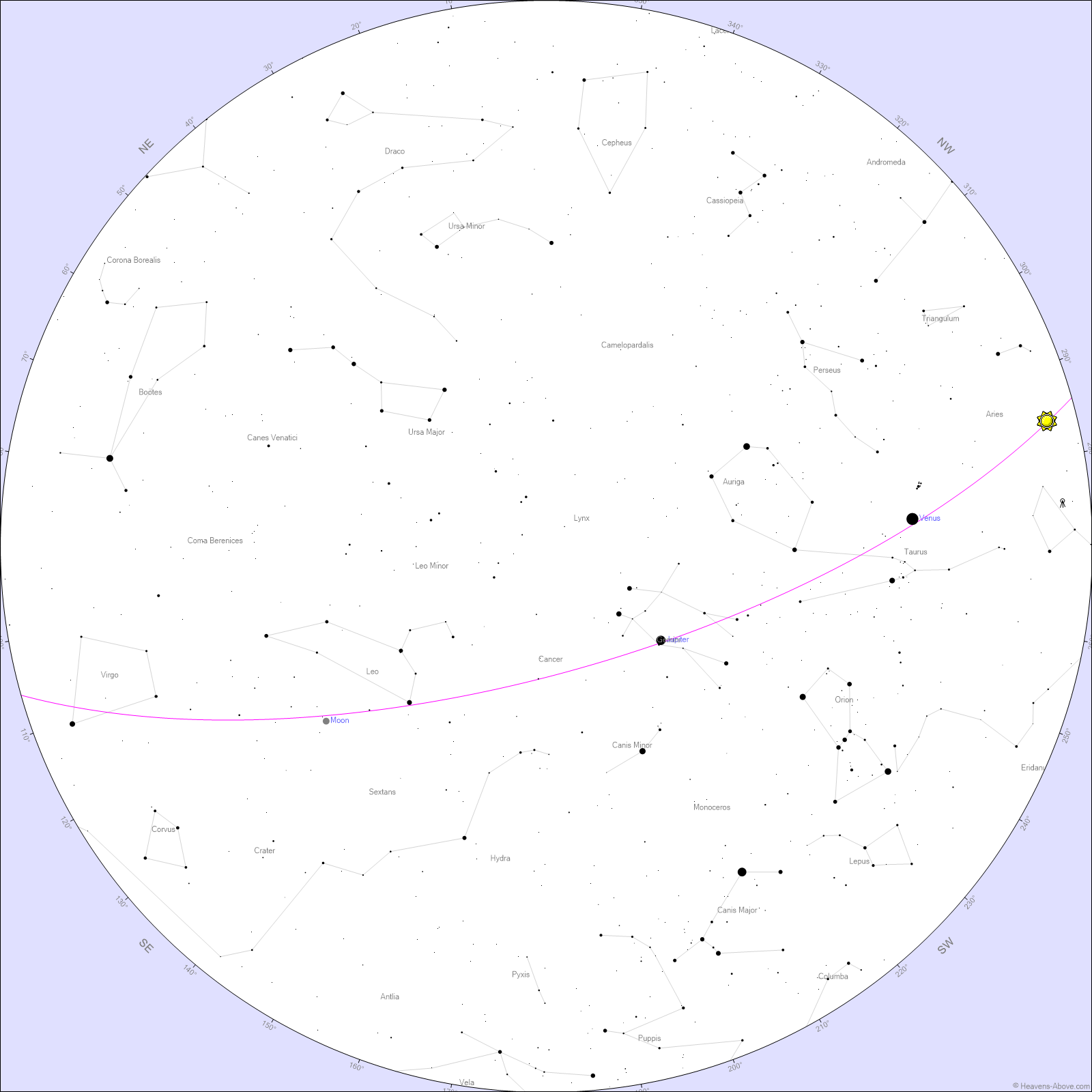
As we close out the month of April and step into early May, the night sky offers a gentle transition, from darker, moonless evenings earlier in the month, to a bright and beautiful full Moon rising at the end of the week.
Throughout this week, the Moon is in its waxing phase, growing brighter with each passing night. Early on, you’ll find it as a waxing gibbous, rising in the afternoon and shining well into the evening hours.
But by Friday, May first, the Moon reaches its full phase.
This is the Flower Moon, a name that comes from the abundance of blooming plants this time of year. And while every full Moon is worth a look, this one is what astronomers call a micromoon, meaning it’s a bit farther from Earth than usual, and may appear just slightly smaller in the sky.
Earlier in the week, before the Moon becomes fully illuminated, take a moment to look along the line between light and shadow, the lunar terminator. That’s where craters and mountains stand out in sharp relief, offering some of the most dramatic views you can get through a small telescope.
Now, turning to the planets. This is something of a split-sky week, with the brightest worlds divided between evening and morning. Just after sunset, look toward the western horizon and you’ll immediately notice Venus, brilliant and unmistakable, shining like a beacon in the twilight.
Higher up, Jupiter continues to dominate the evening sky, steady and bright, and still one of the most rewarding objects to observe through a telescope.
If you happen to be out before sunrise, there’s more to see.
Low in the eastern sky, Mercury, Mars, and Saturn form a loose grouping near the horizon. They’re not especially bright right now, and you’ll need a clear view to the east—but if you catch them, you’re seeing the tail end of a quiet planetary gathering that’s been unfolding over the past few weeks.
Now, this time of year also brings something special for deep sky observers.
We’re entering what astronomers call galaxy season.
The familiar constellations of winter are slipping away, and in their place, the sky is opening up to regions rich with distant galaxies—particularly in the constellations of Leo, Virgo, and Coma Berenices.
Leo is easy to spot, high in the sky after sunset, marked by a distinctive backwards question mark shape. Just beyond it lies Virgo, a sprawling constellation that contains an entire cluster of galaxies, some fifty million light-years away.
With a telescope, and especially under darker skies, you can begin to pick out faint smudges of light. One particularly beautiful region is known as Markarian’s Chain, a gentle arc of galaxies stretching across space, visible as a delicate pattern when conditions are right.
And if you’re just using binoculars, don’t miss the Beehive Cluster in Cancer. It’s still visible early in the evening, and remains one of the most rewarding open clusters in the sky.
By the end of the week, the full Moon takes over, brightening the sky and shifting our attention closer to home.
That’s going to do it for this week. If you found this episode interesting, please share it with a friend who might enjoy it. The easiest way to do that is by sending folks to our website, startrails.show. And if you want to support the show, use the link on the site to buy me a coffee. It really helps!
Be sure to follow Star Trails on Bluesky and YouTube — links are in the show notes. Until we meet again beneath the stars … clear skies everyone!
Support the Show
Connect with us on Bluesky @startrails.bsky.social
If you’re enjoying the show, consider sharing it with a friend! Want to help? Buy us a coffee! Also, check out music made for Star Trails on our Bandcamp page!
Podcasting is better with RSS.com! If you’re planning to start your own podcast, use our RSS.com affiliate link for a discount, and to help support Star Trails.


Leave a comment