How Jupiter Almost Destroyed the Solar System – Star Trails: From Backyard Astronomy to Cosmic Wonder
Episode 116
For generations, we’ve pictured the Solar System as a stable and orderly place: planets forming where they are today and quietly orbiting the Sun for billions of years. But what if that picture is wrong?
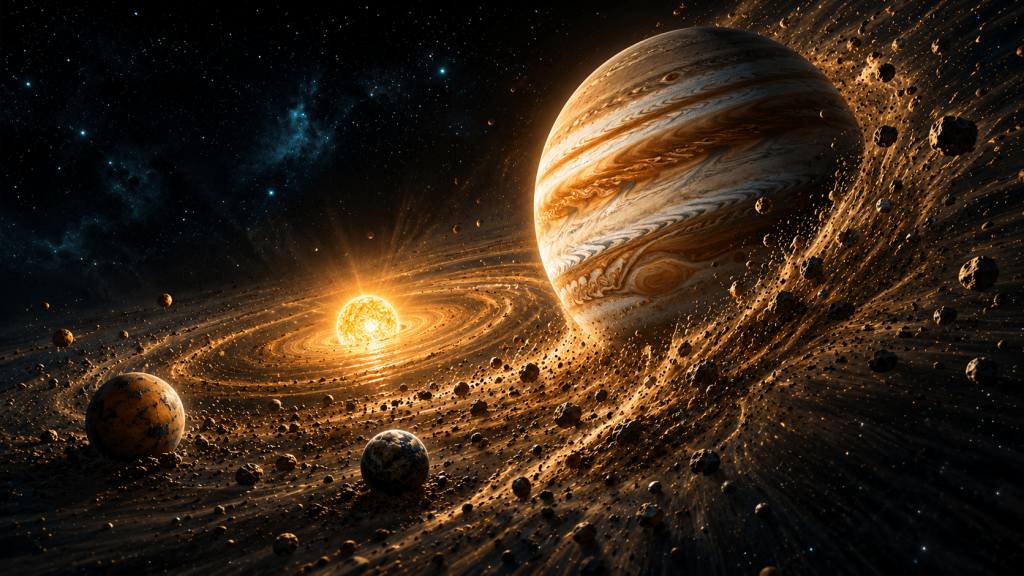
In this episode, we explore the Grand Tack Hypothesis, a fascinating idea suggesting that Jupiter may have migrated deep into the young Solar System before reversing course and heading back outward. Along the way, the giant planet may have reshaped the asteroid belt, influenced the formation of Mars, and helped determine whether Earth as we know it could exist at all.
We’ll also take a closer look at Jupiter’s complicated reputation as both protector and troublemaker. Does the Solar System’s largest planet shield Earth from dangerous impacts, or does it sometimes send trouble our way?
Later, we’ll celebrate the arrival of summer with a look at the summer solstice and explore what’s happening in this week’s night sky, including the Moon, the bright evening planets, the Summer Triangle, and the first great views of the summer Milky Way.
Transcript
Howdy stargazers and welcome to this episode of Star Trails. My name is Drew and I’ll be your guide to the night sky for the week of June 21 to the 27th.
This week we’re taking a journey back four and a half billion years to explore one of the strangest ideas in modern planetary science: a theory suggesting that Jupiter may not have formed where we find it today. In fact, the giant planet may have migrated deep into the young Solar System before turning around and heading back outward, dramatically reshaping the worlds we know today.
Later in the show we’ll celebrate the arrival of summer with a look at the summer solstice, check in on the Moon and planets, and explore a few sights worth seeking out in the warm June night sky.
Whether you’re tuning in from the backyard or the balcony, I’m glad you’re here. So grab a comfortable spot under the night sky, and let’s get started!
If you’ve spent any time outside lately, you’ve probably noticed a brilliant object shining in the evening sky. That’s Jupiter, the largest planet in our Solar System. Through a telescope, it’s a spectacular sight, bands of clouds, four bright moons, and a presence that’s impossible to miss.
Most of us picture Jupiter as a permanent fixture of the Solar System. It’s out there beyond Mars, beyond the asteroid belt, circling the Sun every twelve years, just as it always has.
But what if that’s not the whole story? What if Jupiter wasn’t always where it is today?
What if, billions of years ago, Jupiter embarked on an epic journey through the young Solar System, one that may have changed the fate of every planet, including our own?
Tonight, we’re exploring one of the strangest and most fascinating ideas in modern planetary science: the Grand Tack Hypothesis.
Now, when most of us learn about the Solar System, we’re shown a neat little diagram. The Sun sits in the middle, Mercury is closest, then Venus, Earth, Mars, the asteroid belt, Jupiter, Saturn, and so on. It’s tidy. Ordered. Predictable.
And it’s easy to come away with the impression that the planets formed in those locations and have stayed there ever since. For a long time, astronomers thought something similar.
The story went something like this: a cloud of gas and dust collapsed to form the Sun. Around it, a spinning disk of leftover material began clumping together. Tiny grains became pebbles, pebbles became rocks, rocks became planetesimals, and eventually planets emerged from the chaos.
Simple enough.
But as scientists began building more sophisticated computer models of planetary formation, a problem emerged. Actually, several problems emerged. And one of the biggest was sitting right next door.
Mars. Poor Mars.
Mars is often described as Earth’s little brother, but when you compare the two worlds, the difference is startling. Mars is only about half the diameter of Earth and possesses barely ten percent of Earth’s mass.
And that’s strange. Venus and Earth are both substantial rocky worlds. Yet Mars is tiny by comparison.
When astronomers ran simulations of the early Solar System, they frequently ended up creating a Mars much larger than the one we actually observe.
The models kept producing a planet that shouldn’t exist. Or perhaps more accurately, they failed to produce the one that does. Something seemed to have robbed the region around Mars of the material needed to build a larger planet.
But what? The answer, some scientists proposed, may have been Jupiter.
To understand why, we need to talk about something that once sounded almost heretical in astronomy: Planetary migration, the idea that planets can move. Not just wobble a little. Not drift by tiny amounts. But move, and significantly.
Today, this idea is widely accepted, but a few decades ago it would have sounded bizarre. After all, planets orbit the Sun. That’s what they do.
Then astronomers began discovering planets around other stars. And those discoveries changed everything. They found giant worlds larger than Jupiter orbiting absurdly close to their stars. Some completed an orbit in just a few days.
These so-called “hot Jupiters” shouldn’t have been there. There simply wasn’t enough material close to the star to build such massive planets. The only reasonable explanation was that these worlds formed farther out and later migrated inward.
Suddenly, planetary migration wasn’t just possible. It appeared to be common. And if planets around other stars could migrate, why not the planets in our own Solar System?
As it turns out, there are good reasons to believe that Jupiter did migrate.
To understand how, we need to travel back about four and a half billion years, to a time before the Solar System looked anything like it does today. The Sun had only recently formed. Around it stretched a vast disk of gas, dust, ice, and rocky debris. The planets were still under construction.
Jupiter was one of the first major planets to emerge, and because it was so massive, it didn’t simply orbit quietly within that disk. It interacted with it.
Every orbit, Jupiter’s gravity tugged on the surrounding gas. At the same time, the gas exerted its own influence on Jupiter. These interactions transferred angular momentum back and forth, creating a kind of gravitational conversation between the planet and the disk around it.
Instead of remaining in place, Jupiter slowly began spiraling inward.
Imagine a bowling ball resting on a giant rotating trampoline. The ball distorts the surface around it, and those distortions affect how the ball moves. The physics of a protoplanetary disk is considerably more complicated than that, but the basic idea is similar: Jupiter’s immense gravity created disturbances in the disk, and those disturbances altered Jupiter’s orbit.
Over time, Jupiter drifted closer and closer to the Sun. And according to the Grand Tack Hypothesis, it may have traveled astonishingly far. Some current models suggest Jupiter moved inward to roughly 1.5 astronomical units from the Sun. That’s about one and a half times Earth’s distance.
In other words, Jupiter may have ventured into the region we now associate with Mars.
It’s hard to picture: A world containing more than twice the mass of all the other planets combined, passing through the neighborhood of the young terrestrial planets.
This was not a subtle event. As Jupiter migrated inward, its gravity scattered material in every direction. Some objects were flung outward. Others were sent inward. Some were ejected from the Solar System entirely.
The orderly construction project that would eventually produce the inner planets suddenly had a giant wrecking ball swinging through it.
And this may be where Mars’s fate was sealed.
By plowing through that region, Jupiter likely depleted much of the material that would otherwise have accumulated into a larger planet. When the dust finally settled, there simply wasn’t enough building material left to create an Earth-sized world.
Mars became the underdog of the inner Solar System. A survivor of a cosmic construction site that had been stripped nearly bare.
If the story ended there, our Solar System would look very different today. In fact, Earth itself might never have formed in the way it did. Fortunately for us, another player entered the game.
Saturn.
As Jupiter migrated inward, Saturn was still forming farther out in the disk. Eventually it grew massive enough to begin migrating as well.
The two giant planets were now on a collision course, maybe not physically, but gravitationally.
As Saturn approached Jupiter, the pair became locked into what astronomers call an orbital resonance.
This is one of those terms that sounds complicated but describes a fairly simple idea. A resonance occurs when two objects repeatedly interact in a regular pattern. For example, one planet might orbit the Sun exactly twice for every orbit completed by another planet.
These repeating gravitational nudges can dramatically alter orbits over time, and once Jupiter and Saturn became linked in this way, something remarkable happened: The balance of forces changed.
The two planets effectively began working together against the surrounding gas disk. And instead of continuing inward, they reversed direction.
Jupiter stopped its plunge toward the Sun and Saturn stopped following. Together, the two giant planets began migrating outward.
This reversal is the reason the hypothesis is called the Grand Tack, and the the name comes from sailing. When a sailboat reaches a certain point, it changes direction in a maneuver known as a tack. Rather than continuing on its original course, it swings around and heads off in a new direction.
According to this model, Jupiter performed the ultimate cosmic tack. After heading inward for hundreds of thousands of years, it turned around and sailed back outward toward the orbit we know today. And that’s one of the most dramatic events ever proposed in the history of our Solar System.
If it happened, nearly everything we see around us bears its fingerprints. The asteroid belt, for example, suddenly begins to make more sense. It isn’t a neat collection of identical objects. Instead, it’s a mixture. Some asteroids appear dry and rocky. Others contain much more ice and volatile material.
The Grand Tack offers a possible explanation.
As Jupiter moved inward and then back outward, it stirred up populations of objects from different regions of the Solar System and mixed them together.
The asteroid belt may be less of a pristine relic and more of a cosmic junk drawer, filled with material gathered from multiple neighborhoods during Jupiter’s journey.
And perhaps most importantly, the Grand Tack may explain why our Solar System looks so different from many of the planetary systems we’ve discovered elsewhere.
Around other stars, giant planets are often found very close to their suns. In our system, Jupiter never completed that inward migration, because Saturn arrived just in time to usher the king of planets back outward.
And the Solar System we know today was allowed to emerge from the chaos.
Now, if you’ve spent any time around astronomy clubs, science museums, or popular science books, you’ve probably heard a familiar claim: Jupiter protects Earth.
The idea is simple enough. Jupiter is enormous. Its gravity is powerful. Therefore, it acts like a giant shield, sweeping up dangerous objects before they can threaten our planet.
And there is some truth to that. One of the most spectacular examples occurred in 1994, when Comet Shoemaker-Levy 9 collided with Jupiter. Astronomers watched as fragments of the comet slammed into the giant planet, leaving dark scars larger than Earth itself across Jupiter’s cloud tops.
For many people, it was a vivid demonstration of Jupiter’s protective role. A dangerous object that might have threatened another world instead met its end in Jupiter’s atmosphere. Case closed, right?
Well… Not exactly.
As astronomers began studying the problem in greater detail, a more complicated picture emerged. Because Jupiter doesn’t merely capture objects. It also redirects them.
Imagine placing a giant gravitational pinball machine in the Solar System. Every comet, asteroid, and icy body that wanders nearby can have its path altered.
Sometimes those alterations are helpful. Sometimes they’re not.
Jupiter can fling objects completely out of the Solar System. It can send them harmlessly into the Sun. It can trap them in stable orbits. But it can also redirect them inward. Toward Earth.
In other words, Jupiter doesn’t simply remove threats. Sometimes it creates them.
This has led astronomers to ask an intriguing question. Is Jupiter Earth’s guardian, or is Jupiter Earth’s accomplice in a long history of cosmic violence?
The answer appears to be both.
Without Jupiter, certain classes of comets would probably reach Earth far more frequently. Its immense gravity helps clear many of those objects from the Solar System.
But for some asteroids and smaller bodies, Jupiter’s gravitational influence can actually increase the chances that they cross Earth’s orbit. It’s less like having a security guard at the door and more like having an extremely large, unpredictable bouncer. Most of the time, he’s helping. Occasionally, he’s throwing furniture.
And when we view Jupiter through the lens of the Grand Tack Hypothesis, that ambiguity becomes even more fascinating.
Think about what we’ve discussed so far: Jupiter may have stripped material from the region where Mars was forming. It may have scattered countless smaller worlds. It may have reshaped the asteroid belt. It may have altered the architecture of the entire Solar System.
That’s not the behavior of a passive bystander; that’s the behavior of a cosmic kingmaker. Or maybe a cosmic troublemaker.
And yet, without that journey, the Solar System we know might never have existed. Earth may have formed differently. Mars may have been much larger. The asteroid belt may have looked completely different. Even the delivery of water and volatile compounds to the inner Solar System could have unfolded along another path.
We’re often taught that the Solar System is a finished machine. A clockwork arrangement of planets moving along predictable paths. But modern astronomy paints a very different picture.
The early Solar System was chaotic, violent and messy. Planets migrated, worlds collided, and entire populations of objects were scattered into deep space.
The Solar System we inhabit today is not necessarily the Solar System that had to happen. It may simply be the version that survived.
And that’s one of the reasons I find the Grand Tack Hypothesis so compelling.
It reminds us that our seemingly orderly solar system has a dynamic history filled with twists, reversals, close calls, and accidents.
Saturn forms a little later, and perhaps Jupiter never turns around. Jupiter migrates a little farther inward, and perhaps the inner Solar System is dramatically altered.
Change a few variables, tweak the timing by a few hundred thousand years, and the night sky above us today might belong to a completely different world.
Which brings us back to the present. Tonight, if the skies are clear, step outside and find Jupiter shining in the darkness.
To our eyes, it appears calm and steady, a brilliant point of light moving slowly among the stars. For thousands of years, people have watched it cross the sky and imagined it as a god, a king, or a wandering star.
Today we know it as a giant planet. But according to one remarkable idea, that bright beacon may also be the architect of the Solar System we call home.
Jupiter could be a world-builder, a destroyer, or a savior. Maybe all three at once.
And every time we look at it, we’re looking at a survivor of one of the greatest journeys ever proposed in planetary science.
After a quick break we’ll be back with a look at this week’s night sky. Stay with us.
Welcome back.
Summer has officially arrived. The summer solstice occurs today, marking the beginning of astronomical summer in the Northern Hemisphere. It’s also the longest day of the year and the shortest night of the year.
But what exactly is a solstice? Many people think the seasons are caused by Earth being closer to or farther from the Sun. That’s actually not the case. In fact, Earth is slightly farther from the Sun during Northern Hemisphere summer than it is during winter.
The real reason for the seasons is Earth’s tilt.
Our planet’s axis is tilted by about twenty-three and a half degrees. As Earth travels around the Sun, that tilt causes different parts of the planet to receive more direct sunlight at different times of year.
On the summer solstice, the Northern Hemisphere is tilted most directly toward the Sun. The Sun climbs to its highest noon altitude of the year, daylight lasts the longest, and we experience the year’s shortest night.
From this point forward, the days begin their slow march back toward autumn and winter, though you probably won’t notice the difference for several weeks.
Turning our attention to the Moon, we begin the week with a First Quarter Moon tonight. That means half of the Moon’s Earth-facing hemisphere appears illuminated. First Quarter Moons are good targets for binoculars and telescopes because the shadows along the lunar terminator help craters and mountains stand out in dramatic relief.
As the week progresses, the Moon waxes into a growing gibbous phase, becoming brighter each evening as it heads toward the Full Strawberry Moon arriving on June 29th. By the end of this week, moonlight will begin to interfere somewhat with observations of faint galaxies and nebulae, so early-week observing will offer the darkest skies.
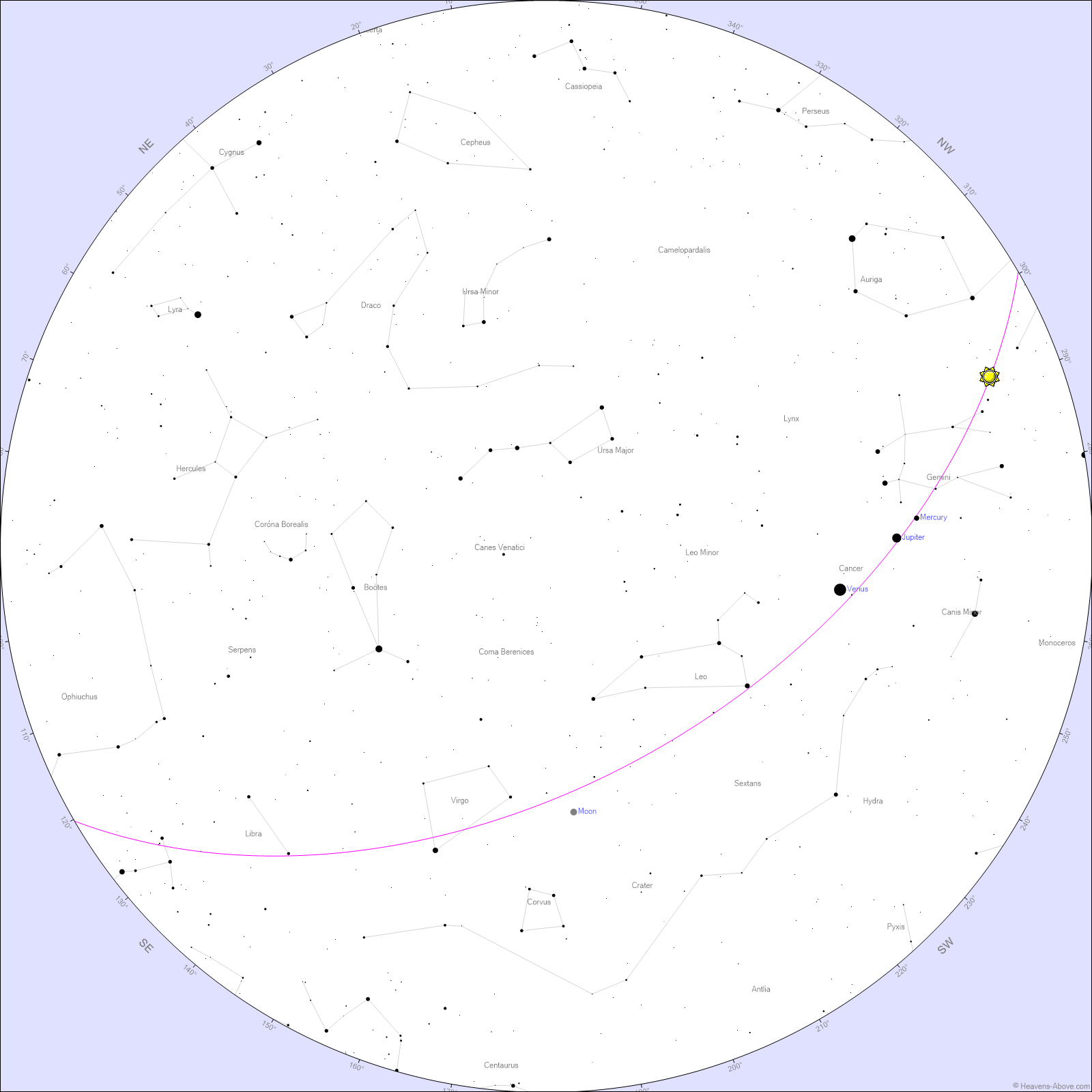
As for the planets, brilliant Venus continues to dominate the western sky after sunset. You’ll find it shining low in the west during twilight, making it nearly impossible to miss. Jupiter remains nearby but is sinking deeper into the evening twilight as the month draws to a close. If you’d like to catch Jupiter, look shortly after sunset and make sure you have a clear western horizon.
Mercury also lingers low in the western sky, though it may be challenging to spot without an unobstructed horizon and clear conditions. Think of it as a bonus target for patient observers.
If you’re willing to rise before dawn, Saturn is becoming increasingly prominent in the morning sky, while Mars can also be found before sunrise. Early risers are beginning to get rewarded as the fall and winter planets slowly return to view.
This is also an excellent time to begin exploring the summer Milky Way.
By late evening, the rich star fields of Sagittarius and Scorpius are climbing higher in the southeastern sky. You’re looking toward the heart of our galaxy, where vast clouds of gas, dust, and countless stars crowd together in one of the most spectacular regions visible to amateur astronomers.
If you have binoculars, spend some time sweeping through Sagittarius. Even under suburban skies you’ll encounter dense star fields and clusters. Under darker conditions, the Milky Way begins to reveal itself as a broad river of light stretching across the sky.
Finally, don’t forget to look overhead for the Summer Triangle. Vega, Deneb, and Altair are becoming increasingly prominent as darkness falls. Over the next few months they’ll serve as reliable signposts for navigating the warm nights of summer.
That’s going to do it for this week. If tonight’s episode sparked your curiosity, or maybe gave you something new to think about the next time you look up, I’d be honored if you shared Star Trails with someone who might enjoy the journey. You can always find the latest episodes, show notes, and extras at startrails.show.
And if you’d like to help support the show, there’s also a little “buy me a coffee” link on the site. It genuinely helps keep these stories coming.
Be sure to follow Star Trails on Bluesky and YouTube — links are in the show notes. Until we meet again beneath the stars … clear skies everyone!
Support the Show
Connect with us on Bluesky @startrails.bsky.social
If you’re enjoying the show, consider sharing it with a friend! Want to help? Buy us a coffee! Also, check out music made for Star Trails on our Bandcamp page!
Podcasting is better with RSS.com! If you’re planning to start your own podcast, use our RSS.com affiliate link for a discount, and to help support Star Trails.


Leave a Reply