A Summer Sky Road Trip – Star Trails: From Backyard Astronomy to Cosmic Wonder
Episode 115
Summer is almost here, and with it comes one of the richest observing seasons of the year.
In this episode, we take a road trip through the summer sky, exploring the constellations, deep-sky objects, planets, meteor showers, and celestial events that will define the next three months of stargazing. Along the way we’ll visit the Summer Triangle, cruise through the star clouds of the Milky Way, stop at famous landmarks like the Great Hercules Cluster and the Lagoon Nebula, and look ahead to the Perseid meteor shower and a deep partial lunar eclipse later this summer.
Summer astronomy has its own character. The nights are warm, the Milky Way is bright, and some of the best observing experiences come not from reaching a destination, but from wandering beneath the stars and discovering something unexpected along the way.
In This Episode:
- The Summer Triangle and why it signals the arrival of summer
- Exploring the Milky Way with binoculars
- The Great Rift and the crowded heart of our galaxy
- M13, the Lagoon Nebula, the Trifid Nebula, the Ring Nebula, and other summer favorites
- The myths and stories behind Scorpius, Sagittarius, Cygnus, and Hercules
- Venus, Saturn, and notable summer conjunctions
- The Southern Delta Aquariids and Perseid meteor showers
- August’s deep partial lunar eclipse
Transcript
Howdy stargazers and welcome to this episode of Star Trails. My name is Drew and this week we’re going to take a summer road trip through the cosmos.
In this episode I’ll preview what you can expect to see in the upcoming months as temperatures rise and the dense starfields of the Milky Way return to the night sky. Along the way I’ll introduce some of the notable constellations of summer, a few nice deep sky objects to track down, planetary conjunctions, a lunar eclipse, and of course, meteor showers.
And keep in mind, we’ll adopt a summer publishing schedule, releasing new episodes every other week from here on out, until Labor Day. But, as I did last week with my remastered Star Party Stories episode, we may revisit some of my favorite topics from the archive in between our main sequence episodes.
Be sure you subscribe to the show so you get the latest episodes. You can do that through any podcast app because Star Trails is available everywhere. Or if you prefer, subscribe to our YouTube channel. Links to everything are on our website: StarTrails.show.
And if you’re a new listener, the website is a great resource. Click the “Start Here” tab up top for a list of our best episodes, and links for new astronomers.
Whether you’re tuning in from the backyard or the balcony, I’m glad you’re here. So grab a comfortable spot under the night sky, and let’s get started!
You know, there are a few trips I’ve always wanted to take in my life. One of them has nothing to do with astronomy.
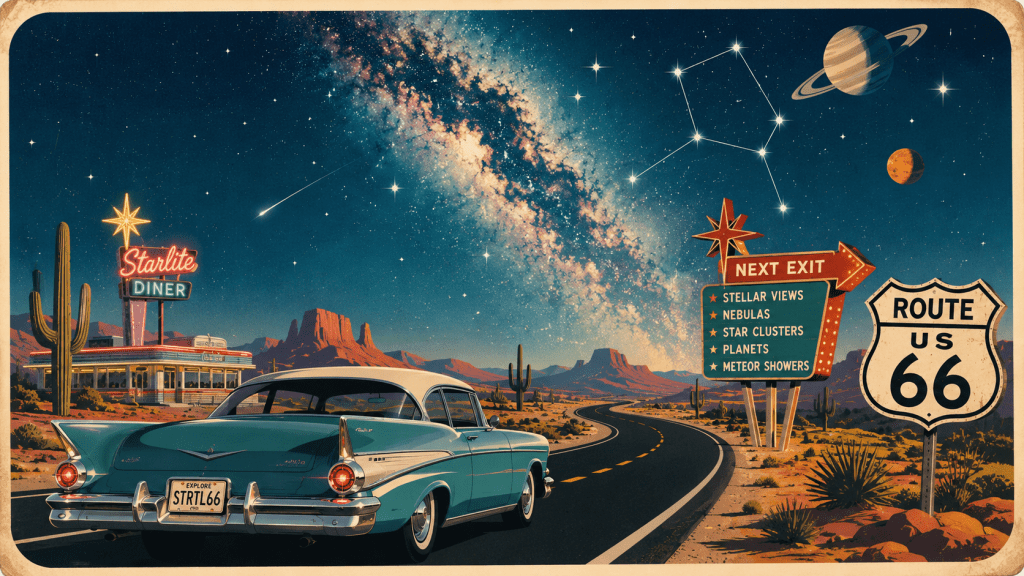
I’ve always wanted to drive the length of Route 66 with a friend. We’d start in Chicago, point the car west, and just go. No rush. No strict itinerary. Just a camera, a good playlist, a cool vintage car, and a ribbon of highway stretching to infinity.
I imagine stopping at old diners and forgotten roadside attractions. Photographing neon signs that have seen better days. Pulling over when something catches my eye. Maybe discovering places that never appeared in any guidebook. Camping under a perfectly dark desert sky, shooting photos of the Milky Way sprawling over an alien landscape.
The best road trips aren’t really about arriving somewhere. They’re about everything that happens along the way. And as I’ve gotten older, I’ve realized that astronomy can be a lot like that too.
Every year, around this time, we enter summer observing season. The nights are hot, uncomfortably so. The mosquitoes are hungry. The humidity can turn your telescope into a science experiment. And darkness doesn’t arrive until many people are already thinking about bed.
Winter skies may be easier to observe, but summer skies are actually richer.
In winter, we’re largely looking outward, toward the quieter neighborhoods of our galaxy. In summer, we’re looking inward, toward the heart of the Milky Way itself. Dense star clouds, glowing nebulae, ancient globular clusters, dark lanes of interstellar dust, and millions upon millions of stars all crowd together overhead.
It’s a little like leaving the countryside and driving into a metropolis after dark. The view becomes busier. Brighter. More alive.
So tonight, we’re going to take a road trip through the summer sky. We’ll visit some famous landmarks, stop at a few hidden gems, check out some roadside attractions, and preview some of the celestial events waiting for us over the next three months.
Summer astronomy is about warm nights in lawn chairs. The sound of crickets. The smell of freshly cut grass. The glow of a red flashlight and conversations with friends beneath the stars.
So before summer arrives, let’s plan our road trip through the stars, and keep in mind, it’s the journey that matters most. Let’s hit the road.
Our first stop is a big one. It’s the highway sign that tells us we’ve entered summer.
As twilight fades and the stars begin appearing one by one, three bright beacons emerge overhead. Together they form one of the most famous patterns in the entire sky: the Summer Triangle.
Unlike many constellations, the Summer Triangle isn’t an official constellation at all. It’s what astronomers call an asterism, a recognizable pattern formed by stars that belong to different constellations. The three stars are Vega, Deneb, and Altair.
Vega shines within the small constellation Lyra, the Harp. Altair marks the heart of Aquila, the Eagle. And Deneb anchors Cygnus, the Swan.
Together they form a giant triangle spanning a huge section of the sky. And once you learn to recognize it, you’ll never stop seeing it. For generations of amateur astronomers, the Summer Triangle has served as a seasonal landmark. It’s one of those patterns that immediately tells you where you are in the year, and it’s a gateway.
Hidden within and around the Summer Triangle is one of the greatest sights in all of astronomy: The Milky Way.
If you’re fortunate enough to escape the city and find a dark sky, you’ll notice a faint river of light flowing directly through the Triangle. It stretches from horizon to horizon, winding across the sky like a celestial highway.
Most people know the Milky Way is our galaxy, but what many don’t realize is that summer is the season when we’re looking toward the galactic core.
Imagine standing on the outskirts of a major city. In one direction, there are scattered houses, quiet roads, and empty fields. In the other direction lies downtown, with millions of lights, skyscrapers and traffic.
That’s essentially what happens in the summer sky.
Our solar system lives far from the center of the Milky Way, about twenty-six thousand light-years away. During summer evenings, Earth happens to be positioned so that nighttime faces inward, toward the densely populated core of our galaxy.
We’re looking inward, and that’s why summer skies seem so rich. The star clouds become brighter. The dust lanes become more dramatic. Nebulae and clusters seem to appear everywhere.
And it’s almost overwhelming. You could spend an entire evening simply wandering through the Milky Way with a pair of binoculars and never settle on a single destination.
As we continue our journey, we’re going to follow this river of stars deeper into the heart of the Milky Way, where some of the finest celestial destinations of the season await.
Before you spend money on a telescope, or try to learn the entire Messier catalog, do this first.
Find a dark place. Lean back in a lawn chair. Start near Deneb in Cygnus and slowly work your way south.
You’ll discover that the Milky Way is textured and layered. Bright knots of stars appear and disappear. Dark lanes of dust snake through the star clouds. Tiny clusters emerge unexpectedly from the background.
The view changes constantly. It’s like exploring a landscape.
Those countless points of light are the combined glow of stars spread across thousands of light-years. The dark patches aren’t empty space but enormous clouds of dust blocking our view of the stars behind them.
Astronomers call one of the largest of these features the Great Rift. This vast network of dark dust clouds splits the Milky Way into two branches, stretching from Cygnus down toward Sagittarius.
Under truly dark skies, the Great Rift becomes surprisingly obvious. It’s as though someone took a brush dipped in black paint and dragged it across the Milky Way. It’s one of the most underrated sights in amateur astronomy.
As we continue southward, the Milky Way grows brighter and more crowded. That’s because we’re approaching the direction of the galactic center.
Somewhere beyond those star clouds, hidden behind layers of dust, lies the core of the Milky Way itself. There, hundreds of billions of stars crowd together around a supermassive black hole known as Sagittarius A*.
Fortunately for us, the view along the way is spectacular. Open clusters dot the star fields. Nebulae glow faintly among the stars. Every sweep of binoculars reveals another surprise.
Winter astronomy often encourages you to hunt specific targets. Summer astronomy encourages you to explore.
You can set out looking for a famous nebula and spend the entire evening being distracted by everything around it.
Every road trip has its iconic destinations, the places you’ve heard about for years, that appear on postcards and travel brochures. The must-see destinations.
The summer sky has a few of those.
Let’s make a stop in the constellation Hercules. There you’ll find Messier 13, better known as the Great Hercules Globular Cluster. If the summer sky has a world’s-largest-ball-of-twine attraction, M13 might be it, though it’s much more dignified.
At first glance, it appears as a fuzzy ball of light. But as magnification increases, something remarkable begins to happen. The fuzz starts breaking apart. Individual stars emerge from the glow. Then more stars.
Soon you’re looking at a vast swarm containing hundreds of thousands of ancient suns packed into a sphere only about a hundred and fifty light-years across.
Many of those stars were already ancient when Earth first formed.
The cluster itself is roughly twenty-two thousand light-years away, meaning the light entering your telescope tonight began its journey when humans were still painting cave walls.
I think that’s one of the reasons M13 remains so compelling. It isn’t merely beautiful, it gives you a sense of depth in both space and time.
M13 is a surviving relic from the early history of our galaxy.
From there, our journey carries us southward toward dramatic skies. Hidden there are giant nurseries where new stars are being born. One of the finest is the Lagoon Nebula, also known as Messier 8.
Even a small telescope reveals a glowing patch suspended among countless stars. Under darker skies, larger instruments begin to reveal its shape and structure.
What you’re seeing is a vast cloud of gas and dust where new stars are actively forming. Some of the brilliant young stars inside the nebula are already sculpting the cloud around them, carving cavities and illuminating the surrounding gas.
In a way, the Lagoon Nebula feels like visiting a growing city. Nothing there is finished.
Just a short distance up the road lies another favorite: the Trifid Nebula.
This object has always fascinated astronomers because it combines several different types of nebulae into one remarkable package. Dark dust lanes divide portions of the glowing cloud, creating the appearance of three distinct lobes, hence the name “Trifid.”
Each time you observe it, you notice something new. A little more structure, contrast, and detail hidden within the glow.
Another delightful destination is the Wild Duck Cluster. Known formally as Messier 11, this dense open cluster sits within the constellation Scutum. Through binoculars it appears as a misty patch, but through a telescope it explodes into a rich field of stars.
Observers have long said the brightest members resemble a flock of ducks flying in formation, though I’ll admit astronomy requires a healthy imagination from time to time.
What I love about M11 is its sheer abundance. Stars seem to spill across the eyepiece. Everywhere you look, there are more.
And then there’s the Ring Nebula, Messier 57. If the Lagoon Nebula represents birth, the Ring Nebula represents an ending.
Located in the small constellation Lyra, almost directly between two of the stars forming the harp, the Ring Nebula is the remains of a dying star. Thousands of years ago, that star shed its outer layers into space. Today those expanding shells of gas form the glowing ring we see through our telescopes.
One day our own Sun will likely experience a similar fate, so the Ring Nebula may offer a glimpse of that distant future.
Of course, every road trip eventually leaves the interstate.
The most memorable journeys include side roads, scenic overlooks, and unexpected discoveries.
And just ahead, we’re entering one of the most mythological regions of the summer sky, where heroes, scorpions, swans, and archers still roam among the stars.
Summer is home to some of the most recognizable and story-rich constellations visible from the Northern Hemisphere. Our first stop sits low in the southern sky: Scorpius.
Its stars form a long, curving shape that genuinely resembles a scorpion. Once you see it, you can’t unsee it. At its heart burns Antares, a giant red supergiant star whose name means “rival of Mars.”
Ancient skywatchers noticed that Antares often resembled the reddish glow of the planet Mars, leading them to give it a name that literally means “the anti-Mars.”
If Antares replaced our Sun, its outer layers would extend beyond the orbit of Mars itself. This enormous dying star has reached the twilight years of its existence and will eventually end its life in a spectacular supernova explosion.
But not anytime soon. For now, it serves as one of summer’s great celestial landmarks.
Scorpius also carries one of the oldest stories in the sky. In Greek mythology, Orion the Hunter boasted that he could kill every animal on Earth. The gods, unimpressed by his arrogance, sent a giant scorpion to deal with the problem. The scorpion succeeded.
To this day, Orion and Scorpius occupy opposite sides of the sky. When Scorpius rises in summer, Orion is nowhere to be found. And when Orion dominates the winter sky, Scorpius has long since disappeared below the horizon.
The hunter and the scorpion continue their celestial chase thousands of years after the story was first told.
Just east of Scorpius lies Sagittarius. Most star charts tell you Sagittarius is an archer. Some of us have looked for decades and still don’t see an archer.
What we do see is a teapot. And once someone points out the famous Teapot asterism, you’ll probably see it too. The handle sits on one side, the spout on the other, with a lid on top.
Sagittarius is important for another reason. It points us toward the heart of the Milky Way.
Somewhere beyond the star clouds and dust lanes in Sagittarius sits Sagittarius A*, the supermassive black hole around which our galaxy revolves.
You can’t see the black hole because it’s blocked by dust clouds, but knowing what’s hidden there adds a certain sense of mystery to this region of the sky.
As darkness deepens and we continue our journey overhead, we arrive at one of the most beautiful constellations: Cygnus the Swan.
If you’ve ever looked up and noticed what appears to be a giant cross flying down the Milky Way, you’ve found Cygnus. Many people know it as the Northern Cross. Others see a graceful swan soaring along the river of stars.
Deneb forms the tail of the swan and serves as one corner of the Summer Triangle we visited earlier. Cygnus sits directly within the Milky Way, making it one of the richest regions in the entire sky for binocular exploration.
Finally, let’s return briefly to Hercules.
We’ve already visited the Great Globular Cluster, but the constellation itself deserves a mention.
Unlike many constellations, Hercules doesn’t leap out at casual observers. Its stars are relatively faint, and Its shape requires a bit of imagination. Perhaps that’s fitting.
The mythological Hercules wasn’t known for beauty or elegance. He was known for perseverance and endurance, for undertaking impossible journeys and somehow making it through.
In a way that feels appropriate for our summer road trip. Because summer astronomy asks a little perseverance from us too. The mosquitoes, humidity, late sunsets, and the dew-soaked gear.
After a quick break we’ll be back to check the itinerary and see what’s waiting for us farther down the road this summer. We’ll check in with this week’s sky, and I have a mystery to tell you about. Stay with us.
Welcome back.
Throughout the summer, the planets become familiar traveling companions.
Venus will spend much of the summer shining brilliantly in the evening sky, becoming one of the easiest celestial objects to spot after sunset. If you’re outside during twilight, perhaps finishing dinner on the patio or taking an evening walk, take a moment to look toward the western horizon. You’ll know Venus when you see it, because nothing else is that bright.
Saturn also makes a welcome return this summer, transitioning from an early morning planet, to rising in the late evening. As summer ends it becomes a prominent target for backyard telescopes.
Few experiences in amateur astronomy compare to seeing Saturn’s rings for the first time. The view isn’t necessarily large or even colorful, but it looks impossible: A tiny world hanging in space, complete with rings that your brain insists can’t possibly be visible from more than 600 million miles away. And yet there it is.
Summer also offers a handful of close encounters between the Moon and planets. These conjunctions often create beautiful opportunities for casual observers and photographers alike.
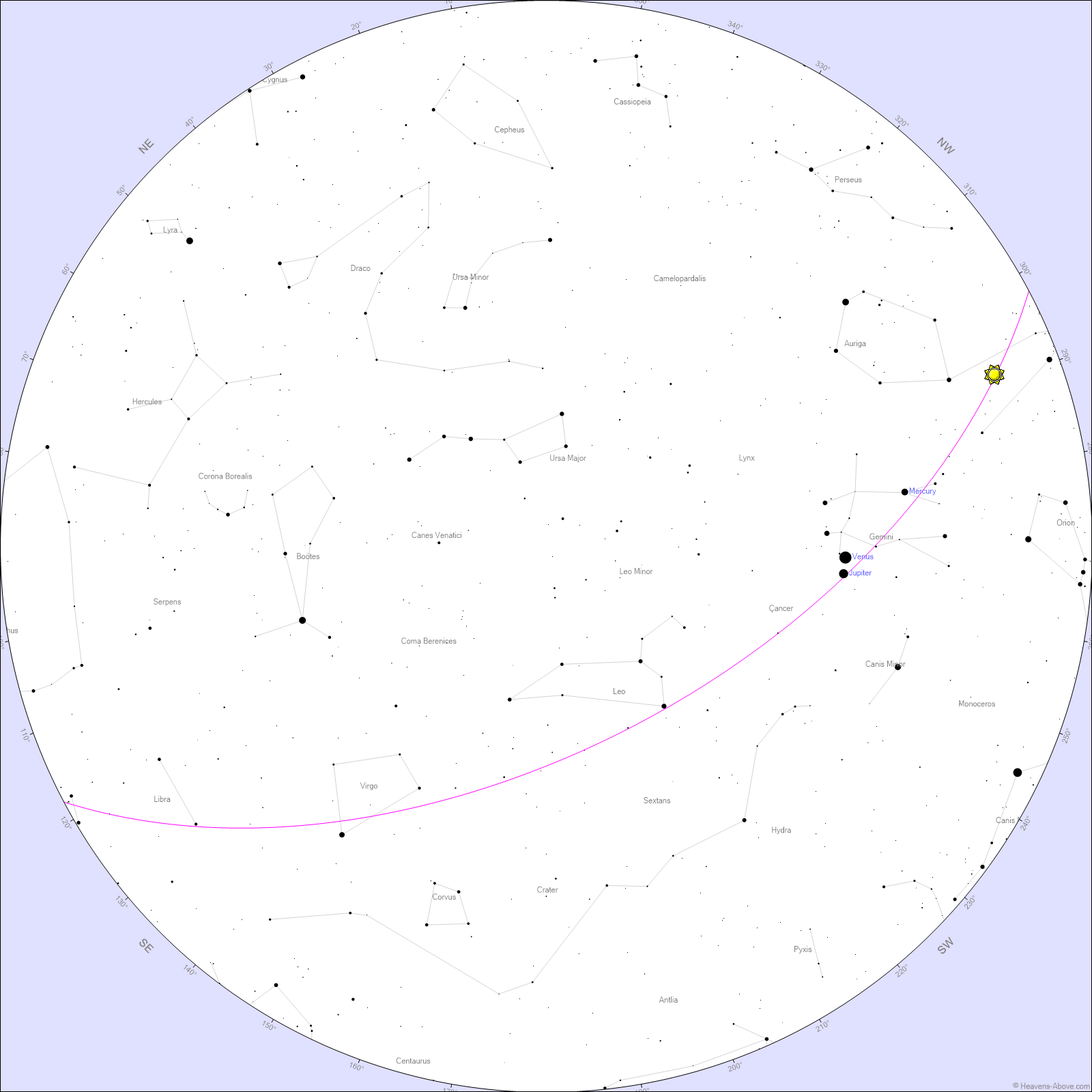
Look for a brilliant Venus-Jupiter conjunction this week on June 8 and 9. Venus is our neighbor at around 111 million miles away, but Jupiter is about five times that, despite their close proximity when viewed in the night sky.
Mark your calendar for a Moon and planet party on June 16 and 17. Shortly after sunset on June 16, the thin waxing crescent moon sits below bright Venus and alongside Jupiter, Mercury, and the stars Castor and Pollux in the constellation Gemini. The next night the crescent moon and Venus sit closer together, with Jupiter, Mercury, Castor and Pollux below.
Of course, if there’s one roadside attraction that draws crowds every summer, it’s the Perseid meteor shower. For many people, the Perseids serve as the unofficial grand finale of summer astronomy.
Each August, Earth passes through debris left behind by Comet Swift-Tuttle. Tiny grains of dust strike our atmosphere at tremendous speeds, producing brilliant streaks of light that race across the sky.
Most of those particles are no larger than grains of sand. Yet for a brief moment they create one of nature’s most spectacular light shows. And unlike many astronomical events, meteor showers don’t require equipment: Just a comfortable chair and patience. The wider your view of the sky, the better.
But the Perseids aren’t alone.
The Southern Delta Aquariids arrive in late July and help kick off meteor season. While less famous than the Perseids, they often provide a nice preview of what’s to come. Keep in mind, they are faint, and best observed from the southern hemisphere, but you may see some streaking from the south even in the northern hemisphere. They will appear to come from the south, while the Perseids radiate from the northern sky.
Every road trip needs a traveling companion, and throughout the summer the Moon faithfully joins us at nearly every stop.
This summer, the Moon has a particularly interesting event on its calendar. On August 27th, a deep partial lunar eclipse will darken a large portion of the Moon’s surface as Earth moves between the Sun and Moon, starting around 10 p.m. Eastern time. Maximum coverage is around 93% around 10:42 p.m. EST, so it should be quite dramatic.
No special equipment is required. You can simply step outside and witness Earth’s shadow crossing another world.
We’ve reached the part of every road trip where the miles begin slipping away, the destination approaches, and you realize you’ve been having so much fun that you don’t really want the trip to end.
The funny thing is, when that moment arrives, you rarely find yourself thinking about the destination. Instead, you remember the highlights, like the little diner you stumbled across in the middle of nowhere, the old neon sign glowing against the twilight, the conversation that somehow lasted three hours but felt like fifteen minutes, and the unexpected detour that turned out to be the best part of the entire trip. Those are the things that stay with you.
As I mentioned at the beginning of the show, I’ve always dreamed of driving the length of Route 66. Just heading west with cameras in hand and no particular urgency. Photographing whatever catches my attention, sharing stories on my travelogue, and watching the landscape change one mile at a time.
The older I get, the more I realize that’s exactly how I want to experience astronomy. Not as a checklist, a competition, or a race to see the most objects.
Most folks won’t remember the exact location of the Lagoon Nebula. They won’t remember the catalog number of a globular cluster, and they probably won’t remember whether a meteor shower peaked on the twelfth or the thirteenth. What they’ll remember is where they were when they saw it.
They’ll remember the excitement of seeing Saturn’s rings for the first time. They’ll remember the sudden appearance of a meteor flashing across the sky when nobody was expecting it, and they’ll remember the friend standing beside them when it happened.
Over the next three months, there’ll be plenty of opportunities to create memories. The Summer Triangle will climb overhead, the Milky Way will arch across dark skies like a river of starlight, and globular clusters, nebulae, planets, and meteor showers will all take their turn stepping into the spotlight. The Perseids will come and go, the Moon will wax and wane, and the nights will slowly begin arriving earlier again.
Before we know it, autumn will be knocking at the door. By Labor Day, the great summer road trip will already be winding down. The Summer Triangle will be leaning westward, the evenings will carry the first hints of cooler air, and we’ll find ourselves looking ahead to a different season and a different sky.
So this summer, don’t worry too much about checking every object off a list. Don’t stress about finding perfect observing conditions, and don’t feel like you have to see everything. Instead, take the scenic route. Spend time wandering through the Milky Way with a pair of binoculars. Sit in a lawn chair beneath the stars. Stay outside a little longer than you planned. Follow your curiosity and take a few detours.
Even though we’ve just spent this episode touring the summer sky, it’s worth remembering that astronomical summer hasn’t officially arrived yet. The summer solstice occurs on June 21st, marking the longest day of the year in the Northern Hemisphere and the official beginning of summer.
Still, the sky is already beginning to make the transition.
This week the Moon is waning, reaching Last Quarter on June 8 before continuing toward New Moon on June 14. That means each night will bring darker skies and improving conditions for deep-sky observing. If you’ve been wanting to explore the Milky Way, track down a globular cluster, or simply spend some time under a dark sky, this is an excellent week to do it.
The headline event this week is a spectacular conjunction between Venus and Jupiter that we touched on earlier. On the evenings of June 8 and 9, the two brightest planets in the night sky will appear very close together low in the western sky shortly after sunset. Venus shines brilliantly at magnitude -4, while Jupiter glows nearby like a bright cream-colored beacon. The pair will be impossible to miss if you have a clear western horizon.
Mercury is also joining the party. As the week progresses, look low in the western twilight beneath Venus and Jupiter. By the end of the week, you’ll have the beginnings of a miniature planet parade, with three planets sharing the same region of sky.
Meanwhile, Saturn continues to improve in the morning sky, rising earlier each day and becoming easier to observe before dawn. If you’re an early riser, you’ll find it shining in the southeastern sky during the hours before sunrise. Mars remains visible as well, though it’s far less conspicuous than Venus, Jupiter, or Saturn.
As for constellations, rather than revisiting some of the headline summer favorites we’ve already discussed, I’d encourage you to spend some time with Lyra. It’s a relatively small constellation dominated by the brilliant star Vega, but hidden within it is the Ring Nebula. Even if you don’t have a telescope, Lyra is worth learning simply because it sits at the gateway to the Summer Triangle and serves as a jumping-off point for exploring the summer Milky Way.
And finally, if you happen to spot a meteor this week, there’s a chance it belongs to the daytime Arietids or the occasionally unpredictable June Bootids. Neither shower is expected to put on a major display, but summer meteor season is beginning to stir, offering a hint of what’s to come when the Perseids arrive later this summer.
And speaking of meteors, my home state made some national news last week after a mysterious sonic boom rocked several midland counties. The sound rattled homes and sent many folks to social media wondering what had happened.
While the cause remains uncertain, some experts have suggested a meteor may have been responsible. Similar atmospheric explosions have been confirmed elsewhere recently, including a meteor that exploded over New England a few days ago with enough force to create sonic booms heard across several states.
Now, we can’t say for certain that our South Carolina boom was connected to any of the meteor showers I just mentioned. But it hasn’t been ruled out either. Most shower meteors are tiny grains of dust that burn up harmlessly in the atmosphere. Every now and then one of those visitors arrives with a little more enthusiasm than expected.
I was outside on my daily walk when this particular boom reverberated through the sky. It didn’t sound like a jet, or an earthquake. It was a singular boom, not unlike the sound made by a cannon, and many videos from home security cameras have confirmed this.
As I’m writing this episode, there’s still no explanation, so the South Carolina Boom remains a mystery!
That’s going to do it for this week. If tonight’s episode sparked your curiosity, or maybe gave you something new to think about the next time you look up, I’d be honored if you shared Star Trails with someone who might enjoy the journey. You can always find the latest episodes, show notes, and extras at startrails.show.
And if you’d like to help support the show, there’s also a little “buy me a coffee” link on the site. It genuinely helps keep these stories coming.
Be sure to follow Star Trails on Bluesky and YouTube — links are in the show notes. Until we meet again beneath the stars … clear skies everyone!
Support the Show
Connect with us on Bluesky @startrails.bsky.social
If you’re enjoying the show, consider sharing it with a friend! Want to help? Buy us a coffee! Also, check out music made for Star Trails on our Bandcamp page!
Podcasting is better with RSS.com! If you’re planning to start your own podcast, use our RSS.com affiliate link for a discount, and to help support Star Trails.


Leave a Reply