From the Archive: Star Party Stories – Star Trails: From Backyard Astronomy to Cosmic Wonder
Episode 114
Back in November of 2024, I attended a star party hosted by the Midlands Astronomy Club and recorded what became one of my favorite episodes of Star Trails. This week, while taking a short break to recharge and prepare future episodes, I thought it would be the perfect time to revisit that night under the stars.
In this remastered archive presentation, we’ll head out to a dark-sky observing site where amateur astronomers gather with telescopes, guitars, stories, and a shared fascination with the cosmos. Along the way, you’ll hear conversations with longtime stargazers, club members, and curious newcomers as we explore what makes star parties so special — and why astronomy is often just as much about community as it is the night sky itself.
You’ll hear stories about first telescopes, vintage gear, cloudy-night camaraderie, public outreach, and the unforgettable experience of seeing Saturn or the Moon through a telescope for the very first time. Even when the weather refuses to cooperate, the sense of wonder remains.
This episode features newly recorded narration and updated audio production, but otherwise remains preserved as originally released in 2024. Whether you’re hearing it for the first time or revisiting it alongside me, I hope it reminds you why we gather beneath the stars in the first place.
Transcript
Howdy stargazers and welcome to this episode of Star Trails. My name is Drew and I’ll be your guide to the night sky for the week of May 31st to June 6th.
There are some episodes that end when you publish them. And there are others that linger.
Over the last 113 episodes of Star Trails, we’ve talked about black holes, dying stars, distant galaxies, radio telescopes, ancient astronomers, and worlds beyond our reach. But every now and then, I find myself thinking back to a much quieter episode.
A year and a half ago, I packed a recorder, drove out into the dark countryside, and spent an evening at a star party with members of the Midlands Astronomy Club.
At the time, I thought I was just gathering tape for an episode. But listening back now, I realize I captured something else.
Not just telescopes and astronomy talk, but the feeling of amateur astronomy itself. The folding chairs. The red flashlights. Old telescope cases covered in dew. The conversations that drift between Saturn, weather forecasts, guitars, and stories about department store telescopes from 1985.
In a hobby increasingly dominated by apps, automation, and glowing screens, there’s something timeless about a group of people gathering under a dark sky simply to look up together.
So this week, while I take a short break, I wanted to revisit one of my favorite episodes from the archive — remastered a bit, with newly recorded narration, but otherwise preserved exactly as it was.
This is Star Trails, episode 41: Star Party Stories.
And be sure to stick around after the segment for a quick look at this week’s night sky.
So settle in, and let’s head back out under the stars.
SOUND: Ambient crowd noise, gentle guitar strumming
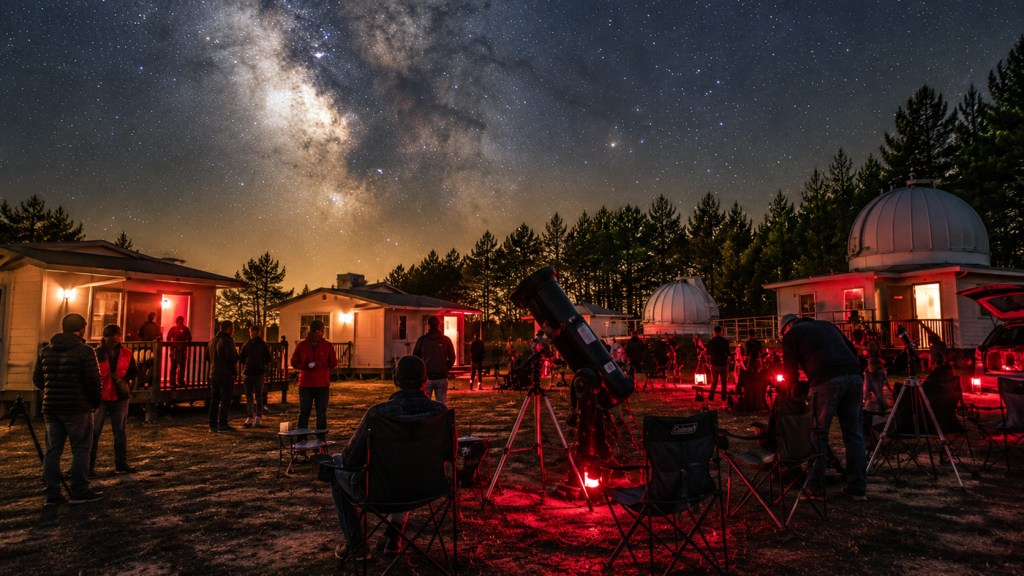
VO: Being at a star party is like stepping into a shared dream—a mix of curiosity, excitement, and a touch of nostalgia. Tonight, the Midlands Astronomy Club converges at one of their secluded observation sites. The twice-yearly gathering is a chance for family, friends and those curious about the hobby.
After an hour’s drive northward, with daylight waning, I arrived at the club’s dark sky sanctuary, just in time to join the familiar faces that bring these nights to life — seasoned observers, club veterans, and newcomers. Telescopes of all kinds already point skyward, waiting for nightfall.
Skies are clear for now, but a front is forecasted to arrive this evening and that could bring clouds or even rain. The real star of the event is the food, and we’ll enjoy the cookout, even if observation is impossible.
SOUND: Sizzling grill
Club president Mike Roberts, who normally plans the club’s monthly meetings and topics, has one of the most important roles of the night. Manning the grill:
MIKE: “Most of us have been doing this for our entire life. And, you know, it’s a hobby that we pursued. And, I just like getting out there and looking, looking at the sky.”
VO: But it’s not just about looking at the stars — it’s about sharing that fascination, connecting with others who feel the same pull of the cosmos. Hap Griffin was one of the original members to build an observatory on the site some years ago.
HAP: Well, you know, it’s a chance for people like us that are just enamored by the night sky to get together. And, commensurate about things that we like to, you know, the similarities of the things that we like together and getting together with people that are interested in the same things. You two are under a really magnificent night sky is just just the best.
VO: Between Hap’s observatory and his neighbor Frank’s, an impromptu gathering place has formed. Astronomers huddle together, guitars in hand, sharing melodies and stories beneath the darkening sky. Most of these club members have known each other for years. I’m a relative newcomer, but before I knew it, someone handed me a guitar and invited me to join in over the murmur of cosmic chatter.
SOUND: People discussing constellations
FRANK: Quote about building a scope/hauling the scope around.
SOUND: Ambiance
WES: “Well, I joined the club when I was 13 or 14 years old. I’ve been in astronomy since 1985 as a first grader.”
VO: That’s past club president Wes Munn.
WES: I started with a department store telescope from the old Service Merchandise. You probably remember those in the 80s. It showed me the craters of the moon. And I thought only PhD scientists could see that. I treated that thing like it was my own Lowell Observatory or, you know, Mauna Kea Observatory. I just felt like I just discovered the moon myself.
VO: For many, telescopes are more than tools — they’re extensions of a passion for the stars, each scope reflecting its owner’s unique story.
SOUND: Steve’s scope
Amateur astronomer Steve Dornburg takes pride in using what would be deemed a vintage scope nowadays. His blue, gray and gold Dynamax scope looked futuristic in the early 80s, but has since graduated to retro-cool status, judging by how many gawkers he gets when he sets it up.
STEVE: Assuming I can keep my optics from fogging up, I’ll get my eight inch Schmidt-Cassegrain made by Dynamax, which is no longer in production. Out here. And we’ll take a look at some stars.
VO: In an era when most astronomers are using some sort of computer-assisted guiding, or a smart scope, Steve relies on methods more in line with the age of his scope, which still renders beautiful views of planets and deep sky objects.
STEVE: It’s all about the optics. At the end of the day, I don’t have a lot of the gee whiz, computer technology because I simply didn’t exist when I bought the telescope. But it can track. It does have a drive motor that can track if I align it properly. And, other than that, I have a Tyrian epoch 2000 star chart in here, that I can look things up, and it’s not totally current. Some of the stars may have drifted a bit in 24 years, but they should be relatively close for my right ascension, and declination may be a bit off, but, hey.
VO: Across the field, a crowd has lined up to view the setting sun through a solar scope.
SOUND: Solar observations
VO: Guests quickly learn that if a scope is pointed at the sky, chances are they’ll be invited to peer into it.
HAP: When you come to a star party, there’s going to be generally a number of different types of telescopes to look through. If you’re trying to get an idea for a telescope that you might want to buy. If you’re a beginner, it’s great to look through a lot of different types of telescopes. Because there’ll be a half a dozen different types of scopes here, and you can see what the pluses and minuses are of each and things like that. So a star party is a great chance to, to actually, kick the tires. So to speak, on other people’s equipment. And they’re happy for you to look through it or they wouldn’t have brought it.”
SOUND: Paul at his scope
VO: For Paul Romanyszyn, who has been the club’s observation chairman for 20 years, education is at the core of the club’s mission.
PAUL: “One of the things is as if you have a telescope for long enough, you need motivation to take it out. So the reason to take it out is to show people stuff.”
VO: And it’s true. There’s an excitement in introducing someone to their first sight of Saturn’s rings or a star cluster. The reactions are often the same – a moment of disbelief, followed by awe.
SOUND: Paul at his scope
PAUL: We do programs for schools. We try to do them around the first quarter moon. So there’s something that’s got nice visuals.
VO: The clouds that were threatening earlier have officially rolled in, covering up the handful of twilight targets that were being studied.
SOUND: Blues guitar
VO: But no one is singing the blues.
HAP: Some of our best star parties have been where it did cloud up, and we just all sat around and talked. I remember one, we were supposed to watch a meteor shower, I think, and a bunch of us got together and we didn’t see a single meteor, but we sat around and talked, and I thought, here, people that know what I’m talking about, and they and I know what they’re talking about, you know, and when I mentioned some big technical term or some concept, the fact that they understand what I’m talking about and that they’re talking about the same things that I’m talking about, it was just it was it was enlightening. It was like, hey, Bing, you know, the light went off. You know, I’ve got to be a part of this forever.
VO: Drizzle has begun and several of us hastily toss our gear into cars and prepare for the long ride home. For most newcomers the experience has been worth it.
FEMALE OBSERVER: “I saw Saturn and I saw the moon right next to Saturn, which I am very surprised to see in this telescope… how you are able to see a different side of Saturn. And I also enjoyed this solar telescope. That was very surprising. I actually didn’t expect to see a spot on the sun.”
MALE OBSERVER: “I saw Saturn pretty close. It was pretty unique. I saw the moon, and I saw the sun earlier.”
SOUND: Light rain
VO: The sky, to these stargazers, is a canvas that stretches into infinity. It’s alive with stories that reveal new wonders. Each time they look, they see something new — a brightening star, a comet, or simply the vastness of space itself.
MIKE: “The sky is not painted on. It actually has depth and meaning. If you look at the sky through a telescope… you’re going to see farther out. So basically what it is is that no matter, no matter, you know, when you look at it, it’s like you’re always going to be able to see more.”
SOUND: Mandolin and guitar music, relaxed crowd noise
VO: Here, it’s rarely JUST about what you see. It’s the moments of shared wonder and the camaraderie that binds them together — under a sky that feels a little less vast when shared with others.
I hope you enjoyed that report from the field, and special thanks go to all the folks who agreed to be interviewed. You can learn more about the club at their website, midlandsastronomyclub.com.
After a quick break we’ll be back with this week’s night sky. Stay with us.
Welcome back.
As we close out May and prepare to head into June, the night sky is offering up some beautiful late-spring observing opportunities — especially if you can get away from city lights for a while.
Tonight is a rare Blue Moon — the second full moon of the month. Despite the name, the Moon won’t actually appear blue, but it’s still a fun calendrical oddity that only happens every couple of years. This particular Blue Moon is also what astronomers call a “micromoon,” meaning the Moon is slightly farther from Earth in its orbit and may appear just a little smaller than usual.
Even with the growing moonlight, there’s still plenty to see.
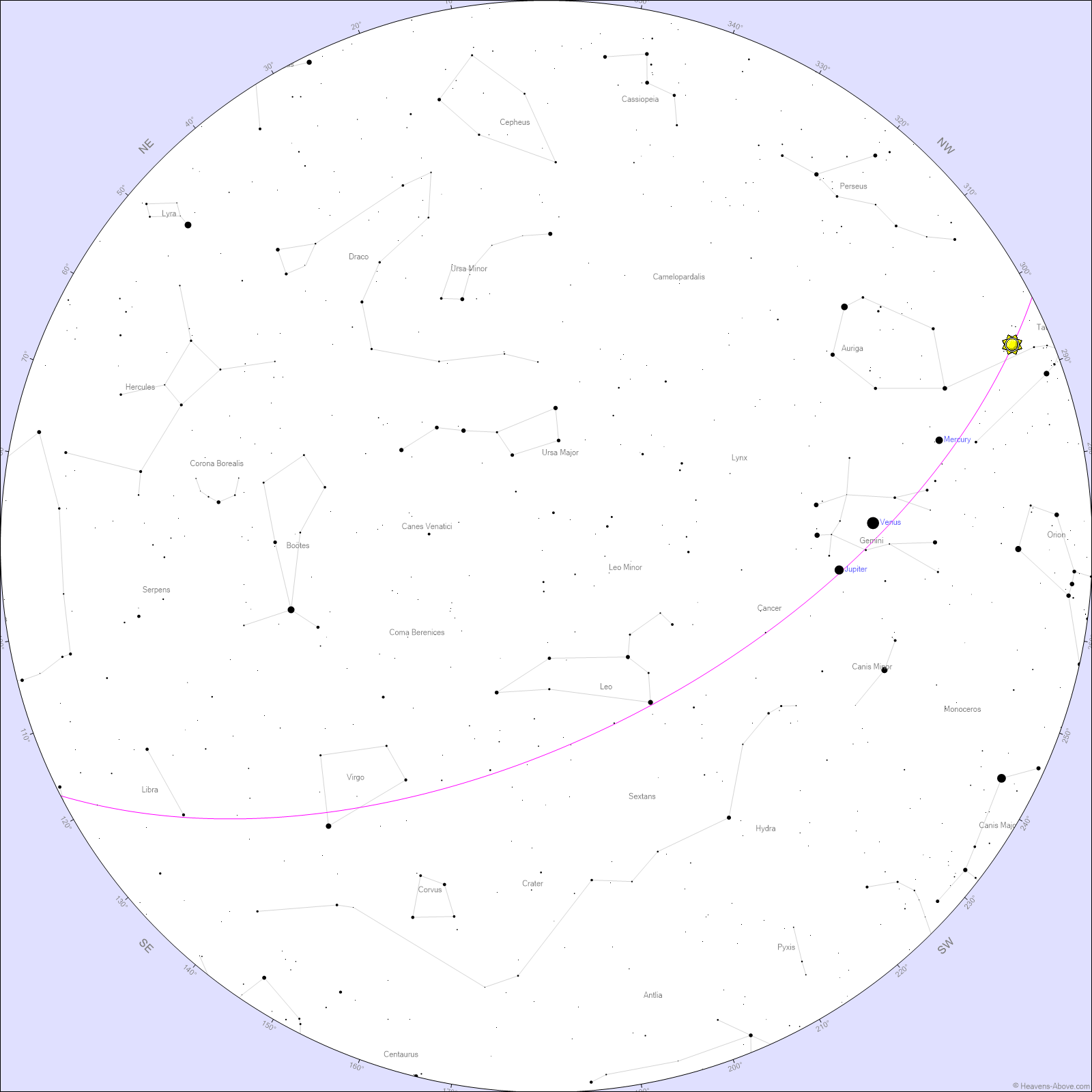
Look toward the western sky shortly after sunset and you’ll spot brilliant Venus shining like an aircraft landing light in the twilight. Jupiter is nearby as well, and the two brightest planets in our sky are slowly drawing closer together for a spectacular conjunction coming up in early June.
Mercury is also beginning to creep into the evening sky very low on the horizon, though it may require binoculars and a very clear western view to catch it.
If you’re willing to get up before dawn, Saturn and Mars are making their return to the morning sky. Saturn rises first in the east before sunrise, with reddish Mars hanging nearby lower on the horizon. Telescopically, Saturn is still sitting fairly low for northern observers, so the atmosphere may make it shimmer a bit, but the rings are unmistakable.
Late spring also marks the return of the Milky Way to the evening sky. By midnight, the bright core of our galaxy begins lifting itself above the southeastern horizon, especially visible from darker rural locations. This is one of my favorite times of year because the sky begins transitioning away from the sparse constellations of winter and into the richer star fields of summer.
Now, let’s turn our attention toward the constellations Boötes and Hercules, now climbing high in the eastern sky during the evening hours. Boötes is anchored by brilliant orange Arcturus, one of the brightest stars in the entire night sky and a reliable beacon this time of year. Nearby is the constellation Hercules, home to one of the finest globular clusters visible in the northern hemisphere: Messier 13.
Under dark skies, M13 appears as a faint fuzzy patch between the stars of Hercules. Through binoculars, it begins to resolve into a grainy ball of light. And through even a small telescope, it explodes into hundreds of ancient stars packed tightly together, a swarm containing perhaps several hundred thousand suns orbiting the outskirts of our galaxy. The light leaving that cluster tonight began its journey toward Earth around the time humans were first developing agriculture.
That’s going to do it for this week. If tonight’s episode sparked your curiosity, or maybe gave you something new to think about the next time you look up, I’d be honored if you shared Star Trails with someone who might enjoy the journey. You can always find the latest episodes, show notes, and extras at startrails.show.
And if you’d like to help support the show, there’s also a little “buy me a coffee” link on the site. It genuinely helps keep these stories coming.
Be sure to follow Star Trails on Bluesky and YouTube — links are in the show notes. Until we meet again beneath the stars … clear skies everyone!
Support the Show
Connect with us on Bluesky @startrails.bsky.social
If you’re enjoying the show, consider sharing it with a friend! Want to help? Buy us a coffee! Also, check out music made for Star Trails on our Bandcamp page!
Podcasting is better with RSS.com! If you’re planning to start your own podcast, use our RSS.com affiliate link for a discount, and to help support Star Trails.


Leave a Reply