The Birth and Death of Galaxies – Star Trails: From Backyard Astronomy to Cosmic Wonder
Episode 113
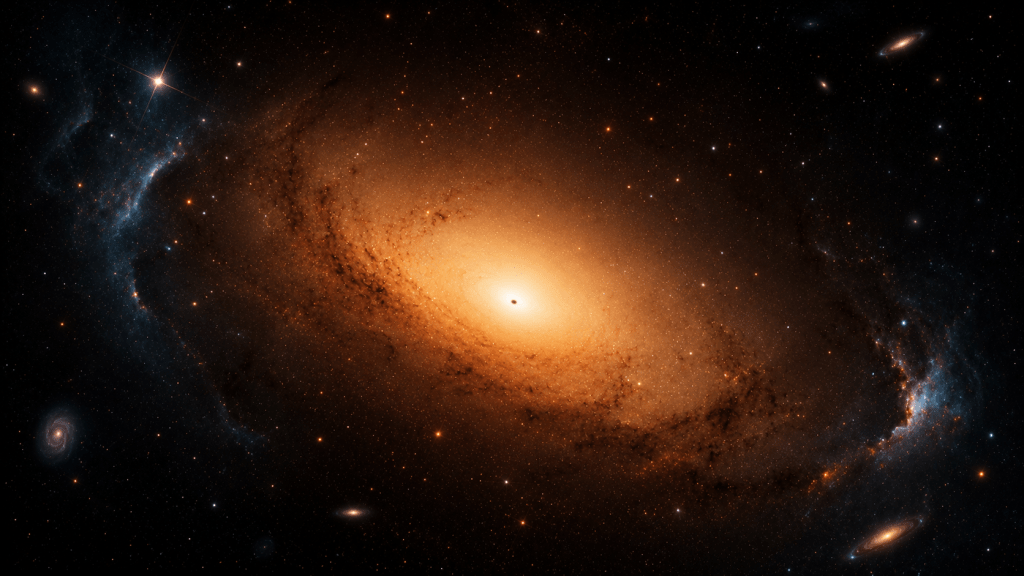
This week we conclude our month-long journey through galaxies by exploring one of the biggest questions in astronomy: how galaxies are born, evolve, and eventually die.
We begin in the aftermath of the Big Bang, tracing how tiny fluctuations in matter slowly grew into the first galaxies. Along the way, we explore starburst galaxies, galactic recycling, and the remarkable realization that the elements making up planets, oceans, and even human beings were forged inside ancient generations of stars.
Then we dive into one of the universe’s greatest mysteries: supermassive black holes. Why do most galaxies appear to contain them? Where did these enormous black holes come from? And did galaxies create black holes, or did black holes help create galaxies? We’ll also explore active galactic nuclei, quasars, and the astonishing discovery that some black holes may have formed far earlier than astronomers once believed possible.
Finally, we examine the groundbreaking discoveries of the James Webb Space Telescope and the ancient galaxies it has revealed, galaxies appearing surprisingly massive and chemically evolved only a few hundred million years after the Big Bang. We close by looking toward the distant future, where galaxies fade into quiet “red and dead” remnants, and where strange objects like jellyfish galaxies reveal that even galaxies themselves can slowly suffocate and die.
Plus:
- This week’s night sky for May 24–30, 2026
- The mythology and zodiac lore of Leo
- A look at the Blue Moon arriving on May 31st
- Planet visibility for Venus, Jupiter, Mars, and Saturn
- And a deep sky visit to Messier 87 — the galaxy whose supermassive black hole became the first ever directly imaged by humanity.
Transcript
Howdy stargazers and welcome to this episode of Star Trails. My name is Drew and I’ll be your guide to the night sky for the week of May the 24th to the 30th.
This week we wrap up our month-long exploration of galaxies by examining how they form and ultimately die. Our journey will take us from the hot early beginnings of the universe, to the dark end times when even black holes begin fading away.
Later in the show we’ll explore this week’s night sky, and take a trip through one of the iconic constellations of summer.
Whether you’re tuning in from the backyard or the balcony, I’m glad you’re here. So grab a comfortable spot under the night sky, and let’s get started!
Just a quick note here at the top of the episode. We’ll be taking a break next week, and I’ll likely publish episodes every two weeks during the summer months. This time of year can be tough for astronomy as we have longer days to contend with, and I know many of you are spending more time with your family or travelling.
This shift in the schedule will allow me to recharge a bit myself, and develop some new content for the show before resuming our normal weekly schedule.
As always, if you have any questions, or would like to suggest topics for coverage, contact me over at our website, startrails.show.
Over the past several weeks, we’ve talked about galactic collisions, dark matter, invisible structure, magnetic fields stretching across intergalactic space, and the strange realization that galaxies are not isolated islands at all, but part of an enormous cosmic web spanning the universe.
But tonight, I want to step back and ask a more fundamental question: Where do galaxies actually come from?
How does something as enormous as the Milky Way come into existence in the first place? Why do so many galaxies contain supermassive black holes at their centers? Did galaxies create those black holes, or did black holes help create galaxies? And why is the James Webb Space Telescope discovering ancient galaxies that seem to have formed far earlier than they theoretically should have?
And finally, do galaxies die?
Tonight, we’re talking about the birth, evolution, and eventual fading of galaxies themselves.
If you could travel back to the earliest moments of the universe, you wouldn’t see galaxies, stars, or planets. The early universe was a hot, expanding sea of particles, mostly hydrogen and helium forged in the aftermath of the Big Bang nearly 13.8 billion years ago.
For hundreds of thousands of years, the cosmos was so hot and dense that light itself could barely travel freely. But as the universe expanded and cooled, atoms began to form. Eventually, the first light escaped into space. Today, we still detect that ancient radiation as the cosmic microwave background, the faint afterglow of the Big Bang itself.
But the universe was still dark.
No stars yet. No galaxies. Just enormous clouds of gas spread across expanding space. And yet the seeds of galaxies already existed.
Tiny fluctuations in density, almost unimaginably small variations in the distribution of matter, were scattered throughout the early universe. Some regions contained slightly more matter than others. Gravity amplified those differences over millions of years.
And lurking invisibly within all of this was something we still do not fully understand: Dark matter, which we talked about extensively in last week’s episode.
Based on everything astronomers can measure, galaxies appear to form inside gigantic halos of invisible matter. These halos acted like gravitational scaffolding in the young universe, helping pull ordinary matter into dense regions where stars and galaxies could begin to form.
In other words, galaxies may have been built inside invisible structures before the galaxies themselves even existed. That idea still sounds like science fiction.
Even now, nobody knows exactly what dark matter is. But without it, galaxies may never have formed at all.
Over time, enormous clouds of hydrogen collapsed under gravity. The first stars ignited. Small protogalaxies merged together into larger galaxies. Gravity built structure slowly, patiently, over billions of years.
Galaxies were born not in an instant, but through accumulation, collision, and time. Some became spirals, like the Milky Way or the Andromeda Galaxy, with elegant rotating arms filled with gas, dust, and star formation. Others became giant elliptical galaxies, vast football-shaped systems dominated by older stars. And some remained chaotic irregular galaxies, warped and distorted by gravitational encounters and cosmic turbulence.
The universe itself was also very different back then. The young cosmos was far more violent than the one we inhabit today.
Galaxies collided more frequently. Quasars blazed across intergalactic space. Star formation rates were dramatically higher. The universe was crowded, chaotic, and energetically alive.
In many ways, the calmer modern universe we inhabit today is the aging aftermath of a much wilder cosmic youth.
Some galaxies experienced enormous bursts of star formation during these chaotic eras. Astronomers call these starburst galaxies.
One spectacular example is the galaxy Messier 82, a galaxy undergoing furious star formation likely triggered by gravitational interactions with neighboring galaxies. It is creating stars at a rate many times faster than galaxies like our own.
The process is so intense that gigantic winds of hot gas are blasting outward from the galaxy itself, meaning entire galaxies can briefly become cosmic furnaces. And all of this stellar activity transforms the galaxy chemically over time, because galaxies aren’t merely collections of stars, they’re recycling systems.
Stars forge heavier elements through nuclear fusion, oxygen, carbon, silicon, iron, and when those stars die, they return those materials back into the galaxy through stellar winds and supernova explosions.
Without ancient generations of stars living and dying long before the Sun formed, rocky planets and life itself could not exist. In a very literal sense, galaxies manufacture the raw ingredients that make us.
And at the center of many galaxies lies something even stranger, a supermassive black hole.
For a long time, astronomers thought black holes might simply be exotic oddities, rare objects hidden in isolated corners of space. Now we know they appear to be almost everywhere.
The Milky Way contains a supermassive black hole known as Sagittarius A*. Although it contains roughly four million times the mass of our Sun, it occupies a region of space smaller than our solar system.
The black hole at the center of Messier 87 is vastly larger, containing billions of solar masses. In 2019, astronomers working with the Event Horizon Telescope produced the first direct image of a black hole’s shadow using observations of M87’s central black hole.
That now-famous glowing orange ring became one of the defining scientific images of the modern era.
But supermassive black holes pose one of astronomy’s greatest mysteries. Where did they come from?
Astronomers have discovered quasars powered by enormous black holes existing less than a billion years after the Big Bang. Some already contained billions of solar masses astonishingly early in cosmic history. And that creates a major problem.
Black holes grow by consuming matter, gas, dust, stars, and anything else unfortunate enough to drift too close. But growth takes time. In some cases, there simply may not have been enough time in the early universe for these black holes to become so enormous through ordinary feeding alone.
So astronomers have proposed several ideas.
One possibility is that the first generation of stars in the universe, so-called Population III stars, were gigantic compared to most modern stars. When those enormous stars died, they may have collapsed into relatively massive “seed” black holes that later grew into supermassive giants.
Another idea is even stranger.
Some researchers suspect enormous primordial gas clouds may have collapsed directly into black holes without forming stars first. These hypothetical “direct collapse” black holes may have started out already containing tens of thousands, or even hundreds of thousands, of solar masses.
In other words, some black holes may have been born huge.
And then there is an even deeper mystery. Did galaxies create black holes, or did black holes help create galaxies?
For decades, astronomers assumed black holes formed inside galaxies as a kind of byproduct. But observations now suggest the relationship may be far more intertwined.
The mass of a galaxy’s central black hole often correlates closely with the size and structure of the galaxy surrounding it. Bigger galaxies tend to host bigger black holes. That correlation suggests galaxies and black holes somehow evolve together.
Some astronomers now suspect supermassive black holes may have acted almost like gravitational anchors in the young universe, helping organize matter around them and influencing how galaxies assembled over cosmic time.
The galaxy feeds the black hole, the black hole regulates the galaxy, and a kind of cosmic symbiosis develops.
And sometimes, when enormous amounts of matter fall toward these black holes, the result becomes one of the brightest phenomena in the universe: An active galactic nucleus.
As matter spirals inward, it forms a superheated accretion disk glowing with extraordinary energy. Magnetic fields twist and intensify. Jets of particles erupt outward at nearly the speed of light, blasting radiation across intergalactic space. These active galaxies can become so luminous that they outshine all the stars in the galaxy combined.
Quasars, the brightest active galactic nuclei, are visible across billions of light years of space. Which means some of the brightest objects in the universe are powered not by creation, but by matter falling into darkness.
These black holes may dramatically influence the fate of the galaxies around them. As matter falls inward and energy blasts outward, gas inside the galaxy can become heated or blown away entirely, and that suppresses future star formation.
And now we arrive at one of the biggest astronomical surprises of the modern era, the ancient galaxies discovered by the James Webb Space Telescope.
Astronomy is really an act of looking backward in time. Light travels at a finite speed, so the farther away an object is, the older the light we receive from it becomes. The Andromeda Galaxy appears to us as it existed more than two million years ago. More distant galaxies appear as they existed billions of years ago.
As the universe expands, the light from extremely distant galaxies becomes stretched into longer wavelengths, a phenomenon known as redshift.
You can think of it almost like sound from a receding siren lowering in pitch as it moves away from you. Except instead of sound waves stretching, it’s light itself being stretched by the expansion of space.
Visible light from some of the earliest galaxies becomes shifted so dramatically that by the time it reaches Earth, it arrives as infrared light, and that’s one reason Webb is so powerful. It was specifically designed to observe the ancient infrared glow of the early universe.
And what Webb found surprised astronomers almost immediately.
Researchers expected to find small, primitive galaxies slowly assembling themselves shortly after the Big Bang. The early universe was supposed to contain messy galactic building blocks, not mature giant systems.
Instead, Webb started finding galaxies that appeared far brighter, more massive, and more chemically evolved than expected astonishingly early in cosmic history.
One example is a galaxy known as JADES-GS-z14-0, observed at a time when the universe was less than 300 million years old, so extraordinarily early. And yet this galaxy already appeared luminous and developed.
Some early Webb observations hinted at galaxies containing unexpectedly large numbers of stars only a few hundred million years after the Big Bang, as though galaxies had evolved too quickly.
In some cases, Webb even detected evidence of heavier elements already existing inside these early galaxies. That matters because the Big Bang primarily produced hydrogen and helium. Heavier elements like oxygen, carbon, and iron, must be forged inside stars and distributed through supernova explosions.
Which means some stars in these ancient galaxies may have already lived and died astonishingly quickly.
Webb is clearly forcing astronomers to rethink parts of the timeline of galaxy formation. Maybe early star formation was dramatically more efficient than expected. Maybe dark matter structures formed faster. Maybe black holes played a role much earlier than anticipated. Or maybe the young universe was simply stranger than our models predicted.
Galaxies are not permanent things. They evolve, collide, eat other galaxies, but eventually, they die.
The Milky Way itself may be on a collision course with the Andromeda Galaxy. In roughly four to five billion years, there’s a chance the two galaxies will experience a long gravitational interaction that will eventually reshape both galaxies.
Their spiral arms will distort and unravel. Vast streams of stars will arc through intergalactic space. Giant clouds of gas may collapse and trigger enormous waves of star formation, before settling into a giant elliptical galaxy.
And after that, things begin to quiet down.
Galaxies slowly consume the gas needed to create new stars. The bright blue stars die first, leaving older red stars behind. Star formation slows. Spiral structure fades. Astronomers sometimes refer to old inactive galaxies as “red and dead.” These galaxies might be full of material, but their great era of creation has largely ended.
Some galaxies die even more dramatically.
Astronomers have discovered so-called jellyfish galaxies, systems moving through dense galaxy clusters so rapidly that enormous streams of gas are literally stripped away behind them, leaving tendrils stretching across intergalactic space like cosmic jellyfish drifting through dark water. One famous example is ESO 137-001, discovered in 2005.
As these galaxies plunge through the hot gas filling galaxy clusters, pressure strips away the raw material needed for future star formation. In a sense, the galaxy is being suffocated, leaving a 260,000 light-year long tail behind in the process.
Astronomers sometimes describe galaxies transitioning between active blue star-forming systems and older red dormant systems as “green valley” galaxies, a kind of galactic middle age where star formation begins fading away.
Galaxies age. Trillions of years from now, galaxies may become darker and quieter still. White dwarfs will cool. Neutron stars will drift through darkness. Black holes may become some of the final surviving structures in the cosmos.
A galaxy does not die in fire; it dies in silence.
Right now, we live during one of the few eras in cosmic history when galaxies are still actively forming stars, colliding, evolving, and illuminating the darkness between them. We exist at a moment when the universe is still bright enough for us to witness it.
And perhaps most remarkable of all, the universe became conscious enough to observe itself. Not bad for a species living on a small rocky planet inside one ordinary spiral galaxy.
After a quick break we’ll be back with this week’s night sky. Stay with us.
Welcome back.
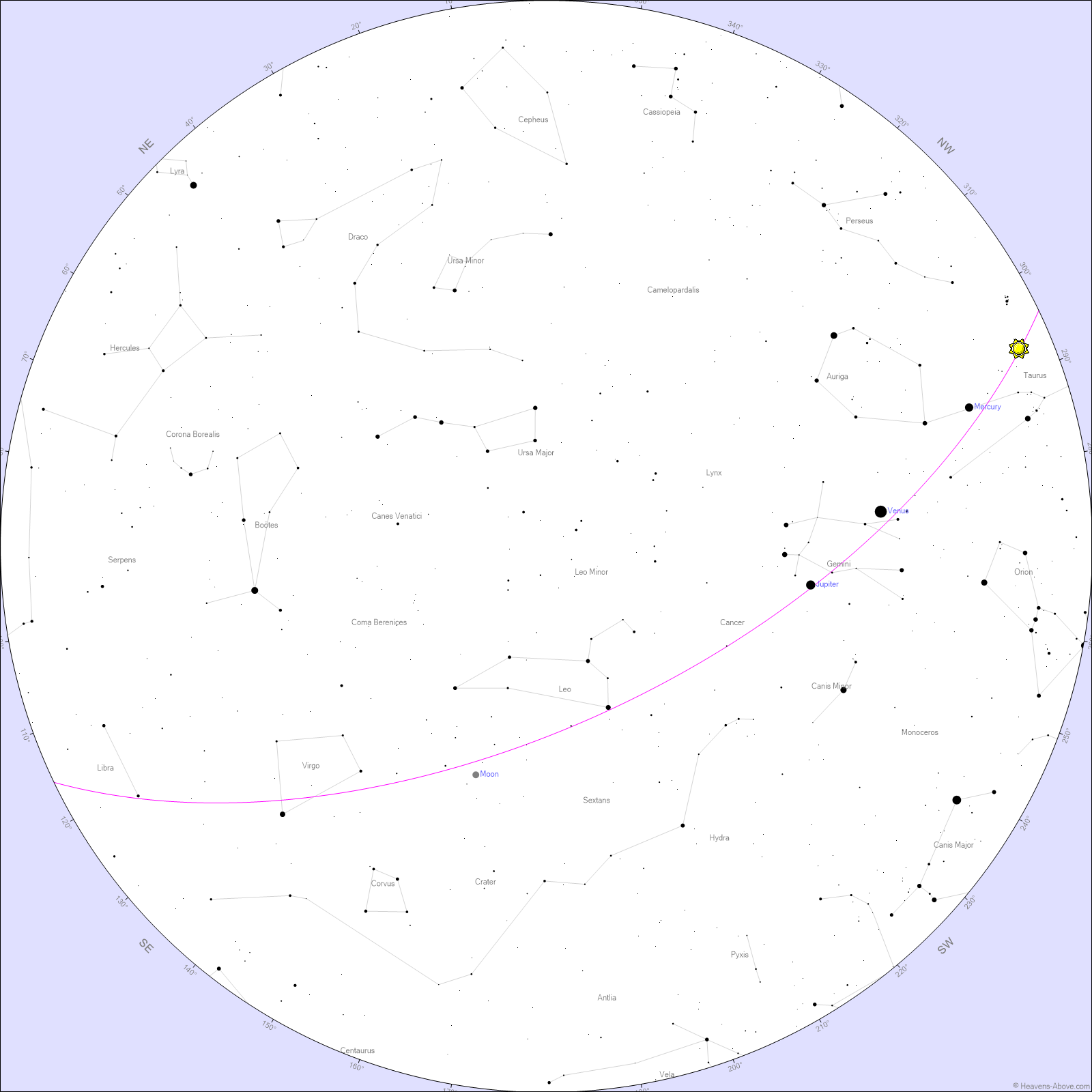
We’re heading toward the end of May now, and the sky is beginning to shift from the familiar constellations of spring toward the richer star fields of summer. If you head outside after sunset this week, you’ll notice the evenings growing warmer, the twilight lingering a little longer, and the Milky Way beginning to rise higher in the overnight hours.
And fortunately for backyard astronomers, the Moon will cooperate fairly nicely for much of the week. The Moon reached First Quarter on May 23rd, so early in the week we’ll be dealing with a waxing gibbous Moon hanging in the evening sky. That means the Moon will grow brighter night after night as we approach the second Full Moon of May on the 31st, a so-called “Blue Moon.”
Despite the name, the Moon will not actually appear blue.
Traditionally, the phrase “Blue Moon” referred to the third Full Moon occurring within a season containing four Full Moons instead of the usual three. But today, most people use the term to describe the second Full Moon occurring within a single calendar month.
That’s where the expression “once in a blue moon” comes from. It’s something relatively uncommon.
Actual blue-colored Moons can occur under very rare atmospheric conditions, usually after major volcanic eruptions or large wildfires when tiny particles in Earth’s atmosphere scatter red light and allow bluish wavelengths to dominate. But this month’s Blue Moon is purely a matter of calendar timing, not color.
Even though brighter moonlight will gradually begin washing out faint deep sky objects later in the week, the first half of the week still offers excellent opportunities for binocular observing and casual telescopic viewing.
First Quarter and waxing gibbous phases are wonderful times to study the Moon itself. Along the lunar terminator, the dividing line between lunar night and day, craters and mountain ranges cast long dramatic shadows across the surface. Even a modest telescope can reveal astonishing detail: rugged crater walls, lava plains, overlapping impacts, and wrinkle ridges stretching across ancient basalt seas.
As darkness falls this week, look toward the western sky after sunset and you’ll find brilliant Venus shining brightly in twilight. Nearby, you should also be able to spot Jupiter glowing above the western horizon. The two planets have been putting on an excellent evening show throughout May and continue drawing closer together in the sunset sky. With a modest scope, or even a pair of high magnification binoculars, you can catch a glimpse of Jupiter’s four large Galilean moons lined up beside the planet like tiny stars.
Meanwhile, early risers can still find Saturn low in the eastern sky before dawn, with reddish Mars nearby. The morning planets remain fairly low right now for northern hemisphere observers, but they hint at richer pre-dawn skies still to come as summer approaches.
This week, let’s spend some time with the constellation Leo, now drifting gradually toward the western sky during the evening hours.
Leo is one of the easiest constellations to recognize because it actually resembles what it’s supposed to be. The front half of the lion forms a backward question mark shape known as “The Sickle,” with the bright star Regulus marking the lion’s heart.
Leo is traditionally associated with the Nemean Lion from Greek mythology, a nearly invulnerable beast defeated by Hercules during the first of his twelve labors. According to legend, the lion’s hide could not be pierced by ordinary weapons, forcing Hercules to strangle it with his bare hands.
Afterward, the lion was supposedly placed into the sky by the gods, becoming the constellation we still recognize thousands of years later. Leo is also one of the constellations of the zodiac.
Long before astrology became newspaper entertainment, the zodiac simply referred to the band of sky through which the Sun, Moon, and planets appear to move over the course of the year. Because the Earth orbits within a relatively flat plane, the planets tend to trace similar paths across the sky, drifting through familiar constellations including Leo, Virgo, Gemini, and Scorpio.
This week the waxing Moon passes near Regulus early in the observing period, making it easier to locate the constellation if you’re still learning the spring sky.
But Leo also serves as a doorway into one of the richest galaxy regions visible from Earth.
Between Leo and Virgo lies the famous Virgo-Coma galaxy region, a sprawling collection of distant galaxies scattered across tens of millions of light years of space. With a moderate telescope under dark skies, observers can begin hunting faint smudges of light that are actually entire galaxies unto themselves.
And that feels particularly fitting after this month’s theme. You are literally looking out into an ocean of galaxies.
For a deep sky object this week, I’d recommend trying for Messier 87 in the constellation Virgo.
At first glance, M87 may not look especially dramatic through a small telescope. Unlike grand spiral galaxies, it appears mostly as a soft oval glow suspended in darkness roughly 53 million light years away.
But what you’re actually looking at is extraordinary.
M87 is a gigantic elliptical galaxy containing trillions of stars and dominating part of the nearby Virgo Cluster. And at its center lies one of the most famous black holes in astronomy, the supermassive black hole imaged by the Event Horizon Telescope in 2019.
That now-iconic glowing orange ring, the first direct image of a black hole’s shadow, came from this galaxy.
And hidden within that faint smudge of light is something even more astonishing. M87’s central black hole is actively launching an enormous jet of particles across space extending thousands of light years beyond the galaxy itself.
In other words, when you observe M87, you are looking at a galaxy whose central black hole is literally reshaping its cosmic environment. And perhaps even more hauntingly, galaxies like M87 may represent part of the future of the universe itself.
Old, massive, quiet. The remnants of countless galactic mergers stretched across cosmic time.
And finally, if you can stay up late, or head out before dawn, here’s another region hiding a black hole: The core of the Milky Way is beginning to return to the sky.
From dark locations away from city lights, you may notice a faint cloudy river of light stretching upward from the southeastern horizon overnight. That glow is the combined light of countless unresolved stars concentrated toward the center of our galaxy. It’s an amazing view, made even more amazing when you remember we’re seeing the internal structure of the galaxy we call home.
That’s going to do it for this week. If tonight’s episode sparked your curiosity, or maybe gave you something new to think about the next time you look up, I’d be honored if you shared Star Trails with someone who might enjoy the journey. You can always find the latest episodes, show notes, and extras at startrails.show.
And if you’d like to help support the show, there’s also a little “Buy Me a Coffee” link on the site. It genuinely helps keep these stories coming.
Be sure to follow Star Trails on Bluesky and YouTube; links are in the show notes. Until we meet again beneath the stars … clear skies everyone!
Support the Show
Connect with us on Bluesky @startrails.bsky.social
If you’re enjoying the show, consider sharing it with a friend! Want to help? Buy us a coffee! Also, check out music made for Star Trails on our Bandcamp page!
Podcasting is better with RSS.com! If you’re planning to start your own podcast, use our RSS.com affiliate link for a discount, and to help support Star Trails.


Leave a Reply