The Hidden Universe: Cosmic Structures in the Dark – Star Trails: From Backyard Astronomy to Cosmic Wonder
Episode 112
This week we continue our month-long journey through the world of galaxies, but this time, we venture into one of astronomy’s darkest frontiers. Beyond the glowing spirals and brilliant star clouds lies a universe filled with hidden structures, invisible matter, and mysteries that continue to challenge modern science.
We venture into the Zone of Avoidance, a cosmic blind spot created by the dust and stars of our own Milky Way, and ask whether entire galaxies may still be hiding just beyond our view. From ghostly ultra-diffuse galaxies like Dragonfly 44, to the invisible gravitational scaffolding of dark matter, we’ll follow the clues that reveal a universe far stranger than it first appears.
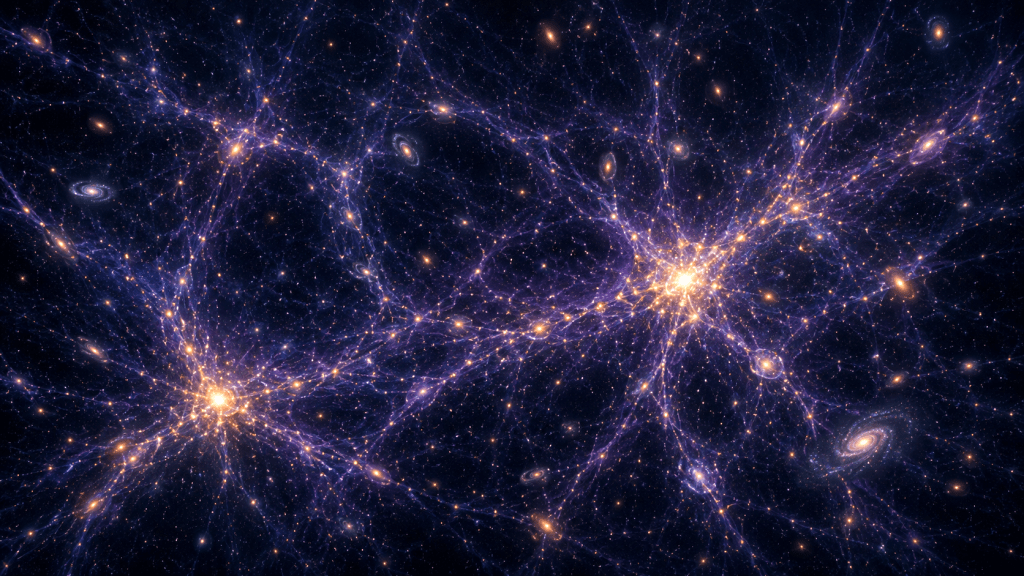
Along the way, we’ll look at the mind-bending beauty of gravitational lensing, the mysterious pull of the Great Attractor, and the breathtaking scale of the cosmic web, an immense network of filaments, nodes, and voids that connects galaxies across billions of light-years.
Later in the show, we step back outside for your weekly night sky report, featuring dark skies after the new moon, evening views of Venus and Jupiter, pre-dawn glimpses of Saturn and Mars, early Milky Way core season, and a few lesser-known galaxy targets hiding in Canes Venatici.
Transcript
Howdy stargazers and welcome to this episode of Star Trails. My name is Drew and I’ll be your guide to the night sky for the week of May 17th to the 23rd.
This week we venture deeper into darkness. We’ll continue our discussion of galaxies, but we’ll probe the invisible structures that hide secrets of the universe. Dark matter, gravitational lenses, a stellar blind spot, and the mysterious cosmic web, which connects almost everything we know.
Later in the show we’ll cover what you can expect to see in this week’s sky, and discover why one humble constellation seems to be home to so many unique galaxies.
Whether you’re tuning in from the backyard or the balcony, I’m glad you’re here. So grab a comfortable spot under the night sky, and let’s get started!
Astronomers today have more access to information about the sky than we’ve ever had. With instruments like the James Webb Space Telescope peering deep into the universe, and new projects such as the Vera Rubin observatory, it’s easy to maybe get a bit jaded. What else is out there, and is there anything new left to discover?
But what if I told you that even today, entire galaxies may still be hiding from us? Not because they’re too far away. But because the universe, and sometimes even our own galaxy, has a way of keeping secrets.
Tonight, we’re stepping into one of the strangest corners of modern astronomy. We’re going to talk about galaxies that barely shine, invisible structures made of unknown matter, gravity that bends light like a lens, and a cosmic web so vast that it makes our home galaxy seem almost insignificant. This is the hidden universe.
If you’ve ever seen a long-exposure image of the night sky, or perhaps a deep astrophoto of a distant galaxy, it’s tempting to think the universe is clean and orderly. Point a telescope in a direction, gather enough light, and eventually the cosmos reveals itself. But the reality is messier.
Our home galaxy, the Milky Way, is a spectacular spiral of stars, gas, dust, and dark nebulae. From a dark sky, it arches overhead like a glowing river. But for astronomers trying to look through it, the Milky Way can be a problem. Dense dust clouds absorb visible light. Thick fields of foreground stars clutter the view. Gas clouds scatter and obscure what lies beyond.
For decades, astronomers noticed something strange. In certain parts of the sky, distant galaxies seemed to disappear. Not entirely, but the number of visible galaxies dropped dramatically. It almost looked as though there were empty patches in the universe itself. Of course, there weren’t.
Astronomers eventually realized that the missing galaxies weren’t missing at all. They were simply hidden behind the thick disk of our own galaxy. This region became known as the Zone of Avoidance, a blind spot in our map of the cosmos.
Imagine trying to study the skyline of a distant city while looking through a dirty windshield filled with bugs, dust, and glare. That’s what parts of the universe look like when we try to peer through the galactic plane.
Astronomers began learning how to “see” in different ways. Instead of relying only on visible light, they turned to infrared detectors and radio telescopes. Infrared light can slip through dust more easily than visible light. Radio waves, especially the faint 21-centimeter signal emitted by neutral hydrogen, can pass through regions that would otherwise appear opaque.
In some cases, astronomers don’t discover galaxies by seeing stars at all. They find them by detecting the faint radio whisper of hydrogen gas drifting through intergalactic space.
And sometimes, what they find is stranger still.
Not every galaxy blazes with the brilliance of a spiral like the Andromeda Galaxy. Some galaxies are so faint that they almost disappear into the background noise of the universe. These are sometimes called ghost galaxies, or ultra-diffuse galaxies, vast collections of stars spread so thinly across space that they glow only faintly.
One of the most famous examples is Dragonfly 44, a ghostly galaxy discovered in the Coma Cluster. At first glance, it looks like little more than a faint smudge. But measurements suggest it may contain the mass of tens, or perhaps even hundreds, of billions of suns.
Think about that for a moment: A galaxy with the mass of a giant spiral, yet so dim you could almost miss it entirely.
And that brings us to one of the greatest mysteries in astronomy.
For nearly a century, astronomers have noticed that stars in galaxies orbit far too quickly for the visible matter alone to hold them together. Something unseen appears to be there, something massive, something that exerts gravity, but doesn’t emit or reflect light.
Of course, I’m talking about dark matter.
Every galaxy we’ve studied, including the Milky Way, appears to sit inside an enormous halo of this invisible material. The stars we see may only be the lanterns hanging inside a much larger, unseen structure. The glowing spiral arms, the clusters, the nebulae, they’re like a visible campfire, surrounded by an invisible forest of matter.
Astronomer Vera Rubin helped bring this mystery into focus by studying how galaxies rotate.
If gravity worked only with the matter we could actually see, stars, gas, dust, nebulae, then stars near the outer edges of galaxies should orbit more slowly than stars near the center, much like planets in our solar system. Mercury races around the Sun much faster than distant Neptune because most of the Sun’s mass is concentrated in one place.
Galaxies should behave in much the same way. But they don’t.
When Rubin and her colleagues measured the outer stars in spiral galaxies, they found something astonishing. Those stars weren’t slowing down at all. In many cases, they were moving just as fast as stars much closer to the galactic core. According to the physics we understand, galaxies spinning that fast should simply tear themselves apart. But they don’t.
And the mystery only deepened.
When astronomers study galaxy clusters, vast gatherings of hundreds or even thousands of galaxies, they find the same problem. The galaxies inside those clusters are moving far too quickly for the visible mass alone to keep them gravitationally bound. There simply isn’t enough visible matter there.
But how do you study something that can’t be seen? Sometimes you don’t look at the object itself. You look at what it does to the light behind it.
This phenomenon is called Gravitational lensing, and its story begins more than a century ago, when Albert Einstein published his theory of General Relativity. Einstein proposed gravity isn’t just a force pulling objects together. Instead, massive objects actually warp spacetime itself. Imagine placing a bowling ball on a stretched rubber sheet. The sheet bends under the weight. Now imagine a marble rolling nearby. Instead of traveling in a straight line, its path curves around the bowling ball.
According to Einstein, light behaves in much the same way.
If a beam of light passes near something extremely massive, a galaxy, a cluster of galaxies, or an enormous concentration of dark matter, its path bends as it travels through warped spacetime. Under just the right alignment, that distant light can be stretched into glowing arcs, duplicated into multiple images, or even bent into a nearly perfect circle known as an Einstein ring.
For decades, astronomers searched for evidence that Einstein was right. In 1919, during a total solar eclipse, astronomers measured the apparent positions of stars near the Sun and found that their light had shifted exactly as Einstein predicted. It was one of the first major confirmations of General Relativity.
But in modern astronomy, gravitational lensing has become something even more powerful.
When NASA first released images from the James Webb Space Telescope in July of 2022, one of the very first images shown to the world was a galaxy cluster known as SMACS 0723. At first glance, it looked like a dense gathering of galaxies suspended in darkness. But if you looked carefully around the cluster, you could see something extraordinary, faint red arcs and distorted streaks of light wrapped around it.
Those were entire galaxies, far beyond the cluster itself, whose light had been bent and magnified by the enormous mass of the foreground cluster. The combined gravity of thousands of galaxies, along with huge concentrations of dark matter, had effectively turned that cluster into a natural telescope in space. SMACS 0723 was acting like a cosmic magnifying glass.
And that’s what makes gravitational lensing so powerful. It allows astronomers to study galaxies so distant, and so faint, that even our most advanced telescopes might otherwise miss them entirely. It helps us map the invisible distribution of Dark matter, and weigh entire galaxy clusters. In some cases, it allows us to peer farther back in time, closer to cosmic dawn, than we could ever see otherwise.
So, when researchers calculate how much visible matter should be there, stars, gas, dust, the math still comes up short. Thanks to gravitational lensing, we can see that the cluster bends light more strongly than visible matter alone can explain.
Again and again, across different scales and different methods, the universe keeps pointing to the same conclusion: There appears to be far more mass out there than we can actually see, and that must be dark matter.
And if that wasn’t strange enough, there’s another mystery hiding behind the dust of our own Milky Way. In the late 20th century, astronomers began measuring how galaxies move relative to the expansion of the universe. What they found was deeply unsettling.
Our galaxy isn’t just drifting through space. It’s falling. The Milky Way, along with our neighboring galaxies and entire galaxy clusters, appears to be moving toward a region of space at roughly 600 kilometers per second, which is well over a million miles per hour.
It seems like something enormous is pulling us. Astronomers named this mysterious region the Great Attractor.
And here’s the truly eerie part: it lies in the direction of the Zone of Avoidance, the very part of the sky obscured by our own galaxy’s dust and stars.
For years, it was like feeling the pull of something massive in the darkness, without being able to see it clearly.
Today, astronomers think the Great Attractor isn’t a single monster object, but part of a much larger concentration of galaxies, clusters, and dark matter spread across immense distances. This hidden region contains the mass of tens of thousands of galaxies. But for a time, it was one of the most unsettling clues that the universe might be hiding far more structure than we realized.
And then, if we zoom out even farther, far beyond individual galaxies, far beyond clusters, beyond the scale most of us can intuitively grasp, we discover something even more astonishing.
Galaxies aren’t scattered randomly through space. They’re connected.
Across billions of light-years, galaxies gather into vast filaments, threadlike rivers of matter stretching across the cosmos. Where these filaments intersect, galaxies pile up into dense regions called nodes, where galaxy clusters and superclusters form. And between them lie enormous voids, cosmic deserts where comparatively few galaxies exist at all.
These structures form what astronomers call the Cosmic web, a vast, ghostly scaffold upon which galaxies are arranged.
Zoom out far enough, and galaxies stop looking like islands in space. They begin to look like neurons, like strands in a structure so immense that it almost feels alive. A ghostly nervous system stretching across the observable universe.
And according to our best models, much of that scaffolding may be built not from stars or glowing gas, but from invisible dark matter, whose gravity helped shape where galaxies formed in the first place.
Long before the first galaxies began to shine, the scaffolding may already have been there.
After a quick break we’ll be back with this week’s night sky. Stay with us.
Welcome back.
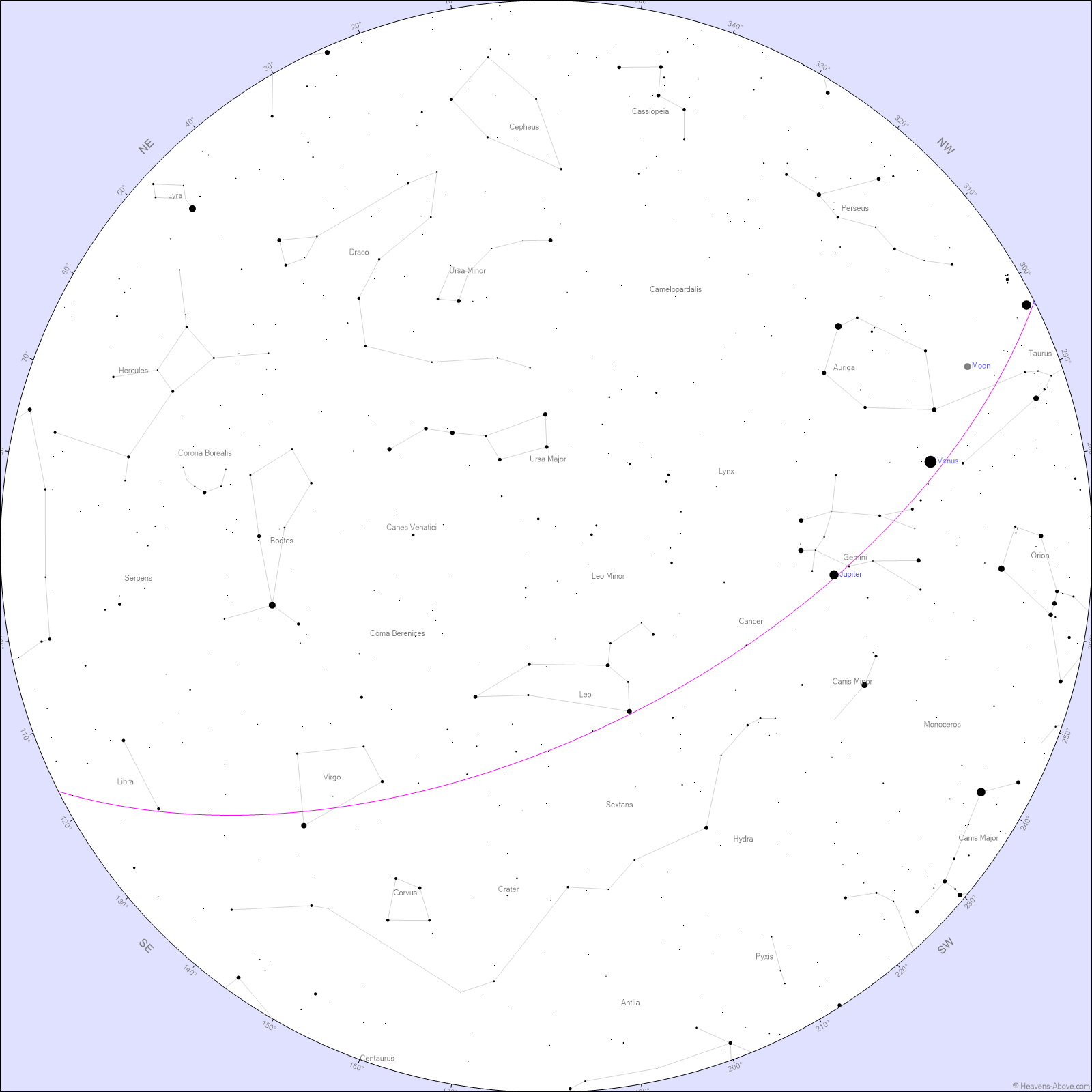
The week begins under beautifully dark skies, thanks to the new moon on May 16, making this one of the better weeks of May to get outside with binoculars, a telescope, or just your eyes.
On May 17, the Moon returns as a razor-thin waxing crescent low in the western sky shortly after sunset, and each evening afterward it grows a little brighter, becoming a more obvious crescent by week’s end. This makes the first half of the evening ideal for deep sky observing, especially before moonlight begins to interfere later in the week.
If you look west shortly after sunset, brilliant Venus dominates the twilight. On the evening of May 18, the thin crescent Moon passes close to Venus, an easy naked-eye pairing and a lovely photo opportunity. This should make for a beautiful post-sunset scene, especially if you have trees, buildings, or a foreground subject to frame it.
Jupiter is still an evening planet, located in the west and higher than Venus. It’s been making its way closer to the horizon month by month.
If you’re up before dawn, look east for Saturn and Mars. Saturn will be the brighter of the pair, lingering in Pisces. Mars is lower and to the left. You’ll only have a narrow window to catch the red planet before it’s lost in the glare of the rising sun.
If you enjoy taking photos of the Milky Way, now is a good time to grab your wide angle lens and capture the galactic core. With darker skies earlier in the week, venture out around midnight to see the core of our home galaxy rising in the southeast. By the pre-dawn hours, the rich star clouds near Sagittarius and Scorpius begin climbing into view. For listeners with darker skies, this is the beginning of true “Milky Way core season.”
The Eta Aquariids, debris from Halley’s Comet, peaked earlier in the month, but the shower remains active through May 28. By this week, activity is lower, but if you’re out before dawn under dark skies, you might still catch a few swift meteors streaking through the southeast.
Before we jump into this week’s galaxy targets, you may have noticed something over the past few episodes: we keep coming back to the constellation Canes Venatici, the Hunting Dogs. And that’s no accident. For backyard astronomers, especially in spring, this relatively modest constellation happens to sit in one of the richest windows into the nearby universe.
Part of the reason comes down to perspective. When we look toward Canes Venatici, we’re looking away from the thick, crowded plane of our own Milky Way. That means there’s less dust, less gas, and fewer foreground stars cluttering the view. In other words, we’re peering through a cleaner patch of cosmic glass—one that opens up into deep extragalactic space.
But it’s not just that the view is clearer. This region of the sky also happens to lie near a broader concentration of galaxies associated with our local cosmic neighborhood, including loose galaxy groups and larger structures connected to the Virgo-Coma region. So when you point a telescope in this direction, you’re not just looking into empty darkness—you’re looking toward a part of the universe where galaxies really do seem to gather.
I’ll talk about three galaxies that are all located in Canes Venatici:
One of my favorites this week is the Sunflower Galaxy. Through a modest telescope, it appears as a soft, glowing oval with a bright core, but long-exposure images reveal a complex spiral structure that gives it its floral nickname. What makes this galaxy especially fascinating is that astronomers have found faint stellar streams surrounding it, ghostly trails of stars that suggest it may have cannibalized smaller companion galaxies in the distant past. In other words, even galaxies carry scars.
A little farther along, you might hunt down Messier 106, another springtime showpiece. At first glance, it may look like just another bright spiral, but this galaxy is anything but ordinary. Deep studies have revealed strange extra arms made not of stars, but of energized gas, structures thought to be influenced by the activity of a supermassive black hole in its core.
And if you’re looking for something a little more unusual, try tracking down the Whale Galaxy. This edge-on galaxy gets its nickname from its long, slightly warped profile, which in photographs really does resemble a whale suspended in space. That distortion is likely the result of gravitational interactions with nearby galaxies.
That’s going to do it for this week. If tonight’s episode sparked your curiosity, or maybe gave you something new to think about the next time you look up, I’d be honored if you shared Star Trails with someone who might enjoy the journey. You can always find the latest episodes, show notes, and extras at startrails.show.
And if you’d like to help support the show, there’s also a little “buy me a coffee” link on the site. It genuinely helps keep these stories coming.
Be sure to follow Star Trails on Bluesky and YouTube — links are in the show notes. Until we meet again beneath the stars … clear skies everyone!
Support the Show
Connect with us on Bluesky @startrails.bsky.social
If you’re enjoying the show, consider sharing it with a friend! Want to help? Buy us a coffee! Also, check out music made for Star Trails on our Bandcamp page!
Podcasting is better with RSS.com! If you’re planning to start your own podcast, use our RSS.com affiliate link for a discount, and to help support Star Trails.


Leave a comment