Listening to the Heartbeat of the Milky Way – Star Trails: From Backyard Astronomy to Cosmic Wonder
Episode 118
Most amateur astronomers spend their nights collecting light. But what if you could study our galaxy without looking through a telescope at all?
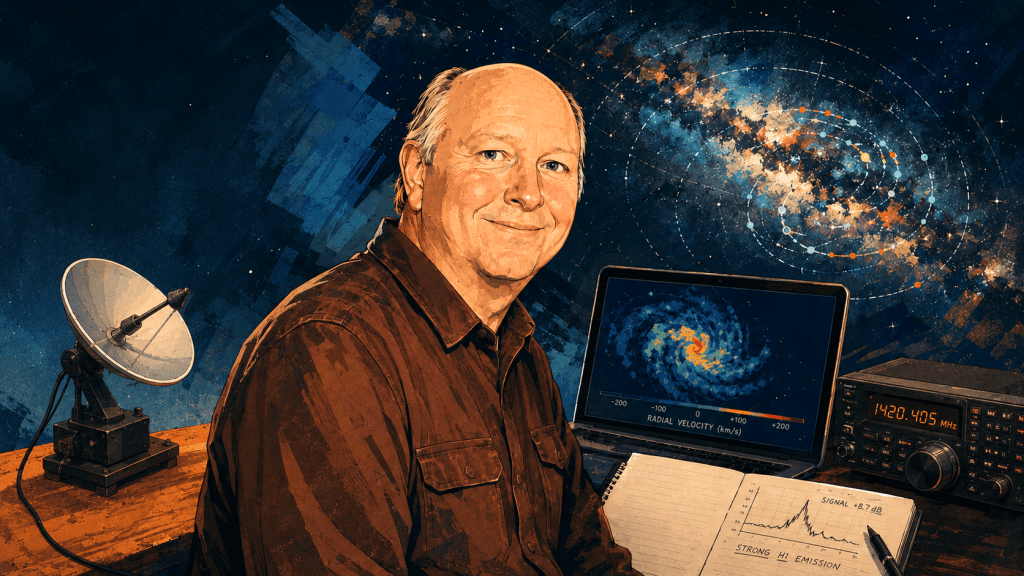
In this episode, we sit down with amateur astronomer and radio enthusiast Hap Griffin to explore the fascinating world of backyard radio astronomy. Using a homemade radio telescope consisting of a recycled microwave dish, and less than $100 worth of electronics, Hap is recreating one of the classic experiments that revealed the Milky Way’s spiral structure.
Along the way, you’ll learn how astronomers use the natural radio emission from hydrogen gas to map our galaxy, why radio astronomy works day or night, and why this remarkable corner of the hobby is far more accessible than most people realize.
Later in the episode, we’ll head outside for a look at the night sky from July 19 through August 1, including the Full Buck Moon, Saturn’s return to the late evening sky, the Double-Double in Lyra, M13, the Lagoon Nebula, and two summer meteor showers.
Links
Transcript
Howdy stargazers and welcome to this episode of Star Trails. My name is Drew and I’ll be your guide to the night sky for the period of July the 19th to August the 1st.
This week, we’re exploring a side of astronomy that most backyard observers never experience. My guest, Hap Griffin, has built a radio telescope capable of detecting the faint radio glow of hydrogen spread throughout our galaxy. Using little more than recycled parts, and off-the-shelf hardware, he’s recreating one of the landmark experiments that revealed the Milky Way’s spiral structure. The best part? You don’t need to spend a lot of money to do it.
Later in the show we’ll take a look at what you can expect to see in the night sky in the coming weeks.
Whether you’re tuning in from the backyard or the balcony, I’m glad you’re here. So grab a comfortable spot under the night sky, and let’s get started!
Hap Griffin is one of those people whose curiosity seems to have no limits. He’s an accomplished astrophotographer, having been published in magazines like Sky & Telescope. His astrophotos have literally been carried to the Moon as part of the MoonArk project. He’s photographed countless NASA launches, and received the Clyde Tombaugh Award for his contributions to amateur astronomy. He’s even discovered an asteroid. But lately, Hap has turned his attention to something many backyard astronomers have never even considered: radio astronomy.
Using less than $100 worth of equipment, he’s recreating one of the landmark experiments in 20th century astronomy: the same experiment that helped reveal the spiral structure of our own Milky Way.
I recently sat down with Hap to learn how it all works… and why it’s much more approachable than you might imagine.
Drew: I’m here with Hap Griffin. Hap, thanks for taking the time to be on the show today. We sure appreciate it.
Hap Griffin: Well, I love doing this for you guys.
Drew: You’ve spent years as a visual astronomer, but more recently you’ve turned your attention to radio astronomy. What drew you into that side of the hobby?
Hap Griffin: Well, of course, I’ve always been interested in astronomy and really got into photographic astronomy back in the late 90s, but my background has always been in radio and radio engineering, broadcast engineering. So radio astronomy was the perfect way to mix these two interests. It’s just a natural for someone who’s who has a background in radio to be able to take advantage of that, to study another aspect of astronomy that obviously just visual astronomers can’t get to.
Drew: Most amateur astronomers spend their nights collecting light through a telescope. Your radio telescope is doing something very different. At a high level, what is radio astronomy?
Hap Griffin: Well, it turns out that when we’re doing visual astronomy, we’re working through the visible light spectrum. And if you look at the entire spectrum of electromagnetic radiation, it goes all the way from very low frequency radio waves down in the Am radio that you might have in your car, that kind of frequency up through X-rays and gamma rays and all these sorts of things that are very much higher in frequency than what we can see.
Hap Griffin: And it turns out that that the visual range that we can see, that you always see as a spectrum between red and violet, is just a tiny, narrow window that is in the pretty much the middle of the the spectrum, that is. But radio waves open up the the entire spectrum of emissions from astronomical objects that by limiting yourself just to the visual frequency range, you’re totally going to miss out on.
Hap Griffin: Of course, you can do radio astronomy in the daytime. Night day doesn’t matter. Generally weather doesn’t matter. So you can do radio astronomy pretty much. 24 365.
Drew: One advantage that immediately comes to mind is weather. Here in the Southeast we spend a lot of time waiting for clear skies… and you really don’t have that problem.
Hap Griffin: It’s terrible. You might wind up with one clear night a month during these these periods of time here. And even though the wintertime is is cold, it’s also the clearest. And so you have to make do with that when you’re dealing with with visual astronomy. But for radio astronomy doesn’t matter the time of year because the objects are going to, you know, whatever is in the sky, you can you can pick up and weather doesn’t really make a difference.
Drew: Well, let’s talk about what you are picking up out there. When I arrived today, your dish was pointed almost directly toward the center of the Milky Way. What exactly is your telescope measuring, and what does that tell you about our galaxy?
Hap Griffin: Yeah. It turns out that one of the easier ways of getting started with radio astronomy is by picking up what I call the heartbeat of the Milky Way. It’s it turns out that there’s a physical process that is really astounding to think about. We live in a galaxy that is composed of stars and gas and dust, and most of that gas is hydrogen.
Hap Griffin: That’s the most abundant element in the universe. Once in every 10 million years for an individual atom, there will be a spontaneous flip of the electron spin axis. And what will happen is it’ll give off a photon of energy, and you can calculate the frequency and the wavelength of that energy. And it turns out it falls right in the radio spectrum at 1420 plus some little bit of megahertz.
Hap Griffin: And you would think that, well, if there’s a single atom only does it every 10 million years, you’d never have anything to look at. But it turns out that when we’re looking at arms of the Milky Way galaxy, you’re looking at hydrogen clouds that are hundreds or thousands of light years across. And within that cloud, there’s, you know, a gazillion atoms of hydrogen.
Hap Griffin: And at any one time, there are lots of atoms that are firing off and doing that spontaneous flip. And it makes a radio signal, that continuous radio signal that you can actually pick up on a receiver.
Drew: So once you’ve detected that hydrogen signal… how do you go from a simple radio measurement to actually mapping the spiral structure of the Milky Way?
Hap Griffin: There was some conjecture back in the the mid part of the, the 20th century that that we lived in a spiral galaxy because we can see other other galaxies and a lot of them are spirals, but we couldn’t visualize it by just looking at the Milky Way itself, because we’re inside of it. And you’re looking along the the equator of the Milky Way, and you currently can’t see those arms.
Hap Griffin: And so it was proposed that we use the detection of this hydrogen emission that we just spoke about to actually measure what shape the shape and size the Milky Way was, because radio waves can travel through all of that dust. The blocks are visual sighting. And sure enough, back in the 1950s, a couple of scientists did this same experiment.
Hap Griffin: They put put together a an antenna and a receiver, and they started mapping out these arms of the, of the galaxy in, in the emissions of hydrogen. And sure enough, it came out to to show that we do live in a spiral galaxy. So what I’m doing is basically replicating the work that they did back in the 1950s to determine what the shape of of our galaxy is.
Hap Griffin: And sure enough, making these observations on my own and creating a spreadsheet that analyzes the data that comes from it, the spiral shape of the galaxy just falls out of the map. And it’s just fascinating to me.
Drew: You’re making a visualization of the shape of the galaxy itself. You’re collecting measurements, plotting them on a graph, and somehow the structure of the galaxy emerges from the data. That’s a fascinating way to do astronomy.
Hap Griffin: These radio waves. Like I said, this one particular is at 21cm in length and the antenna is only a few times that in diameter. And so you don’t really have a lot of resolution. The antenna that I’m using right now is about six degrees. So if you could imagine dividing the sky up into six degree pixels, that’s basically what I’m looking at.
Hap Griffin: So you’re looking at a fairly big patch of sky at one time, but the receiver takes and plots out the signal level versus the frequency. And it just saves those numbers in a file. And I can take those those numbers that file and import it into a spreadsheet that I’ve built, and it draws out the graphs and gives you information on, on how fast the object is either coming towards us or away by calculating the Doppler effect and all that sort of thing.
Hap Griffin: So that’s how you actually can visualize what you’re seeing when the numbers are coming from a really relatively low resolution source.
Drew: Another piece of the puzzle is the Doppler effect. The hydrogen line shifts slightly depending on whether that gas is moving toward us or away from us. Is that how you’re able to reconstruct the galaxy’s structure?
Hap Griffin: That’s right. Well, we’ll go back just to the concept of Doppler shift to start with. If you if you think about if you stood beside a train track and you see a train coming towards you and it blows its whistle, you hear a high pitched whistle as it’s coming towards you, but as it passes you, the pitch of that whistle drops off.
Hap Griffin: The whistle hasn’t changed. It’s just the speed in relation to you. The velocity in relation to you has changed. Same thing happens with electromagnetic radiation. Objects that are coming towards us at a significant fraction of the speed of light tend to have their spectrums shifted towards the blue end of the spectrum. In other words, the wavelengths become compressed together and the frequency rises up.
Hap Griffin: Something that’s going away from us has the opposite effect. The wavelengths get stretched out. The pitch of the sound, if you will, gets lower in frequency. And so that’s called Doppler effect. We know, for instance, that the hydrogen emission is is an exact frequency at 1420 point, some odd some odd megahertz. And we but when we see that same emission either risen up in frequency or lower down in frequency, we can take and do some math to it and figure out how fast that object is going away from us, or coming towards us, or us or the other way around us, towards it, or away from it, depending on where you aim your antenna along
Hap Griffin: the equator of the Milky Way. If you aim your antenna towards the core of the Milky Way, for instance, we’re just in orbit around the core, and the emission that you see from the core of the galaxy doesn’t shift very much from where it’s supposed to be at 1420 megahertz. But if we start looking off to the side, you know, ten, 20, 30, 40 degrees east of the core of the Milky Way, along the equator of the Milky Way, what we see is signals that are being shifted lower and higher in frequency, depending on what time of day it is, what time of year it is, that sort of thing.
Hap Griffin: So we can tell how fast we’re moving in relation to that cloud of gas that we’re looking at, either towards it, away from it, and you can build a model once you do a systematic study of the whole, the whole Milky Way, you can put it all together in a, in a model, knowing which parts are coming towards you and which parts are going away from you.
Hap Griffin: And that’s where the the shape of the galaxy, in terms of the various arms of the galaxy. And the rotation comes out of these equations.
Drew: You’ve shown me the graphs you’ve collected, and the spiral structure really is visible in the data. And I will make your data available on the show website so folks can see what you’re working on. It’s amazing that you’re doing this with equipment that’s surprisingly simple.
Hap Griffin: One of the most mysterious questions in all of astronomy what what type of galaxy and what what’s the shape of of the galaxy that we’re in, whether it’s a spiral or an irregular galaxy or one of a number of different types, and how fast we’re moving around it, things like that, all of these really deep questions can be solved with $100 worth of hardware.
Hap Griffin: It really is funny. I mean, you can build an antenna, a workable radio telescope antenna out of a small Wi-Fi dish. Okay, that’s like three feet in diameter. And I got one out of a scrap pile. And you can buy the the actual receiver that you use is what they call a software defined receiver, an SD. And it’s a little USB thing that plugs into the USB jack on the side of a computer, costs about $40 from Amazon, and you need to boost up the signal from that small antenna before you go to the receiver.
Hap Griffin: And Amazon sells a what’s called a low noise amplifier specifically for this frequency. And it’s also about $40. So, you know, about $80 worth of hardware and an antenna made out of scrap and some free software. You can detect the heartbeat of the universe yourself if you, you know, go through the math and everything. It pretty much answers those fundamental questions about where we are in the galaxy and what the galaxy shape like and all of that.
Drew: I’ll include links to these items in the show notes, because I think that’s one of the most remarkable things about this. An astrophotography setup can cost thousands—or even tens of thousands—of dollars. Yet for around eighty dollars, someone can start measuring the structure of our own galaxy.
Hap Griffin: Even cheaper than that is there’s there’s areas of radio astronomy that anybody who is an amateur radio operator probably already has this gear. For instance, the planet Jupiter has immense storms on its surface and interactions with one of its inner moons. That gives off a signal at one of the shortwave frequencies around 20MHz. And so any radio amateur who has a receiver and an antenna for for that part of the spectrum can can aim their antenna at the eastern horizon when when Jupiter comes up above the horizon, they can hear it at that frequency, that can hear the noise that it generates.
Hap Griffin: So you’re you’re listening in on some, some physical calamity that’s going on out at, at in Jupiter’s atmosphere with just a receiver that you might listen to any shortwave broadcast with.
Drew: I’m sure there are listeners hearing this and thinking, “I’d like to try this.” Where would you recommend someone begin?
Hap Griffin: YouTube is your friend when it comes to experiment with radio astronomy. Just just type in a hydrogen line astronomy or amateur radio astronomy. And there’s there’s hundreds and hundreds of videos taking are produced by people like me that show you how to do it and what you need to do it, and types of things that you’ll find and all of that.
Hap Griffin: So the internet is a great resource, particularly YouTube.
Drew: Tell us about your observatory. What equipment are you using to do all of this?
Hap Griffin: Right now I’m running a 2.4m diameter parabolic dish. It’s an a homemade feed horn for it that I built in my workshop. And it’s set up, up, up at my observatory, which is about 40 or 50 miles from where I live here. And the reason I’ve got it up there is because when there’s nobody there, it’s a radio quiet.
Hap Griffin: In other words, it’s exceedingly sensitive. And so it picks up any interference, like if somebody else is there and turns on a computer or something like that, it causes noise in the receiver. And so I don’t want to have it here at my house. For another thing, I live in an HOA, and I don’t think they would take too kindly for a big satellite dish out in the backyard.
Hap Griffin: But anyway, it’s a 2.4m diameter. What used to people used to call a satellite dish? It’s actually a microwave dish that I got from a from scrap, and it’s mounted on a concrete pedestal that I built. I’ve got a way of remotely tying into that system, even though it’s 40 miles from here. I can tie into it from my computer at the house and operated here at the house, which is when I usually do it, when there’s nobody else up there at the observatory site.
Drew: Since you’re working with incredibly weak radio signals, I imagine interference becomes a real concern. What are the biggest challenges?
Hap Griffin: Is, there can be some of the strongest parts. The strongest sources of interference are astronomical in origin itself. In other words, the sun. The sun puts off a tremendous amount of radio noise. And when the earth turns and moves my antenna across the sun, or the sun appears to move across my antenna, it basically swamps the receiver. And so it’s useless when the sun is within a few degrees of my antenna.
Hap Griffin: But otherwise, anybody that has a computer owned within a couple of hundred feet, or things like that, that generate what we call broadband or wideband radio noise, that affects it too. But so that’s why I, like I say, I have it remote from here at the house, and I operate the system when there’s nobody else around up there.
Drew: So, you’ve already mapped the Milky Way. What’s the next challenge?
Hap Griffin: I want to be able to detect other galaxies. In other words, we have one relatively next door to us that’s almost our twin called the Andromeda Galaxy. It’s it’s about 2.5 million light years away. And I want to try to increase the sensitivity of the system such that I can actually see the hydrogen in that galaxy. I think that’s going to be a little bit of a stretch, but I think I can do it with the equipment that I have.
Drew: That sounds like a lot of fun. I was talking with Dr. Enrique Lopez Rodriguez a few months ago, he’s a friend of the show, and when I mentioned your work, he said, “That’s not amateur radio astronomy, that’s radio astronomy. That’s science.” That validation has to be rewarding.
Hap Griffin: It is. And of course, I’m not discovering anything new. I’m essentially replicating science that was done 50 years or 60 years ago, which is fine with me. But but what’s fun is doing it with my with my own gear, most of it homemade, with spreadsheets that I wrote the software for and being able to come up with the same conclusions that they did.
Hap Griffin: You know, 50 years with this little bit of very simple, off the shelf hardware.
Drew: Hap, thanks so much for taking us behind the scenes of your radio observatory. It’s been fascinating, and thanks for joining us on Star Trails.
Hap Griffin: My pleasure always.
I can’t thank Hap enough for that interview. If his voice sounds familiar, it may be because you heard him back in our star party episode.
Interestingly, when I arrived for our interview, Hap had his dish pointed toward the heart of the Milky Way. On his computer screen, a distinct bump stood out at the hydrogen line — a clear sign we were looking through dense clouds of hydrogen gas near the galactic center. By the time we finished talking, 45 minutes later, the Earth had turned, the Milky Way had moved, and that once-prominent peak had nearly disappeared. Nothing about the equipment had changed. The galaxy had simply moved on. And that was probably the best demonstration of radio astronomy I could have asked for.
It’s remarkable to think that something as simple as a small dish antenna, a USB receiver, and a graph can reveal the structure of our galaxy. Sometimes the universe doesn’t need spectacular images to tell its story. Sometimes all it takes is a small bump on a graph, and knowing what you’re looking at.
After a quick break we’ll be back with what you can expect to see in the night sky in the coming weeks. Stay with us.
Welcome back.
Now let’s step outside and see what’s happening in the night sky over the next couple of weeks.
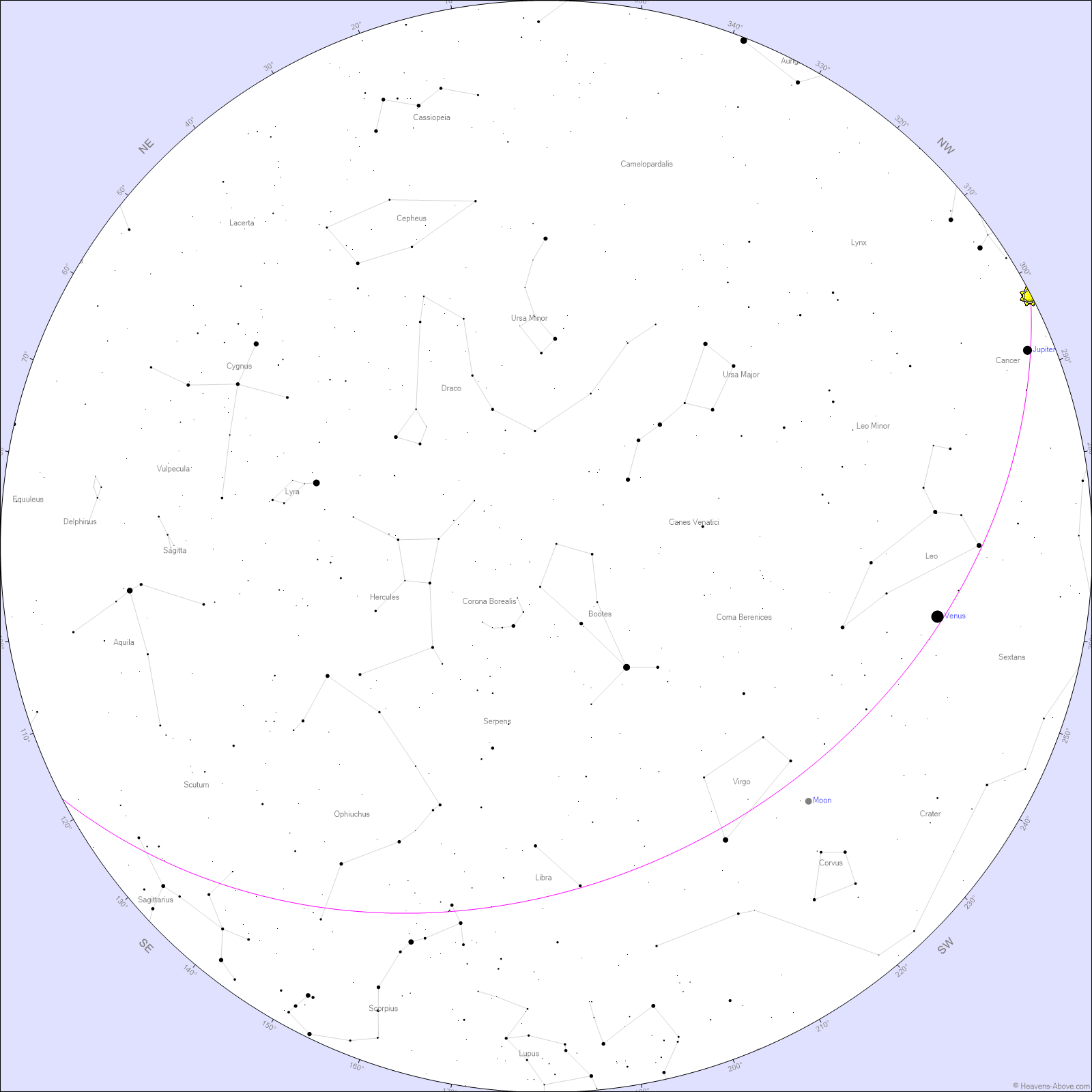
The Moon will dominate the early part of our observing period. On July 21st, it reaches First Quarter, making this one of the best times of the month to explore the lunar surface through binoculars or a telescope. The long shadows along the terminator, the line dividing lunar day from lunar night, bring craters and mountain ranges into dramatic relief.
As the week progresses, the Moon will continue to brighten, becoming a waxing gibbous before reaching the Full Buck Moon on July 29th. Unfortunately, that bright moonlight will wash out many of the fainter deep-sky objects for a few nights around full phase, but it’s still a beautiful sight in its own right.
The Buck Moon is named for the time of year when male deer are growing a fresh set of antlers. Those new antlers, still covered in soft velvet, are growing at an astonishing rate during the height of summer.
If you’ve got a telescope, here’s a fun challenge for the evenings around July 19th. Just off brilliant Vega in the constellation Lyra is Epsilon Lyrae, better known as the “Double-Double.” To the naked eye it looks like a single faint star. Binoculars reveal two stars, and under good seeing, a telescope at around 100-power will split each of those stars into another pair. You’re actually looking at a four-star system. This is a classic summertime test of your telescope’s optics and the steadiness of the atmosphere.
Planet-wise, Venus continues to shine brilliantly low in the western sky after sunset. It’s the unmistakable “evening star.”
Saturn is becoming a real treat in the late evening and early morning hours. Rising before midnight, it’s climbing higher into the sky each night, giving us steadily improving views of its rings as they begin opening back up after appearing nearly edge-on last year.
Meanwhile, Jupiter has disappeared into the Sun’s glare as it approaches solar conjunction on July 29th. It’ll return to the morning sky in the weeks ahead.
If you’re looking beyond the planets, don’t overlook two of summer’s showpiece deep-sky objects. The Great Hercules Cluster, also known as M13, is nearly overhead during the evening. Just to the south, in Sagittarius, the Lagoon Nebula, or M8, is another rewarding target through binoculars or any small telescope. Even under modest skies, both objects are well worth your time.
And finally, we begin entering meteor shower season. The Southern Delta Aquariids and the Alpha Capricornids both peak on the nights of July 30th and 31st. The Delta Aquariids typically produce around twenty meteors per hour under dark skies, while the Alpha Capricornids are known for fewer meteors but an occasional spectacular fireball. This year, though, the nearly full Moon will make conditions less than ideal. You’ll still have a chance to catch the brighter meteors, but the moonlight will hide many of the fainter ones. If you head outside after midnight and let your eyes adjust, you may still be rewarded.
That’s going to do it for this week. If tonight’s episode sparked your curiosity, or maybe gave you something new to think about the next time you look up, I’d be honored if you shared Star Trails with someone who might enjoy the journey. You can always find the latest episodes, show notes, and extras at startrails.show.
And if you’d like to help support the show, there’s also a little “buy me a coffee” link on the site. It genuinely helps keep these stories coming.
Be sure to follow Star Trails on Bluesky and YouTube — links are in the show notes. Until we meet again beneath the stars … clear skies everyone!
Support the Show
Connect with us on Bluesky @startrails.bsky.social
If you’re enjoying the show, consider sharing it with a friend! Want to help? Buy us a coffee! Also, check out music made for Star Trails on our Bandcamp page!
Podcasting is better with RSS.com! If you’re planning to start your own podcast, use our RSS.com affiliate link for a discount, and to help support Star Trails.


Leave a Reply