
When Black Holes Twist Spacetime – Star Trails: From Backyard Astronomy to Cosmic Wonder
Episode 119
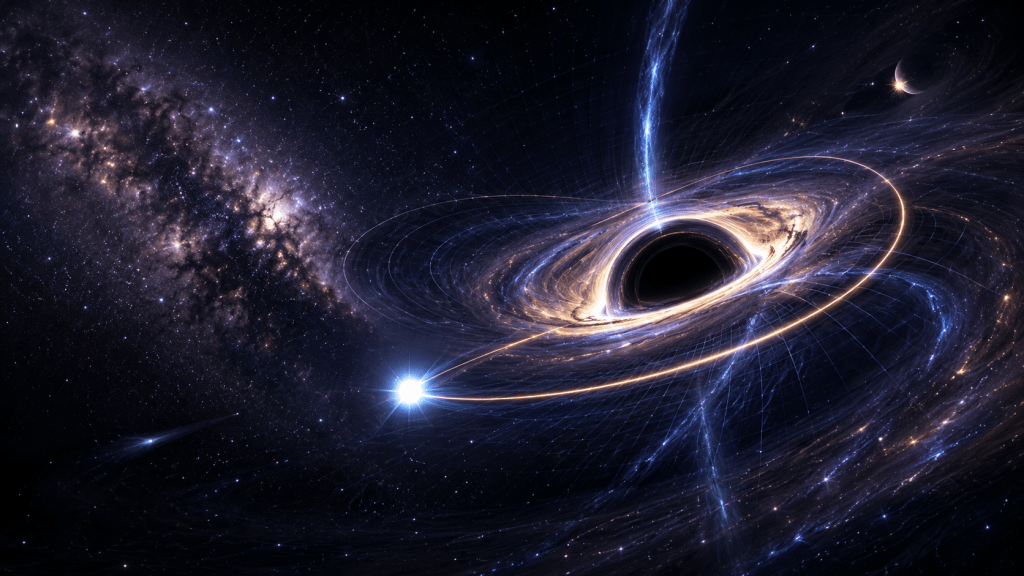
What happens when a black hole spins? According to general relativity, it doesn’t simply rotate in space, it actually drags spacetime around with it.
This episode explores the strange phenomenon known as frame dragging, from its first predictions more than a century ago to new observations that may let astronomers watch it at work around supermassive black holes. We’ll visit a distant black hole where the remains of a shredded star appear to be wobbling through twisted spacetime, then return to the center of our own Milky Way to meet S301, a star racing around Sagittarius A* at more than eight percent of the speed of light. Its extreme orbit may eventually help astronomers measure the spin of our galaxy’s central black hole.
And there’s plenty happening closer to home. A spent Falcon 9 rocket stage is expected to crash into the Moon on August 5, Comet 10P/Tempel is making a favorable pass through the inner Solar System, and the Perseid meteor shower arrives under nearly perfect dark-sky conditions thanks to the New Moon.
We’ll also look at Mercury, Venus, Mars, Saturn and Jupiter in the August sky, plus the total solar eclipse of August 12.
Finally, we look back fifty years to Viking 1 and the extraordinary moment when Mars stopped being merely a world seen from afar and became a place with rocks, dirt, sky, and a horizon.
It’s a packed couple of weeks beneath the stars.
Transcript
Howdy stargazers and welcome to this episode of Star Trails. My name is Drew and I’ll be your guide to the night sky for the period of August the 2nd to the 15th.
This week we take a look at a recent discovery that seems to indicate a black hole is capable of twisting the spacetime around it. The phenomenon is called “frame dragging” and yes, it’s another one of those weird quirks of astrophysics, foretold more than a century ago by Einstein’s theory of General Relativity.
This is a story written in the orbits of two stars thousands of light years away, and we’ll journey to these extreme worlds in a moment.
Later in the show we’ll check in with what you can expect to see in the night sky over the next two weeks. Spoiler alert, there’s a lot going on in the night sky over this period, and with a New Moon in the mix, there’s darkness also.
Whether you’re tuning in from the backyard or the balcony, I’m glad you’re here. So grab a comfortable spot under the night sky, and let’s get started!
Albert Einstein has been dead for more than seventy years. And yet, every few months, the universe seems to send him another report card: Some wild, mind-bending phenomenon proves his theories valid. It’s almost like he was some sort of Nostradamus of astrophysics.
After all, Einstein was right about gravitational waves. He was right about gravity bending light. He was right about black holes. And every time one of these stories appears, the headline is inevitably some variation of: “Einstein was right again.”
At this point, I think we can probably stop keeping score. Because the more interesting part isn’t whether Einstein was right. It’s what we can now do with the physics he left behind.
And lately, I’ve been seeing headlines about another prediction of general relativity, one with the wonderfully intriguing name of “frame dragging.” Astronomers have apparently caught a black hole dragging the very fabric of spacetime around with it.
That’s a wild concept. It sounds less like astrophysics and more like subject of a heavy metal concept album. But what does it actually mean? How can something drag space? And if space is empty, what exactly is being dragged?
To understand that, we have to change the way we normally imagine the universe. Most of us instinctively picture space as the stage on which everything happens. The planets move through space. Stars move through space. Galaxies move through space. Space itself just sits there in the background.
General relativity says that isn’t quite right. Space and time are joined together into spacetime, and that spacetime isn’t simply scenery. It’s the physics of our reality.
Put mass into spacetime, and the geometry changes. That’s gravity. Add rotation, and something else happens. The geometry can acquire a twist.
That’s the basic idea behind frame dragging.
Now, this is one of those concepts where almost every analogy eventually gets us into trouble. You’ll sometimes hear it described as a spinning ball dragging a sheet around with it, or a spoon stirring honey, or a whirlpool forming in water. Those pictures are helpful up to a point.
But there isn’t actually any cosmic fluid being dragged around by friction. What’s changing is the geometry itself. A spinning mass changes the local definition of what it means to remain pointed in the same direction.
Imagine a perfectly balanced gyroscope floating nearby. Normally, that gyroscope wants to keep its axis pointed toward the same distant direction. But near a rotating mass, its orientation will slowly drift. Nothing reached out and pushed it. Instead, the spacetime in which the gyroscope is keeping its direction has changed.
The reference frame itself has been dragged. Hence the name.
The effect is also called Lense-Thirring precession, after Austrian physicists Josef Lense and Hans Thirring, who worked out the effect from general relativity in 1918. And despite some of the more enthusiastic headlines, frame dragging isn’t something astronomers have only just discovered.
The Earth does it. Our planet has mass, and our planet rotates, so Earth very slightly drags the spacetime around it. The effect is unbelievably tiny.
But NASA actually built a spacecraft to measure it. Gravity Probe B carried four extremely precise gyroscopes into Earth orbit and watched to see whether their axes slowly changed direction. It turns out they did. NASA announced the final results in 2011, and the measured frame-dragging effect agreed with the prediction of general relativity.
So we’ve already measured Earth twisting spacetime. But Earth is not especially massive, not especially compact, and certainly doesn’t rotate at anything approaching relativistic speeds.
Around Earth, frame dragging is a whisper. Around a black hole, things become much more interesting.
Black holes concentrate enormous amounts of mass into an incredibly small region. And we expect most black holes to spin. The star that originally collapsed to create the black hole was already rotating. As that material collapsed inward, its rotation could speed up, somewhat like a figure skater pulling in their arms during a spin on ice.
Then, throughout its life, a black hole can continue swallowing gas, stars, and perhaps even other black holes, adding still more angular momentum.
A rotating black hole doesn’t merely bend spacetime. It twists it. And that twist can affect the motion of material nearby.
If a disk of gas around the black hole is tilted relative to the black hole’s spin, frame dragging can cause the disk to slowly precess. Think of a spinning top. The top is rotating rapidly, but at the same time its axis can trace out a slower circle.
That’s precession.
Now replace the top with an accretion disk full of superheated matter traveling around a black hole. And attach a jet of high-energy material blasting away from that disk. If the entire system precesses, the disk changes orientation—and the jet sweeps around with it. Like a cosmic searchlight.
And that brings us to an object with the painfully unromantic name AT2020afhd. Astronomy’s filing cabinet has never been known for poetry.
AT2020afhd was first detected in 2020 in the center of a distant galaxy. Then, in early 2024, it dramatically brightened again. Astronomers concluded that a star had wandered too close to the galaxy’s central supermassive black hole.
And that is a very bad place for a star to wander.
The difference in gravity between the near side of the star and the far side became so enormous that the star was pulled apart. Some of the wreckage escaped. Some fell toward the black hole. And that material formed a hot disk around it.
We call this a tidal disruption event.
I like to think of these events as nature throwing a bucket of luminous paint into a machine we normally can’t see. The black hole itself remains dark. But suddenly we have glowing material moving through the warped spacetime around it.
And in AT2020afhd, that glowing material began doing something very interesting. The X-rays from the system started getting brighter and dimmer on a cycle of about 19.6 days.
Not a subtle change, either. At the peaks, the X-ray emission was more than ten times brighter than it was at the lows. And at radio wavelengths, astronomers saw another large variation.
The really important part was that the radio and X-rays were changing on nearly the same rhythm. That’s unusual because those signals aren’t necessarily coming from exactly the same place.
The X-rays tell us about the extremely hot material near the inner accretion disk. The radio emission traces material farther out, associated with the jet. And yet both seemed to be keeping the same beat.
About once every twenty days.
The disk and the jet appeared to be moving together. Astronomers modeled the system and found that a tilted disk and jet precessing around the black hole’s spin axis could reproduce the pattern.
In other words, the spinning black hole appeared to be dragging the surrounding spacetime strongly enough to make the entire system wobble.
Now, I want to be careful about the way we say that. Nobody took a photograph of twisted spacetime. We can’t. Instead, astronomers watched matter moving through that spacetime and reconstructed what must be happening.
It’s a little like watching trees bend on a windy day. You can’t see the wind itself. But you can certainly see what the wind is doing.
In this case, the shredded remains of a star became our indicator. The black hole twisted the spacetime. The tilted disk responded. The jet responded. And from hundreds of millions of light-years away, our telescopes saw the whole thing keeping time.
Every 19.6 days.
That by itself is pretty remarkable. But here’s the part that makes this story especially interesting right now.
We may soon have another way of looking for the same physics. And this time, we don’t have to travel hundreds of millions of light-years.
We just have to look toward Sagittarius.
During August evenings, Sagittarius is sitting low in our southern sky. Look for the familiar teapot asterism. Somewhere in that direction, hidden from ordinary view behind enormous amounts of dust, is the center of the Milky Way.
And sitting there is Sagittarius A-star, the supermassive black hole at the heart of our galaxy. It contains about four million times the mass of the Sun.
For decades, astronomers have been watching individual stars whip around this invisible object. Those stars are incredibly useful because they’re essentially test particles. Follow their motion closely enough, and they map the gravitational field for us.
One of the most famous is a star called S2. S2 takes about sixteen years to orbit Sagittarius A-star, and observations of that orbit have already revealed effects predicted by general relativity.
Its light experiences gravitational redshift. Its orbit precesses. Einstein’s gravity works there.
But S2 has a problem if what we really want to measure is frame dragging. It doesn’t get close enough. The effect caused specifically by the black hole’s spin is much weaker than the effect caused simply by its enormous mass.
To see that extra twist, astronomers need a better probe. And now they may have one.
Its name is S301.
S301 is a faint, fairly ordinary main-sequence star. There is nothing particularly remarkable about the star itself.
Its address, however, is insane.
S301 completes one orbit around Sagittarius A-star every 8.7 years. Its orbit is extremely stretched out. And during its closest approach, the star passes only about 140 Schwarzschild radii from the black hole. That’s just around 24 astronomical units.
Let’s turn Sagittarius A-star into a ridiculous Solar System model for a moment. Put the black hole where the Sun is. Its event horizon would fit well inside the orbit of Mercury.
Now send S301 swooping past. At closest approach, the star would pass through the region between the orbits of Uranus and Neptune.
Except it would be traveling at around 25,000 kilometers per second. More than eight percent of the speed of light.
Again: A star, moving at eight percent of light speed. That is the kind of sentence that makes me love astronomy.
At those speeds, this is no longer an orbit you can fully describe with Newtonian physics. Relativity starts leaving visible fingerprints.
S301’s orbit itself precesses dramatically. Instead of tracing the same ellipse again and again, the orientation of that ellipse shifts by roughly two degrees during every revolution.
Most of that shift comes from the curvature of spacetime created simply by Sagittarius A-star’s enormous mass. That’s the same basic type of relativistic orbital precession we’ve measured around S2—and, on a vastly smaller scale, in the orbit of Mercury.
But S301 dives much closer to the black hole than S2 does. Close enough that astronomers think there may be another, smaller signal buried in its motion.
The signal caused by the black hole’s spin. Frame dragging.
If Sagittarius A-star is rotating, the spacetime around it should twist. And that twist should very slightly change the path of S301.
The effect is small enough that we probably aren’t going to watch one orbit and immediately announce how fast the black hole is spinning. But calculations suggest that after several revolutions, the predicted orbit around a spinning black hole should separate enough from the predicted orbit around a non-spinning black hole that modern instruments may be able to tell the difference.
That’s an amazing idea. We may eventually measure the spin of the black hole at the center of the Milky Way by watching a star repeatedly fall past it.
S301 essentially becomes a space probe, one that nature put there for us.
And S301 may have another story to tell. Its orbit is so wildly elongated that astronomers suspect it may once have belonged to a binary star system.
Imagine two stars orbiting each other as they approach Sagittarius A-star. The black hole’s gravity pulls the pair apart. One star receives enough energy to be flung away from the galactic center at tremendous speed. The other loses energy and is captured into a tight orbit around the black hole.
That’s called the Hills mechanism.
And just within the past few week, another group of researchers has raised a fascinating possibility. S301 may be the captured former companion of a known hypervelocity star called S5-HVS1.
We already have good evidence that S5-HVS1 was launched from the center of the Milky Way. And when researchers worked backward from its mass and motion, S301 turned out to look remarkably like the kind of companion that should have been left behind.
That connection is not established yet. The researchers themselves say better measurements will be needed.
But consider the possibility.
One binary system wanders too close to Sagittarius A-star. The black hole tears the pair apart. One star is fired out of the galactic center. The other remains behind, trapped on one of the most extreme stellar orbits we’ve ever measured.
And now, millions of years later, we may be using both pieces of that ancient gravitational encounter to reconstruct what happened.
And this brings us back to black-hole spin. Because despite what we usually see in illustrations, a black hole doesn’t have a visible surface with a mark painted on it. We can’t watch the mark come around once per revolution and start a stopwatch.
So astronomers have to measure spin indirectly.
One approach examines the hot material in an accretion disk. The spin of a black hole changes how close matter can maintain a stable orbit, which changes the temperature and spectrum of the inner disk.
Another approach is the one we’ve just been discussing. Watch something precess. If you know the black hole’s mass and understand the geometry of the system, frame dragging can reveal information about the spin.
That’s what makes AT2020afhd useful. And that’s what may eventually make S301 useful.
There are even new ideas involving polarized light. Jets around black holes contain charged particles moving through enormous magnetic fields, and the radio light they produce can be polarized.
That polarization carries information about the magnetic field, the jet, and the environment immediately around the black hole. Recent work looking toward the future of Event Horizon Telescope observations suggests that some of those polarization patterns may eventually help constrain spin as well.
We’re not quite there yet. Current Event Horizon Telescope observations tell us more reliably about things like magnetic-field geometry, source orientation, and the relationship between the disk and jet than they do about the exact spin of the black hole.
But that’s changing.
And the important part is that astronomers are developing several independent ways to attack the same problem: accretion disks, precession, stellar orbits, polarized jets.
None is perfect. But when different techniques begin converging on the same answer, confidence goes way up.
And knowing a black hole’s spin isn’t just collecting another number for the catalog.
Spin is history.
A black hole that spends millions of years feeding steadily from material rotating in one direction can build up angular momentum. A black hole assembled through chaotic mergers and material arriving from many different directions can end up with a very different spin.
That rotation can affect how matter behaves near the event horizon. It can influence the tremendous jets launched from the region around the black hole. And those jets can carry energy far beyond the black hole itself, heating gas and influencing the evolution of entire galaxies.
So when astronomers measure black-hole spin, they’re doing a kind of archaeology.
They’re asking: How did this thing grow? What has it eaten? What happened to it along the way? And what has it done to the galaxy around it?
Which brings us back to those “Einstein was right again” headlines.
Yes. Einstein was right. Again.
Lense and Thirring took general relativity and showed that a rotating mass should twist the spacetime around it. Gravity Probe B measured that tiny twist around Earth. Astronomers watched the wreckage of a star apparently wobble under the same effect beside a distant supermassive black hole.
And now, at the center of our own galaxy, S301 may be giving us the chance to watch frame dragging affect the orbit of an actual star.
A century ago, this was an almost impossibly subtle consequence hiding inside a set of Einstein’s equations. Today, we’re using it as a tool.
We’re using the motion of matter to map something we can’t see. We’re using a wobbling disk to study one black hole. And we’re preparing to use a star traveling at eight percent of the speed of light to study another.
And here’s the part I especially like.
Later tonight, you can walk outside and look toward Sagittarius. You won’t see Sagittarius A-star. You certainly won’t see S301. Twenty-seven thousand light-years of dust and distance make sure of that. But it’s there.
Behind the familiar stars of the summer sky, a fairly ordinary star is hurtling around a four-million-solar-mass black hole on one of the most extreme orbits we’ve ever observed. And as it moves, it may eventually show us that spacetime itself is being pulled around beneath it.
Coming up after a short break, we’ll leave the strange geometry around black holes behind and come back to our own corner of the universe. We have a comet worth hunting down, and, just a few days after this episode drops, a piece of rocket hardware is expected to crash into the Moon.
So there is quite a bit happening overhead. Stay with us.
Welcome back.
We begin the week with a bang: A rocket crashing into the Moon. Not a spacecraft landing on the Moon, but crashing into it.
During the early morning hours of Wednesday, August the 5th, a spent upper stage from a SpaceX Falcon 9 rocket is expected to collide with the lunar surface.
The rocket launched back in January of 2025, carrying the Blue Ghost and Hakuto-R lunar landers toward the Moon. After completing its job, the upper stage was left in a highly elongated orbit around Earth. That orbit eventually brought it back near the Moon, and astronomers now calculate that the stage should strike the lunar surface at approximately 6:35 UTC on August the 5th.
Here in the United States, that’s around 2:35 in the morning Eastern Daylight Time.
The predicted impact point is near Einstein Crater, close to the Moon’s eastern limb as we see it from Earth. The rocket stage will strike sunlit terrain, and researchers say there are at least two things observers might potentially detect: a very brief flash at the moment of impact and a plume of ejecta thrown above the lunar surface afterward.
And I want to emphasize the word “potentially.”
Nobody is promising that you’re going to look through a backyard telescope and see a giant explosion on the Moon. The actual brightness of the impact flash is uncertain, and the event may be difficult even for professional observatories to record.
But an international team of researchers is organizing observations, and amateur astronomers are specifically being encouraged to try. The Moon will be above the horizon for much of the eastern half of North America at the predicted impact time.
So if you happen to own a telescope and a camera capable of recording the lunar limb, this is one of those wonderfully strange opportunities where it might be worth pointing the equipment at the Moon just to see what happens.
And even if nobody catches a spectacular flash, scientists should eventually be able to locate the fresh crater and compare it with the impact predictions.
And while we’re talking about objects moving through the Solar System, we also have a comet worth looking for.
Comet 10P/Tempel is making one of its regular visits to the inner Solar System, and the timing is almost perfect for this episode.
10P/Tempel is a short-period Jupiter-family comet that circles the Sun roughly once every 5.4 years. It reaches perihelion, the closest point in its orbit to the Sun, on August the 2nd, and then makes its closest approach to Earth on August the 3rd at a distance of about four-tenths of an astronomical unit.
As I’m recording this, the comet has been hovering around magnitude eight or nine and is expected to peak somewhere around eighth magnitude. That means this is not a naked-eye comet.
But from a dark rural location, it has been visible in ordinary 10-by-50 binoculars, and a small telescope should make it considerably easier. Sky & Telescope reports that even a four-inch telescope may be enough from the outer suburbs once the Moon gets out of the way.
Look for the comet low in the southern part of the sky, moving from eastern Capricornus toward Piscis Austrinus. For observers at mid-northern latitudes it doesn’t get especially high, so this is one where a clear southern horizon will help.
It clears the thickest horizon haze around 11 p.m., but your best views will probably come after midnight, with the comet highest around three in the morning.
And conveniently, the bright Moon becomes less and less of a problem during the first week of August. By around August the 4th, darker skies return for comet hunting.
Through binoculars, don’t expect some enormous Hale-Bopp-style object with a sweeping tail. You’re looking for a small fuzzy patch that doesn’t quite look like a star.
And honestly, that’s part of the fun. Finding an eighth-magnitude comet yourself, knowing that you’re looking at a little chunk of ice and dust making another five-year lap through the inner Solar System, is still pretty satisfying.
The Moon itself begins our observing period in its waning phases after the full Moon of July the 29th.
It reaches last quarter on August the 5th at about 10:21 p.m. Eastern Time, and then continues shrinking toward new Moon on August the 12th at about 1:36 in the afternoon Eastern.
That disappearing Moon creates some excellent observing conditions as we move toward the middle of the month.
And it also gives us a handy guide to several planets.
During the mornings of August the 2nd and 3rd, look for the waning Moon near Saturn. Saturn is now rising before midnight and stands well up in the southern sky before sunrise, looking like a bright golden star. A telescope will, of course, reveal the rings.
A few mornings later, on August the 8th and 9th, the shrinking crescent Moon moves over toward Mars.
Mars is still very much a morning object. It isn’t particularly spectacular right now, but it is gradually climbing higher into the predawn sky and will spend the rest of this year getting brighter as Earth begins catching up with it ahead of its next opposition in February of 2027.
Look east before sunrise and use the crescent Moon as your guide. Mars will appear as the reddish point nearby.
Mercury is also having a good run in the morning sky.
In fact, August the 2nd is the date of Mercury’s greatest western elongation—its greatest apparent distance from the rising Sun during this particular morning appearance.
Look very low toward the east as dawn begins to brighten. Mercury will still be fighting the twilight, but this apparition is particularly favorable for Northern Hemisphere observers.
As the month continues, Mercury drops back toward the Sun but actually gets brighter.
And on the morning of August the 15th, it has a fun little encounter with Jupiter.
Jupiter has spent the beginning of August essentially lost in the Sun’s glare after passing behind the Sun at the end of July. But by the 15th it will begin poking back into the morning twilight.
About half an hour before sunrise, Mercury and Jupiter should appear only around six-tenths of a degree apart. That’s barely more than the width of the full Moon. You’ll need a very clear eastern horizon, and binoculars may help.
At the opposite end of the day, Venus is putting on a show.
Venus is the brilliant object in the western sky after sunset throughout this observing period, and on August the 15th it reaches greatest eastern elongation.
That means Venus is about as far from the setting Sun as it gets during this evening appearance—around 46 degrees—and it will shine at a blazing magnitude of about minus 4.4. You won’t have any trouble identifying it.
And just as our observing window closes, on the evenings of August the 15th and 16th, a young waxing crescent Moon joins Venus in the western twilight.
On the 16th, the Moon is only about 15 percent illuminated, with Venus nearby and the star Spica also in the neighborhood. That should make a very nice early-evening grouping and probably a good target for a phone camera or a simple wide-angle photograph.
But the big naked-eye event of these two weeks is probably the Perseid meteor shower.
And this year, we finally get lucky.
The Perseids peak around the night of August the 12th into the morning of August the 13th—and new Moon falls on August the 12th.
That means essentially no moonlight.
The American Meteor Society describes conditions for the 2026 Perseids as optimum, with normal rural-sky rates commonly around 30 to 50 Perseid meteors per hour near maximum. The theoretical zenithal hourly rate can reach around 100 under ideal conditions.
Now, as always, don’t take that “100 meteors per hour” figure to mean that you’re guaranteed to stand in your driveway and see one meteor every 36 seconds. That’s not how the hourly rate works.
Real-world numbers depend on your light pollution, how much sky you can see, where the radiant is, clouds, trees, how long you actually stay outside, and whether your neighbor has decided that three in the morning is a good time to illuminate his entire property like a football stadium.
But this is still about as favorable a Perseid setup as we can ask for.
The shower is active for weeks, but the best viewing should come late on August the 12th and especially during the dark predawn hours of August the 13th.
You don’t need a telescope or binoculars. In fact, those will make things worse because you want to see as much sky as possible.
Find the darkest place you reasonably can, get comfortable, give your eyes half an hour or so to adapt, and look generally toward the darkest part of the sky.
The meteors appear to radiate from Perseus, but they can flash across almost any part of the heavens. The radiant climbs higher as the night goes on, which is why the hours before dawn are usually best.
The Perseids are bits of debris shed by Comet Swift-Tuttle, slamming into Earth’s atmosphere at around 59 kilometers per second.
So if you’ve been ignoring meteor showers because I’ve talked about them approximately ten thousand times on this show, I understand. But this is one I would actually put on the calendar because conditions are as good as they get.
There is one other enormous astronomical event on August the 12th, although most listeners in the United States won’t get to see it.
The new Moon that gives us those beautiful dark skies for the Perseids will also pass directly in front of the Sun, producing a total solar eclipse.
The path of totality crosses parts of Greenland, Iceland, northern Russia, Spain and a tiny portion of Portugal. Large areas surrounding that path will see a partial eclipse, including much of Canada and portions of the northern United States.
Here in the southeast where I live, we’re just outside the eclipse altogether. There will be no partial phase visible here.
But if you’re listening from farther north, or especially if you’ve somehow arranged to spend August the 12th in Iceland or Spain, then obviously your observing priorities are going to be a little different that day.
And remember: except during the brief period of totality, proper certified solar filters should be used whenever you’re looking at the Sun.
Finally, before we leave the Solar System this week, there’s an anniversary that slipped past us by just a few days, and I don’t want to let it go completely unnoticed.
On July the 20th, 1976 – fifty years ago – NASA’s Viking 1 lander successfully touched down at Chryse Planitia on Mars. About forty minutes after mission controllers received confirmation of the landing, an image slowly began appearing on their monitors, line by line.
Rocks. Dust. A piece of the spacecraft’s own footpad. It was the first time we saw mars from the surface. It’s difficult now to appreciate just how extraordinary that must have felt.
Today we’ve seen panoramas from Mars. We’ve seen sunsets on Mars. We’ve watched rovers drill holes, climb hills and take selfies. We’ve even flown a little helicopter through the Martian atmosphere.
We’d photographed Mars through telescopes. Spacecraft had flown past it. Mariner 9 had mapped much of it from orbit. But in 1976, Viking gave Mars a horizon.
For the first time there was dirt in the foreground, rocks in the distance, a sky above them, and a machine built on Earth sitting in the middle of it all.
Viking 1’s science package included experiments designed specifically to search the Martian soil for possible signs of life. It became the beginning of a continuous scientific question that every Mars lander and rover since has inherited in one form or another: was Mars ever a place where life could exist?
And this anniversary strikes me personally because that first picture of Mars has existed for almost exactly as long as I have. For essentially my entire lifetime, humanity has known what it looks like to stand on another planet and look across the ground.
There are moments in exploration when a world stops being a point of light and becomes a place. For Mars, Viking 1 was one of those moments.
That’s going to do it for this week. If tonight’s episode sparked your curiosity, or maybe gave you something new to think about the next time you look up, I’d be honored if you shared Star Trails with someone who might enjoy the journey. You can always find the latest episodes, show notes, and extras at startrails.show.
And if you’d like to help support the show, there’s also a little “buy me a coffee” link on the site. It genuinely helps keep these stories coming.
Be sure to follow Star Trails on Bluesky and YouTube — links are in the show notes. Until we meet again beneath the stars … clear skies everyone!
Support the Show
Connect with us on Bluesky @startrails.bsky.social
If you’re enjoying the show, consider sharing it with a friend! Want to help? Buy us a coffee! Also, check out music made for Star Trails on our Bandcamp page!
Podcasting is better with RSS.com! If you’re planning to start your own podcast, use our RSS.com affiliate link for a discount, and to help support Star Trails.


Leave a Reply