Did the Milky Way Flip? – Star Trails: From Backyard Astronomy to Cosmic Wonder
Episode 120
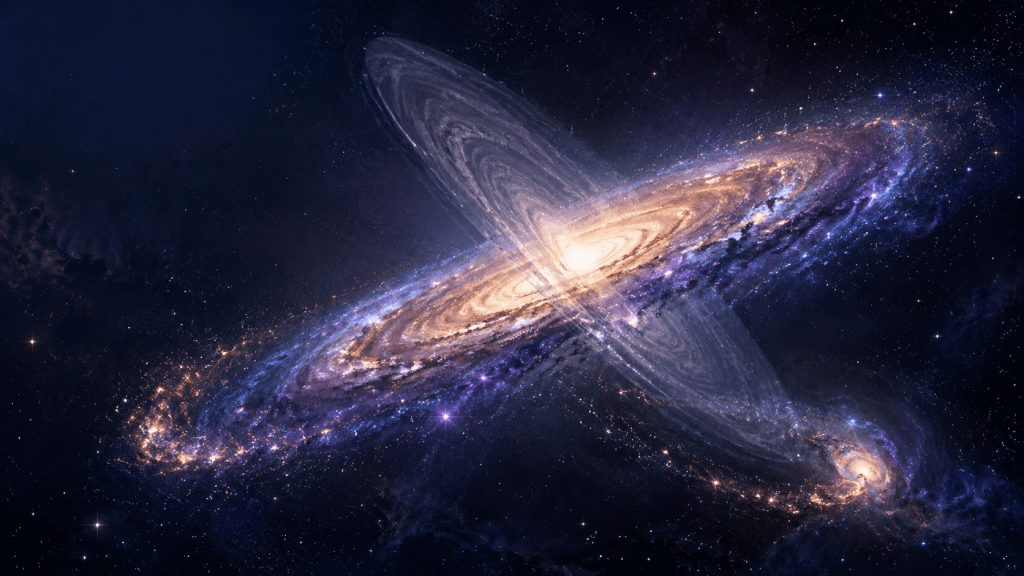
The Milky Way looks permanent from our place inside it, a great band of stars stretching across the night sky. But new research suggests our galaxy may once have been oriented in a completely different direction, perhaps reorienting by more than 90 degrees during its violent youth.
This episode explores the evidence for the Milky Way’s possible ancient flip and, even more remarkably, how astronomers could possibly reconstruct something that happened around ten billion years ago. Using stellar motions measured by Gaia, the debris of the ancient Gaia-Enceladus merger, cosmological simulations, and even the inferred shape of the Milky Way’s invisible dark-matter halo, astronomers are learning to read our galaxy’s history from the fossils it left behind.
We also follow up on the August 5 rocket-body impact on the Moon, and discover why an event involving four tons of hardware traveling thousands of miles per hour was still almost impossibly tiny from Earth.
Then we head outside for the August 16–29 night sky. Venus meets the crescent Moon, Saturn continues its return to the evening sky, Mars and Jupiter appear before dawn, and the first autumn constellations begin climbing into view. We’ll use Pegasus and Cassiopeia to find the Andromeda Galaxy and watch for lingering Perseids and Kappa Cygnid fireballs.
And circle August 27–28 on the calendar: the Full Sturgeon Moon will pass almost completely into Earth’s shadow during a deep partial lunar eclipse, with roughly 96 percent of the lunar disk immersed in the umbra at maximum.
Transcript
Howdy stargazers and welcome to this episode of Star Trails. My name is Drew and I’ll be your guide to the night sky for the period of August 16 to the 29th.
This week we’re chasing a galactic mystery: The idea that our home, the Milky Way, may have flipped its orientation after a violent collision with another galaxy. New results posted just months ago provide compelling evidence for this ancient event, and how we arrived at that conclusion is just as intriguing as the mystery itself.
Later in the show, we’ll close out summer with a spectacular full moon, and a lunar eclipse. It’s another double-stacked episode as the final months of summer come to an end.
Whether you’re tuning in from the backyard or the balcony, I’m glad you’re here. So grab a comfortable spot under the night sky, and let’s get started!
Before we head out into the Milky Way for our main topic this week, I need to follow up on something we talked about on the last episode.
Back on August 5th, a discarded upper stage from a SpaceX Falcon 9 rocket slammed into the Moon. This was the rocket stage left over from the January 2025 launch that sent the Blue Ghost and Hakuto-R lunar landers on their way. The stage had been wandering around out there ever since, until orbital dynamics finally brought its journey to a rather abrupt end near the Einstein crater on the Moon.
And before the impact, I suggested that this might be something worth watching from your backyard.
Well. Maybe I got a little carried away.
To be fair, professional astronomers really were watching for this thing, and researchers had even encouraged experienced amateur astronomers with sufficiently large telescopes and imaging equipment to give it a try. The rocket stage was about 12 meters long, weighed around four metric tons, and hit the Moon at roughly 5,400 miles per hour. Models suggested the collision might throw a plume of lunar dust high enough above the surface to become detectable from Earth.
But for most of us, there wasn’t a show. And I think the reason that surprises us is that we have a terrible intuitive sense of the scale involved here. Think about the Earth and the Moon for a moment. Chances are, the picture that appears in your head looks something like the diagrams we’ve all seen since elementary school: big Earth, little Moon, with the Moon hovering comfortably nearby.
That picture isn’t accurate. The average distance from the center of Earth to the center of the Moon is roughly 239,000 miles. Put another way, you could fit about 30 Earths across that distance. And when the Moon reaches apogee, the farthest part of its orbit, that distance grows to around 252,000 miles.
Here’s an even better way to picture it.
At apogee, you could take every other planet in the Solar System, Mercury, Venus, Mars, Jupiter, Saturn, Uranus and Neptune, turn them pole-to-pole so we don’t have to worry about Saturn’s rings, and line them up between Earth and the Moon.
All of them. The entire rest of the planetary family could be stuffed into that gap.
So, there’s a lot of space between us and the Moon.
And the Moon itself isn’t some little rock floating at the end of that distance. It’s a world about 2,159 miles across. Its diameter is more than one-quarter the diameter of Earth. If Earth were shrunk down to the size of a nickel, the Moon would still be about the size of a coffee bean.
Now put our rocket stage back into that picture. We’re talking about something roughly the length of a city bus, smashing into a world more than 2,000 miles wide, a quarter million miles away.
Suddenly, hoping to watch that from the backyard sounds a little ambitious.
Of course, nobody expected to actually resolve the rocket itself. The hope was that its impact might produce a flash or throw enough illuminated dust above the lunar surface to become visible through a telescope. And there was an observable event. South Korea’s Danuri lunar orbiter photographed the area before and after the collision and picked up a subtle dark streak at the impact site. Meanwhile, astronomers using the Very Large Telescope detected sodium and lithium in the debris plume for several minutes afterward.
So scientifically, the crash wasn’t a dud at all. But for those of us standing down here on Earth, it turned into a sobering lesson in scale.
The Moon is so familiar that it’s easy to forget what we’re actually looking at. That bright disk in the sky is an entire world, nearly as wide as the continental US from coast to coast. As this scale, a rocket body is like a dust speck, smaller even. It’s believed the new crater formed by the crash landing could be a few dozen meters across. From Earth, that’s not something you’re going to notice, even with the best instruments.
In other news from last week — which was a really busy week for stargazers — I enjoyed seeing images on social media from the recent total eclipse. I’m so far south that we didn’t even see a partial, but I bet some listeners farther north caught it.
Last week also represented the peak period for the Perseid meteor shower. I tried to observe this around 3 a.m. on the morning of August 13th, and was met with cloudy skies. Later, that evening, I had plans to try again, but as luck would have it, one of these late afternoon storms rolled in a few hours before sunset and essentially wrecked the seeing for the remainder of the night.
If you managed to catch the eclipse or the meteor shower, I’d like to hear about it. Visit startrails.show and contact me there with your observation report.
We’ll leave the familiar neighborhood of our solar system behind for now, but we’ll return to it in our night sky segment later. We’re about to blast off deep into space, far enough that we can see the entire disk of our home galaxy. And from this distant vantage point, an extragalactic mystery is unfolding.
If you can get somewhere dark on a summer night, far enough from the city lights, the Milky Way has a way of looking almost permanent.
It stretches across the sky like a pale band of smoke, the combined glow of stars too distant and too numerous for our eyes to separate. Cultures have watched it for thousands of years. The individual stars move, of course, and the constellations slowly change over immense spans of time. But the galaxy itself feels like something more fundamental. A structure so enormous and so old that, from our tiny human perspective, it might as well have always been there exactly as we see it now.
Apparently, that may not be true.
Because according to new research presented this summer, the Milky Way may once have been oriented in a completely different direction. And it’s not a subtle difference.
The entire disk of our galaxy may have reoriented by more than ninety degrees. In other words, the Milky Way may have effectively turned on its side.
And if your first reaction to that sentence is, “How in the world could anybody possibly know that?” — good. Because that’s the question that makes this story interesting.
Nobody was around ten billion years ago with a camera pointed at the Milky Way. We can’t leave the galaxy, travel a few million light-years away, and look back at it. We’re inside it.
And yet astronomers are beginning to reconstruct events from the childhood of our galaxy by studying the motions of stars that are still here. This is galactic archaeology. The story begins with something that doesn’t quite fit.
The Milky Way is usually pictured as a big spiral disk, and that’s certainly where most of its familiar stars live. Our Sun is embedded in that disk, roughly twenty-six thousand light-years from the galactic center, making its way around the galaxy along with hundreds of billions of other stars.
But the disk is not the entire Milky Way. Surrounding it is a much larger, much fainter region known as the stellar halo.
The halo is sparse. If you could somehow stand outside the Milky Way, the bright disk would dominate the view while the stellar halo would be extraordinarily difficult to see. But spread throughout that enormous volume are old stars, globular clusters and the remnants of smaller galaxies the Milky Way has consumed during its lifetime.
Those halo stars don’t behave quite like the stars in the disk. The disk is organized. Most of its stars are moving around the galactic center in roughly the same direction, like runners occupying different lanes around an enormous racetrack.
The stellar halo is messier. Its stars can move on steeply inclined paths. Some dive toward the center of the galaxy and then swing far back out again. Some orbit in directions very different from the disk. It’s a population built, at least in part, from the wreckage of other galaxies.
And astronomers noticed something peculiar about it. The Milky Way’s stellar halo rotates surprisingly slowly.
Much of our ability to measure the halo comes from the European Space Agency’s Gaia mission. Gaia has been performing one of the most ambitious mapping projects in the history of astronomy. Rather than simply photographing stars, Gaia has measured their positions, distances and motions with extraordinary precision.
That turns the night sky from a picture into something more like a moving three-dimensional map.
And motion matters. If you want to reconstruct the history of an ancient battlefield, you might examine where objects were buried, where walls collapsed or where debris was scattered.
Astronomers have stars. A star moving through the Milky Way today can preserve information about something that happened billions of years ago. Its orbit is a fossil. Its chemical composition is another fossil. Put enough of those fossils together, and populations begin to emerge.
And that’s exactly what happened several years ago when Gaia revealed a strange group of stars moving through our galaxy on highly elongated orbits.
These stars didn’t behave like normal members of the Milky Way’s disk. Many were moving on trajectories that carried them almost directly toward and away from the galactic center rather than smoothly around it.
When astronomers plotted their motions, the distribution had a stretched shape that inspired one of the more memorable names in modern astronomy: The Gaia Sausage. It is also known, somewhat more majestically, as Gaia-Enceladus.
And the stars of Gaia-Enceladus appear to be the remains of another galaxy.
Around ten billion years ago, while the Milky Way was still young, a smaller galaxy came crashing in. The Milky Way tore the incoming galaxy apart.
Its stars were scattered throughout our halo. Its gas became mixed with our own. The collision helped reshape the young Milky Way and may have contributed to the formation of structures that are still part of the galaxy today.
The galaxy that crashed into us is long gone. But its stars remain. Ten billion years later, its stars are still moving through the Milky Way, carrying the memory of the collision in their orbits. And that ancient crash may help explain why our stellar halo rotates so slowly.
But according to research presented at the Royal Astronomical Society’s National Astronomy Meeting in July, there may be another piece of the story.
Researchers at Durham University looked at twenty-five simulated galaxies with masses and structures broadly similar to the Milky Way. These aren’t simple animations where somebody draws two spirals and tells the computer to smash them together.
They’re part of the Auriga project, a suite of cosmological simulations designed to let galaxies grow inside virtual universes over billions of years. The simulations follow gravity, dark matter, gas, star formation, magnetic fields and the messy history of mergers and accretion that goes into building a galaxy.
The advantage is that you can do something with a simulated galaxy that you can never do with the real Milky Way. You can rewind it. You can look at the galaxy today, measure some unusual feature, and then run backward through its history to see how it got there.
And when the Durham team examined the simulated galaxies with the slowest rotating stellar halos, they noticed a pattern. Those galaxies tended to have experienced major, nearly head-on mergers, like Gaia-Encedalus.
But there was another connection. The simulated galaxies with particularly slow halos had also undergone dramatic changes in the orientation of their disks. Their disks had flipped. In some cases, the direction of the disk changed by more than ninety degrees.
Now, before we go any further, we need to define what “flip” means here, because space does not have a universal up or down.
What astronomers are tracking is the orientation of the galaxy’s rotation, essentially the direction in which its angular momentum points, relative to the surrounding galaxy and halo.
Imagine the Milky Way’s disk as a dinner plate. Draw an imaginary arrow coming straight up through the center of the plate. That arrow represents the axis around which the galaxy rotates.
If the direction of that arrow changes dramatically over cosmic time, the orientation of the disk has changed. That’s the flip.
And there’s another important distinction. We’re not talking about somebody grabbing a rigid Milky Way and physically turning it like a Frisbee. A galaxy isn’t a solid object.
It’s hundreds of billions of stars, clouds of gas, dark matter and other material, all moving under the influence of gravity. Changing a galaxy’s orientation means changing the combined motion of that enormous system.
Mergers can do that because they bring their own momentum into the collision.
Imagine one rotating system being struck by another moving in a very different direction. Gravity exerts torques. Gas gets pulled and compressed. Orbits change. Material can be thrown outward while other material falls inward. New gas arriving later can settle into a new plane.
Over enormous spans of time, the preferred plane of the galaxy can move. And here’s where the slow stellar halo becomes important.
The disk can change its orientation faster than the enormous diffuse halo around it can completely reorganize itself. So after a major reorientation, the disk and halo can temporarily remember different versions of the galaxy.
The disk says, in effect, “This is the direction we’re rotating now.” The halo is still carrying stars whose motions were established under the old arrangement. Viewed relative to the new disk, those halo stars don’t have much coherent rotation. The halo looks strangely slow.
And that’s essentially the clue the Durham researchers started with. We see a slowly rotating stellar halo in the Milky Way today.
We already know the Milky Way experienced a major ancient merger.
When astronomers look at simulated galaxies with those same characteristics, many of them also experienced dramatic disk reorientations. Put those pieces together, and you get the possibility that the Milky Way flipped too.
And I want to emphasize the word “possibility,” because the precise history of our galaxy is still being reconstructed.
Even the simulations show that mergers aren’t necessarily the only way to produce a disk flip. Galaxies can experience changing gas flows, gravitational torques from surrounding structure and complicated sequences of smaller encounters.
So we shouldn’t simplify the story into: Gaia Sausage hit Milky Way. Milky Way immediately tipped ninety degrees. Case closed.
The reality is almost certainly messier than that. But there is another intriguing piece of evidence. And this one comes from something we can’t see at all.
Dark matter.
Every large galaxy appears to live inside an enormous halo of dark matter. The visible Milky Way sits inside a dark structure that extends much farther into space. We can’t photograph that halo directly. Instead, astronomers infer its shape by watching how stars and other objects move through its gravity.
And in 2025, a separate group of researchers used stars measured by Gaia and the LAMOST survey to model the three-dimensional shape of the Milky Way’s dark-matter halo. What they found was strange.
The outer dark-matter halo appears to be oriented in a way that doesn’t neatly line up with the Milky Way’s present stellar disk. Its geometry seems almost as though the visible galaxy and the larger invisible structure around it remember different orientations.
The researchers proposed an explanation. Perhaps the disk used to be better aligned with the dark-matter halo. Then the disk moved.
In their models, gravitational torques from mergers could reorient the visible galaxy while the outer dark-matter halo preserved more of the older geometry.
If that’s correct, the halo may be another fossil of the flip. And I find that idea mind-blowing. We’ a’re talking about reconstructing the former orientation of the Milky Way using the shape of something invisible.
Astronomers can’t see dark matter. They can’t see the Milky Way from outside. But they can measure where stars are today, and how those stars are moving. They can use those motions to infer the gravity of dark matter.
And then they can compare the resulting structure with virtual galaxies that have been evolving inside computers for billions of simulated years.
That’s how you investigate whether the galaxy flipped. With fingerprints left behind from a galactic merger billions of years ago. There is also something wonderfully unsettling about what all of this does to our mental picture of the Milky Way.
A spiral galaxy can be stretched. It can consume smaller galaxies. Its halo can fill with the stolen stars of destroyed neighbors. Its dark matter can be twisted and disturbed.
And apparently, the orientation of the entire stellar disk can change.
And that raises a question I can’t resist. What would the Milky Way have looked like before the flip?
That’s difficult to answer because the event we’re talking about would probably have occurred long before the Solar System existed. The Sun is only about four-and-a-half billion years old.
If the flip is connected to the ancient Gaia-Enceladus era, then Earth never experienced the old orientation.
But imagine some impossible observer suspended outside the young galaxy. The Milky Way would not yet look exactly like the graceful spiral we imagine today. It was still assembling itself.
Then another galaxy arrives. Stars are thrown onto radial paths. Gas is disturbed. The stellar halo grows and the disk changes. Over time, the axis of rotation begins pointing somewhere else.
Hundreds of billions of individual gravitational interactions add up to a galaxy that is, in a very real sense, facing a new direction.
Billions of years pass. The system settles. New stars form. One of those stars is eventually our Sun. Planets assemble around it.
And much later, one of those planets produces creatures who look into the surrounding halo, measure the motions of ancient stars and realize: Something happened here.
And the story isn’t finished. The Milky Way is still interacting with other galaxies. The Magellanic Clouds are gravitationally entangled with us right now. Smaller satellite galaxies continue to be stripped and absorbed.
And in the distant future, the Milky Way and Andromeda will undergo their own enormous gravitational encounter.
Exactly what the final system will look like remains a complicated question, and modern measurements have made the old simple picture of an inevitable head-on Milky Way-Andromeda crash less certain than it once seemed.
But the larger point remains. Galaxies evolve.
So sometime during the next clear night, go outside and look for the band of Milky Way. Especially during these late-summer evenings, when the bright central regions toward Sagittarius are still hanging in the southern sky.
Hidden in the motion of those stars is a memory of what was, and we’re finally beginning to piece together what happened that got us to this point.
After a quick break we’ll be back with this week’s night sky report … Stay with us.
Welcome back.
As we move into the second half of August, the night sky is beginning to feel a little different.
Summer isn’t over yet. Sagittarius and Scorpius are still hanging around in the south, and the Summer Triangle remains impossible to miss overhead. But if you look toward the east later in the evening, some of the stars we associate with autumn are beginning to appear.
And over the next two weeks, the Moon is going to provide several useful markers before ending the month with one of the better lunar eclipses we’ve had in a while.
We begin tonight with a young waxing crescent Moon.
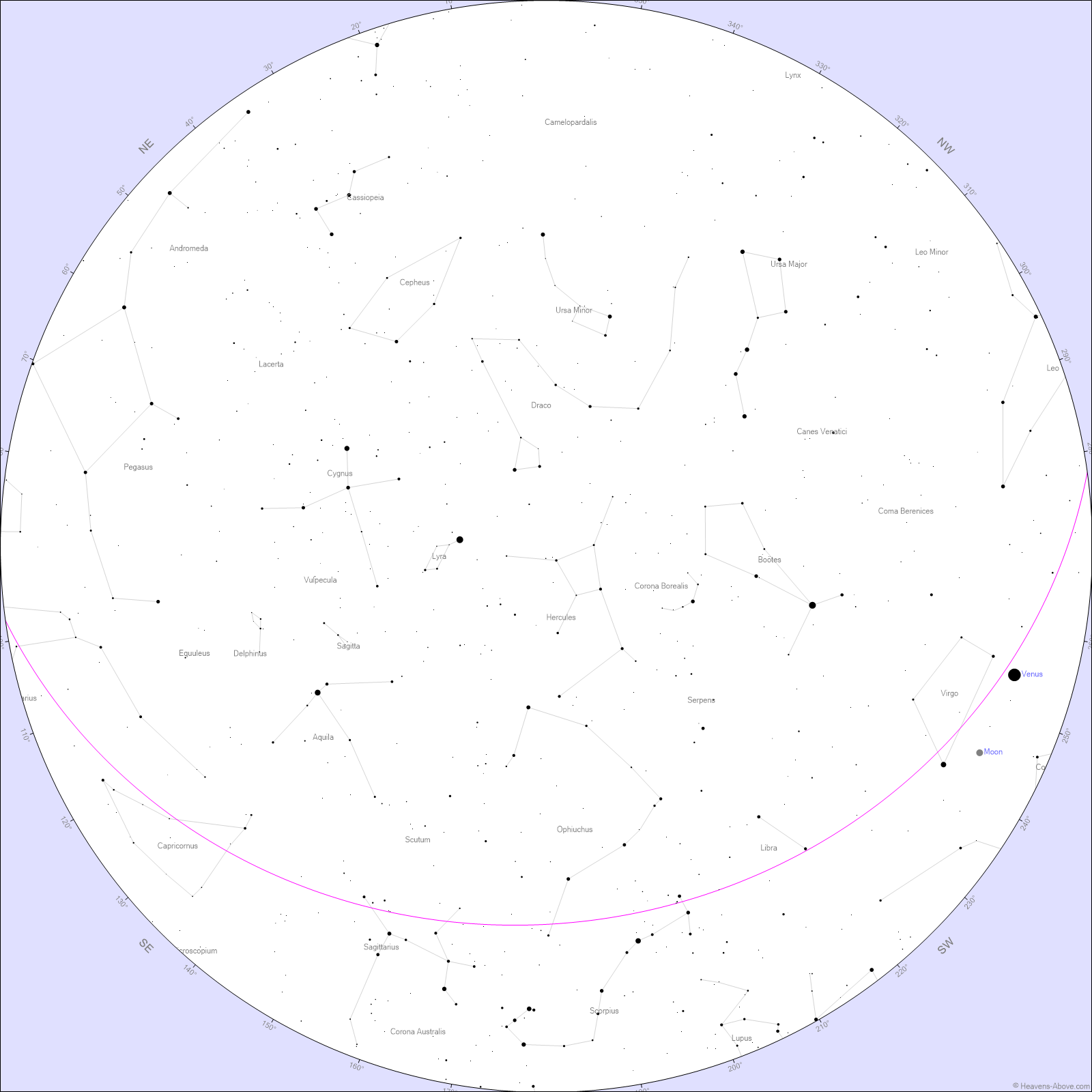
Look low toward the west after sunset for a beautiful pairing of Venus near the crescent Moon. The two will be separated by only about two degrees, close enough to make a very attractive naked-eye sight and an easy target for a wide-angle photograph.
Venus has just reached greatest eastern elongation, meaning it’s near its maximum apparent distance from the Sun during this evening appearance. So throughout the next couple of weeks, it remains the dominant planet in the western sky after sunset.
The Moon continues moving east from there.
On August the 17th, the crescent passes near Spica, the brightest star in Virgo.
Then on the evening of August the 21st, the Moon moves very close to Antares, the bright reddish heart of Scorpius, passing less than a degree away.
Antares is one of those stars whose color becomes obvious once you know to look for it. Its name is often translated as “rival of Mars” because of its reddish-orange appearance. With the Moon nearby, it should be an easy landmark for identifying Scorpius before that great summer constellation begins sinking away for another year.
Between those encounters, the Moon reaches First Quarter late on Wednesday, August the 19th.
That’s a good time to point a telescope at the lunar surface. Along the terminator — the line separating lunar day from night — low-angle sunlight casts long shadows from crater walls and mountains, revealing far more relief than you’ll see under a Full Moon.
The Moon eventually reaches full phase just after midnight on Friday, August the 28th.
August’s Full Moon is traditionally called the Sturgeon Moon.
The name is associated with lake sturgeon in the Great Lakes and other North American waterways. These enormous freshwater fish were historically an important seasonal resource for Indigenous peoples around the Great Lakes, and August became associated with a period when sturgeon were particularly abundant.
Other names associated with the August Full Moon include the Grain Moon and Corn Moon, reflecting the late-summer harvest season.
This particular Full Moon is neither a supermoon nor a micromoon under the commonly used distance-based definitions. The Moon reaches apogee on August the 22nd, several days before Full Moon, so it will be on the more distant side of its orbit and appear somewhat smaller.
But honestly, this Full Moon has something much better going for it.
A lunar eclipse.
During the night of August the 27th into the early morning hours of the 28th, the Full Moon will pass through Earth’s shadow and produce a very deep partial lunar eclipse.
From the East Coast, the faint penumbral phase begins at about 9:23 Thursday evening, August the 27th.
There isn’t much to see initially. The outer portion of Earth’s shadow is subtle, and the Moon may simply look slightly dimmer along one side.
But at approximately 10:33 p.m. Eastern, the real show begins.
That’s when the Moon starts entering Earth’s dark central shadow, called the umbra.
From that point forward, you’ll be able to watch a curved bite slowly spread across the lunar surface.
Maximum eclipse occurs at approximately 12:12 a.m. Eastern time on Friday, August the 28th.
At that point, roughly 96 percent of the Moon’s disk will be inside Earth’s umbra, leaving only a very thin bright portion outside the shadow.
So this is technically a partial lunar eclipse. Just barely.
Most of the Moon should take on the same coppery or reddish coloration we associate with a total lunar eclipse while a narrow bright edge remains illuminated by direct sunlight.
That red color comes from sunlight filtering through Earth’s atmosphere before reaching the Moon. Our atmosphere scatters away much of the blue light while allowing more red and orange wavelengths to continue through.
If you could stand on the Moon during a lunar eclipse and look back toward Earth, you would essentially see a glowing red ring around our planet — the combined light of sunrises and sunsets passing through the atmosphere all around the world.
And that filtered light is what paints the eclipsed Moon red.
The partial phase ends at around 1:51 a.m. Eastern, and the final traces of the penumbral shadow disappear by around three in the morning.
You don’t need any special gear, just go outside and look up. And because the eclipse occurs around midnight here in the eastern United States, the Moon will be comfortably above the horizon.
The planets remain scattered between the evening and morning skies.
Venus is by far the easiest evening target, shining brightly in the west after sunset.
Saturn is becoming increasingly convenient later at night as it rises earlier each evening. Look toward the east and southeast for a steady yellowish point of light. Even a modest telescope should reveal the rings.
Before sunrise, Mars remains visible toward the east in Gemini as a modest reddish-orange point, while Jupiter is beginning to emerge from the northeastern twilight and will become easier to see as the month continues.
Mercury is doing the opposite. After its favorable morning appearance earlier in August, it falls back toward the Sun and reaches superior conjunction on August the 27th, effectively disappearing into the solar glare.
The Perseids are also fading after their August 12th and 13th peak, but the shower remains active until roughly August the 24th, so you may still catch an occasional straggler.
The much weaker Kappa Cygnids are also active and can occasionally produce a bright, relatively slow-moving fireball.
And finally, let’s look toward autumn.
We’ve spent most of the summer talking about Sagittarius, Scorpius and the Summer Triangle.
But the seasonal handoff has already begun.
Go outside around nine or ten in the evening during the final week of August and look toward the east.
One of the first patterns you’ll notice is the Great Square of Pegasus.
It’s exactly what the name suggests: four stars forming an enormous, somewhat lopsided square.
By late August, Pegasus is climbing higher in the eastern sky each evening, and from here onward it will become one of the dominant patterns of the autumn sky.
Attached to one corner of that square is the constellation Andromeda.
And Andromeda gives us one of the best binocular targets of the entire fall.
The Andromeda Galaxy, Messier 31, lies roughly two and a half million light-years away. Under genuinely dark skies, you can see it without optical aid as a faint fuzzy patch, while binoculars make its bright central core much easier to pick out.
And there’s something I particularly like about pointing it out in this episode.
We’ve just spent most of the show talking about how astronomers are reconstructing the violent history of our own Milky Way.
Then you can walk outside and look at another enormous spiral galaxy with your own eyes.
Actual light from another galaxy, crossing two and a half million light-years of space and ending its journey in your eye.
Nearby, Cassiopeia is also becoming increasingly prominent toward the northeast, recognizable by its familiar W shape. Below and around it you’ll find Perseus, another constellation that becomes more important as we move deeper into autumn.
The sky itself is changing shifts. Sagittarius and Scorpius are slipping west. Pegasus, Andromeda and Cassiopeia are climbing in the east. And before too much longer, the evening sky will belong to fall.
But before we get there, don’t forget August the 27th.
A Full Sturgeon Moon rising into the evening sky, followed a few hours later by Earth’s shadow swallowing almost the entire lunar surface.
That’s a pretty good way to close out the summer.
We’ll release our next episode in two weeks, and after that one we’ll be back on our regular weekly publishing schedule as we move into September.
That’s going to do it for this week. If tonight’s episode sparked your curiosity, or maybe gave you something new to think about the next time you look up, I’d be honored if you shared Star Trails with someone who might enjoy the journey.
You can always find the latest episodes, show notes and extras at startrails.show.
And if you’d like to help support the show, there’s also a little “buy me a coffee” link on the site. It genuinely helps keep these stories coming.
Be sure to follow Star Trails on Bluesky and YouTube — links are in the show notes.
Until we meet again beneath the stars … clear skies everyone!
Support the Show
Connect with us on Bluesky @startrails.bsky.social
If you’re enjoying the show, consider sharing it with a friend! Want to help? Buy us a coffee! Also, check out music made for Star Trails on our Bandcamp page!
Podcasting is better with RSS.com! If you’re planning to start your own podcast, use our RSS.com affiliate link for a discount, and to help support Star Trails.


Leave a comment