Little Red Dots at Cosmic Dawn – Star Trails: From Backyard Astronomy to Cosmic Wonder
Episode 121
The James Webb Space Telescope has uncovered hundreds of tiny red points in the early universe. They are extraordinarily compact, unexpectedly bright and strangely quiet in the X-ray and radio wavelengths where an active black hole should reveal itself.
Astronomers call them “little red dots,” but that modest nickname conceals one of the most intriguing mysteries of the Webb era.
In this episode, we follow the clues hidden in their light. Some may contain young black holes buried inside enormous cocoons of hydrogen, objects researchers have nicknamed “black hole stars.” Others may be powered by supermassive stars, furious bursts of star formation or combinations of several different cosmic engines.
We’ll examine new evidence from several unusual objects, visit the nearby Saguaro galaxy and the curious galaxies known as Green Peas, and ask whether the young Milky Way might once have appeared as a little red dot of its own.
Then, in the Night Sky Report for August 30 through September 6, we’ll look for the Moon beside Saturn, Venus near Spica, Mars and Jupiter before dawn, and some of the quieter constellations hiding around the Summer Triangle.
Transcript
Howdy stargazers and welcome to this episode of Star Trails. My name is Drew and I’ll be your guide to the night sky for the week of August 30 to September 6.
This week we’ll examine new data that emerged this summer about some of the most distant structures we’ve ever catalogued. Astronomers are calling them “little red dots” and they represent a new mystery uncovered by the James Webb Space Telescope. We’re still trying to understand what they are, and what they might tell us about the early years of our own galaxy, the Milky Way.
Later in the show we’ll take a look at what you can expect to see in a relatively quiet night sky this week.
Whether you’re tuning in from the backyard or the balcony, I’m glad you’re here. So grab a comfortable spot under the night sky, and let’s get started!
In the first deep images from the James Webb Space Telescope, astronomers began noticing something strange.
Scattered among the ancient galaxies were tiny points of reddish light. They were easy to overlook. No dramatic spiral arms. No luminous jets. No great clouds of glowing gas. Just little red dots.
That casual nickname stuck. And it may turn out to describe one of the most important discoveries of the Webb era.
These objects didn’t suddenly appear when Webb opened its mirror. Cosmic expansion had stretched their most revealing light into the infrared, where Webb is far more capable than Hubble. Its NIRCam finds their unusual colors and compact shapes; NIRSpec spreads their light into a spectrum, revealing the fingerprints of hydrogen, helium and other elements.
Most come from a remarkably early chapter in cosmic history, roughly 600 million to a billion and a half years after the Big Bang. Webb sees them as they existed more than 12 billion years ago, when the first generations of galaxies and black holes were still taking shape.
Astronomers have assembled samples containing hundreds of them, far more than earlier surveys led us to expect in the young universe.
At first glance, their name sounds almost comical. But every word in “little red dot” hides a clue.
They are little because even Webb usually cannot resolve much structure in them. Many appear only a few hundred light-years across, versus roughly 100,000 light-years for the Milky Way. Magnified examples may be smaller still.
They are red because Webb receives much of their light at its longer infrared wavelengths. Cosmic expansion has stretched that ancient light on its journey to us, but redshift alone is not the whole story. When astronomers reconstruct the original spectrum, these objects still have a peculiar shape: relatively blue in ultraviolet light, then sharply rising toward the red in visible light. Plot it on a graph and it looks something like the letter V.
And they are dots because whatever is producing most of that light is extraordinarily concentrated.
So what could pack that much energy into such a small space? The first obvious suspect is a feeding black hole.
Black holes themselves don’t shine, of course. But gas falling toward one can become hot, creating an active galactic nucleus, or AGN. Quasars are the most spectacular members of that family.
Many little red dots have broad hydrogen lines. These usually appear when gas moves at a wide range of speeds, often thousands of kilometers per second, just as it does while whirling around active black holes.
That sounds like a confession. But the case isn’t closed because the suspect’s fingerprints don’t quite match.
A vigorously feeding black hole should also produce X-rays from extremely hot material near the center and maybe radio emission. If dust makes the object red, that dust should absorb energy, warm up and glow brightly in the infrared.
But most little red dots are strangely weak or missing X-rays. They’re quiet in radio surveys. The expected glow from hot and cold dust is often absent. And when astronomers watch them over time, they show much less flickering than ordinary active galactic nuclei.
Put those clues together, and an ordinary dusty quasar begins to look like the wrong answer.
The purely stellar explanation has problems too. Dense young galaxies could produce plenty of light and the bottom of that V-shaped spectrum. But fitting everything with stars can require an astonishing mass in far too little space, while still struggling to explain the broad hydrogen lines.
This is what makes the little red dots such a satisfying scientific mystery. We have evidence and clues, but they seem to point in different directions.
One increasingly persuasive answer begins with an object that sounds almost self-contradictory: a black hole star, not to be confused with the Soundgarden song from the 90s, “Black Hole Sun.”
A black hole star is not a star with a black hole sitting on its surface. Picture a young black hole buried inside a dense cocoon of hydrogen. The feeding black hole replaces the nuclear furnace of an ordinary star, while the gas absorbs and reprocesses that energy into something resembling a gigantic false stellar atmosphere.
From the outside, the whole system could glow with a surface temperature of only about 5,000 degrees Kelvin, comparable to a cool star, even though a black hole is raging inside it.
That hydrogen cocoon solves several clues at once. It can absorb X-rays before they escape. It can make the object red without relying on great quantities of dust. It can remain compact. And electrons packed into the gas can scatter photons and broaden the hydrogen lines.
That last point matters. Astronomers originally treated those broad lines like a speedometer: faster gas implied a more massive black hole. Some estimates reached tens or hundreds of millions of solar masses, quite large for such a young universe. But if electron scattering contributes much of the broadening, revised estimates of a hundred thousand to ten million solar masses become possible. Still enormous, but not quite so cosmically premature.
Earlier this year, Webb obtained an extraordinarily deep spectrum of one little red dot called GLIMPSE-17775. A foreground galaxy cluster’s gravitational lensing acted as a natural magnifying glass, and Webb gathered the equivalent of roughly 80 hours of observing time. Astronomers pulled more than 40 spectral lines from that faint source.
Hydrogen, oxygen and helium showed the signature of light scattering through dense gas. Sixteen iron lines formed what the researchers called an “iron forest.” Helium fluorescence and absorption also pointed toward a powerful source sealed inside a thick medium. It was some of the best evidence yet for the black-hole-star picture.
Then, in August, astronomers reported something even more striking.
The object is called MoM-BH-star-one. We see it as it existed only about 660 million years after the Big Bang. In Webb’s images it is unresolved, intensely red, and almost disappears at shorter wavelengths.
Its spectrum contains an enormous Balmer break. That’s a sharp drop in brightness produced when dense hydrogen absorbs particular wavelengths of light. Ordinary stellar populations can make a Balmer break, but this one is far deeper than ordinary stars should be able to produce.
The underlying physics is not exotic. We see the same basic hydrogen fingerprint in the spectrum of Vega, one of the brightest stars in the summer sky. What is extraordinary is the depth of this break. It’s as though Webb has found something wearing a stellar atmosphere on a scale no ordinary star could support.
It also contains almost no sign of elements heavier than hydrogen and helium. Yet the object produces far too much energy to be any known star type.
The model that best fits the evidence places a black hole of roughly 100,000 solar masses inside a hydrogen envelope about the size of our solar system. That makes MoM-BH-star-one less like an entire hidden galaxy and more like the black-hole-star engine itself, briefly outshining almost everything around it.
This does not prove that every little red dot is the same object in the same stage of life. In fact, a large spectroscopic study released this year found that the label may cover a family of related objects, mixing black-hole activity, young starbursts and dense gas in different proportions.
And there is another fascinating suspect.
Some researchers propose that at least a few dots contain genuine supermassive stars, perhaps 100,000 times the mass of the Sun. Models suggest that late in their brief lives, these stars could pulsate violently and eject dense shells of hydrogen, helium and nitrogen. The star and shell could reproduce several Little Red Dot clues before collapsing into a massive black-hole seed.
Another Webb object, Pseudo-LRD-NOM, (these names are something else aren’t they?), may show an earlier step in the process. This appears to be a metal-poor starburst galaxy less than about ten million years old, apparently containing an active black hole while the surrounding galaxy is still being assembled.
These ideas don’t have to be completely exclusive. A supermassive star could create a heavy black-hole seed. The new black hole could then feed inside a dense gaseous envelope and become a black hole star. As the gas clears and the host galaxy grows easier to see, the system could mature into a more familiar active galaxy.
That possible life story may even explain where the little red dots went.
They are common early in cosmic history, but rare nearby. In 2026, astronomers studied a later spiral galaxy nicknamed the Saguaro. At its center is a compact red nucleus with the same V-shaped spectrum as a little red dot. Chandra detected weak X-rays, indicating a heavily obscured active black hole.
When the researchers simulated moving the Saguaro much farther away, its spiral arms faded below Webb’s detection limit. Only the bright red center remained.
The Saguaro is not the only nearby object that may help astronomers interpret the distant universe. Another class of galaxies carries the equally informal nickname “Green Peas.” They looked like small green blobs in images from the Sloan Digital Sky Survey, but they are actually compact, low-mass galaxies producing stars at a furious pace. Their relatively primitive chemical makeup and intense radiation make them useful local stand-ins for some of the rapidly growing galaxies common in the early universe.
Astronomers have now found the first confirmed pair of actively feeding supermassive black holes inside a Green Pea system. Chandra resolved two bright X-ray sources, while observations from the Keck Observatory confirmed two separate galactic nuclei at the same distance, about 27,000 light-years apart. The system appears to be a merger in progress, feeding both black holes while igniting new stars.
A Green Pea is not simply a nearby Little Red Dot. But it gives astronomers a much closer laboratory for studying the same tangled processes: galaxies colliding, stars forming, gas rushing inward and black holes growing at the center. Conditions that Webb reveals as a few unresolved pixels more than 12 billion light-years away can sometimes be examined in far greater detail closer to home.
A galaxy isn’t born as a finished spiral. Inside an invisible halo of dark matter, gas gathers, forms stars and feeds a growing central black hole. Over billions of years, star formation, gas inflows and mergers can build the disks, bulges and spiral arms we recognize today. A Little Red Dot may be one brief episode in that story, when the black hole overwhelms the unfinished galaxy around it.
Could our own Milky Way once have passed through such a phase? Possibly, but we can’t say that it did. We can’t follow one particular dot across 12 billion years and identify the galaxy it became. But the young Milky Way also had to assemble its stars and grow the black hole we now call Sagittarius A-star. If that black hole once fed inside a dense cocoon of gas, our unfinished galaxy might have appeared from across the universe not as a majestic spiral, but as one tiny red point.
In other words, at least some little red dots may not be little, and they may not truly be only dots. We may be seeing the brilliant tips of much larger, fainter galaxies, the brief visible phase of young black holes feeding behind curtains of gas.
There may be more hidden in those galaxies than their faint outer structure. Astronomers estimate the mass of a distant galaxy from its combined light because they can’t resolve and count its individual stars. The brightest, most massive stars dominate that light, while large populations of small, dim stars must be inferred, kind of like judging a distant city from its illuminated skyscrapers while missing all the houses below.
New Webb spectroscopy suggests that some ancient galaxies contain far more low-mass stars than the standard recipe assumes. The study examined nine later, quiet galaxies rather than Little Red Dots themselves, so it doesn’t directly weigh the dots. But the oldest galaxy in the sample contained the largest excess of small stars. If similarly bottom-heavy stellar populations existed in its early ancestors, some already-massive young galaxies could have contained several times more stellar mass than astronomers estimated.
That would not solve Webb’s early-galaxy mystery. It would deepen it. The young universe may not only have assembled galaxies and black holes much faster than expected; it may also have formed stars in proportions different from those in the Milky Way. We may be trying to understand an unfamiliar cosmic era using a recipe measured much closer to home.
The mystery isn’t solved, but astronomers know what evidence to seek. Deeper images may reveal faint host galaxies. More precise spectra can test whether electron scattering really shapes those broad hydrogen lines. Nitrogen-rich shells would strengthen the case for supermassive stars, while changes in brightness could expose an ordinary active nucleus hiding underneath. And more intermediate objects like the Saguaro may finally connect the dots across cosmic time.
The most important clue may be that “little red dots” is an appearance, not necessarily a single identity.
But the emerging picture is extraordinary. Webb may have found the missing adolescence of supermassive black holes: objects no longer merely seeds, not yet exposed quasars, wrapped in the material that is both feeding them and hiding them from view.
And all of that history, the birth of black holes, the assembly of galaxies, and perhaps the ancestors of the giant black hole at the center of our own Milky Way, arrives in our telescopes as a few quiet red pixels.
Sometimes the smallest marks on the cosmic map lead to the biggest questions.
And with that journey into the universe’s distant past behind us, let’s return to the sky over our own backyards and see what is waiting for us tonight.
Stay with us.
Welcome back.
I hope you managed to catch the near-total lunar eclipse a few nights ago. Once again, dense clouds rolled in and I saw exactly nothing. But if you managed to catch it, shoot me a message over at our website, startrails.show, and give me an observation report.
This week’s sky is not packed with one enormous headline event, but it offers several lovely pairings and a welcome return of darker evenings. As always, exact rise times vary with your location, but these directions work well for observers across the middle latitudes of North America.
The Moon begins the week as a bright waning gibbous, just two days past full. On Sunday evening, August 30, look toward the east-southeast around ten o’clock for the Moon beside Saturn. The planet will look like a steady, pale-gold star a few degrees from the Moon. Binoculars will frame the pair nicely, while even a modest telescope can reveal Saturn’s rings.
The Moon continues drifting eastward and reaches the Pleiades before dawn on Thursday, September 3. The Moon will be bright enough to wash out some of the Seven Sisters, but binoculars should pull the little blue-white cluster back into view. The following morning, September 4, the Moon reaches last quarter at 3:51 a.m. Eastern time. That means it will not rise until around midnight, and the first half of the night will grow noticeably darker as the week continues.
By the morning of Sunday, September 6, the waning crescent Moon has moved into Gemini and appears near Mars before sunrise. Mars is not especially bright this year, so let the Moon guide you to the small reddish point nearby. The Moon also reaches perigee that day, the closest point in its monthly orbit, although the effect will be subtle rather than a dramatic “supermoon.”
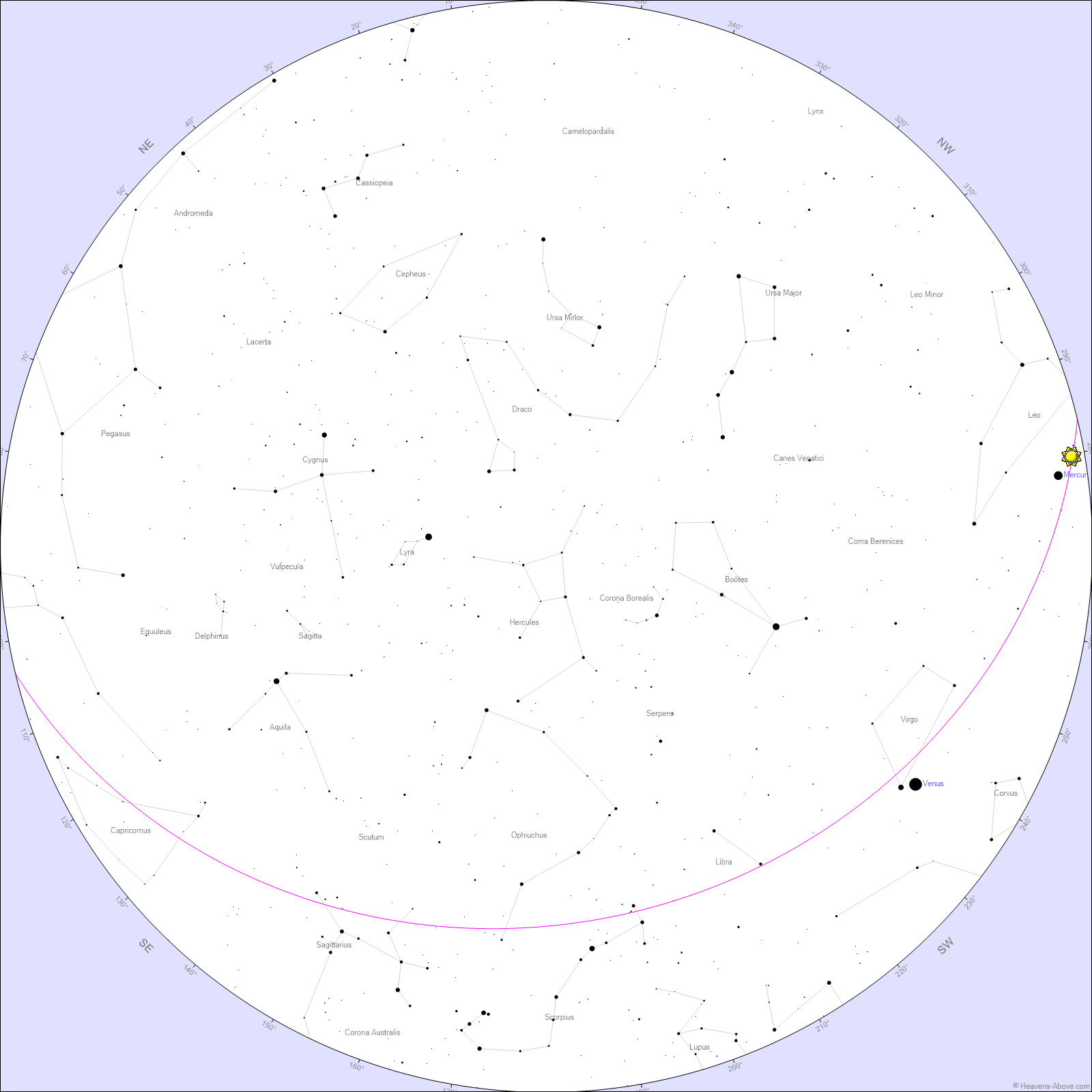
Venus remains the easiest planet to find. It blazes low in the west-southwest after sunset. Around September 1 and 2, Venus passes very close to Spica, the brightest star in Virgo. You’ll need a clear horizon, and binoculars may help pick pale-blue Spica out of the twilight beside the much brighter planet. Wait until the Sun is fully below the horizon before sweeping with binoculars.
Saturn is now becoming a convenient late-evening target, rising in the east-southeast and climbing higher as the night goes on. Jupiter and Mars belong to the morning shift. Before dawn, Mars stands in Gemini, while brilliant Jupiter shines lower in the east and becomes easier to see with each passing morning. Mercury, meanwhile, is too close to the Sun to be a useful target this week.
If you are outside before dawn on September 1, you might also catch an Aurigid meteor. This is a minor shower, and the bright Moon will interfere, so think of any meteor as a bonus rather than a promised show.
For a quieter constellation challenge, start with the Summer Triangle—Vega, Deneb and Altair—still high and easy to recognize. Then look just east of Altair for Delphinus, a small diamond of stars with a short tail. Nearby is Sagitta, the Arrow, one of the smallest constellations in the sky. Neither is flashy, but both are satisfying little patterns to find once the brighter landmarks are familiar.
As the evening darkness improves late in the week, binoculars can sweep the Milky Way through Cygnus, and a small telescope can hunt for the Dumbbell Nebula in Vulpecula. The Andromeda Galaxy is also climbing into the northeast during the evening. From a dark location it appears as a faint, elongated smudge, but this light began its journey roughly two and a half million years ago.
Finally, if you’re willing to venture outside before dawn, Comet 220P/McNaught has become an unexpected target for northern observers. This normally obscure periodic comet experienced two enormous outbursts this year, briefly becoming about 20,000 times brighter than expected. During the coming week, it will be high in the southern sky before sunrise, moving through Cetus toward Pisces.
The comet was hovering around ninth or tenth magnitude late this month, so this is not a naked-eye spectacle. Under dark skies it may appear in binoculars as a small, fuzzy patch, although a telescope,a long camera exposure, or smart scope will provide a more reliable view. Its brightness is fading, so consult an app like Stellarium before heading outside. But that unpredictability is what makes 220P interesting: after awakening twice already, astronomers are watching to see if it has another surprise left before its closest approach to Earth in October.
And before we close this episode, one of astronomy’s next great eyes is on its way to space. NASA’s Nancy Grace Roman Space Telescope was scheduled to lift off aboard a SpaceX Falcon Heavy this morning. From there, Roman will travel roughly a million miles to the Sun-Earth Lagrange Point known as L2. That’s the same neighborhood occupied by the James Webb Space Telescope.
Roman has a mirror about the same size as Hubble’s, but its 300-megapixel infrared camera will see a field at least 100 times wider. If Webb is built to examine selected objects in extraordinary detail, Roman is designed to reveal the larger cosmic landscape. It will survey billions of galaxies, looking for the fingerprints of dark matter and dark energy and measuring how the universe’s structure and expansion have changed over time.
Roman will also conduct a broad census of planets beyond our solar system and test advanced equipment for directly photographing worlds hidden in the glare of their stars. It won’t replace Webb; the two observatories should complement one another. Roman can discover patterns and unusual objects across enormous regions of sky, while Webb moves in for a closer look. After spending this episode exploring one of Webb’s great mysteries, it seems fitting that astronomy’s next great surveyor is now beginning its own journey into the dark.
That’s going to do it for this week. If tonight’s episode sparked your curiosity, or maybe gave you something new to think about the next time you look up, I’d be honored if you shared Star Trails with someone who might enjoy the journey. You can always find the latest episodes, show notes, and extras at startrails.show.
And if you’d like to help support the show, there’s also a little “buy me a coffee” link on the site. It genuinely helps keep these stories coming.
Be sure to follow Star Trails on Bluesky and YouTube — links are in the show notes. Until we meet again beneath the stars … clear skies everyone!
Support the Show
Connect with us on Bluesky @startrails.bsky.social
If you’re enjoying the show, consider sharing it with a friend! Want to help? Buy us a coffee! Also, check out music made for Star Trails on our Bandcamp page!
Podcasting is better with RSS.com! If you’re planning to start your own podcast, use our RSS.com affiliate link for a discount, and to help support Star Trails.


Leave a comment