Rivers Through the Dark – Star Trails: From Backyard Astronomy to Cosmic Wonder
Episode 122
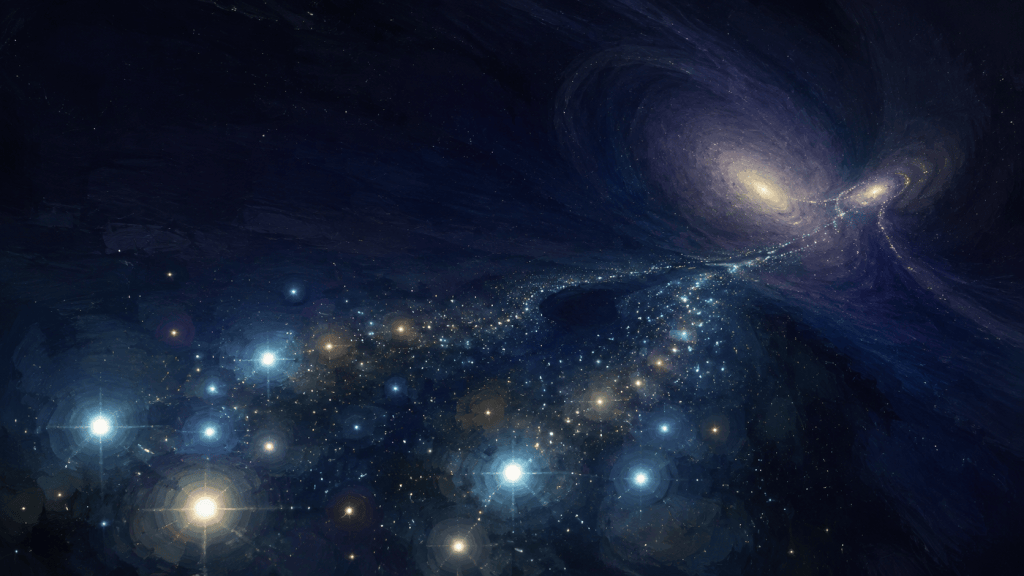
Galaxies carry the evidence of their past. When the Milky Way captures a dwarf galaxy or tears apart a globular cluster, it leaves behind long, ghostly ribbons of stars called stellar streams. These streams preserve the history of ancient collisions, and their shapes may trace the invisible dark matter surrounding a galaxy.
This week, we follow the stellar wreckage left behind by galactic cannibalism, from the enormous Sagittarius stream wrapped around the Milky Way to Oyashio, the first suspected globular-cluster stream discovered beyond our galaxy. We’ll explore how astronomers use these delicate structures as cosmic windsocks and seismographs, and why gaps or kinks in a stream might reveal an encounter with something made almost entirely of dark matter.
We’ll also look at how the newly launched Nancy Grace Roman Space Telescope could transform this work by finding stellar streams around hundreds of other galaxies.
Then, in this week’s night sky report, the Moon visits Mars and Jupiter, the September Epsilon Perseids arrive under nearly moonless skies, and Saturn returns as a prime telescopic target.
Transcript
Howdy stargazers and welcome to this episode of Star Trails. My name is Drew and I’ll be your guide to the night sky for the week of September 6 to the 12th.
Over the past few episodes, we’ve followed galaxies through some almost unimaginably slow transformations. We looked at distant Little Red Dots and asked what galaxies were like during their mysterious adolescence. And, we explored how repeated collisions may have gradually shifted the Milky Way’s orientation in space.
This week, we’ll complete a loose trilogy by examining the stellar wreckage left behind by those encounters, and how ghostly streams of stars can preserve a galaxy’s history while tracing the invisible dark matter surrounding it.
Later in the show we’ll take a look at this week’s night sky during what will be a nice, dark observation period.
Whether you’re tuning in from the backyard or the balcony, I’m glad you’re here. So grab a comfortable spot under the night sky, and let’s get started!
NASA’s newest space telescope is now on its way.
Just a week ago, on August 30th, the Nancy Grace Roman Space Telescope lifted off from Kennedy Space Center aboard a Falcon Heavy rocket. A little more than half an hour later, Roman separated from the rocket’s upper stage and began flying on its own. Its destination is the second Sun–Earth Lagrange point, or L2, about a million miles from Earth. That’s the same point occupied by the James Webb Space Telescope.
But Roman and Webb are very different kinds of observatories. Webb is the specialist with the narrow, penetrating gaze. Roman is built to see the big picture. Its 300-megapixel Wide Field Instrument will produce images with roughly Hubble’s sharpness while taking in about one hundred times as much sky in a single view. Roman can examine a crowd where Hubble might study a handful of faces.
That enormous field of view will help Roman survey hundreds of millions of galaxies, hunt for distant worlds, and map the large-scale distribution of dark matter, the invisible scaffolding upon which the visible universe seems to have been built.
But there may be another way Roman can help us find what cannot be seen. Instead of looking directly for dark matter, astronomers can watch what gravity has done to the stars around it. And some of the most sensitive records of that gravity are long, ghostly rivers of stars called stellar streams.
The name is descriptive. A stellar stream really does look like a current of stars flowing through space. But the stars aren’t being carried by water, of course. They are following one another along a shared orbit, sometimes in a ribbon stretching for tens of thousands of light-years.
And embedded in that ribbon may be a map of an otherwise invisible galaxy.
So how can a river of stars reveal something we can’t see?
To make a stellar stream, begin with a group of stars held together by gravity. It might be a globular cluster, a dense, ancient ball containing tens or hundreds of thousands of stars. Or it might be an entire dwarf galaxy orbiting a much larger one.
Every time that smaller system approaches the larger galaxy, it feels a gravitational pull. But the pull isn’t perfectly equal across the whole cluster. The side facing the galaxy is tugged a little more strongly than the far side. Over many orbits, those tidal forces begin peeling stars away.
Some of the escapees drift slightly ahead of their former home. Others trail behind it. The once-compact cluster is slowly unwound into a long, thin strand.
Imagine pulling apart a loose ball of yarn while walking around a room. The ball keeps moving, but it leaves a thread tracing the path it has taken. A stellar stream is something like that thread, except gravity is doing the unraveling, and the path may remain visible for billions of years.
Some streams come from globular clusters and remain exceptionally narrow. Others are the remains of dwarf galaxies and spread into broader, more complicated structures. Either way, they tell a story of galactic cannibalism. Large galaxies such as the Milky Way didn’t grow in isolation. They were assembled, in part, by capturing, stripping and eventually consuming smaller systems.
We can see that process happening now with the Sagittarius dwarf galaxy.
Sagittarius has been orbiting the Milky Way for billions of years. Again and again it has passed through our galaxy’s disk, and each encounter has stripped away more of its stars. Those stolen stars now wrap around the Milky Way in an enormous stream, debris from a galaxy that is gradually being absorbed into our own.
Galaxies don’t just neatly form as spirals and stellar streams reveal something much messier. The Milky Way has a past. It has collided with other galaxies, torn them apart, and incorporated their stars. Some of the stars overhead may not have been born in the Milky Way at all.
This is why astronomers sometimes call the study of these structures “galactic archaeology.” The original dwarf galaxy may be nearly gone, but its stars retain clues. Their motion and chemical makeup can identify them as members of the same ancient population.
Gaia, the European Space Agency observatory that measured the positions and motions of nearly two billion stars, allowed astronomers to pick out related groups moving through the crowded Milky Way, even when a stream was no longer obvious as a neat line in the sky.
Those fossil populations have helped reconstruct the Milky Way’s family tree. They reveal ancient mergers with names such as Gaia–Sausage–Enceladus, Sequoia, Shakti and Shiva. Some are remnants of encounters so old that they helped build the earliest structure of our galaxy. We talked about some of these mergers back in episode 120, when we looked at the theory that collisions with our galaxy may have caused it to shift its orientation in space.
But streams do more than preserve the history of what a galaxy ate. Their shapes also record the gravity they encountered afterward.
A star in a stream follows an orbit determined by all the mass around it, not merely the mass we can see. If a galaxy contained only its luminous stars and gas, that orbit would take one path. Add a huge halo of invisible matter, and the path changes.
Astronomers can build computer models of a stream, adjust the amount and distribution of mass in the host galaxy, and ask which model produces the ribbon we actually observe. The stream becomes a tracer dropped into an invisible current.
Or perhaps a better comparison is a windsock. We can’t see the moving air itself, but we can infer its direction and strength from the shape it gives a piece of fabric. In much the same way, stars reveal the gravitational field through which they move.
This gives astronomers a way to estimate not only how much dark matter surrounds a galaxy, but how it is arranged. Is the dark matter halo roughly spherical? Is it flattened? Does it extend farther than expected? The stars in a stream respond to the full gravitational landscape, including matter that produces no light of its own.
Until recently, this sort of detailed stream analysis had largely been confined to the Milky Way. That makes sense. From inside our own galaxy, we can identify individual stream stars and measure how they move. Around another galaxy, a thin stream becomes a barely perceptible smudge against the darkness.
Then an astronomer spotted something in an old Hubble image.
The galaxy is called UGC 9050-Dw1. It is an ultra-diffuse dwarf galaxy about 115 million light-years away, a very faint, spread-out collection of stars that appears to contain far more mass than its starlight alone could explain.
In 2023, David Hendel noticed a delicate feature in archived Hubble observations of the galaxy. It looked like a thin stellar tail extending away from a compact point of light. A research team later returned to those images, combined them with other observations and simulations, and concluded that the feature is probably a globular cluster being pulled apart.
The stream has been named Oyashio, after a cold ocean current in the western Pacific. It extends from a possible surviving globular cluster roughly eight thousand light-years from the center of the dwarf galaxy.
If the interpretation is correct, Oyashio is the first globular-cluster stellar stream identified beyond the Milky Way.
That makes this faint little streak an important proof of concept. The team modeled the stream’s visible shape and asked what sort of gravitational environment could produce it. Their results suggest that UGC 9050 is embedded in a substantial dark matter halo.
Think about the layers of invisibility involved here. The host galaxy is already so diffuse that it is difficult to see. The stream is fainter still: a ribbon of stars torn from a cluster around that nearly ghostly galaxy. And from the shape of that ribbon, astronomers infer a much larger structure made of matter that emits no light at all.
It is an extraordinary chain of deduction, light from a few scattered stars sketching the outline of something dark.
Oyashio was found in a Hubble image almost by chance. Roman is designed to turn that sort of narrow glimpse into a survey.
Hubble still has exquisite vision, but its field of view is small. Searching for extragalactic streams with Hubble is a little like studying a coastline through a drinking straw. Roman will retain comparable sharpness across a far larger patch of sky. Faint streams, shells and stellar halos around other galaxies should emerge in numbers rather than as isolated curiosities.
Astronomers will be able to compare streams around many kinds of galaxies. That matters because the Milky Way is only one example. If we learn everything about dark matter from our own galaxy, we risk mistaking local quirks for universal rules. A large sample can reveal which features are common, which depend on the host galaxy, and whether the dark matter halos predicted by our models resemble the ones nature actually built.
Roman may find streams that are unusually smooth, and others with gaps, bends, kinks or small offshoots. Those irregularities are especially tempting, because they may record collisions with objects made almost entirely of dark matter.
Our leading cosmological model predicts that a galaxy’s dark matter halo should not be perfectly smooth. It should contain smaller clumps called subhalos. Some subhalos may contain stars and appear as dwarf galaxies. Others may be completely dark.
Because a dark subhalo produces no light, we can’t photograph one in the usual sense. But if it passes close to a narrow stellar stream, its gravity should disturb the stars. It might carve a gap, pull out a spur, or introduce a kink into the stream’s path.
Here is where the stream begins to resemble a cosmic seismograph. A dark object passes nearby, the stars are jostled, and the resulting pattern preserves evidence of the encounter long after the intruder has moved on.
Finding those dark clumps, and measuring how many exist at different masses, could test what dark matter actually is. Cold dark matter predicts abundant structure even at small scales. Other possibilities, including warmer or more strongly interacting forms of dark matter, could erase some of those smaller clumps. The fine structure of stellar streams might help distinguish among those ideas.
But there’s a catch. A seismograph may faithfully record a vibration without telling us what caused it. And a stream may faithfully record a gravitational disturbance without identifying the culprit.
In a new set of simulations with the wonderfully ominous title “No Stream Left Unscathed,” researchers created about fifteen thousand globular-cluster streams inside four simulated Milky Way-size galaxies. They allowed the galaxies’ larger gravitational structures to evolve naturally—but deliberately left out the small dark matter subhalos astronomers often invoke to explain stream irregularities.
Even without those small clumps, roughly three quarters of the simulated streams developed complicated features: gaps, spurs, bends, kinks and cocoon-like envelopes. Only about seventy of the fifteen thousand remained free of detectable wiggles at every scale the team examined.
In other words, the host galaxy itself can make a stream look as if something crashed into it.
The gravitational field of a real galaxy is not a perfectly smooth, motionless bowl. A galaxy has a disk, a central bulge and spiral structure. It has molecular clouds, a bar and satellite galaxies. Its mass distribution changes with time. The stream’s own orbit repeatedly carries it closer to and farther from the crowded center. All of those effects can shape the ribbon.
This doesn’t mean streams have failed as dark matter detectors. It means astronomers must establish the background noise before claiming they have found the signal.
That’s an important distinction. Science rarely advances because one measurement provides a perfectly unambiguous answer. More often, a promising new tool reveals a new layer of complexity. Researchers learn what can imitate the effect they seek, improve their models, gather more examples and look for patterns that the impostors cannot easily reproduce.
And that brings us back to Roman.
The telescope will not simply give astronomers prettier pictures of these structures. Its great contribution may be statistics. Instead of arguing over every wrinkle in one or two streams, researchers can study hundreds of them across different environments. They can compare the quiet outskirts of galaxies with their turbulent inner regions. They can test models against an entire population.
Roman will also work as part of a larger astronomical team. Gaia has provided extraordinarily precise positions and motions for stars in the Milky Way. The Vera C. Rubin Observatory will repeatedly survey the southern sky, exposing changes over time. Euclid is mapping the dark universe across an enormous area. Roman will add a sharp, infrared, wide-field view from space.
Together, those observatories may transform stellar streams from rare ghostly curiosities into working instruments.
Gravity is a patient sculptor. It stretches star clusters into ribbons. It pulls dwarf galaxies apart. It bends those stellar trails around an invisible landscape and sometimes leaves scars where unseen objects passed through. In other words, the stars remember.
Sagittarius remembers the repeated passages that are destroying it. Ancient populations moving through the Milky Way remember the mergers that built our galaxy. Oyashio may preserve the shape of the dark halo surrounding a faint dwarf galaxy 115 million light-years away. And the wrinkles in future streams may remember encounters with structures made almost entirely of matter we cannot see.
Roman is now beginning its journey to L2. After its cruise, deployment, testing and calibration, it will begin looking at the universe with a combination we have never had before: Hubble-like detail across a panoramic field.
We began with a telescope built to see more of the sky at once. But its most intriguing discoveries may come from learning how to read what’s barely visible at all: a few stars, stretched into a thread, tracing their way through the dark.
After a quick break, we’ll be back with this week’s night sky. Stay with us.
Welcome back.
This week, the Moon is slipping out of the evening sky and heading toward its new phase, leaving us with some of the darkest nights of the month.
The Moon reached perigee today, its closest point to Earth during this orbit, at a distance of about 228,800 miles. Since this is a crescent rather than a full Moon, this is not what we would call a supermoon. But the Moon will be a little closer than average as it passes through this week’s planetary lineup.
By Monday morning, September 7th, the crescent will have moved eastward, forming a loose line with Castor, Pollux and Jupiter. Then, before dawn on Tuesday the 8th, the Moon will sit very close to Jupiter. This may be the best naked-eye scene of the week: brilliant Jupiter beneath a thin crescent Moon, with the unlit part of the lunar disk possibly visible in the soft gray glow of earthshine. Mars is higher in the sky, so the three worlds form a long procession down toward the sunrise.
The Moon will actually pass in front of Jupiter later that day in an occultation visible from portions of the contiguous United States. Unfortunately, the event happens in daylight for most observers. This is potentially observable with a properly aimed telescope, but it’s not a casual event because the Moon and Jupiter will be in the same general part of the sky as the Sun. For most of us, the best choice is simply to catch the close pairing before sunrise.
The Moon continues shrinking on Wednesday and Thursday mornings, becoming an extremely thin crescent low in the dawn. New Moon arrives Thursday night, September 10th.
That timing gives us moonless skies through the end of the week. Friday and Saturday nights are excellent for deep-sky observing, and the Moon won’t return to the evening sky in any meaningful way until after this report. There is technically a conjunction between the Moon and Mercury on Saturday the 12th, but both are buried very low in the Sun’s glare and are not practical observing targets.
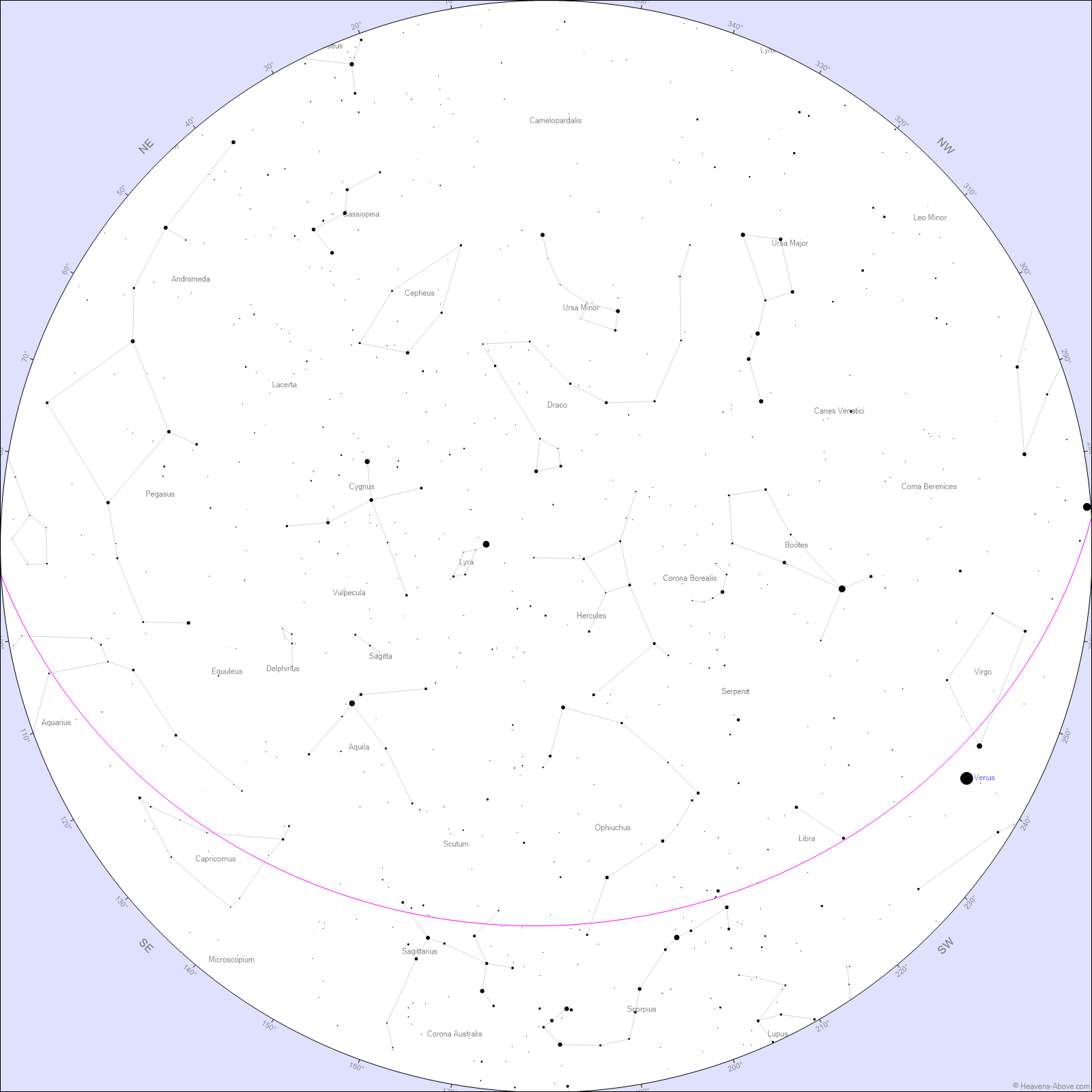
As for the planets, Venus is the unmistakable Evening Star. Look low in the west shortly after sunset. It’s heading toward its brightest appearance later in September and should be easy to identify even in twilight, although it doesn’t remain up very late. A clear western horizon is the key. Through a telescope, Venus is becoming a larger and thinner crescent as it swings closer to the line between Earth and the Sun.
Saturn occupies the other end of the night. It rises in the east during the evening and remains visible for most of the night. Saturn is approaching opposition later this month, so it’s already becoming a very good telescopic target. Give it time to climb higher in the sky before increasing the magnification; the view will usually sharpen as Saturn rises out of the thick, turbulent air near the horizon.
The rings are continuing to open slightly following their nearly edge-on presentation last year, but they still look unusually thin compared with the broad ring system many of us picture. Titan should be within reach of even a modest telescope, and several of the planet’s fainter moons may appear under steady skies with a little more aperture.
Mars and Jupiter belong to the morning. Mars rises first and sits higher in the east before dawn, while Jupiter follows below it and is impossible to mistake once it clears the horizon. Jupiter is the much brighter of the pair. A telescope aimed at Jupiter may reveal its two main cloud belts and the changing arrangement of the four Galilean moons. Mars remains small and will show limited detail in most backyard instruments.
Mercury is technically transitioning into the evening sky, but it is still too close to the Sun to offer a useful view this week. Uranus and Neptune are available to experienced observers with charts and optical aids but neither is a naked-eye object.
The darkest nights of the week also coincide with the peak of the September Epsilon Perseid meteor shower. This isn’t the famous August Perseid shower. It is a much smaller and less predictable stream, normally producing a hourly rate of around eight meteors under ideal conditions. In real backyard skies, expect fewer than that. But the meteors are very fast, and the shower has occasionally produced brief bursts and a healthy share of bright meteors.
The ordinary maximum is expected around September 9th, and models also suggest a possible encounter with older dust trails at about 2 a.m. Eastern on Thursday morning. The predictions do not promise an outburst; the additional activity could be weak or even nonexistent. Still, with the Moon nearly new, conditions are about as favorable as they can be.
The radiant lies in northern Perseus and becomes useful late in the evening, improving after midnight. You don’t need to stare directly at the radiant. Find the darkest open sky you can and watch a broad area overhead. A reclining chair will contribute more to the experience than a telescope. Even if the shower remains quiet, the moonless sky should provide a good background of sporadic meteors.
Comet 10P/Tempel is still being reported around eighth magnitude, but it’s become a poor target from our latitude. It’s fading and sits very low for Northern Hemisphere observers. An experienced observer with a clear southern horizon, and a telescope or imaging setup may still record it, but this is no longer the easy comet opportunity suggested by the magnitude alone.
That’s going to do it for this week. If tonight’s episode sparked your curiosity, or maybe gave you something new to think about the next time you look up, I’d be honored if you shared Star Trails with someone who might enjoy the journey. You can always find the latest episodes, show notes, and extras at startrails.show.
And if you’d like to help support the show, there’s also a little “buy me a coffee” link on the site. It genuinely helps keep these stories coming.
Be sure to follow Star Trails on Bluesky and YouTube — links are in the show notes. Until we meet again beneath the stars … clear skies everyone!
Support the Show
Connect with us on Bluesky @startrails.bsky.social
If you’re enjoying the show, consider sharing it with a friend! Want to help? Buy us a coffee! Also, check out music made for Star Trails on our Bandcamp page!
Podcasting is better with RSS.com! If you’re planning to start your own podcast, use our RSS.com affiliate link for a discount, and to help support Star Trails.


Leave a Reply