
Dyson Spheres: The Heat Has to Go Somewhere – Star Trails: From Backyard Astronomy to Cosmic Wonder
Episode 123
What if the first evidence of an advanced alien civilization isn’t a message, but a star whose energy books don’t quite balance?
This week, we explore the strange history and surprisingly real science of Dyson spheres, from Olaf Stapledon and Freeman Dyson to the unforgettable Star Trek: The Next Generation episode “Relics.” We’ll learn why a vast swarm of orbiting collectors makes more sense than a solid shell, and how astronomers search for the missing starlight and excess infrared heat such a civilization might produce.
We also examine Project Hephaistos and its search through millions of nearby stars, the James Webb observations that unmasked two promising candidates, and a recent proposal suggesting that hyper-efficient alien computers could create a much colder, and harder to find, form of waste heat.
Then, in the night sky report, the Moon visits brilliant Venus, Antares and the Teapot of Sagittarius. Venus reaches peak brightness, Saturn rules the evening sky, and International Observe the Moon Night gives everyone a reason to spend Saturday evening looking up.
Transcript
Howdy stargazers and welcome to this episode of Star Trails. My name is Drew and I’ll be your guide to the night sky for the week of September 13th through the 19th.
This week we lighten things up a bit with a look at the weird world of Dyson spheres — objects inspired by science fiction, that ended up inspiring real theories, which in turn led to inspiration for an episode of Star Trek: The Next Generation.
Believe it or not, scientists are actively searching for these unusual alien objects, and a study released just a few months ago has returned some interesting findings.
Later in the show we’ll follow the Moon as it takes us on a tour of some of mid-September’s celestial wonders.
Whether you’re tuning in from the backyard or the balcony, I’m glad you’re here. So grab a comfortable spot under the night sky, and let’s get started!
We’ve spent a lot of time lately grappling with some enormous ideas: galaxies being pulled apart, stars scattered into streams, and a universe built on scales that can make even a trip across the solar system feel absurdly ambitious. So this week, I thought we could have a little fun. Not that our subject is any smaller. In fact, it may be the largest hypothetical construction project anyone has ever seriously proposed.
We’re going looking for Dyson spheres.
And I do mean looking. Because this isn’t merely a piece of science-fiction hardware. Astronomers are conducting real searches for Dyson spheres in real astronomical data. A few particularly curious stars have even earned follow-up observations with the James Webb Space Telescope.
No one has found an alien megastructure. I should probably say that before we get too excited. But scientists have worked out what one might look like from Earth—and they are checking the sky.
That may be the most wonderfully surprising part of this entire story. But first, some science fiction.
My own favorite encounter with a Dyson sphere comes from the sixth-season Star Trek: The Next Generation episode “Relics.” This is the episode that brings Engineer Montgomery Scott — better known as Scotty — into the 24th century after he spends 75 years preserved inside a transporter buffer.
Scotty is obviously the emotional center of the story. We get his visit to the holodeck recreation of the original Enterprise bridge, his struggle to find a place in a century that seems to have passed him by, and, eventually, his chance to prove that an old engineer may still have a few tricks left.
But sitting behind that entire story is one of the most astonishing objects Star Trek ever put on screen.
The Enterprise discovers an enormous, apparently dark sphere surrounding a star. Its diameter is said to be about 200 million kilometers. The outer surface is lifeless, but the inner surface contains a vast habitable environment, illuminated by the star at its center. When the Enterprise accidentally triggers an automated hatch, the ship is pulled inside.
It’s a gloriously literal Dyson sphere: a complete, solid shell built around a star. The amount of living area inside such a thing would be almost silly. Using the dimensions given in the episode, its inner surface would provide roughly a quarter of a billion times the total surface area of Earth.
The sphere’s builders are long gone, and the star has become unstable, so the Enterprise doesn’t get much time to sightsee. That is probably just as well for the plot. The discovery of a structure that enormous ought to occupy the Federation for the next several centuries. Instead, Scotty and Geordi LaForge wedge a 75-year-old transport ship in the doorway, the Enterprise escapes, and everyone gets back to the more important business of appreciating James Doohan.
It is one of my favorite episodes, but it’s also not quite what physicist Freeman Dyson originally had in mind.
Dyson introduced the idea in a very short 1960 paper with the wonderfully restrained title, “Search for Artificial Stellar Sources of Infrared Radiation.” He was not really drawing up plans for a giant ball around the Sun. He was asking a question about energy.
And Dyson freely admitted that the original spark was not entirely his. He traced it to Olaf Stapledon’s 1937 science-fiction novel Star Maker, which imagined advanced civilizations surrounding their stars with arrays of light traps. Dyson later suggested that “Stapledon sphere” might have been a better name. So the idea began in science fiction, passed into real astrophysics, returned to science fiction in “Relics,” and has now landed back in real telescope data.
As a technological civilization grows, its appetite for energy may grow with it. Planets receive tremendous amounts of sunlight, but they intercept only a minute fraction of everything their stars produce. Earth catches roughly one part in two billion of the Sun’s total output. The rest races away into space.
To a sufficiently old and capable civilization, that might begin to look like waste.
Dyson imagined that such a civilization could eventually surround its star with energy-collecting structures, capturing a substantial portion of its light. This is the kind of civilization later described as Type II on the Kardashev scale: one operating with energy on the scale of an entire star.
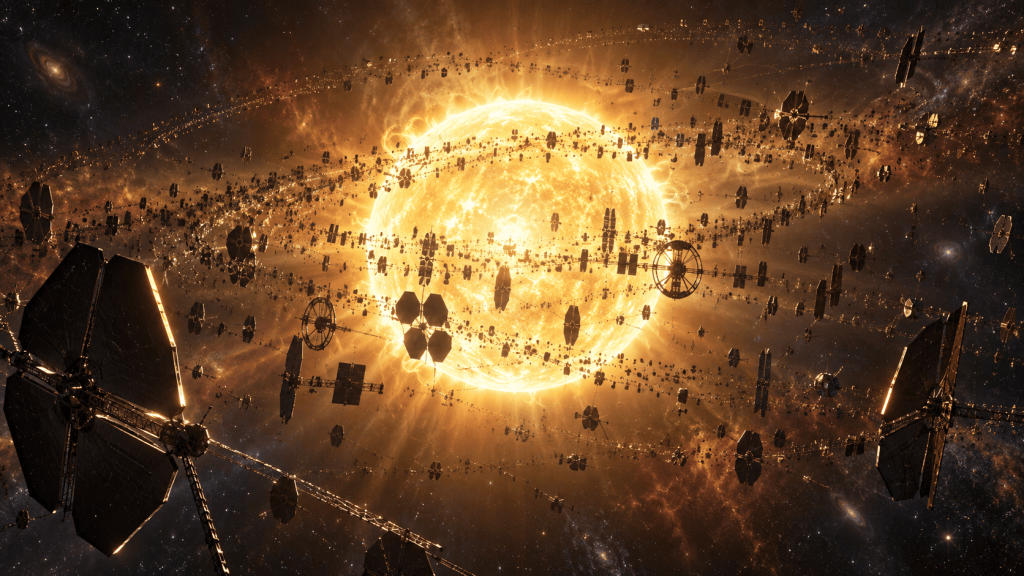
But the Star Trek interpretation isn’t exactly what Dyson had in mind. He wasn’t advocating one rigid shell. The more plausible version is now usually called a Dyson swarm: an immense collection of independently orbiting solar collectors, habitats, factories, and other structures. It could begin modestly and expand over centuries or millennia as more material was converted into orbiting infrastructure.
That is still engineering on a scale that makes the pyramids look like a weekend craft project. But it doesn’t require anyone to manufacture a single unbroken sphere hundreds of millions of kilometers across.
A solid shell creates all sorts of additional problems. We know of no material remotely capable of supporting it. The shell would not naturally keep the star centered. And gravity on its inner surface would not work the way it does on a planet.
A swarm is slightly less preposterous. More importantly, it would still accomplish the thing Dyson cared about: intercepting starlight.
And that brings us to the clever part. Dyson realized that we might be able to see the result.
Imagine an advanced civilization captures half the light from its star and uses that energy to run habitats, computers, industry, or whatever else an ancient alien society does all day.
The energy doesn’t simply disappear when they are finished with it. Eventually, it becomes heat.
That’s thermodynamics. Even a civilization capable of dismantling planets can’t negotiate its way out of the energy budget.
So a Dyson swarm could produce two broad clues. The star might appear dimmer in visible light because some of its light is being blocked. At the same time, the system might appear unusually bright in infrared wavelengths as all those collectors radiate their waste heat into space.
In other words, astronomers are looking for a star whose books don’t quite balance: less visible starlight than expected, paired with more infrared heat than ordinary astrophysics seems able to explain.
That makes a Dyson sphere a technosignature, an observable sign of technology. Traditional SETI searches often listen for radio signals or look for brief optical pulses. Those approaches may depend on another civilization deliberately transmitting something, in our direction, at the same time we happen to be listening.
Waste heat is different. It’s not intended as a message at all. It’s simply the cosmic exhaust from a very large scale civilization. So, we’re not intercepting a greeting. Basically, we’re noticing a power bill.
This idea is now being tested by a research effort called Project Hephaistos, named for the Greek god of fire and metalworking. The researchers are combining observations from several sky surveys to look for stars with the peculiar mixture of visible and infrared light expected from a partial Dyson sphere.
Gaia provides extraordinarily precise measurements of stars, including their distances and visible light. The Two Micron All Sky Survey, or 2MASS, covers the near-infrared. And NASA’s WISE mission surveyed the sky at longer infrared wavelengths, where warm dust and hypothetical alien waste heat can glow.
In a study published in 2024, the Project Hephaistos team began with roughly five million objects located within about 300 parsecs of Earth, or just under a thousand light-years. A succession of filters narrowed the sample. The researchers rejected poor measurements, crowded images, nebulae, and other obvious impostors. Out of those five million initial objects, seven survived as candidates worthy of more investigation.
All seven were M dwarfs: small, cool red stars. Each appeared to produce more mid-infrared radiation than the researchers could readily explain.
Now, the word candidate is doing some very heavy lifting here. It didn’t mean the team had found seven alien civilizations. It meant they had found seven objects that had not yet been eliminated from an extremely long list of more ordinary possibilities.
Infrared astronomy is filled with those possibilities. Young stars can be surrounded by warm disks. Dust absorbs visible light and reradiates it in the infrared, just as a Dyson swarm would. A distant infrared-bright galaxy can also happen to sit almost directly behind a nearby star. Seen in a survey image with limited resolution, the two objects may blur together and masquerade as one very strange stellar system.
That last explanation turned out to be especially important.
In July of this year, Project Hephaistos researchers reported James Webb observations of two of their candidates, known simply as D and E. Webb’s Mid-Infrared Instrument could see the targets with far greater clarity than WISE.
And the suspicious infrared glow was not coming from structures around either star.
In both cases, a distant galaxy was hiding almost perfectly behind the foreground M dwarf. Candidate D was aligned with a hot, dust-obscured galaxy billions of light-years farther away. Candidate E was paired with a dusty, star-forming galaxy. From WISE’s point of view, each distant galaxy and nearby star had blended into a single point of light. Webb separated them.
In other words, the two suspects had alibis.
That result may sound disappointing, but it’s exactly how a serious search is supposed to work. The researchers didn’t declare that unusual infrared light must be alien technology. They identified anomalies, developed natural explanations, and used a more powerful telescope to test them.
And take a moment to appreciate how strange that test was. The James Webb Space Telescope, humanity’s premier infrared observatory, spent time determining whether two nearby stars were surrounded by alien technology.
They weren’t. But the question was observationally valid enough to investigate.
And just as I was writing this episode, a new paper pushed that same search into much colder territory. Astronomer Michael Garrett proposes that a mature civilization dominated by computation might distribute much of its computer hardware through the frigid outer reaches of its planetary system. Operating computers at lower temperatures reduces the theoretical energy cost of computation, so this machinery might radiate waste heat at temperatures of only 5 to 30 kelvin, shifting its glow out of the mid-infrared and into far-infrared and submillimeter wavelengths.
Garrett calls this hypothetical structure a “Slysh halo,” after astronomer V. I. Slysh, an early advocate of searching for cold alien technology. It would still be a kind of partial Dyson swarm, and for now it remains a proposal rather than a discovery. But its conclusion is wonderfully stubborn: greater efficiency might change the temperature of the waste heat and where astronomers need to look for it.
There are currently no confirmed Dyson spheres. Every suspicious object has to compete with dust, galaxies, bad measurements, and a universe that is perfectly capable of being weird without any help from extraterrestrial engineers.
But a search that finds nothing isn’t necessarily a failure. It tells us how uncommon large, warm, partial Dyson spheres must be within the region surveyed. It improves the filters. It teaches astronomers which natural objects can impersonate technology. And it prepares us to recognize a stronger candidate if one eventually appears.
I love that the Dyson sphere began as a speculative argument, became an almost absurd piece of science-fiction scenery, and then quietly turned back into observational astronomy.
If one exists, we probably won’t find it the way the Enterprise did. There may be no immense metal wall, no automated doorway, and no legendary engineer waiting inside a transporter buffer.
It may begin with a dot in a catalogue, a star that looks a little too faint, a little too warm, or somehow wrong in precisely the right way.
Somewhere in that light, a portion of the star has gone missing. And the heat has to go somewhere.
After a quick break we’ll be back with a look at this week’s night sky. Stay with us.
Welcome back.
As we head outside this week, a young Moon returns to the evening sky, and spends its time pointing out some of late summer’s best-known celestial landmarks.
Tonight and Monday evening, shortly after sunset, look low toward the west for a thin waxing crescent Moon near Venus. The planet should be unmistakable. Venus is approaching the brightest point of its current evening appearance and will shine through the twilight long before most stars become visible.
You will need a reasonably clear western horizon because both objects will be fairly low. But the pairing should be beautiful, particularly on Monday. Look closely at the Moon and you may also notice earthshine faintly illuminating the portion of the lunar surface where the Sun has already set. That soft glow is sunlight reflected from Earth onto the Moon and then back toward us.
After visiting Venus, the Moon continues moving eastward against the stars. On Thursday evening it passes near Antares, the reddish star marking the heart of Scorpius.
Antares is often compared with Mars because of its warm color. Its name roughly means “rival of Mars,” although the two objects could hardly be more different. Mars is a small rocky planet reflecting sunlight from within our solar system. Antares is a red supergiant roughly 550 light-years away, with a diameter hundreds of times greater than our Sun.
From Antares, follow the Moon eastward toward Sagittarius and one of the easiest star patterns to recognize in the late-summer sky: the Teapot. The handle, lid, and triangular spout are all formed by stars within Sagittarius.
Under a dark sky, the hazy band of the Milky Way appears to rise from the Teapot’s spout like steam. When you look into that especially bright and crowded portion of the Milky Way, you are looking toward the center of our galaxy, about 26,000 light-years away.
Friday brings two events. The Moon reaches first quarter during the afternoon and will appear almost exactly half illuminated that evening. First quarter is one of the best times to explore the Moon through binoculars or a telescope. Along the boundary between lunar day and night, long shadows exaggerate the shapes of craters, mountains, and ridges.
Meanwhile, Venus reaches peak brilliance for its current evening appearance. It will shine at approximately magnitude minus 4.8, far brighter than any star. Venus is becoming a larger but thinner crescent as it draws closer to Earth, and those competing effects, its increasing apparent size and decreasing illuminated portion, briefly combine to make the planet as bright as it can be.
Through a small telescope, Venus should resemble a tiny crescent Moon.
Saturday is International Observe the Moon Night, an annual invitation from NASA and lunar organizations around the world to spend some time with our nearest celestial neighbor. The Moon will be just past first quarter and well placed in the evening sky, making this an especially convenient year to participate. You don’t need a telescope. Binoculars will reveal plenty of detail, but even your unaided eyes can trace the boundary between the bright lunar highlands and the darker plains known as maria.
Elsewhere in the sky, Saturn rises in the east not long after sunset and remains visible for most of the night. Look for a steady, yellowish point of light. A telescope will reveal its rings, although the ring system is still presented at a relatively narrow angle from our perspective.
Morning observers can find brilliant Jupiter in the eastern sky before sunrise. Reddish Mars is there as well, considerably fainter than Jupiter but gradually becoming easier to see as Earth begins catching up with it.
This isn’t a particularly active week for major meteor showers, and there are no bright naked-eye comets demanding our attention. But between Venus at peak brightness, a lunar walk past Antares and Sagittarius, and a worldwide evening devoted to observing the Moon, there is still plenty waiting overhead.
That’s going to do it for this week. If tonight’s episode sparked your curiosity, or maybe gave you something new to think about the next time you look up, I’d be honored if you shared Star Trails with someone who might enjoy the journey. You can always find the latest episodes, show notes, and extras at startrails.show.
And if you’d like to help support the show, there’s also a little “buy me a coffee” link on the site. It genuinely helps keep these stories coming.
Be sure to follow Star Trails on Bluesky and YouTube — links are in the show notes. Until we meet again beneath the stars … clear skies everyone!
Support the Show
Connect with us on Bluesky @startrails.bsky.social
If you’re enjoying the show, consider sharing it with a friend! Want to help? Buy us a coffee! Also, check out music made for Star Trails on our Bandcamp page!
Podcasting is better with RSS.com! If you’re planning to start your own podcast, use our RSS.com affiliate link for a discount, and to help support Star Trails.



Leave a Reply