There Was a Planet That Swallowed a Moon – Star Trails: From Backyard Astronomy to Cosmic Wonder
Episode 124
What if Venus once had a moon, and then destroyed it?
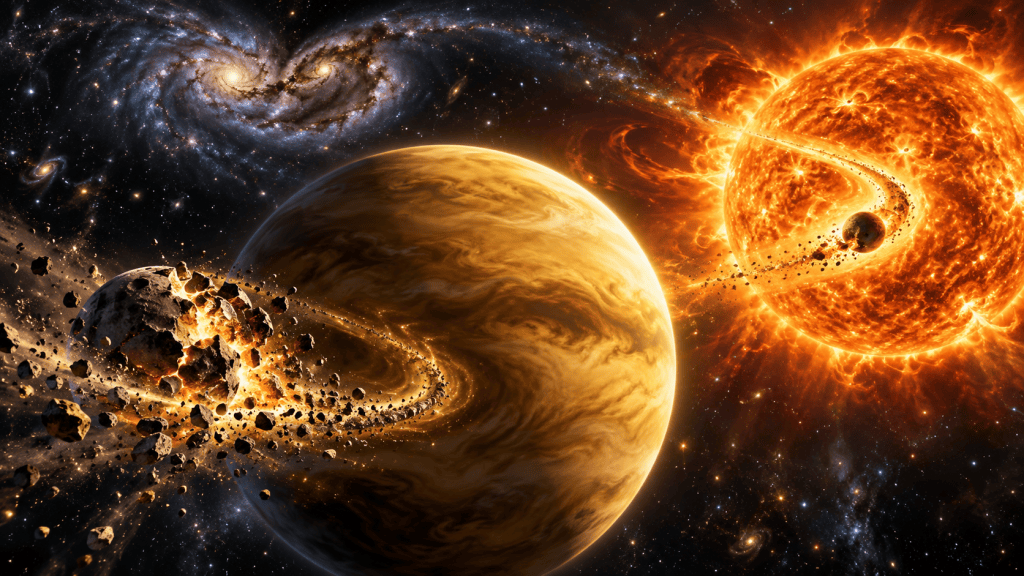
A new study suggests that under plausible conditions, an ancient Venusian moon could have slowly migrated inward, crossed the Roche limit and ultimately been torn apart or swallowed by the planet. And Venus may not be the only hungry object in our cosmic neighborhood: another recent study explores whether the young Sun could have consumed a super-Earth, leaving subtle chemical and structural fingerprints behind billions of years later.
This week on Star Trails, we’re following a cosmic version of the old nursery rhyme “There Was an Old Lady Who Swallowed a Fly.” Planets can swallow moons. Stars can swallow planets. Galaxies devour other galaxies. Along the way, we’ll explore why orbits aren’t permanent, why Earth’s Moon is slowly escaping us while Mars’s Phobos is falling inward, and how gravity can transform apparently stable systems over astronomical timescales.
Then in the Night Sky Report for September 27 through October 3, autumn has officially arrived. We’ll look for Saturn near opposition, a Moon-and-Pleiades pairing, Jupiter and its Galilean moons, and the changing fall sky. We’ll also visit a newly discovered crater on the Moon and check in on the fast-moving mystery of Webb’s strange Little Red Dots.
Transcript
Howdy stargazers and welcome to this episode of Star Trails. My name is Drew and I’ll be your guide to the night sky for the week of September 27th through October 3rd.
This week we’re talking about our solar system’s “eating disorder” — can planets swallow moons, and can stars swallow planets? It may have already happened, and there’s evidence that at least one planet is about to swallow one of its moons.
Also, we’re moving into autumn. Later in the show we’ll discuss what you can expect to see in the night sky as October looms. The Moon shows off a new crater, and, we have an update on the evolving mystery of the universe’s “Little Red Dots.”
And, I need to apologize, because I didn’t have an episode for you last week. I was out of the country for nearly a week on vacation, and sadly, I didn’t have time to load up new episode, or even a re-run, before I left. I’d planned to, but I became busy with work and with trip preparations, and it just didn’t happen. But, this is a packed episode, so hopefully that makes up for the lack of one last week.
Whether you’re tuning in from the backyard or the balcony, I’m glad you’re here. So grab a comfortable spot under the night sky, and let’s get started!
When I was a kid, one of my favorite nursery rhymes was There Was an Old Lady Who Swallowed a Fly.
You may or may not remember this thing. The old lady swallows a fly. Then she swallows a spider to catch the fly. Then a bird to catch the spider. Then a cat to catch the bird. And this continues escalating until eventually she swallows a horse.
The little rhyme ends with: “She’s dead, of course.” I guess children’s entertainment was little different when I was growing up.
Anyway, I’ve been thinking about that nursery rhyme lately because astronomy seems to be developing a similar eating problem.
A planet may have swallowed a moon. A star may have swallowed a planet. Galaxies swallow other galaxies. Every time you think you’ve reached the top of the cosmic food chain, it seems like there’s something bigger waiting with a knife and fork.
Let’s start with Venus.
If you’ve been outside around dusk lately, Venus is very easy to find. Look low toward the western horizon shortly after sunset and that ridiculously bright point of light is our neighboring planet. Venus reached its greatest brilliance for this evening appearance in mid-September, and although it’s now sinking lower into the twilight each evening, it remains unmistakable if you have a clear western horizon.
It’s gorgeous, and it’s serene. And according to a fascinating new study, it may once have had a moon.
But Venus got hungry. And that needs an enormous asterisk.
Nobody has discovered the remains of a Venusian moon. We don’t have a crater that we can point to and say, “Yep, that’s where the moon landed.” We don’t even know for certain that Venus ever formed a moon in the first place.
What researchers have done is ask a different question. If Venus did once have a moon, could it have survived?
And the answer, under a surprisingly broad range of plausible circumstances, appears to be no.
Venus is almost the same size as Earth. Its diameter is only a little smaller. Its mass is a little lower. Both worlds formed in the same young Solar System from much of the same raw material.
But Earth has an enormous companion hanging in its sky, while Venus has nothing.
Mercury and Venus are, in fact, the only planets in the Solar System with no natural satellites.
And that’s always made Venus interesting.
We think our own Moon probably formed after a tremendous collision very early in Earth’s history. Something roughly the size of Mars slammed into the young Earth, blasting material into orbit that eventually collected into the Moon.
The early Solar System was chaotic. Giant impacts were not unusual. So it isn’t unreasonable to wonder whether Venus might also have experienced an impact capable of creating a moon.
Researchers led by astrophysicist Stephen Kane at the University of California, Riverside decided to essentially build hypothetical Venus-moon systems inside a computer and let gravity run the clock forward.
They varied the early rotation speed of Venus. They changed the mass of the moon. They altered its orbit. They modeled how the gravitational tug between the two bodies would change both the moon’s orbit and Venus’s rotation over billions of years.
Before doing that, they tested the model against a system where we already know what happened: Earth and our Moon. Their calculation reproduced the measured recession of our Moon, about 3.8 centimeters per year, with good accuracy.
And that recession is important, because our Moon is not actually parked at a fixed distance from Earth. It is leaving us, albeit, very, very slowly. About an inch and a half every year.
That happens because Earth rotates much faster than the Moon travels around us. The Moon raises tides on Earth, and because Earth is spinning, those tidal bulges get carried slightly ahead of the Moon.
The gravity of that bulge gives the Moon a tiny forward tug. Earth loses a little rotational energy. The Moon gains orbital energy.
And as a result, Earth spins ever so slightly more slowly while the Moon moves ever so slightly farther away.
We have measured this directly using lasers bounced off reflectors left on the Moon during the Apollo missions.
So here’s the first important idea in this story: An orbit is not a shelf where the universe stores things. An orbit is a relationship. And relationships can change.
Venus presents almost the opposite situation from Earth.
Today Venus rotates absurdly slowly. One rotation takes about 243 Earth days. And Venus spins backward compared with most of the other planets. A day on Venus is actually longer than its year.
The new study is not simply assuming Venus always rotated that way. In fact, the researchers modeled many possible rotation rates for the young planet. And that’s where things get interesting.
There is a kind of gravitational boundary around a rotating planet. Inside that boundary, a moon moves around the planet faster than the planet itself rotates. Outside it, the planet rotates faster than the moon orbits.
You don’t need the equations here. The important part is that this boundary determines which direction tidal forces push the moon.
Our Moon is on the side where Earth’s rotation helps push it outward.
But imagine a young Venus gradually slowing down. As Venus loses rotational speed, that gravitational boundary moves farther and farther away from the planet.
A moon that had initially been migrating outward could suddenly find the rules changing underneath it. The boundary catches up. The direction of the tidal exchange reverses.
And now, instead of being pushed away from Venus, the moon begins falling inward.
Slowly at first, orbit after orbit, year after year. Million years after million years.
The researchers found that for some plausible early Venus configurations, particularly with moderate initial rotation rates or relatively massive moons, the satellite eventually crossed the point of no return. In one class of models, destruction happened anywhere from roughly 30 million years to 1.7 billion years after the system formed.
And “destroyed” may not necessarily mean one enormous moon striking Venus intact like a planetary wrecking ball.
As the moon approached the planet, Venus’s gravity could eventually overwhelm the moon’s own ability to hold itself together.
It crosses what astronomers call the Roche limit. The moon breaks apart. For a while, Venus might actually have had a ring. But that ring wouldn’t last. Much of the material could eventually rain down onto the planet below.
Venus, in other words, may have digested its moon one piece at a time.
Again, we have to be careful here. The study does not prove Venus ever had a moon.
There are also modeled circumstances where a moon survives, particularly if early Venus rotated rapidly enough. And exactly how efficiently a rocky planet dissipates tidal energy introduces additional uncertainty into the calculations. The paper itself describes a fairly specific region of possible starting conditions that both destroys a moon and evolves Venus toward something resembling the world we see today.
So this isn’t a solved murder mystery. It’s more like investigators demonstrating a credible method.
If there was a moon, Venus was perfectly capable of getting rid of it without requiring some second giant collision to come along and knock it away.
And finding evidence billions of years later is difficult because Venus has done a pretty good job of erasing its own history. Much of its visible surface appears geologically young, reshaped by enormous episodes of volcanism and resurfacing. Any obvious scar from an ancient moon might be long gone.
But there’s another reason this story is so compelling. We can see a version of it happening elsewhere in our own Solar System.
Mars has two tiny moons, Phobos and Deimos.
Phobos is the inner one, and it’s doomed. Unlike our Moon, Phobos is moving inward.
NASA estimates that it drops about 1.8 meters, roughly six feet, closer to Mars every century. Eventually, perhaps 30 to 50 million years from now, Phobos will either crash into Mars or be torn apart and create a temporary ring around the planet.
So a moon spiraling toward its planet isn’t some exotic mathematical curiosity. We have one doing it right now. The difference is simply timescale.
Our Moon is slowly leaving. Phobos is slowly falling.
And a hypothetical Venusian moon may have already completed the entire process billions of years ago.
The Solar System looks permanent because we don’t live very long. That orderly diagram we learned in school, the Sun in the middle, planets on neat tracks, moons circling the planets, looks almost mechanical.
But take away the human timescale and let the clock run for a few billion years, and the machinery starts moving. Moons and planets migrate. Rotations slow. Orbits change. Things collide or get torn apart, and sometimes things get eaten.
Which brings us back to that old lady and her fly. Because if planets can swallow moons, the next question is obvious. What swallows a planet?
It turns out, stars do.
And a new study suggests our own Sun may already have done exactly that.
Astronomers have known for years that there are some irritating little details about the Sun that our models don’t reproduce perfectly. One involves lithium.
The Sun’s outer layers contain considerably less lithium than we would expect based on the material from which the Solar System originally formed.
Another problem comes from helioseismology.
That’s neat piece of astronomy jargon that essentially means astronomers study vibrations moving through the Sun in much the same way geologists use seismic waves to study the interior of Earth. Those waves allow us to infer what’s happening deep inside the Sun.
And near the bottom of the Sun’s convection zone, the observed speed of those waves doesn’t line up perfectly with standard solar models.
Neither problem means we fundamentally misunderstand how the Sun works. But there are discrepancies.
So Professor Mutlu Yildiz of Ege University in Turkey asked an intriguing question: Could both problems have the same cause? What happens if the young Sun swallowed a planet?
Yildiz modeled the Sun’s evolution under different scenarios, including the ingestion of rocky planets with different masses and compositions.
And the results favored something remarkable: a rocky super-Earth somewhere in the neighborhood of five to ten times the mass of our planet could alter the young Sun in ways that help reproduce several of the properties astronomers actually observe today—including aspects of its internal structure and its depleted lithium abundance.
Once again: nobody has found a fossilized planet sitting intact inside the Sun. That is not what this means.
However, if a super-Earth plunged into the young Sun billions of years ago, the planet is gone. But its material would have mixed into the star.
What the researchers are looking for is the fingerprint of the event, the chemical and structural consequences of a meal eaten more than four billion years ago.
And there’s a possible pathway for such a planet to have existed.
One of the interesting things we learned after discovering thousands of planets around other stars is that our Solar System is a little strange. Super-Earths, these rocky or partly gaseous planets several times the mass of Earth, are extremely common elsewhere.
But we don’t have one. Previous work has suggested that super-Earths could have formed inside Mercury’s present orbit during the Solar System’s youth and then migrated inward through the disk of gas and dust surrounding the young Sun.
And if one migrated far enough… it became lunch.
The new work doesn’t prove that happened. The researchers are now asking whether independent observations of the Sun can reveal the predicted fingerprints strongly enough to distinguish planetary engulfment from other possible solutions to these solar-model problems.
But we know stars really can eat planets. In 2023, astronomers announced what appeared to be the first observation of a star in the act of engulfing a planet.
And then the James Webb Space Telescope came along and made the story even better.
The initial explanation was that the star had expanded outward and swallowed a nearby world. But Webb observations published in 2025 indicated something different. The star had not simply grown until it reached the planet. The planet itself had been spiraling inward.
It was probably a Jupiter-sized world orbiting even closer to its star than Mercury orbits our Sun. Over millions of years its orbit decayed until the planet began grazing the star’s atmosphere.
From there, the process ran away. The planet plunged in. The star swallowed it. And astronomers observed the dusty aftermath.
There it is again. An orbit is not a shelf. And apparently neither planets nor moons should assume their reservation is permanent.
At this point the old lady in the nursery rhyme would need to find something larger than a star.
Fortunately, the universe has us covered. Galaxies eat galaxies.
We’ve recently talked about stellar streams, the long, thin trails of stars left behind when a larger galaxy gravitationally tears apart a smaller one. Our own Milky Way has been doing this for billions of years.
The Sagittarius dwarf galaxy is being dismantled right now, its stars stretched into enormous streams as the Milky Way incorporates them. Other ancient mergers helped build the galaxy we live in today. Astronomers have found dozens of stellar streams around the Milky Way, relics of smaller systems and star clusters that were pulled apart and absorbed.
So now we have the complete astronomical version of this nursery rhyme.
There was a planet that swallowed a moon. There was a star that swallowed a planet. There was a galaxy that swallowed another galaxy. And somewhere out there, gravity is already working on the next verse.
But beneath this goofy metaphor is something I genuinely love about this story.
We look into the night sky and everything seems fixed. The stars return. The planets follow their familiar paths. The Moon rises tonight looking much the same as it did when people first started telling stories about it thousands of years ago. Venus hangs over the sunset looking like it belongs exactly where it is.
But nothing up there is really holding still. What looks permanent is really just slow.
So sometime this week, if you have a clear western horizon, step outside shortly after sunset and find Venus. That brilliant white point low in the twilight is one of the most beautiful things you can see in the sky without a telescope.
And it may once have had a moon. Until it got hungry.
After a quick break we’ll be back with this week’s night sky, and some new updates from around the cosmos. Stay with us.
Welcome back.
While I was off enjoying a little vacation, the seasons changed on us.
The September equinox occurred last week on September 22nd, officially beginning astronomical autumn here in the Northern Hemisphere. At that moment, the Sun crossed the celestial equator heading south, beginning the half of the year when the Northern Hemisphere is tilted increasingly away from the Sun.
The word “equinox” comes from Latin words suggesting equal night, although day and night aren’t actually exactly twelve hours long on the equinox. The atmosphere bends sunlight slightly around the horizon, and sunrise and sunset are measured using the upper edge of the Sun rather than its center. So the date when day and night are truly closest to equal depends somewhat on where you live.
But the practical result is obvious now: the nights are getting longer.
Around the equinox, the Sun also rises very close to due east and sets very close to due west. And for observers in the Northern Hemisphere, these autumn mornings offer another seasonal treat: the ecliptic rises at a steep angle from the eastern horizon before dawn, making this one of the better times of year to search for the zodiacal light. From a really dark location, about an hour and a half before sunrise, look toward the east for a faint triangular glow extending upward from the horizon. That’s sunlight reflecting off interplanetary dust, the so-called “false dawn.”
The Moon begins our reporting period just one day removed from full.
September’s full Moon occurred on Saturday the 26th, and because it was the full Moon nearest the autumn equinox, it was this year’s Harvest Moon. The name comes from that familiar autumn geometry: around this time of year, successive moonrises occur unusually close together, historically providing farmers with several evenings of useful moonlight during the harvest season.
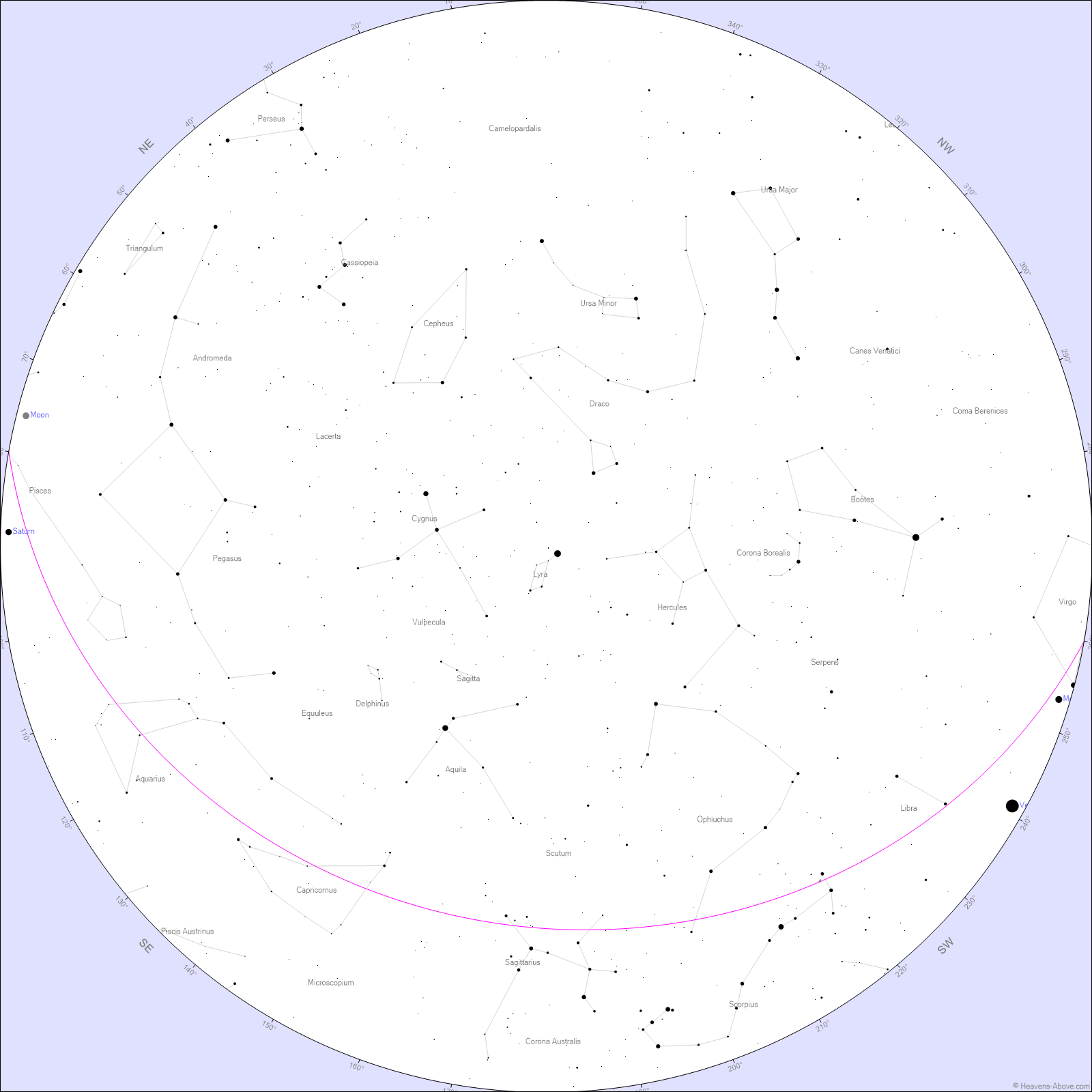
So tonight look for a nearly full waning gibbous Moon rising in the east along with Saturn. The Moon and Saturn reached conjunction today, separated by just under seven degrees. They won’t fit together in a typical telescopic field of view, but they’ll make an obvious naked-eye pairing for much of the night.
And Saturn is especially worth your attention right now.
The ringed planet reaches opposition on October 4th, literally the day after this reporting period ends, which means this entire week is basically prime-time Saturn season. Saturn rises around sunset, remains visible through the night and reaches its highest point around midnight. It’s also unusually bright, shining around magnitude zero.
Through a telescope, the rings remain relatively narrow, tilted only about eight degrees toward us. This is the last season we’ll see them quite this narrow for roughly another dozen years, so if you own a telescope, Saturn absolutely deserves some eyepiece time this week.
Nearby Neptune is also enjoying excellent placement. Neptune reached opposition on September 25th, so it’s visible for most of the night in Pisces. You won’t see it with the naked eye, but with binoculars or a telescope and a good chart, this is about as favorable as Neptune gets.
Our Moon continues moving eastward through the stars as the week goes on, and on September 30th, it pays a visit to one of my favorite objects in the autumn sky: the Pleiades.
The Moon will still be around 80 percent illuminated, so it will absolutely murder your dark adaptation, but the Seven Sisters are bright enough to survive the glare. Binoculars should give you a particularly nice view of the Pleiades beside the waning gibbous Moon in Taurus. If the Moon is washing the cluster out, you can use the edge of a building or tree to physically block the lunar disk while leaving the Pleiades exposed.
The Moon reaches perigee, its closest point to Earth for this orbit, on October 1st, and then reaches last quarter on Saturday, October 3rd. At last quarter, the Moon rises around midnight and remains high into the morning sky.
And while we’re talking about the Moon, astronomers just found evidence that our nearest neighbor changed rather dramatically while none of us were looking.
NASA’s Lunar Reconnaissance Orbiter has discovered a new impact crater that formed sometime between April 11th and May 22nd of 2024. It’s been officially named McGetchin crater, and it’s no little divot. The crater measures about 728 feet across and it’s about 141 feet deep.
Researchers think an asteroid or comet fragment roughly the size of a three- to six-story building slammed into the lunar surface. Scientists estimate an impact of this scale happens on the Moon only about once every century or longer.
And the impact changed far more than just the crater itself. LRO’s Diviner instrument found an area around four miles wide that is now about sixteen degrees Fahrenheit colder during the lunar night than the surrounding terrain. The impact apparently churned and loosened the regolith so much that the ground no longer retains heat as efficiently.
Which is a nice reminder that although we tend to treat the Moon as this ancient, geologically frozen object, the Solar System is still taking shots at it.
Turning to the planets, Venus is still technically hanging around in the evening sky, but you’re running out of time.
Our hungry planet from today’s main segment reached spectacular brightness earlier in September, but it’s now dropping rapidly toward the Sun. By the end of September, Venus is only about five degrees above the west-southwestern horizon around sunset and sets only a little more than half an hour after the Sun. You’ll need a very clear horizon and you’ll need to look almost immediately after sunset.
Mercury is also poking into the evening twilight during the final days of September, especially for observers in the southern half of the United States. But like Venus, it remains low and challenging in the west-southwest. Binoculars may help.
The morning sky is considerably easier.
Mars rises after midnight and is well up in the east before morning twilight. The red planet moved out of Gemini and into Cancer late in September, and it continues slowly brightening as Earth and Mars draw closer over the coming months.
Jupiter follows in the predawn hours and should be impossible to mistake. It’s now in Leo, shining brilliantly in the east before sunrise. A small telescope will show the planet’s cloud bands, and even binoculars should reveal some or all of the four Galilean moons lined up alongside it.
And those moons are especially interesting right now because we’ve entered one of their periodic mutual eclipse seasons.
Over the coming months, Earth’s viewing angle lines up closely enough with the orbital planes of Io, Europa, Ganymede and Callisto that the moons can actually eclipse and occult one another. One moon may pass directly in front of another, or one moon’s shadow may fall across another moon.
These seasons happen roughly every five to six years, and the geometry becomes especially favorable around the middle of October. Even a modest telescope can sometimes show a moon fading away during a total mutual eclipse and then gradually returning. So if you’ve never paid much attention to Jupiter beyond its cloud bands, this is a great season to start watching the little clockwork solar system orbiting alongside it.
For the somewhat more adventurous telescope observer, September 28th also offers a chance to hunt for two periodic comets: 10P/Tempel 2 and 161P/Hartley-IRAS. Both are currently predicted somewhere around magnitude ten, although comet brightness predictions are famously unreliable. They’re not binocular showpieces, and the bright Moon won’t help, but observers with larger telescopes may be able to pick them up in the southern evening sky.
And as we turn the calendar into October, here’s an easy seasonal target that requires considerably less effort.
The Andromeda Galaxy reaches excellent placement on October 2nd, climbing high into the autumn sky and culminating around midnight. Under dark skies, M31 is visible to the naked eye as a faint smudge; binoculars make it obvious. The Moon will still brighten the sky this week, so this isn’t your ideal night for teasing out Andromeda’s faint outer reaches, but its arrival high in the evening sky is another sign that autumn observing season is here.
Finally, we have a quick update on a Star Trails mystery.
A few weeks ago, in episode 121, we explored the strange “Little Red Dots” that the James Webb Space Telescope has found scattered through the early universe. We talked about the problem: they’re extraordinarily compact and red, their spectra look in some ways like active black holes and in other ways like unusual populations of stars. Astronomers have struggled to explain how massive black holes could have appeared so quickly after the Big Bang.
Well, that story is moving quickly.
A new study published September 16th in Nature used full cosmological radiation-hydrodynamic simulations to follow one possible pathway from the early universe to the Little Red Dots. In the simulations, intense ultraviolet radiation from nearby young galaxies suppresses ordinary star formation inside certain massive gas clouds. Instead, enormous stars hundreds of thousands of times the mass of the Sun can form and quickly collapse into black holes with masses approaching a million Suns.
Those already enormous “heavy seeds” can then enter short periods of extremely rapid feeding, growing to tens of millions of solar masses. Just as importantly, the simulated black holes become surrounded by thick disks of gas that reproduce several of the strange spectral features astronomers actually observe in the Little Red Dots.
That doesn’t mean the Little Red Dot mystery has been solved. They’re still active research targets, and competing explanations remain. But this simulation provides something astronomers have been missing: a physically plausible evolutionary path connecting enormous black-hole seeds, the Little Red Dots Webb is seeing, and eventually the quasars and supermassive black holes that appear astonishingly early in cosmic history.
So our little red dots may not merely be weird objects from the universe’s adolescence. We may actually be watching supermassive black holes grow up.
That’s going to do it for this week. If tonight’s episode sparked your curiosity, or maybe gave you something new to think about the next time you look up, I’d be honored if you shared Star Trails with someone who might enjoy the journey. You can always find the latest episodes, show notes, and extras at startrails.show.
And if you’d like to help support the show, there’s also a little “buy me a coffee” link on the site. It genuinely helps keep these stories coming.
Be sure to follow Star Trails on Bluesky and YouTube — links are in the show notes. Until we meet again beneath the stars … clear skies everyone!
Support the Show
Connect with us on Bluesky @startrails.bsky.social
If you’re enjoying the show, consider sharing it with a friend! Want to help? Buy us a coffee! Also, check out music made for Star Trails on our Bandcamp page!
Podcasting is better with RSS.com! If you’re planning to start your own podcast, use our RSS.com affiliate link for a discount, and to help support Star Trails.


Leave a Reply