
A Black Hole Is Pointing at Us – Star Trails: From Backyard Astronomy to Cosmic Wonder
Episode 125
A black hole in our galaxy appears to be aiming a relativistic jet almost directly toward Earth. That sounds like a reasonably good opening line for October.
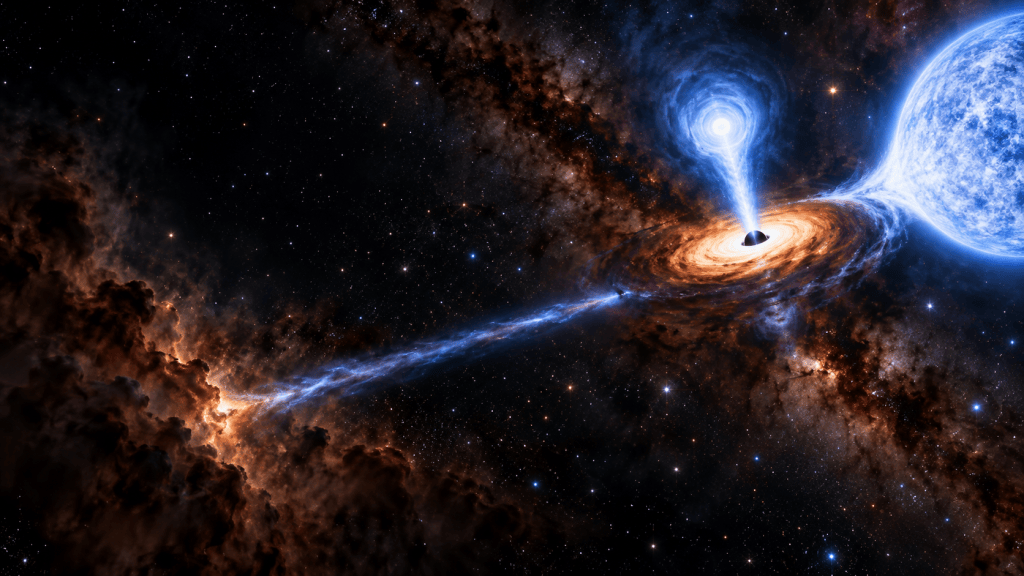
The object, IRAS 18293−0941, is a binary system about 12,000 light-years away. A stellar-mass black hole is feeding on material from a massive companion star and launching jets at no less than roughly two-thirds the speed of light. Because one jet is directed close to our line of sight, astronomers believe they may have found the Milky Way’s first convincing microblazar—a miniature version of the blazars powered by supermassive black holes in distant galaxies.
This week on Star Trails, we’ll look down the barrel of that cosmic engine, learn why the jet is far more interesting than frightening, and follow the other jet as it crashes into a molecular cloud and may accelerate particles to extraordinary energies.
Then in the Night Sky Report for October 4 through the 10th, Saturn reaches opposition, the waning Moon visits Mars and the Beehive Cluster, and much of North America gets to watch the Moon make Jupiter disappear. We’ll also look for a dragon’s handful of meteors under nearly moonless skies before the new Moon arrives on Saturday.
Links
- Sky map for week starting Oct. 4, 2026
- Episode 125 on YouTube
- Research paper: A Galactic microblazar as a potential accelerator of ultra-high-energy particles
- University of Amsterdam: First microblazar produces possibly the fastest particles in the Milky Way
- SARAO: A black hole in the Milky Way aims its jet at us
- October 6 lunar occultation of Jupiter viewing guide
- International Meteor Organization 2026 meteor shower calendar
Transcript
Howdy stargazers and welcome to this episode of Star Trails. My name is Drew and I’ll be your guide to the night sky for the week of October 4th through the 10th.
This week, a black hole is pointing at us.
I realize that’s a slightly alarming way to begin the month of October. But don’t panic. Nothing is about to blast Earth out of the galaxy. This is not a cosmic death ray, and the black hole is about 12,000 light-years away.
What astronomers may have found is actually far more interesting: the first convincing microblazar in the Milky Way, a small-scale version of some of the most powerful objects in the universe.
Later in the show we’ll come back home for a particularly busy week in the sky. Saturn reaches opposition tonight, the Moon passes Mars and then makes Jupiter disappear, and the Draconid meteor shower gives us a perfectly appropriate October excuse to look for a dragon in the stars.
Whether you’re tuning in from the backyard or the balcony, I’m glad you’re here. So grab a comfortable spot under the night sky, and let’s get started!
The object at the center of this story has the wonderfully memorable name IRAS 18293−0941.
That name is not exactly designed for radio, so after this we’ll just call it IRAS 18293.
The first part of the name comes from the Infrared Astronomical Satellite, or IRAS, which cataloged the object back in 1983. For more than four decades it sat in the astronomical record, largely unnoticed as anything extraordinary.
It was hiding in a busy, dusty part of the Milky Way where visible light doesn’t travel very well. And that is a recurring theme in astronomy: the universe doesn’t necessarily hide its secrets by making them faint. Sometimes it hides them by putting them in a crowded room and letting them look ordinary.
IRAS 18293 did not look ordinary once astronomers started combining observations across the electromagnetic spectrum. The investigation was led by astronomer Josep Martí at the University of Jaén in Spain and brought together researchers and observatories from several countries.
Radio telescopes revealed a narrow, one-sided jet. Optical observations showed a hot, massive star. X-ray observations revealed the kind of energetic radiation expected when matter falls toward a compact object. Infrared images exposed warm dust around the system. And gamma-ray observations suggested that something in this neighborhood may be accelerating particles to astonishing energies.
Put the pieces together and the picture looks like this.
A massive star and a black hole orbit one another every 11.38 days. The black hole is probably somewhere around ten times the mass of our Sun. Material from the star is being captured by the black hole and spiraling into an accretion disk.
The word “captured” may conjure up the usual image of a black hole roaming around like a vacuum cleaner, sucking up everything nearby. That isn’t how it works.
If you replaced our Sun with a black hole of exactly the same mass, Earth would continue orbiting almost exactly as it does now. We would have several very serious problems, beginning with the sudden disappearance of sunlight, but being pulled into the black hole would not be one of them.
IRAS 18293 is different because the companion star is extremely close. The two objects complete an orbit in less than twelve days. The star is pouring out material in a powerful stellar wind, and the black hole’s gravity can capture some of that material.
The gas doesn’t fall straight in. It carries angular momentum, so it forms a rapidly rotating disk. Friction, magnetic fields and turbulence heat the disk to tremendous temperatures as material moves inward.
And then something counterintuitive happens.
Not everything falling toward the black hole actually reaches the event horizon. Magnetic fields around the inner disk can redirect part of that material and launch it outward in two narrow jets, one above the disk and one below it.
The radio measurements require the approaching flow to move at no less than roughly two-thirds the speed of light. The researchers use three-quarters the speed of light as a representative example, which would put the jet about 26 degrees from our line of sight.
This kind of object is called a microquasar.
The “micro” part is there because the central black hole is a stellar-mass object rather than a supermassive black hole containing millions or billions of Suns. The “quasar” part is there because the machinery looks remarkably similar.
A quasar is powered by a supermassive black hole feeding at the center of a galaxy. Matter forms a hot accretion disk and, in many cases, produces enormous jets that can extend far beyond the galaxy itself.
A microquasar runs the same basic engine on a much smaller scale. Instead of a black hole millions or billions of times the mass of the Sun, you have one perhaps ten times the mass of the Sun. Instead of feeding on gas at the center of a galaxy, it feeds on a companion star.
The proportions change dramatically, but the physics rhymes.
Now we need one more word: blazar.
A blazar is a galaxy whose central black hole launches a jet pointed close to our line of sight. We are looking almost directly down the jet.
That orientation makes a tremendous difference because of relativistic beaming.
Imagine a flashlight moving toward you at an appreciable fraction of the speed of light. The light is not simply traveling in your direction. Relativity bunches the radiation together and concentrates it into a narrower cone. From your perspective, the approaching source can appear far brighter than the same source would from the side.
Meanwhile, the jet moving away from you is de-boosted. It looks much fainter.
So if a microquasar is the small-scale cousin of a quasar, a microblazar is the small-scale cousin of a blazar: a stellar-mass black-hole binary whose jet is pointed almost our way.
And IRAS 18293 appears to fit the description.
The researchers used radio observatories including the European VLBI Network, e-MERLIN and South Africa’s MeerKAT telescope to examine the system at several different scales. They saw a compact radio source with a persistent, collimated jet extending away from it.
But they did not see a similarly bright counterjet on the opposite side.
That asymmetry is one of the clues. If one jet is coming toward us and the other is moving away, Doppler boosting can brighten the approaching jet while suppressing the receding one.
The orbit supplies another clue.
The system’s light changes on that 11.38-day cycle, but it does not show the deep eclipses we might expect if we were viewing the orbit edge-on. The researchers conclude that the binary is probably tilted no more than about thirty degrees away from face-on.
Jets tend to emerge roughly perpendicular to an accretion disk. If the black hole’s disk and the binary orbit are aligned, a face-on orbit means one jet should indeed be aimed fairly close to Earth.
None of those clues alone seals the case. Together they make IRAS 18293 what the paper calls a “compelling Galactic microblazar candidate.”
That cautious phrasing matters.
Some of the announcements surrounding the discovery call it the first microblazar in the Milky Way. The evidence is persuasive, and it may well deserve that title. But the research paper itself leaves the door open for additional observations.
That’s how science should work. “Most convincing candidate so far” may not fit as comfortably in a headline, but it tells us where the evidence actually stands.
At this point, we should return to the scary part.
Does a black hole jet pointing toward Earth pose a danger?
No.
First, “pointing toward us” in astronomy does not mean that someone has precisely sighted a rifle on the Solar System. It means the jet lies relatively close to our line of sight—perhaps within a few tens of degrees.
Second, this system is about 12,000 light-years away. The jet is spectacular on the scale of its local environment, but it is not a tightly focused beam that remains equally powerful across the galaxy.
What reaches us is radiation that astronomers can measure, not an approaching wall of destruction.
If anything, the alignment is a gift. It makes the system appear brighter and gives astronomers a rare chance to study jet physics from a direction we don’t usually get to see inside our own galaxy.
And IRAS 18293 has one more surprise waiting on the far side.
The approaching jet is the one boosted toward us. The other jet travels away, deeper into the surrounding interstellar material. On radio images, astronomers can follow structures associated with the system across an enormous distance—roughly a hundred light-years from end to end.
Infrared observations reveal a shell of warm dust aligned with the jet. Larger-scale radio observations show what looks like a cavity carved through the surrounding material, ending in a bright hotspot.
That hotspot appears where the receding jet encounters a dense molecular cloud.
Think of the jet as a fire hose of high-speed particles boring through fog. For much of its journey it crosses relatively thin interstellar gas. Then it hits something denser.
The flow slows down. Shock waves form. Magnetic fields become tangled and compressed. Particles can ricochet through the shock again and again, gaining energy each time.
Nature has built a particle accelerator.
And possibly a very powerful one.
Near the system is an ultra-high-energy gamma-ray source known as LHAASO J1831−1007u. The researchers propose that IRAS 18293 may be responsible for much of that emission.
One possibility is that the jet accelerates protons to energies in the peta-electronvolt range. “Peta” means a quadrillion. We are talking about individual particles carrying around a million billion electron volts.
When those protons slam into the dense molecular cloud, they can collide with atomic nuclei and produce short-lived particles called pions. Neutral pions decay into gamma rays, and gamma rays travel in straight lines, allowing telescopes to trace them back toward the collision site.
Cosmic rays are much harder to trace. Most cosmic rays are charged particles, so magnetic fields bend and scramble their paths on the journey through the galaxy. By the time one reaches Earth, the direction it came from may tell us very little about where it began.
Gamma rays can serve as the forwarding address.
This is why astronomers are so interested in objects capable of accelerating particles into the peta-electronvolt range. They sometimes call them PeVatrons. We know the Milky Way produces particles at these energies, but identifying the specific engines has been difficult.
IRAS 18293 offers an unusually complete crime scene.
There is the compact object and its companion star. There is the accretion disk. There is the relativistic jet. There is a cavity extending through the interstellar medium. There is a hotspot where the jet appears to strike a cloud. And there is ultra-high-energy gamma radiation coming from the same neighborhood.
The researchers built a model of the system that can reproduce much of the observed emission from radio waves through gamma rays. That doesn’t prove this one microblazar accounts for every gamma ray detected there. The region is complicated, and the paper describes the connection as plausible rather than final.
But it gives astronomers a physical story they can test.
And that story helps explain why the discovery required so many different observatories.
At visible wavelengths, dust gets in the way. Infrared light reveals the warm shell and sees farther through the dust. Radio waves map the jets and the larger cavity. Optical spectroscopy measures the motion and character of the companion star. X-rays reveal hot material near the compact object. Gamma rays reveal the extreme particles created far downstream.
No single telescope gets the whole story.
This is less like taking a photograph and more like reconstructing an animal from its footprints, its heat, the sounds it makes and the trail it left through the forest.
Which brings us back to October.
The black hole has been sitting behind a curtain of dust, feeding on a companion and sending two jets through the dark. One is aimed roughly toward us. The other disappears into a cloud and lights up the other side in gamma rays.
It sounds like a monster story.
But the thing I love about it is that the monster becomes less frightening as we understand it.
The black hole is not hunting us. The jet is not a weapon. The system is obeying the same laws of gravity, magnetism and relativity that operate throughout the universe.
What makes it extraordinary is our point of view.
Across the observable universe, astronomers study blazars powered by supermassive black holes in the centers of distant galaxies. Those systems are huge, ancient and far away. Their jets may stretch for hundreds of thousands of light-years.
IRAS 18293 gives us a nearby, fast-moving laboratory. Its central engine has the mass of a large star, and its binary orbit takes less than two weeks. Changes that might unfold over enormous timescales around a supermassive black hole can happen much faster in a stellar-mass system.
It is a working scale model of some of the most energetic machinery in the cosmos.
And it was hiding in plain sight since 1983.
So the next time a headline tells you that a black hole is pointing at Earth, take a breath before you start building the bunker.
Sometimes the universe points something at us not to threaten us, but to show us how it works.
After a quick break we’ll be back with Saturn at its best, two remarkable meetings between the Moon and the planets, and a few slow meteors from the constellation of the Dragon. Stay with us.
Welcome back.
Our observing week begins with one of the best planetary events of the year.
Saturn reaches opposition today, October 4th.
Opposition occurs when Earth passes between an outer planet and the Sun. Saturn appears opposite the Sun in our sky, so it rises around sunset, reaches its highest point around local midnight and sets around sunrise.
In other words, Saturn is available all night.
The planet shines at about magnitude zero and looks like a steady, pale golden point of light. Look toward the east after darkness falls. As the night continues, Saturn climbs higher and moves across the southern part of the sky.
You don’t need optical aid to see the planet, but a telescope transforms the view. Even a modest backyard instrument should separate Saturn’s rings from the planet itself when the air is steady.
The rings are still presented at a fairly narrow angle after passing through their edge-on appearance last year. They will gradually open wider in the years ahead, but the thin presentation gives Saturn a distinctly different look from the broad-rimmed version many of us picture.
Opposition is not simply a one-night appointment. Saturn remains a wonderful evening target throughout October. If clouds interfere tonight, keep trying. The best views usually come when the planet is high above the horizon and you’re looking through less of Earth’s atmosphere.
Then set an alarm for the morning of Monday, October 5th.
A 32-percent illuminated waning crescent Moon rises in the early morning with Mars less than a degree or two away. For much of North America, the pair will be easy to spot in the east and southeast before dawn.
Mars is not especially bright right now, but its warm orange color should stand out beside the Moon. And just below the pair is the Beehive Cluster, Messier 44, a loose swarm of stars in the constellation Cancer.
The Moon’s glare will hide the faintest members, but binoculars should still reveal a very pretty field: a crescent Moon, orange Mars and a scattering of stellar bees.
Jupiter will be lower in the same general part of the sky, much brighter than Mars. So if you have a clear eastern horizon, this one predawn outing gives you the Moon, two planets and a star cluster.
The Moon keeps moving, and one morning later it performs the best vanishing act of the week.
On Tuesday, October 6th, the waning crescent Moon passes directly in front of Jupiter for observers across much of North America, northern Cuba and parts of the Atlantic region and western Africa.
This is a lunar occultation.
Jupiter will approach the bright, sunlit edge of the Moon and then disappear behind it. Depending on your location, it may remain hidden for roughly an hour before reappearing from the Moon’s dark edge.
The event happens at different times from different places. In Chicago, for example, Jupiter disappears around 3:21 in the morning Central time and returns around 4:16. Near Albany, New York, disappearance occurs around 4:26 Eastern time and reappearance is around 5:26.
Those times are examples, not a schedule for the entire continent. Check Stellarium or another reliable planetarium program for your exact location. Along the western edge of the visibility path, the geometry may produce only a grazing event, and for much of the West Coast the pair will rise too late for the full occultation. Even there, though, the Moon and Jupiter will be extremely close together.
You can see Jupiter vanish with the naked eye, but binoculars or a telescope will make the process much more dramatic. With enough magnification, watch for Jupiter’s disk to slip behind the lunar limb. The four bright Galilean moons are spread around Jupiter, and depending on their positions, they will disappear and return at slightly different times.
One important reminder: the Moon and Jupiter will be low in the eastern sky for many observers. Find a safe location with a clear horizon before the event rather than wandering around in the dark at four in the morning while holding binoculars. October already has enough horror stories.
Our next event requires no telescope and, mercifully, no predawn alarm.
The Draconid meteor shower is active from October 6th through the 10th and reaches its predicted maximum around 1:00 Universal Time on October 9th. That corresponds to the evening of Thursday, October 8th in North America—about 9:00 p.m. Eastern and 6:00 p.m. Pacific, although the sky will still be bright at the western end of the continent.
Unlike many meteor showers, the Draconids are often best in the evening rather than after midnight. Their radiant lies in Draco, the Dragon, which is already high in the northern sky as darkness falls for observers at mid-northern latitudes.
You do not need to stare directly at Draco. Find the darkest open sky you can, get comfortable and look generally upward. Meteors near the radiant have short trails; those farther away tend to draw longer lines across the sky.
The Draconids are unusually slow meteors, entering the atmosphere at around twenty kilometers per second. That still sounds fast because it absolutely is, but it is leisurely by meteor standards. Their parent is Comet 21P/Giacobini-Zinner, and the shower occurs when Earth crosses trails of dusty debris left along the comet’s orbit.
This is usually a modest shower. The International Meteor Organization lists a typical zenithal hourly rate around five, and even that number assumes a perfectly dark sky, an unobstructed view and the radiant directly overhead. Most of us should expect fewer.
The Draconids do have a history of sudden meteor storms. In 1933 and 1946, observers saw extraordinary displays, and the shower surprised astronomers again in 2011 and 2012. No comparable outburst is predicted for 2026, so don’t promise the family a sky full of fire.
But conditions are excellent. The Moon is a very thin waning crescent and won’t interfere with the evening sky. A handful of slow meteors from a dragon seems like a pretty good way to spend an October night.
Saturday, October 10th brings the new Moon, with the exact phase occurring late in the morning Eastern time.
That means dark skies at the end of our reporting period, and autumn offers several excellent targets.
Start with the Great Square of Pegasus, rising in the east and southeast after sunset. It is a large, slightly lopsided box of four stars. From the northeastern corner of the square, follow the line of stars forming the constellation Andromeda. Under a dark sky, the Andromeda Galaxy appears as a dim, elongated smudge. Binoculars make it much easier.
You are looking at a galaxy containing perhaps a trillion stars, more than two and a half million light-years away, with nothing more than your eyes or a pair of binoculars.
For another binocular target, find the W-shaped constellation Cassiopeia in the northeastern sky. Between Cassiopeia and Perseus lies the Double Cluster, two rich open star clusters that share the same field of view. From a dark location they form a faint hazy patch to the naked eye. Through binoculars, the haze begins to break into dozens of tiny stars.
And while you are outside on October 9th, take a moment to think about a star that is no longer there.
On that date in 1604, observers recorded the appearance of the object we now call Kepler’s Supernova. It became brighter than every star in the night sky and remained visible to the naked eye for more than a year.
Today the expanding remnant is far too faint for ordinary backyard observing, but the anniversary is a nice October ghost story. The star vanished centuries ago. Its debris is still racing outward, and the light from that explosion helped change the way human beings thought about the supposedly unchanging heavens.
So this week begins with Saturn shining all night, moves through two beautiful lunar encounters, gives Jupiter a brief disappearance, and ends under the dark skies of a new Moon.
If you only choose one easy target, make it Saturn. If you’re willing to wake up early, check the occultation path for Jupiter. And if Thursday evening is clear, spend half an hour looking north for a few embers shaken loose from the Dragon.
That’s going to do it for this week. If tonight’s episode sparked your curiosity, or maybe gave you something new to think about the next time you look up, I’d be honored if you shared Star Trails with someone who might enjoy the journey. You can always find the latest episodes, show notes, and extras at startrails.show.
And if you’d like to help support the show, there’s also a little “buy me a coffee” link on the site. It genuinely helps keep these stories coming.
Be sure to follow Star Trails on Bluesky and YouTube — links are in the show notes. Until we meet again beneath the stars … clear skies everyone!
Support the Show
Connect with us on Bluesky @startrails.bsky.social
If you’re enjoying the show, consider sharing it with a friend! Want to help? Buy us a coffee! Also, check out music made for Star Trails on our Bandcamp page!
Podcasting is better with RSS.com! If you’re planning to start your own podcast, use our RSS.com affiliate link for a discount, and to help support Star Trails.



Leave a Reply