
The Moon That Sends Us Its Ocean – Star Trails: From Backyard Astronomy to Cosmic Wonder
Episode 126
Saturn has a moon with a hidden ocean, and that ocean is spraying samples of itself into space.
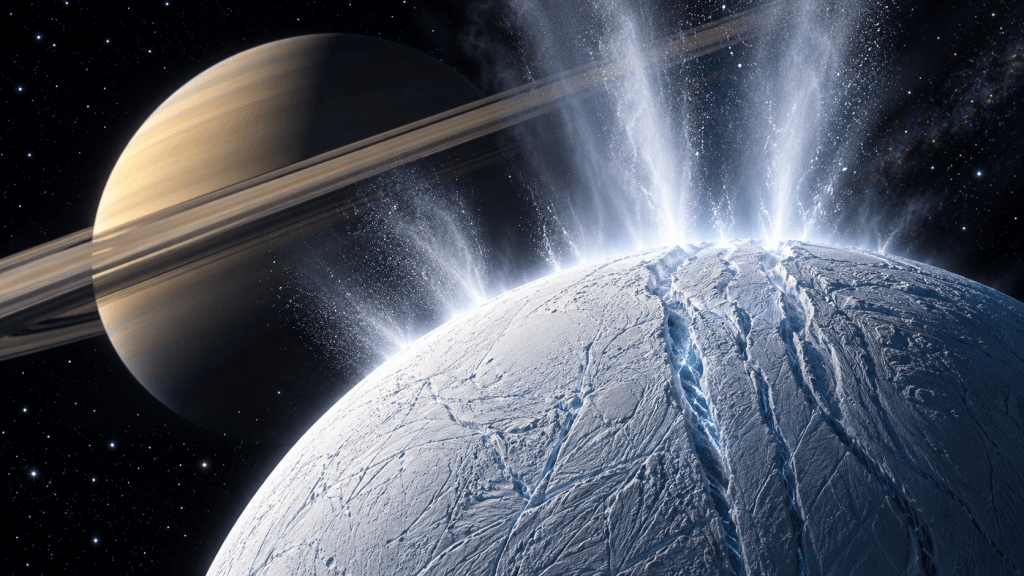
Enceladus is only about 310 miles wide, but beneath its brilliant shell of ice lies a global saltwater ocean warmed by the pull of Saturn. Along its south pole, enormous fractures release water vapor and tiny frozen grains. NASA’s Cassini spacecraft flew through that spray and found salts, organic compounds, molecular hydrogen, silica and phosphorus: an intriguing collection of water, chemistry and energy.
Now two new studies make the story even more compelling. One suggests that Enceladus naturally separates and concentrates its ocean chemistry into individual ice grains, potentially making signs of life easier for a future spacecraft to detect. The other shows that a methane-producing microorganism from Earth can survive under a laboratory recreation of Enceladus-like conditions.
This week on Star Trails, we’ll visit the little moon that may be preparing its own samples for us. Then, after the break, we’ll discover why the average color of the universe is called Cosmic Latte before heading outside for Mars in the Beehive Cluster, a young Moon beside Antares, Vesta at opposition and a perfectly timed fade of the Demon Star.
Links
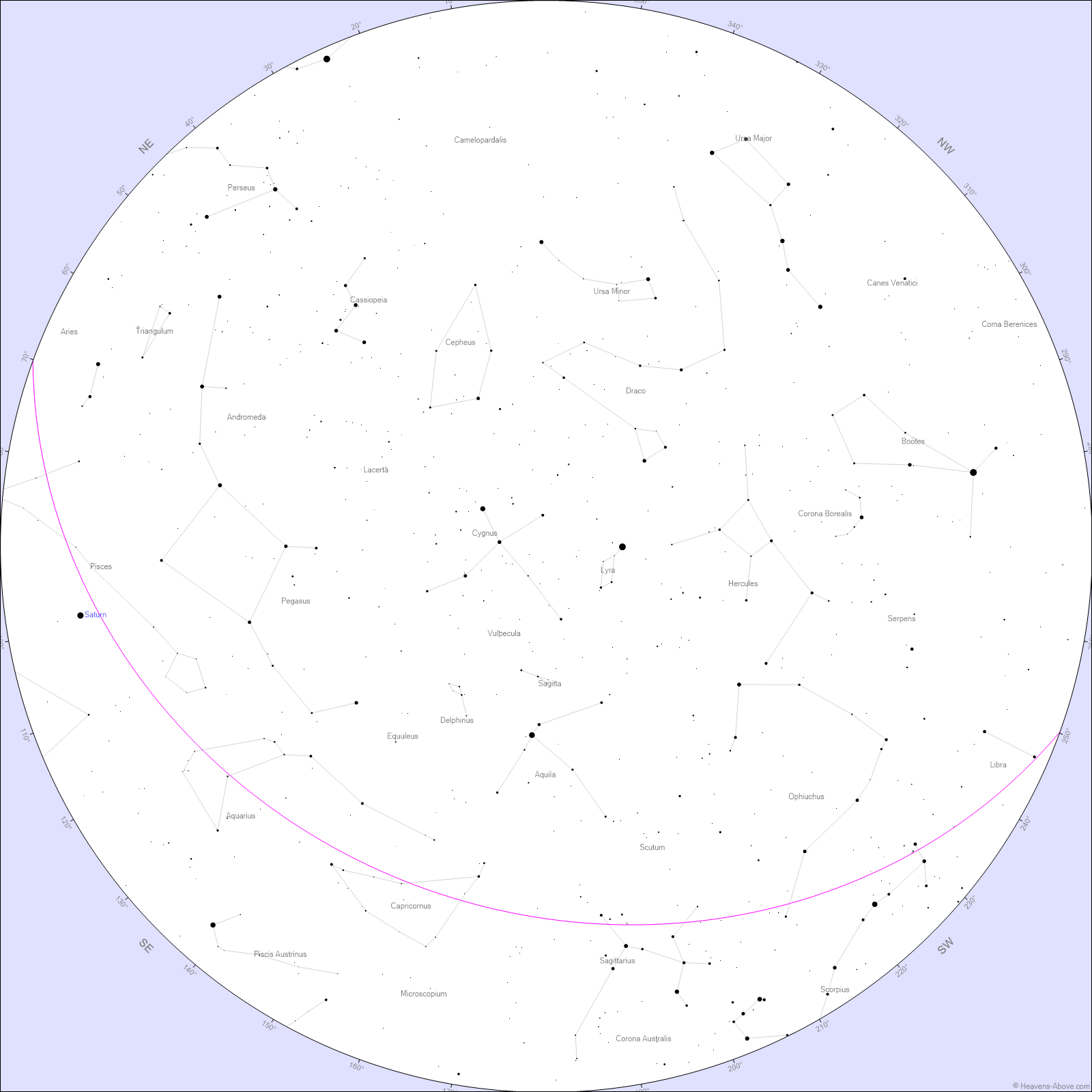
- Night sky map for the week starting October 11, 2026
- Episode 126 on YouTube
- How Enceladus ocean spray becomes chemically diverse ice grains
- EarthSky: Life on Enceladus? Chances get a big boost in two new studies
- Universe Today: Finding life on Enceladus could be easier than we thought
- Nautilus: One of Saturn’s moons could support life—and it might be easy to find
- NASA APOD: Cosmic Latte, the average color of the universe
Transcript
Howdy stargazers and welcome to this episode of Star Trails. My name is Drew and I’ll be your guide to the night sky for the week of October 11th through the 17th.
This week, we’re going swimming.
Not in an ocean on Earth, and not somewhere warm. We’re heading more than 800 million miles away to a tiny moon of Saturn where the surface temperature can fall more than 300 degrees Fahrenheit below zero.
It is a place where the ground is ice, the sky is black and the Sun looks far smaller than it does from home.
And beneath that frozen surface is an ocean.
The moon is Enceladus, and it does something wonderfully convenient. It doesn’t keep its ocean completely sealed away. It sprays some of it into space.
New research suggests those sprays may be even more useful than scientists realized. As droplets travel from the hidden ocean toward space, the freezing process may separate different chemicals into different ice grains. Some grains could contain highly concentrated samples of particular ocean ingredients. If life exists down there, even a small piece of biological material might be packaged inside one of those grains and launched above the surface where a spacecraft could collect it.
Enceladus may be preparing its own laboratory samples for us.
Later in the show we’ll return to Earth for a cup of Cosmic Latte, the surprisingly creamy average color of the universe. Then we’ll head outside for this week’s Night Sky Report. Mars swims through the Beehive Cluster, the young Moon visits Antares, an asteroid reaches opposition and the Demon Star performs a visible fade on Saturday night.
Whether you’re tuning in from the backyard or the balcony, I’m glad you’re here. So grab a comfortable spot under the night sky, and let’s get started!
Enceladus does not look like a place that should contain an ocean.
It is only about 310 miles, or 500 kilometers, across. You could fit nearly seven Enceladuses side by side across the diameter of our Moon. Its surface is almost entirely water ice, and that fresh, clean ice reflects so much sunlight that Enceladus is one of the brightest, most reflective bodies in the Solar System.
For a long time, that brightness was one of its main claims to fame.
The Voyager spacecraft photographed Enceladus during their visits to Saturn in the early 1980s. The pictures showed a small white moon with a surprisingly smooth surface in some places. Smooth terrain usually means that something has erased the old impact craters. On a world this cold and small, that was a mystery.
But Voyager was moving quickly and could only give us a glimpse. Enceladus remained an interesting snowball until the Cassini spacecraft arrived at Saturn in 2004.
Cassini carried a collection of instruments designed to study Saturn, its rings and its moons. During an early pass near Enceladus, the spacecraft’s magnetometer noticed something odd. Saturn’s magnetic field was being pushed and disturbed around the moon, as though Enceladus were releasing gas.
That was not what scientists expected from a frozen ball only a few hundred miles wide.
Mission planners brought Cassini closer.
In 2005, its cameras revealed enormous plumes rising from the moon’s south pole. Water vapor and ice grains were pouring through long, roughly parallel fractures in the surface. Those fractures became known as the tiger stripes.
This was not an ancient scar left behind by something that happened millions of years ago. Enceladus was active right now.
Imagine standing near the south pole—although standing there would be a terrible and currently impossible idea. The ground around you would be hard water ice. The horizon would curve noticeably because the moon is so small. Saturn would hang enormously in the sky. And from fractures stretching across the landscape, fountains of vapor and ice would rush upward into the darkness.
Because Enceladus has very little gravity, much of that material travels hundreds of miles above the surface. Some falls back and continually coats the moon in clean frost. Some escapes entirely and becomes part of Saturn’s broad, faint E ring.
It is a moon painting both itself and one of Saturn’s rings with water from its own interior.
The obvious question was where all that water came from.
A small reservoir beneath the south pole was one possibility. But as Cassini repeatedly measured Enceladus, the evidence grew for something much larger: a global ocean extending beneath the ice shell.
That ocean remains liquid because Enceladus is being gently kneaded by gravity.
The moon travels around Saturn in a slightly stretched orbit rather than a perfect circle. Its distance from the planet changes, and so does the strength of Saturn’s pull. Enceladus is squeezed and relaxed over and over again. Another moon, Dione, helps maintain this orbital rhythm through a gravitational resonance.
If you’ve ever bent a piece of wire back and forth and felt it become warm, you already understand the basic idea. Repeated flexing turns motion into heat. Inside Enceladus, that tidal flexing provides enough warmth to help keep water liquid beneath an exterior that is otherwise bitterly cold.
The ocean also touches a rocky core.
That matters because water interacting with warm rock can produce interesting chemistry. On Earth, seawater circulates through cracks in the ocean floor, becomes heated and returns through hydrothermal vents carrying dissolved minerals and gases. Entire ecosystems survive around those vents without sunlight. Their energy comes from chemistry.
Cassini found signs that something comparable may be happening inside Enceladus.
It detected tiny silica grains that most likely formed where hot water interacted with rock. It found molecular hydrogen, a potential energy source for certain microbes. It detected methane, salts, organic compounds and, in later analysis of Cassini’s stored data, phosphorus.
Phosphorus is important to life on Earth. It helps form DNA, cell membranes and the molecules cells use to move energy around. Finding it does not mean somebody found an Enceladean microbe. It means one more useful ingredient is available in the ocean.
That distinction is essential.
Water is not life. Organic molecules are not life. Methane is not life. Hydrogen and phosphorus are not life. A pantry can contain flour, sugar, eggs and chocolate without a cake suddenly assembling itself on the counter.
What Enceladus appears to possess is a remarkable pantry: liquid water, useful chemistry, a source of energy and a stable environment that may have persisted for a very long time.
And unlike the hidden oceans of some other icy moons, this one offers home delivery.
Cassini flew directly through the plume several times. Its instruments tasted the gas and collected impacts from tiny ice grains. The spacecraft was never designed to look for life at Enceladus because nobody knew about the ocean or plumes when Cassini was built. Its instruments could identify ingredients, but they were not a complete biological laboratory.
Even so, the data Cassini returned have kept scientists busy nearly a decade after the mission ended.
That brings us to the first of the two new studies.
Researchers examined around a thousand mass spectra collected from individual Enceladus ice grains by Cassini’s Cosmic Dust Analyzer. A mass spectrum is a chemical fingerprint. The instrument captured a grain moving at tremendous speed, the impact broke its contents into electrically charged fragments, and the pattern of those fragments revealed something about what had been inside.
Scientists already knew that the grains were surprisingly diverse. Some were dominated by nearly pure water ice. Others carried salts or organic compounds. The new work asked how grains from the same ocean could end up so different from one another.
The answer may lie in the journey from ocean to space.
Picture a bubble reaching the surface of the ocean beneath the ice. When it pops, it throws tiny droplets upward. Those droplets enter narrow, icy fractures leading toward the surface.
The simple assumption was that the droplets would freeze almost instantly. If that happened, each ice grain ought to preserve a fairly even little sample of whatever was dissolved in the droplet.
But the new models and laboratory work suggest that freezing can happen more slowly.
As a droplet freezes, pure water tends to join the growing ice crystal first. Dissolved salts and other materials are pushed away from the advancing ice. Different ingredients collect in different parts of the droplet, a little like the way freezing seawater leaves much of its salt behind.
The droplet is no longer evenly mixed. It develops chemically distinct pockets.
Then the journey becomes violent. The partly or fully frozen droplet is accelerated through the fissure. If it strikes an icy wall or breaks apart while rushing into space, those different pockets can separate into many smaller grains.
One grain may be mostly water. Another may be rich in sodium chloride. Another may concentrate carbonate. Another could contain a cluster of organic material.
Think about a bowl of snack mix. If everything were ground into a perfectly uniform powder, every spoonful would taste about the same. But if the ingredients remain separate, one handful might contain mostly pretzels and another might deliver the jackpot of chocolate pieces.
Enceladus may be turning droplets of ocean spray into a cosmic snack mix.
Scientifically, this means two things.
First, one ice grain cannot necessarily represent the average composition of the entire ocean. A future mission will need to analyze many individual particles rather than collect a few and assume every grain contains the same mixture.
But second, the natural sorting can work in our favor. A chemical present only in a tiny amount throughout the ocean might become concentrated inside a small number of grains. Instead of trying to detect a faint biological signal diluted across a large sample, an instrument could encounter one particle where that signal is much stronger.
The moon is separating and concentrating ingredients before we even arrive.
That does not guarantee that a spacecraft would find a cell, a fragment of a cell or any other sign of biology. It does suggest that if biological material is present and enters the plume, modern instruments may have a reasonable chance of recognizing it.
The second new study approaches the mystery from the opposite direction.
The first asks: if life is there, how might we detect it?
The second asks: could a living thing actually cope with the ocean chemistry we expect to find?
Scientists created a laboratory mixture intended to reproduce important features of the water and rock chemistry at the bottom of Enceladus’s ocean. It was salty, had almost no oxygen, contained very little available carbon dioxide and was highly alkaline, with a pH reaching about 11.
That is not a friendly swimming pool.
They then introduced an organism from Earth called Methanothermococcus okinawensis. The name is intimidating, but the lifestyle is fairly easy to understand.
It is an archaeon, a single-celled organism from a branch of life separate from bacteria. It lives around hydrothermal environments and makes methane by using hydrogen and carbon dioxide. It does not need sunlight, and it does not need oxygen.
That general metabolism is especially interesting at Enceladus because Cassini detected hydrogen, carbon dioxide and methane in the plume.
The researchers expected the extreme alkalinity and shortage of carbon dioxide to make survival difficult. Instead, the organisms continued growing under some of the simulated Enceladus conditions, even at a pH of 11. They changed which genes they were using and adjusted their metabolism to capture the limited carbon dioxide more effectively.
Life, at least this particular example of life from Earth, proved more flexible than expected.
Again, this experiment did not create an alien microbe. It did not show that life began on Enceladus. And it certainly did not prove that the methane Cassini detected came from biology. Rocks and water can produce methane without any organism being involved.
The result is more modest, but still important. It demonstrates that the chemistry predicted for Enceladus is not automatically too harsh for a familiar methane-producing metabolism.
One study says that a possible organism could function there.
The other says that traces of an organism might become concentrated in grains we can collect.
Together, they strengthen both halves of the case for returning to Enceladus: the ocean may be habitable, and the plume may make it unusually practical to search.
That practicality is what sets Enceladus apart.
If you want to investigate an ocean beneath miles of ice, the usual plan sounds like the beginning of an engineering nightmare. Land a spacecraft. Melt or drill through the shell. Prevent material from Earth from contaminating the ocean. Maintain communication through the ice. Survive all the way down.
At Enceladus, you can begin much more simply. Fly through the plume with a modern dust analyzer and a mass spectrometer. Let the moon bring the ocean to you.
A future mission might make many passes, collecting thousands or millions of grains. It could examine them one by one, looking for complicated organic patterns, unusual concentrations, structures resembling fragments of cells or chemical ratios that are difficult to explain through geology alone.
No single clue would necessarily settle the question.
Life detection is difficult because chemistry can imitate biology. Methane can come from microbes or rocks. Organic molecules can form without life. Even an interesting pattern may have more than one explanation.
Scientists would want several independent lines of evidence all telling the same story.
That caution may sound less exciting than announcing aliens. But I think the real situation is better.
We have a moon that, until twenty years ago, looked like a bright frozen ball. We now know it contains an ocean, active geology, water-rock chemistry, chemical energy and many of the ingredients used by life on Earth. That ocean is erupting into space where our machines can reach it. And old measurements from a spacecraft built in the 1980s and 1990s are still revealing how a future mission might conduct one of the most profound experiments in human history.
There is also something wonderfully tangible about this search.
The ocean is not a statistical hint in the light of a distant exoplanet. It is inside our own Solar System. The water is real. The ice grains struck a spacecraft we built. The chemical fingerprints are sitting in our archives. Saturn is visible from the backyard this week.
You will not see Enceladus with your unaided eyes. Even through a small telescope it is difficult, faint and crowded close to Saturn’s glare. But point a telescope toward Saturn and you are looking at the system where all of this is happening.
Near that golden planet, a moon smaller than many nations is circling once every day and a half. Beneath its white shell, an ocean moves against warm rock. Bubbles rise. Droplets enter cracks. Ice grains burst into space and spread outward to become part of a ring around Saturn.
We do not know whether anything is alive in that water.
But for the first time in human history, that question feels less like pure imagination and more like an experiment waiting to be flown.
After a quick break, we’ll average the light of 200,000 galaxies, order ourselves a Cosmic Latte and use it to ease into a very busy week in the backyard sky. Stay with us.
Welcome back.
Before we head outside, I have a question that sounds like it belongs on a paint commercial.
What color is the universe?
The obvious answer is black. Step outside at night, look between the stars and there it is. Space is dark.
But that isn’t quite the question astronomers Karl Glazebrook and Ivan Baldry asked. They wanted to know what color we would get if we took the visible light from a huge collection of galaxies, blended all of it together and translated the result into a single color perceived by human eyes.
They were studying the combined spectrum of more than 200,000 galaxies from the 2dF Galaxy Redshift Survey. The serious purpose was to learn about the history of star formation. Young populations contain more hot blue stars. Older populations become redder as the biggest, brightest blue stars burn out.
But once you have averaged the visible light of 200,000 galaxies, it is difficult to resist turning that spectrum into a paint swatch.
The answer is beige.
More specifically, it is a warm, creamy off-white commonly represented on a computer as hex color F-F-F-8-E-7.
There was a brief complication. The first calculation produced a pale greenish turquoise, which was much more dramatic. Then a color scientist noticed that the software had handled its white reference incorrectly. The astronomers corrected the mistake and the universe became beige.
I appreciate the honesty, but that has to rank among the most disappointing software updates in history.
The corrected color still needed a name. Suggestions included “skyvory” and “univeige,” neither of which should ever be spoken again. The winning choice was much better: Cosmic Latte.
And the beige carries a real piece of astronomy. The average light of galaxies has become less blue over billions of years. The universe once formed stars much more rapidly, filling galaxies with brilliant, short-lived blue stars. As cosmic star formation slowed and stellar populations aged, the combined light shifted toward warmer colors.
So Cosmic Latte is not the color of empty space, and it is not what the sky would look like if we turned on some enormous universal light switch. It is the result of blending the visible light from a vast sample of galaxies into one deliberately whimsical answer.
Apparently the universe contains black holes, exploding stars, hidden oceans and galaxies colliding across billions of light-years, but when you stir everything together, you get the wall color in a tastefully renovated kitchen.
And with that soothing cup of intergalactic beige in hand, let’s head outside.
Our observing week begins before dawn on Sunday, October 11th, with the best binocular pairing of the week.
Mars is passing through the Beehive Cluster, Messier 44, in the constellation Cancer.
The Beehive is a loose open cluster containing hundreds of stars. Under a reasonably dark sky, your unaided eyes may see it as a small hazy patch. Binoculars break that haze into a field of individual stars.
Now place orange-red Mars directly among them.
Look toward the east and southeast before morning twilight. To the naked eye, Mars and the cluster create a small reddish point against a faint mist. Through ordinary binoculars or a telescope at low power, the view becomes much richer: warm-colored Mars surrounded by scattered blue-white stars.
Use low magnification. This is not the night to enlarge Mars as much as possible. The pleasure comes from keeping the planet and the surrounding cluster in the same field.
The alignment changes from morning to morning, so if clouds interfere on Sunday, keep trying over the next couple of days. Mars will drift out of the center, but the pairing will remain attractive.
On Monday, October 12th, Mercury reaches greatest eastern elongation. That means it is at its greatest apparent distance east of the Sun during this evening appearance.
Normally, that sounds like the right time to find Mercury. Unfortunately, sky geometry matters as much as the number printed in an almanac.
For much of North America and Europe, the evening ecliptic lies at a shallow angle to the western horizon in autumn. Mercury, Venus and a very thin crescent Moon are technically gathered in the evening sky, but they sit extremely low and set soon after the Sun. Most northern observers are unlikely to get a satisfying view.
If you live farther south, the geometry improves dramatically. Observers in the Southern Hemisphere may see the thin Moon, Mercury and Venus stacked above the western horizon in twilight.
Wherever you are, do not sweep for Mercury with binoculars until the Sun is completely below the horizon. A low planet is not worth risking your eyesight.
The Moon becomes much easier during the rest of the week. New Moon occurred on October 10th, so each evening brings a slightly thicker waxing crescent and a longer observing window.
Look for earthshine during the first few evenings: the bright crescent is direct sunlight, while the dim gray remainder of the lunar disk is being softly illuminated by sunlight reflected from Earth. From the Moon, our nearly full Earth would be shining brilliantly in the sky.
On Tuesday, October 13th, asteroid 4 Vesta reaches opposition in the constellation Cetus.
Vesta is the second-most massive object in the main asteroid belt, after Ceres. At opposition it rises around sunset, remains visible all night and comes closest to Earth for the year. It reaches about magnitude 6.5, right on the edge of naked-eye visibility under an exceptionally dark sky.
For most of us, this is a binocular or small-telescope target.
Vesta will look exactly like a faint star. The satisfying part is proving that it isn’t one. Use a planetarium app or a current finder chart to identify the field, make a quick sketch or take a photograph, and return a night or two later. One little point will have shifted against the background stars.
You are watching an asteroid move in real time.
Wednesday evening, October 14th, offers the easiest Moon pairing of the week.
The four-day-old crescent Moon passes close to Antares, the reddish heart of Scorpius. Look low in the southwest as twilight deepens. Antares is a red supergiant, and its warm color should contrast beautifully with the pale crescent.
The pair will be low, so find a place with an open southwestern horizon. This is also an excellent smartphone photograph. Put a tree, rooftop or familiar landmark beneath them and let the foreground provide a sense of scale.
Saturn remains the anchor of the evening sky all week.
The planet reached opposition on October 4th, so it is still bright, close to its best and visible for most of the night. Look east after sunset for a steady, pale golden point. By late evening it will be higher in the southern sky where Earth’s atmosphere disturbs the view less.
A small telescope reveals the rings. They are still presented at a relatively narrow angle, giving Saturn a slimmer appearance than the wide-open rings shown in many photographs. Titan is the easiest moon to spot. Enceladus is much fainter and huddles close to the planet’s glare, so don’t be discouraged if our featured ocean world remains invisible. Knowing it is there is enough.
Finally, Saturday night gives us an astronomical change you can watch without any telescope at all.
Algol, the Demon Star in Perseus, is an eclipsing binary. Two stars orbit one another in a system turned almost edge-on toward Earth. Every 2.87 days, the fainter star passes in front of the brighter one and the combined light noticeably fades.
On October 17th, the timing is unusually friendly for North America. Algol should reach minimum brightness around 10 p.m. Eastern, or 7 p.m. Pacific.
Find Algol in the northeastern sky earlier in the evening and compare it with nearby stars such as Mirfak in Perseus or Almach in Andromeda. Algol normally shines around magnitude 2.1. During the eclipse it falls to about magnitude 3.4, becoming roughly one-third as bright as normal.
Check it once early, again near the predicted minimum and once more later if you are still awake. You are not seeing a star physically switch off. You are watching one sun pass in front of another from more than 90 light-years away.
The Moon will be approaching first quarter by the end of Saturday. The exact phase arrives on Sunday, October 18th, but Saturday evening is already a fine time to explore the lunar surface. Along the curved line separating day from night, low sunlight casts long shadows from crater walls and mountain peaks. Binoculars will reveal the roughness, and a telescope turns the terminator into a landscape.
If you only choose one event this week, take binoculars out before dawn for Mars in the Beehive. If mornings are not your thing, catch the crescent Moon and Antares on Wednesday. And if you want to see the clockwork of a distant solar system with your own eyes, check Algol several times on Saturday night.
From an ocean erupting beneath the ice of Enceladus to two distant stars eclipsing one another on schedule, this is a week full of worlds that reveal themselves through change.
That’s going to do it for this week. If tonight’s episode sparked your curiosity, or maybe gave you something new to think about the next time you look up, I’d be honored if you shared Star Trails with someone who might enjoy the journey. You can always find the latest episodes, show notes, and extras at startrails.show.
And if you’d like to help support the show, there’s also a little “buy me a coffee” link on the site. It genuinely helps keep these stories coming.
Be sure to follow Star Trails on Bluesky and YouTube — links are in the show notes. Until we meet again beneath the stars … clear skies everyone!
Support the Show
Connect with us on Bluesky @startrails.bsky.social
If you’re enjoying the show, consider sharing it with a friend! Want to help? Buy us a coffee! Also, check out music made for Star Trails on our Bandcamp page!
Podcasting is better with RSS.com! If you’re planning to start your own podcast, use our RSS.com affiliate link for a discount, and to help support Star Trails.


Leave a Reply