The Death of Andromeda – Star Trails: From Backyard Astronomy to Cosmic Wonder
Episode 127
The Andromeda Galaxy is not disappearing, exploding or running out of stars. But it may be entering something astronomers recognize as a kind of galactic old age: it is gradually losing the ability to make new ones.
Using the Hubble Space Telescope, researchers reconstructed 500 million years of star formation across two-thirds of Andromeda’s disk. They found a long decline, followed by an especially steep drop during the past 40 million years. The galaxy’s great ring of stellar nurseries is going quiet.
This week on Star Trails, we’ll find out how astronomers read the fossil record of 200 million individual stars, why a small satellite galaxy named M32 may be involved and what Andromeda’s slowdown could tell us about the future of the Milky Way.
Then, in the Night Sky Report for October 18 through the 24th, we’ll look for Andromeda itself, explore the first-quarter Moon, watch for fast Orionid meteors from Halley’s Comet and finish the week with the Moon beside Saturn.
Links
- Night sky map for the week starting October 18, 2026
- Episode 127 on YouTube
- NASA: Hubble shows star formation in Andromeda winding down
- PHAST study: The spatially resolved recent star formation history in M31
- EarthSky: Star formation in Andromeda is winding down
- NASA: October 2026 skywatching tips
- NASA: The Orionids meteor shower
Transcript
Howdy stargazers and welcome to this episode of Star Trails. My name is Drew and I’ll be your guide to the night sky for the week of October 18th through the 24th.
This week, we’re going to watch a galaxy die.
That sounds dramatic. And if you’re picturing the Andromeda Galaxy exploding, collapsing into a black hole or being torn apart in a spectacular collision, I should probably lower the temperature right away.
None of those things is happening.
Andromeda is still a magnificent spiral galaxy containing hundreds of billions of stars. It will remain in the sky for longer than our minds can comfortably imagine. But new observations from the Hubble Space Telescope show that something fundamental is changing inside it.
Andromeda is gradually losing the ability to make new stars.
Its great stellar nursery is winding down. The galaxy isn’t dying in a sudden catastrophe. It is aging.
Later in the show we’ll step outside to find Andromeda for ourselves. We’ll also explore the first-quarter Moon, watch for fast meteors left behind by Halley’s Comet and finish the week with the Moon beside Saturn.
Whether you’re tuning in from the backyard or the balcony, I’m glad you’re here. So grab a comfortable spot under the night sky, and let’s get started!
The Andromeda Galaxy is one of the most distant things the human eye can see without a telescope.
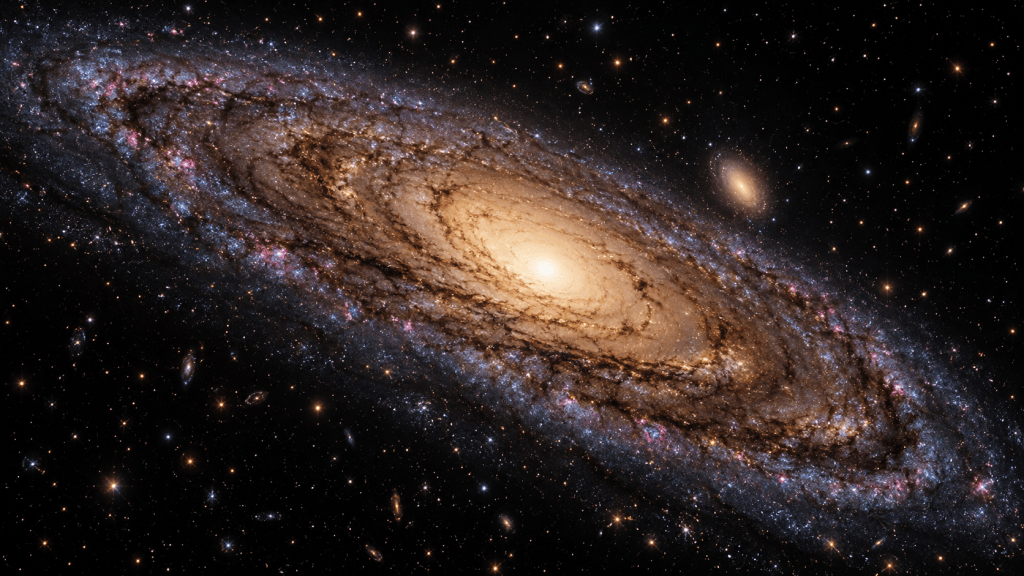
From a genuinely dark location it appears as a faint, soft smudge in the autumn sky. It does not look like the enormous spiral shown in long-exposure photographs. Our eyes mainly detect the bright central region. The galaxy’s dim outer disk stretches much farther than it appears.
That little patch of light is about two and a half million light-years away. The photons reaching your eyes began their journey before modern humans existed.
Andromeda, also known as Messier 31 or M31, is the largest galaxy in our Local Group. The Milky Way is the other dominant member. Around both of them is a collection of smaller galaxies, including the Triangulum Galaxy and dozens of dwarfs.
Because Andromeda is nearby by galactic standards, astronomers can do something remarkable there. They can separate enormous numbers of its stars and study them individually.
In most distant galaxies, billions of stars blur into a single glow. Astronomers can measure the combined light, but individual stellar lives disappear into the crowd.
Andromeda is close enough for the Hubble Space Telescope to pick that crowd apart.
Two ambitious observing programs, the Panchromatic Hubble Andromeda Treasury and the Panchromatic Hubble Andromeda Southern Treasury—mercifully shortened to PHAT and PHAST—mapped about two-thirds of Andromeda’s star-forming disk.
Together, the surveys measured roughly 200 million individual stars.
That number deserves a moment. Astronomers did not merely take one attractive picture of a galaxy. They assembled a stellar census large enough to reconstruct when different neighborhoods inside Andromeda were making stars.
The researchers divided the Hubble maps into more than 6,500 small regions. Each covered an area about 300 light-years on a side. Then they built a color-magnitude diagram for every region.
A color-magnitude diagram is one of astronomy’s most useful tools. It organizes stars by brightness and color. Those properties reveal a great deal about their mass, temperature and age.
Hot, massive stars burn blue and live fast. Some survive only a few million years. If you find a large population of bright blue stars, you know star formation occurred there recently.
Smaller stars can survive for billions or even trillions of years. As the short-lived blue stars disappear, an aging stellar population becomes dominated by redder, longer-lived stars.
So the stars form a fossil record.
Nobody watched Andromeda continuously for half a billion years. Instead, astronomers looked at the mix of stars that remains today and worked backward. It is a little like reconstructing the history of a forest from the ages and species of the trees still standing.
The result is a time-lapse portrait of Andromeda’s recent past.
Five hundred million years ago, the galaxy was turning roughly one Sun’s worth of gas into stars each year. That rate has fallen steadily. The new study finds a particularly pronounced drop during the past 40 million years.
Depending on exactly which part of the galaxy and which time window is measured, the modern rate is only a few tenths of a solar mass per year.
That does not mean Andromeda creates one star every several years. Stars come in many sizes. Astronomers add together the total mass going into all of them and compare it with the mass of our Sun.
The important point is the direction. Andromeda is making new stars far more slowly than it did in the recent past.
Most of that activity is not spread evenly across the disk. It is concentrated in a broad ring about 32,000 light-years from the galactic center.
In ultraviolet images, that ring glows with young stars. In infrared views, lanes of dust and gas trace the material from which future stars might form. It is the galaxy’s main maternity ward.
And the maternity ward is becoming quiet.
That is what astronomers mean when they describe a galaxy as dying or becoming quenched. The existing stars do not all switch off. The galaxy does not vanish. It simply stops replacing old stars with enough new ones.
At first, the change may be subtle. The largest blue stars disappear quickly because they burn through their fuel at astonishing rates. Later, other bright stars reach the ends of their lives. The galaxy becomes redder and quieter as its population shifts toward small, long-lived stars.
This process can take billions of years.
Andromeda is not a corpse. It is more like a city where fewer children are being born each year. The buildings remain. The population remains enormous. Life continues everywhere you look. But the age of the population begins to change, and the future starts to look different from the past.
Why is it happening?
Stars form inside cold clouds of molecular gas. Gravity gathers dense pockets together until they collapse. A new star switches on, often surrounded by a disk that may eventually form planets.
A galaxy needs cold gas to keep that process going. It can use up the gas already in its disk, recycle material expelled by aging stars or pull fresh supplies from the space around it.
Star formation can also regulate itself. Young stars pour ultraviolet radiation and stellar winds into their surroundings. Supernovae stir and heat the gas. That feedback can compress some clouds while scattering others. A galaxy is constantly balancing gravity, turbulence, heating, cooling and the arrival or loss of material.
The new Andromeda study does not point to one simple cause. The authors interpret the decline as the late stage of a wind-down that has been unfolding for billions of years rather than evidence that the galaxy suddenly ran out of raw material.
But there is an intriguing suspect nearby.
M32 is a compact satellite galaxy seen close to Andromeda’s bright center. It may be the stripped remnant of a much larger galaxy that interacted with Andromeda in the past.
The new maps show that the part of Andromeda nearest M32 experienced an especially clear decrease in star formation beginning roughly 60 million years ago.
That timing is interesting, but it is not a conviction.
Astronomers do not know M32’s exact three-dimensional position or the details of its past orbit. The researchers cannot say that M32 caused the slowdown. They can say it is nearby, the effect is strongest in its direction and a past encounter is a plausible part of the story.
Galactic interactions can have apparently opposite effects.
Gravity can squeeze gas clouds and ignite a burst of new stars. But an interaction can also rearrange gas, heat it or help move it away from the places where stars form efficiently. A collision may produce a brilliant flare of star birth followed by a long decline.
Andromeda appears to have experienced a major burst around two billion years ago, possibly connected with an earlier merger or close encounter. The galaxy may now be settling down after that active period.
This is where Andromeda becomes a mirror.
The Milky Way is still forming stars at roughly a Sun’s worth of mass per year. We live inside its disk, which makes a complete census difficult. Dust blocks our view, and distance is much harder to judge when you are embedded in the thing you’re trying to measure.
Andromeda gives us an outside view of a large spiral galaxy with many similarities to our own. We can see the whole structure while still resolving individual stars. Its slowdown shows one possible chapter in the future of the Milky Way.
Our galaxy will not keep making stars forever either.
Its cold gas supply will change. Some material will become locked inside stars and planets. Some will be expelled. Some will return from aging stars and fall back into the disk. The balance will gradually shift, and the Milky Way will eventually join the enormous population of galaxies that shine mostly with old stars.
What about the famous collision between the Milky Way and Andromeda?
For years, the usual story was that the two galaxies would crash together in about four or five billion years and merge into one enormous galaxy.
That ending is no longer certain.
Improved measurements from Hubble and the European Space Agency’s Gaia mission have shown how sensitive the prediction is to the motion and mass of Andromeda, the Triangulum Galaxy, the Large Magellanic Cloud and the dark-matter halos surrounding them. Recent studies have produced very different probabilities depending on the measurements and assumptions used.
The honest answer is that Andromeda and the Milky Way may merge, may experience a distant encounter or may continue their slow gravitational dance for far longer.
If they do merge, individual stars are very unlikely to collide. Galaxies are mostly empty space. Their gas clouds would interact, however, and that encounter could briefly trigger new star formation before the combined galaxy eventually settles into another quieter state.
But Andromeda does not need the Milky Way to kill it.
The slowdown has already begun.
That may be the most tangible part of this story. We often discuss galactic evolution as something remote and abstract, hidden in galaxies too faint to see without a major telescope.
Andromeda is outside tonight.
The little oval in your binoculars is a galaxy whose stellar birth rate we have measured neighborhood by neighborhood. The blue lights in its great ring are becoming less common. A dwarf galaxy may have disturbed one side of the disk. Hundreds of millions of stars preserve the record of what happened.
Its death will not resemble an explosion.
It will resemble a sunset so slow that generations of stars pass while the light fades.
After a quick break, we’ll find Andromeda in the autumn sky, explore the Moon’s mountains and watch pieces of Halley’s Comet burn above us. Stay with us.
Welcome back.
Our Night Sky Report begins tonight with the subject of our story.
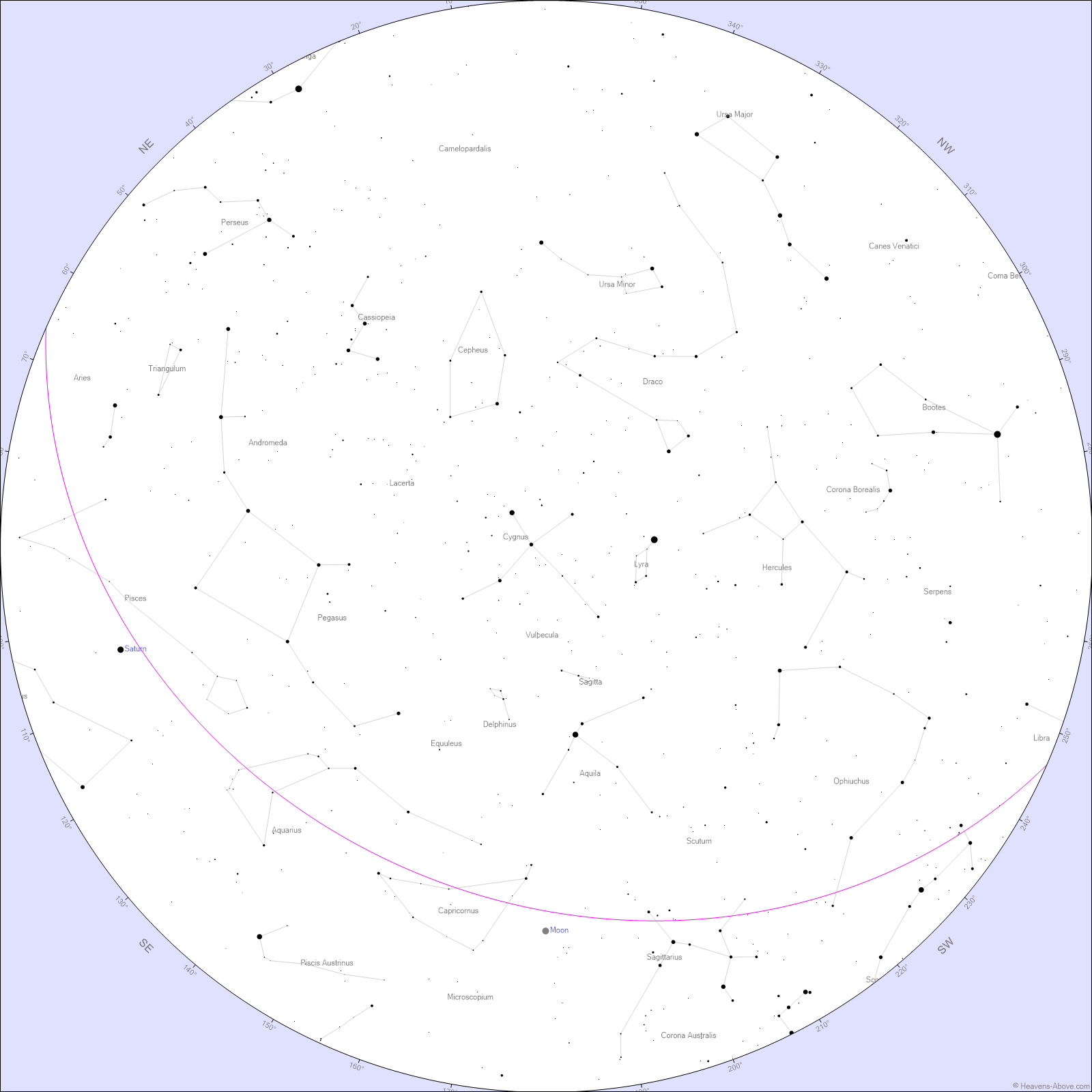
Andromeda is beautifully placed for northern observers on October evenings. By mid-evening it is high in the eastern and northeastern sky, above much of the murk near the horizon.
Start with the Great Square of Pegasus, a large box of four stars. The star at its northeastern corner is Alpheratz. From there, follow two chains of stars extending away from the square into the constellation Andromeda.
Find the orange-tinted star Mirach. Then look above it for a fainter star called Mu Andromedae. Continue roughly the same distance again and you should arrive at the Andromeda Galaxy.
From a dark location you may see it with the unaided eye as a faint oval patch. In suburban skies, binoculars are the better tool. Do not expect a detailed spiral. You will probably see a bright center fading into a softer halo.
The light is faint, but the object is not small. Andromeda spans several times the apparent width of the full Moon. Most of that outer disk is simply too dim for our eyes to detect.
The Moon becomes an increasing obstacle as the week continues, so try for Andromeda early in the week or after moonset.
The Moon reaches first quarter on the day this episode comes out.
The name can be confusing. The Moon looks half illuminated, but it is one-quarter of the way through its cycle from one new Moon to the next.
First quarter is one of the best times to explore the lunar surface. Along the terminator—the boundary between lunar day and night—the Sun is low in the lunar sky. Mountains and crater walls cast long shadows that make the landscape appear dramatically three-dimensional.
Binoculars reveal the rough line of the terminator. A small telescope can pick out the lunar Apennine Mountains curving along the edge of Mare Imbrium. These mountains rise where an enormous impact excavated the Imbrium basin billions of years ago.
On the night of Wednesday, October 21st into the morning of Thursday the 22nd, the Orionid meteor shower reaches its peak.
The Orionids are pieces of Comet Halley. The comet itself will not return to the inner Solar System until 2061, but dust shed during earlier visits remains spread along its orbit. Earth crosses that stream every October.
These meteors strike the atmosphere at about 41 miles, or 66 kilometers, per second. Their speed allows bright Orionids to leave glowing trains that linger after the meteor disappears.
Under ideal dark skies, the shower can produce around 10 to 20 meteors per hour. Conditions are not ideal during the first half of the night because a bright waxing gibbous Moon will wash out the fainter streaks.
The better opportunity comes after the Moon sets, roughly around two in the morning for many locations. Orion will be well up, and the remaining hours before dawn should provide a darker window.
You don’t need to stare directly at Orion. Meteors can appear anywhere in the sky, and the longest trails are often seen 45 to 90 degrees away from the radiant. Get comfortable, give your eyes time to adjust and take in as much sky as possible.
Finally, watch the Moon approach Saturn as the week ends.
By Friday evening, October 23rd, the bright gibbous Moon and Saturn are in the same broad area of the southeastern sky. On Saturday the 24th, they draw closer and travel together through the evening.
Saturn reached opposition earlier this month, so it remains bright and easy to find. It looks like a steady golden point beside the much brighter Moon. A small telescope reveals the rings and Titan, although the moonlight may reduce contrast for fainter objects nearby.
Neptune is also in that part of the sky, but it is far too faint for the unaided eye and requires careful use of a current finder chart.
If you choose one observing project this week, make it Andromeda. Find the Great Square, follow the stars to Mirach and let binoculars collect light that has been traveling since our ancestors were shaping some of the earliest known stone tools.
Then remember what that faint glow contains: a bright center, a disk hundreds of thousands of light-years wide, a fading ring of stellar nurseries and roughly 200 million stars whose colors allowed astronomers to watch a galaxy grow old.
That’s going to do it for this week. If tonight’s episode sparked your curiosity, or maybe gave you something new to think about the next time you look up, I’d be honored if you shared Star Trails with someone who might enjoy the journey. You can always find the latest episodes, show notes, and extras at startrails.show.
And if you’d like to help support the show, there’s also a little “buy me a coffee” link on the site. It genuinely helps keep these stories coming.
Be sure to follow Star Trails on Bluesky and YouTube — links are in the show notes. Until we meet again beneath the stars … clear skies everyone!
Support the Show
Connect with us on Bluesky @startrails.bsky.social
If you’re enjoying the show, consider sharing it with a friend! Want to help? Buy us a coffee! Also, check out music made for Star Trails on our Bandcamp page!
Podcasting is better with RSS.com! If you’re planning to start your own podcast, use our RSS.com affiliate link for a discount, and to help support Star Trails.


Leave a Reply