The Darkroom at the Edge of the Universe – Star Trails: From Backyard Astronomy to Cosmic Wonder
Episode 129
There was a time when photographing a distant galaxy required enormous telescopes, glass photographic plates, exotic chemistry, and almost unimaginable patience. But capturing the light was only half the battle. Sometimes the greatest discoveries were hiding inside the photographs themselves, waiting for someone clever enough to bring them into view.
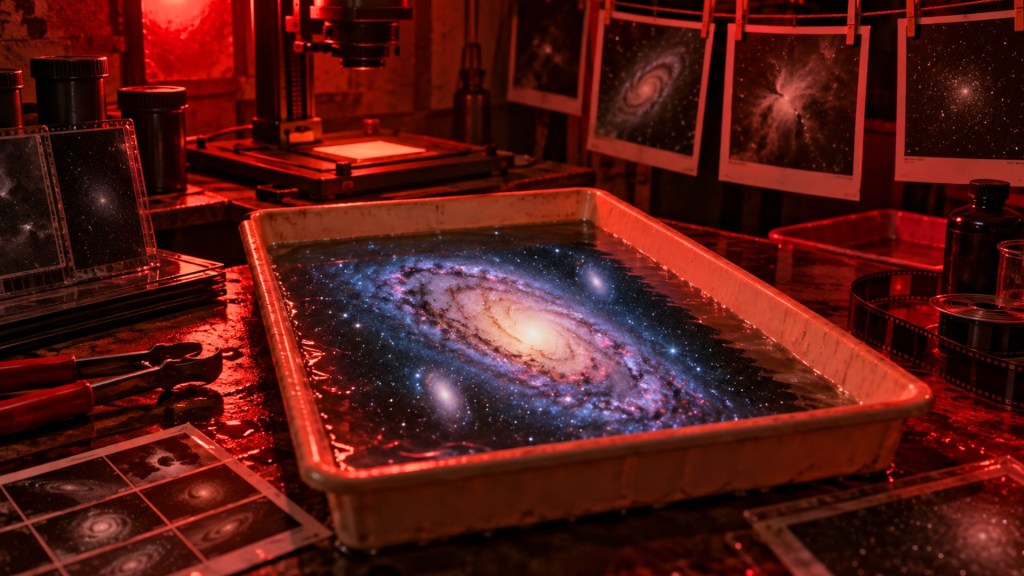
This week we explore the extraordinary work of David Malin, the photographic scientist whose ingenious darkroom techniques helped transform our view of the universe. Working with massive telescopes at the Anglo-Australian Observatory, Malin developed ways to reveal faint cosmic structures and assemble breathtaking color photographs from black-and-white negatives. His work helped uncover previously unseen features of distant galaxies, including an enormous, ghostly spiral that now bears his name.
We’ll also revisit the sometimes miserable world of film astrophotography, from manually guiding telescopes through hours-long exposures to treating photographic film to make it more sensitive to faint light. And we’ll consider how Malin’s legacy lives on in today’s digital cameras, image-stacking software, and remarkable little smart telescopes that can photograph galaxies from our own backyards.
Plus, in our night sky report for November 1–7, 2026: The waning Moon brings darker evenings, Mars and Jupiter brighten the morning sky, Venus returns to the dawn, and Saturn remains a rewarding evening target. We’ll also visit some of autumn’s finest binocular sights, including the Andromeda Galaxy, the Double Cluster, and the Pleiades.
Transcript
Howdy stargazers and welcome to this episode of Star Trails. My name is Drew and I’ll be your guide to the night sky for the week of November the 1st to the 7th.
This week, we’re taking a trip back to the days before digital cameras, when photographing the universe required enormous telescopes, photographic plates, some rather exotic chemistry, and an extraordinary amount of patience. We’ll meet a man who helped transform astronomical photography, revealing colors and details that had bThis week …
Later in the show …een hiding in the darkness all along. His work produced some of the most breathtaking images of the cosmos ever made, and it helped inspire a generation of stargazers — including yours truly.
Later in the show, we’ll explore the night sky for the first week of November. The waning Moon is clearing the way for some terrific evening stargazing, while Mars and Jupiter are putting on a nice show in the morning sky. We’ll also catch up with Saturn, look for Venus returning to the dawn, and visit some of autumn’s finest celestial attractions, including the Andromeda Galaxy, the Double Cluster, and the Pleiades.
Whether you’re tuning in from the backyard or the balcony, I’m glad you’re here. So grab a comfortable spot under the night sky, and let’s get started!
There was a time, somewhere in the 1980s, when I could travel millions of light-years without leaving my bedroom. All I had to do was look at the wall.
Like a lot of kids fascinated by astronomy, I had pictures of galaxies and nebulae hanging around my room. Some were enormous posters, big enough to stand in front of and get lost in. I remember the intricate dust lanes, the wisps of glowing gas, and those delicate pinpricks of starlight against an impossibly black background. The colors were extraordinary. And supposedly, these were photographs.
But photographs taken with what? I knew you could attach a camera to a telescope, but I also knew that looking through a backyard telescope was nothing like looking at those posters. Nebulae were pale, ghostly things. Galaxies were gray smudges. Where the hell were those magnificent colors coming from?
I assumed the answer involved gigantic telescopes, and that was partly true. What I didn’t know was that behind some of the most spectacular astronomical images of that era was a man whose most important instrument wasn’t a telescope at all. It was a darkroom. His name was David Malin.
Before we meet him, consider how miserable astrophotography could be before digital cameras. Today you can put a small automated telescope outside, select a galaxy on your phone, and let the computer collect and combine exposures while you sit indoors. In the old days, you loaded film, focused as carefully as possible, opened the shutter, and waited. Sometimes for an hour or more.
And you couldn’t necessarily walk away. Earth was turning, so your telescope had to track the stars accurately. Some amateurs spent those long exposures staring into a guiding eyepiece, making tiny corrections to prevent their stars from becoming white dashes. After all that, you still had to develop the film to discover whether you’d photographed a galaxy or absolutely nothing.
Even with perfect focus and tracking, film had another problem: reciprocity failure. Normally, if you cut the light reaching film in half, you can compensate by doubling the exposure time. But during very long exposures, photographic emulsions become less efficient at recording faint light. Keeping the shutter open longer doesn’t necessarily give you the improvement you’d expect. That’s a nasty problem when your subject is already almost unimaginably dim.
Astrophotographers fought back with special emulsions, cooling, and a process called hypersensitization. Some films were treated with carefully controlled heat and gases, including hydrogen, to make them more responsive to faint light. Kodak Technical Pan became a favorite because of its fine grain and sensitivity to deep red. Astrophotography could begin to resemble a chemistry experiment conducted by somebody who probably should have been supervised.
And after all that trouble, many amateurs were recording the universe on a little 35-millimeter negative. Professional observatories, meanwhile, could use glass photographic plates as large as fourteen inches square. Those plates, exposed through powerful telescopes, could hold tremendous amounts of detail. They weren’t perfect, but they preserved information across enormous fields of view. Sometimes the real challenge wasn’t getting that information onto the plate. It was getting it back out.
David Malin was unusually well prepared for that challenge. Born in England in 1941, he was trained as a chemist, not an astronomer. He spent years photographing microscopic structures with specialized lighting and photographic techniques, searching for details the naked eye couldn’t detect. His images of crystals and other materials could be beautiful as well as scientifically useful. He understood that a photograph might contain information that wasn’t obvious when you first looked at it.
In 1975, Malin joined the Anglo-Australian Observatory, home to a 3.9-meter telescope near Coonabarabran, Australia. He’d gone from studying the very small to the almost unimaginably large, but the central question was the same: how do you make something visible when the evidence is hiding inside a photographic emulsion?
Many of the most useful astronomical plates were black and white. Monochrome emulsions could record faint objects more effectively than ordinary color film, whose separate color-sensitive layers behaved differently during long exposures. That made accurate color a nightmare.
Malin adapted a technique with nineteenth-century roots. Instead of taking one color exposure, astronomers could photograph the same region through red, green, and blue filters, producing three black-and-white records. Malin then used an enlarger and a painstaking registration system to combine them into a color image. Every plate had to be developed, aligned, and balanced with extraordinary care.
Today software can align those channels and let us tweak the colors with sliders. Malin had photographic materials, handmade equipment, a deep understanding of light, and apparently a supernatural supply of patience.
The results were breathtaking. Gas clouds surrounding newborn stars glowed with color. Dust lanes became black rivers winding through galaxies. Stars showed subtle differences in hue. This wasn’t merely decoration: color could convey information about the objects themselves. And for people like me, it made the universe feel real. These weren’t paintings of what astronomers imagined might exist. They were images assembled from actual starlight.
But Malin’s color photographs were only half the story. He also found ways to reveal faint structures already recorded on photographic plates but nearly invisible to anyone examining them.
A photographic emulsion isn’t simply a flat picture. It has thickness: tiny light-sensitive grains suspended in a gelatin layer. Faint astronomical detail and unwanted background fog don’t always behave the same way within that layer. Malin exploited those differences with carefully controlled photographic copying, including a technique called photographic amplification. By suppressing some of the background and boosting subtle contrast, he could bring out structures that had seemed to disappear into the plate.
Think about what that means. He wasn’t pointing a telescope somewhere new or taking another exposure. Ancient photons had already crossed space, entered the telescope, and changed grains in the photographic emulsion. The evidence was sitting there. Malin was figuring out how to retrieve it.
In 1978, he published work in Nature describing photographic amplification of faint astronomical images. His techniques helped researchers examine dim galactic extensions, faint clouds, and other elusive structures. Sometimes the difference between discovering something and overlooking it wasn’t a bigger telescope. It was a more imaginative way of looking at the photograph.
That idea led to an especially fitting discovery. In 1986, Malin’s work helped uncover an enormous, exceptionally faint spiral galaxy that became known as Malin 1. Its disk extended across a vast region, yet its light was spread so thinly that the galaxy was remarkably difficult to detect. Imagine an immense galaxy practically vanishing into the background because it doesn’t shine brightly enough in any one place. For a man devoted to revealing faint things, it was almost the perfect namesake.
I have a particular affection for all this because I’m a photographer. Today I can take a picture with a digital Sony camera, inspect the focus immediately, adjust the exposure and color, and recover details with software. If I get it wrong, I take another shot. No darkroom, no chemicals, and no next-morning revelation that the entire roll was out of focus.
Astronomy has changed just as dramatically. Electronic sensors are much more efficient at collecting faint light than most photographic emulsions. Instead of one heroic hour-long exposure, an astrophotographer can capture dozens or hundreds of shorter ones and let a computer align and combine them. We call it stacking, but the underlying goal would have been familiar to Malin: gather faint signals, reduce noise, and make the useful information visible.
Even familiar image-processing ideas have darkroom ancestors. Unsharp masking, despite the name, makes details appear sharper by increasing local contrast. Long before Photoshop, photographers made physical masks and combined them with negatives to achieve effects we now produce with a few clicks. Malin was particularly skilled at applying such techniques to astronomical images.
It would be easy to say digital processing made his work obsolete. I think the opposite is closer to the truth. The technology made many of those painstaking ideas available to almost anybody. The tools changed, but the challenge remained.
Which brings me back to those posters on my bedroom wall. Lately I’ve been considering one of the small automated telescopes that have become popular with backyard astronomers. Some are scarcely bigger than a hardback book. You put one outside, connect your phone, select an object, and let it quietly collect photons. No guiding eyepiece, no elaborate mount, and certainly no hydrogen-treated film.
I’ve seen some impressive pictures from these little machines. But I keep wondering whether they could produce something I’d want to hang on a wall. Not a picture that looks terrific on a phone and falls apart when enlarged, with every star resembling a sharpened doughnut. I mean a substantial print, with convincing detail and enough depth that you can wander around inside it with your eyes. Something like those posters.
Part of their magic came from huge telescopes and glass plates, of course. But another part came afterward. Somebody had to understand the negative, find the faint details, control the contrast, and decide how to reproduce the image without destroying what made it special. Those were scientific decisions, but they were also photographic and artistic ones. David Malin was extraordinarily good at making them.
A few years ago, I tried photographing the Andromeda Galaxy with a Sony camera and a 200-millimeter lens. No tracking mount, just a camera, a lens, and the unreasonable confidence that a galaxy two and a half million light-years away might cooperate with my schedule.
The result was modest. I captured the bright core, some dust lanes, and its two companion galaxies. But I hadn’t collected nearly enough exposure time. The stars overwhelmed the scene, the background was noisy, and I pushed the processing too hard trying to rescue faint details. It’s a photograph of Andromeda, but it certainly isn’t David Malin’s Andromeda.
At first I thought I needed a longer lens or a bigger telescope. Looking again, though, I realized I’d already captured genuine structure in that galaxy. The problem wasn’t simply magnification. I needed more good information to work with. Malin spent his career wrestling with versions of that same problem. Taking the exposure is only the beginning.
And that brings us to a question people sometimes ask about astronomical photographs: are these pictures real? Their colors may come from separate exposures. Contrast is adjusted. Modern images can combine hundreds of frames, and sometimes invisible wavelengths are assigned colors we can see. Isn’t that cheating?
Not necessarily. There’s a tremendous difference between revealing information and inventing it. Scientific images should be honest about what their colors and features represent, especially when colors are assigned rather than recorded in visible light. But processing doesn’t automatically make a photograph fraudulent. The human eye isn’t the final authority on what exists in the universe. It’s excellent at navigating a room, and rather less impressive at detecting the faint outskirts of a galaxy millions of light-years away.
Photography gives us something our eyes cannot: time. We can accumulate light, then use careful processing to reveal what was hidden in it. Malin understood that distinction. He wasn’t painting an imaginary universe. He was finding ways to show us information the universe had already delivered.
I don’t know what happened to those posters from my childhood. They’re probably long gone. Back then I knew nothing about glass plates, reciprocity failure, or combining three black-and-white negatives into a universe full of color. I certainly didn’t know that a photographic scientist in Australia had spent years finding ways to pull faint cosmic structures out of the darkness.
All I knew was that the pictures were beautiful, and they made me want to look up.
Millions of years ago, light left a distant galaxy. It crossed the darkness, reached Earth, and fell onto a photographic plate in an Australian observatory. In a darkroom, David Malin found a way to bring some of that ancient light into view. Decades later, a kid in the Deep South stared at pictures like those and fell in love with the universe.
All these years later, I still think those pictures are beautiful. Only now, I understand a little more about why.
After a quick break we’ll be back with this week’s night sky. Stay with us.
Welcome back.
First, a clock reminder for listeners in most of the United States and Canada: daylight saving time ended this morning and we’ve turned the clocks back an hour. That means darkness arrives at a more convenient hour on the clock.
We target the middle northern lattitudes for these sky reports, but keep in mind exact viewing times and the positions of close pairings will vary with location. So it’s always a good idea to check an app like Stellarium for exact times and locations.
The Moon reached last quarter today. During the week it thins toward a crescent and rises progressively later, leaving the evenings free of moonlight. New Moon comes just beyond our reporting period, on November ninth.
That’s a welcome change for faint autumn targets. You can go outside after dinner and enjoy a dark sky without waiting for the Moon to set.
The Moon itself is worth a look in the morning. Along the boundary between lunar day and night, low sunlight throws crater rims and mountain peaks into relief. At this phase you’re looking along a line of lunar sunsets. A modest telescope can show plenty of detail, and binoculars offer a good view of the contrast between the darker plains and brighter highlands.
Our best morning gathering comes early in the week. Before dawn on Monday, find the Moon with Mars close beside it. From much of North America they’ll be roughly one or two degrees apart. Brilliant Jupiter shines below the pair, with Regulus, the brightest star in Leo, farther along the grouping.
You won’t need a telescope to enjoy this. The Moon is your signpost, Jupiter is unmistakably bright, and Mars is the more modest light close to the Moon.
Look again on Tuesday morning, November third. The Moon will have moved onward toward Regulus, while Jupiter and Mars remain nearby. Comparing the scene on two consecutive mornings is a good way to see the Moon’s orbital motion for yourself.
Jupiter and Mars are also drawing closer together as the month progresses. Their closest meeting comes later in November, so this week is a good time to start following them.
For telescope users, Jupiter is the more rewarding target right now: look for its cloud belts and its four large Galilean moons. Their positions change from night to night, and sometimes within a single observing session. Mars is still a small disk so keep expectations modest if you’re hoping to pick out surface markings.
There’s another morning planet returning to view: Venus. It’s emerging from the Sun’s glare into the dawn sky. By the end of the week, try for it low in the east to east-southeast before sunrise, with a clear, unobstructed horizon.
On Saturday morning, November seventh, the thin crescent Moon is nearby, with the star Spica also in the neighborhood. Venus should be the easiest point of light to pick out; Spica may be more difficult in the brightening sky. This is a low twilight gathering, so a horizon full of trees may settle the matter for you.
Keep that one a naked-eye hunt, and finish before sunrise. Mercury remains too close to the Sun for a useful observing recommendation this week.
If early mornings aren’t your thing, Saturn is available at a perfectly civilized hour.
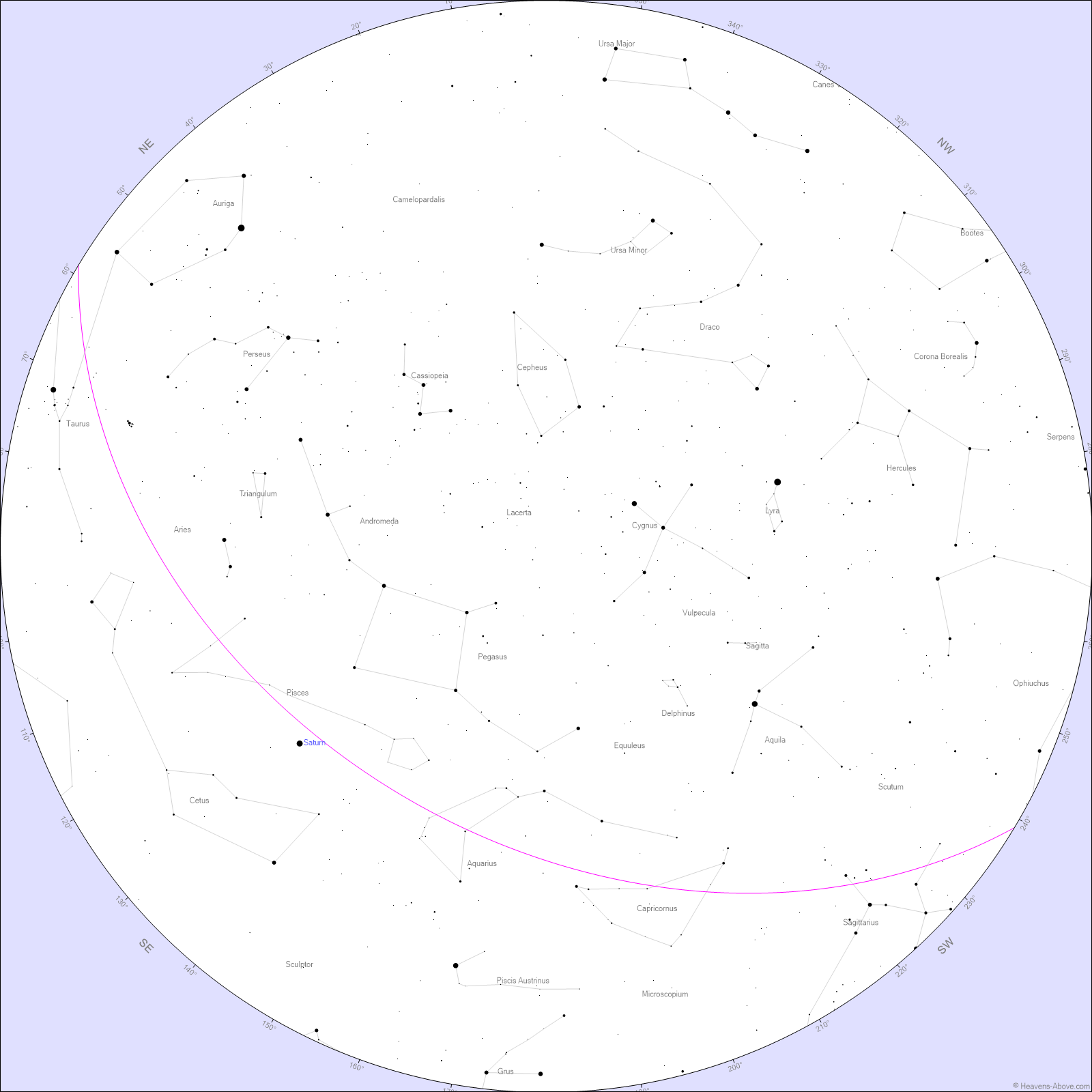
Look in the southeastern sky after dark. It climbs toward the south as the evening progresses, and its steady light makes it stand out among the relatively faint stars around it. Saturn is past opposition but remains well placed for an evening telescope session.
Use a comfortable magnification and give yourself time. A steadier atmosphere often helps more than higher magnification. If the image wobbles, wait for those brief moments when the air settles and the planet sharpens.
With the Moon waning, let’s spend some time among the stars with a pair of binoculars.
Start with the Great Square of Pegasus, prominent in the east and southeast after dark. Its four widely separated corner stars outline a useful landmark. This is a big square, spread across a substantial piece of sky.
From its northeastern corner, the chain of Andromeda leads you toward one of autumn’s great binocular destinations: the Andromeda Galaxy, M31. Look for a soft oval glow, with its central region easiest to see.
Then move northward to the familiar W of Cassiopeia. Between Cassiopeia and Perseus lies the Double Cluster: two neighboring open star clusters that binoculars can show in the same field. Under a dark sky, your eyes alone may pick out a hazy patch there. Binoculars begin to reveal why that patch is special.
A telescope at low power can turn it into two rich gatherings of stars. But resist the urge to zoom straight in. Part of the beauty is seeing both clusters together, with some surrounding darkness to frame them.
Farther east, the Pleiades are climbing into the evening sky. This is another target where binoculars often provide the most satisfying view, keeping the whole cluster together. Compare it with the Double Cluster: different patterns, different concentrations of stars, and plenty to enjoy without chasing anything faint or difficult.
Later in the evening, Taurus rises higher, with bright Aldebaran marking the bull’s eye, and Orion follows into the eastern sky. The winter constellations are returning to the evening shift. You can watch the season change simply by noticing what’s coming up over the trees.
If you only have time for one outing this week, I’d choose the Moon and Mars before dawn on Monday. If you’d rather take your time after dinner, bring binoculars and make a little circuit through Andromeda, the Double Cluster, and the Pleiades.
No spectacular equipment is required. Just a clear patch of sky, a few familiar landmarks, and enough patience to let the view come to you.
That’s going to do it for this week. If tonight’s episode sparked your curiosity, or maybe gave you something new to think about the next time you look up, I’d be honored if you shared Star Trails with someone who might enjoy the journey. You can always find the latest episodes, show notes, and extras at startrails.show.
And if you’d like to help support the show, there’s also a little “buy me a coffee” link on the site. It genuinely helps keep these stories coming.
Be sure to follow Star Trails on Bluesky and YouTube — links are in the show notes. Until we meet again beneath the stars … clear skies everyone!
Support the Show
Connect with us on Bluesky @startrails.bsky.social
If you’re enjoying the show, consider sharing it with a friend! Want to help? Buy us a coffee! Also, check out music made for Star Trails on our Bandcamp page!
Podcasting is better with RSS.com! If you’re planning to start your own podcast, use our RSS.com affiliate link for a discount, and to help support Star Trails.


Leave a Reply