
The Case of the Martian Meteorite – Star Trails: From Backyard Astronomy to Cosmic Wonder
Episode 130
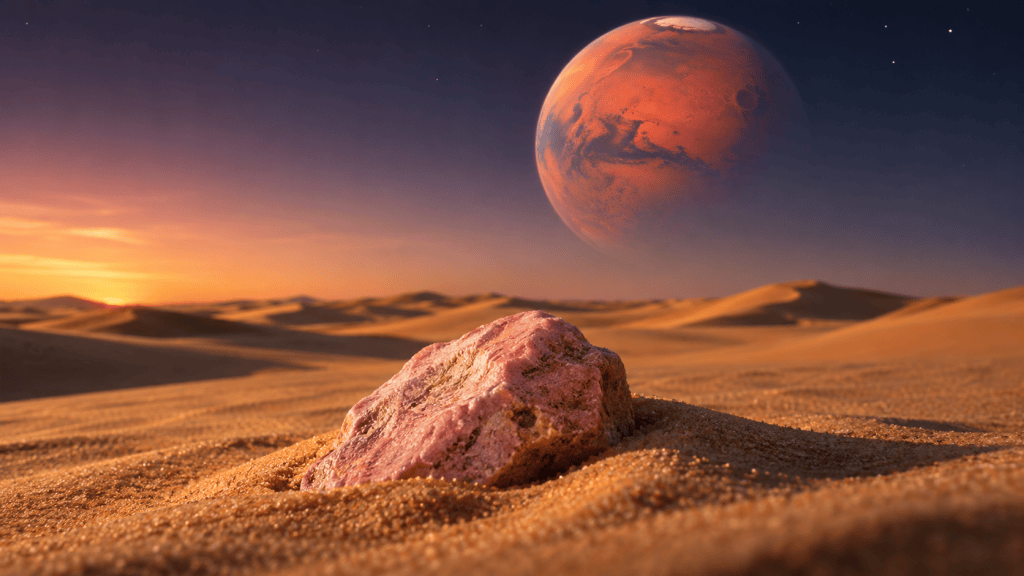
Somewhere in the Sahara Desert, someone picked up an unusual, rose-colored stone. It wasn’t particularly impressive to look at, but scientists would eventually discover that this little rock had traveled across millions of miles of space, survived a violent escape from another planet, and preserved evidence of events more than four billion years old.
It came from Mars.
In this episode, we’re investigating the remarkable science of Martian meteorites. How can researchers identify a rock from another planet with such confidence? What do the Viking landers have to do with meteorites discovered on Earth? And what kind of cosmic catastrophe could send a piece of the Martian crust hurtling across the solar system?
Along the way, we’ll revisit one of the biggest astronomy stories of the 1990s: the sensational announcement that a Martian meteorite might contain evidence of ancient microbial life. We’ll also examine the newly studied Teghaza 001 meteorite, whose minerals preserve clues to the earliest chapters of Martian history, including the role of water on the young Red Planet.
Then, we’ll turn our attention to one of the world’s most famous paintings. New astronomical research suggests that Vincent van Gogh’s The Starry Night may have been inspired by a particular arrangement of the Moon, Venus, and the stars of Taurus in July 1889. Could modern astronomy help solve a 137-year-old artistic mystery?
Finally, in our night sky report for November 8–14, 2026, we’ll explore excellent dark-sky observing conditions around the new Moon, the Northern Taurid meteor shower, Saturn in the evening sky, Jupiter and Mars drawing closer before dawn, and some of autumn’s finest celestial sights, including the Pleiades, Hyades, Andromeda Galaxy, and Orion Nebula.
Links
Transcript
Howdy stargazers and welcome to this episode of Star Trails. My name is Drew and I’ll be your guide to the night sky for the week of November 8, through the 14th.
This week, we’re investigating a mysterious stone discovered in the Sahara Desert. It doesn’t look like much, but scientists say it came from Mars, and that it contains clues to events more than four billion years old. How can researchers identify a rock from another planet, and how did it get here in the first place? It’s a remarkable detective story that takes us from the African desert to the surface of Mars, with a few stops along the way.
Later in the show, we’ll look at some new research that may reveal the actual night sky behind Vincent van Gogh’s famous painting The Starry Night. And we’ll head outdoors for a week of excellent stargazing, with dark, moonless skies, a promising meteor shower, and a beautiful gathering of planets in the early morning hours.
Whether you’re tuning in from the backyard or the balcony, I’m glad you’re here. So grab a comfortable spot under the night sky, and let’s get started!
Somewhere in the Sahara Desert, among the countless stones scattered across that enormous expanse of sand and rock, somebody found something unusual. It wasn’t particularly impressive. A pale, almost rose-colored stone, weighing less than two pounds. You might have walked right past it without a second glance.
But this little rock had a secret.
It had once been part of another planet. It had survived a violent catastrophe, traveled through interplanetary space, and eventually crash-landed here on Earth. And locked inside its minerals was a record of events that took place more than four billion years ago.
The stone was discovered in Mali in 2022, near an ancient salt plain called Teghaza, and scientists named it Teghaza 001. Just last month, researchers published a detailed analysis of this unusual meteorite, announcing that it had formed from material in the crust of Mars at least 4.1 billion years ago. That makes it one of the oldest Martian meteorites ever discovered.
What captured my attention was the simple fact that scientists were confident that this stone had come from Mars. We’re talking about a rock found in the middle of the Sahara Desert. Nobody watched it leave Mars. Nobody tracked its journey across the solar system. We don’t even know exactly when it fell to Earth.
And yet scientists can examine this little stone and tell us, with remarkable confidence, that it came from a planet tens of millions of miles away. How does that work?
Well, today, we’re going to investigate a mystery. We’ll follow a trail of geological clues, examine evidence from ancient planetary catastrophes, and discover how a little piece of Mars ended up in the African desert.
And along the way, we’ll uncover something remarkable about the planet Mars used to be.
Our investigation begins with an important distinction. Not every unusual rock found lying on the ground is a meteorite.
Most rocks on Earth formed right here. Some cooled from molten lava. Others accumulated as sediments, or were transformed by enormous pressure and heat. Every one of them has a geological history.
Meteorites, on the other hand, are extraterrestrial visitors. They’re fragments of other objects in the solar system that have survived the fiery journey through Earth’s atmosphere and reached the ground.
The overwhelming majority come from asteroids. These are remnants of the solar system’s formation, and collisions between them can send fragments wandering into orbits that eventually intersect Earth’s.
Occasionally, though, we find rocks that don’t fit the usual pattern.
Some have mineral compositions suggesting they came from much larger, geologically active worlds. Their crystals formed under conditions that distinguish them from ordinary asteroid debris.
And some of those rocks have a particularly intriguing collection of characteristics.
Their mineral chemistry, their isotopes, and their geological histories all point toward Mars.
Now, an isotope is simply a variation of an element whose atoms have different numbers of neutrons. Oxygen, for example, comes in several varieties. Chemically, they’re all oxygen, but their slightly different masses allow scientists to distinguish between them.
Different planetary bodies developed different proportions of oxygen isotopes during the solar system’s early history.
That means the oxygen in a rock can provide a kind of chemical fingerprint.
When researchers examined Teghaza 001, they discovered that its oxygen isotope ratios matched those found in other Martian meteorites.
It was an important clue. But wait a minute. How did scientists know those *other* meteorites came from Mars? Isn’t that just comparing one mysterious rock with another mysterious rock?
This is where our investigation takes a remarkable turn. Because the evidence that established the Martian origin of these meteorites came from something scientists discovered trapped inside the rocks themselves. Not minerals or fossils, but air.
In 1976, NASA accomplished something extraordinary. The Viking 1 and Viking 2 spacecraft landed successfully on Mars. These were the first American spacecraft to operate successfully on the Martian surface, and they returned an enormous amount of information about our neighboring planet.
Among their scientific instruments were devices that measured the chemical composition of the Martian atmosphere. Mars has a very thin atmosphere, composed mostly of carbon dioxide, with smaller amounts of nitrogen, argon, and other gases. And crucially, the Viking experiments measured the proportions of those gases and their isotopes.
Keep that detail in mind.
A few years later, researchers were studying a meteorite recovered from Antarctica. This particular rock, known as EETA79001, contained pockets of glass formed when parts of the rock had been subjected to an enormous shock. Inside that glass were tiny quantities of trapped gas.
Scientists extracted the gases and analyzed their chemical composition. And what they found was extraordinary.
The gases had the distinctive chemical and isotopic signature of the Martian atmosphere, matching the measurements taken by the Viking landers.
Imagine you’re investigating an unidentified artifact, and you discover that it contains a sealed sample of air from a particular location. You already have measurements of the atmosphere at that location, and the samples match. That’s an awfully compelling piece of evidence.
Some of these meteorites had apparently been carrying tiny samples of Martian air all the way to Earth. The trapped gases, combined with the meteorites’ mineral chemistry and other isotopic evidence, established that these rocks really did come from Mars.
And that discovery gave planetary scientists a reference collection of Martian material.
So when a new meteorite appears, like Teghaza 001, scientists can compare its characteristics with those of rocks whose origins have already been established through multiple lines of evidence.
Not every Martian meteorite contains a sample of trapped atmospheric gas, but they don’t all need to. We now have an expanding collection of geological fingerprints that help distinguish rocks from Mars from those originating elsewhere in the solar system.
And here’s something I find interesting about this whole business.
Those Viking landers weren’t sent to Mars to help identify mysterious rocks on Earth. They were sent to investigate the planet itself. But their measurements of the Martian atmosphere helped solve a completely different mystery, involving meteorites that had been sitting in terrestrial collections.
Now, if you’ve been following astronomy news for a few decades, you might remember that Martian meteorites made enormous headlines back in 1996. I certainly do.
At the time, I was in college, working on my senior practicum. I was interviewing members of the astronomy department about some of the programs being presented at the campus planetarium. And naturally, the conversation turned to a remarkable announcement from NASA.
Scientists had been studying a meteorite recovered from Antarctica in 1984. The rock was called Allan Hills 84001, or ALH84001 for short. It was another fragment of Mars, approximately the size of a potato, weighing a little over four pounds.
What I remember most about that conversation was the astronomers joking about just how small the thing was. Here was a discovery that might change humanity’s understanding of life in the universe, and the evidence was a rock you could practically fit in your hand.
But this wasn’t just any Martian meteorite.
Researchers believed they had found possible evidence of ancient microbial life inside it.
They had identified organic compounds, certain minerals, and tiny structures that appeared to resemble fossilized bacteria.
The announcement was so sensational that President Bill Clinton addressed it publicly from the White House in August 1996. For a brief moment, it seemed possible that humanity had discovered the first evidence of life beyond Earth.
Now, as you probably know, that interpretation didn’t hold up particularly well. Other scientists challenged the findings, demonstrating that the compounds and structures could be produced by nonbiological processes. Today, the prevailing scientific view is that ALH84001 does not provide convincing evidence of ancient Martian life.
But here’s what I find interesting about that entire controversy. The claim about possible fossils was disputed. The claim that the rock came from Mars was not.
By the time of the 1996 announcement, scientists already had strong evidence that meteorites like this one originated on the Red Planet. And ALH84001 itself was astonishing, even without any Martian fossils.
Scientists estimate that it was blasted away from Mars about 16 million years ago, eventually falling onto the Antarctic ice roughly 13,000 years ago. For millions of years, it wandered through space before arriving on Earth.
Which brings us to the next part of our mystery. How in the world does a rock get from Mars to Earth in the first place?
Getting something off the surface of a planet isn’t easy. We know this from launching spacecraft. Rockets need enormous quantities of energy to overcome Earth’s gravity and reach space.
Mars has less gravity than Earth, but it’s still a planet. You can’t simply toss a stone into the air and expect it to drift off into the solar system.
To escape Mars entirely, an object needs to achieve a speed of about five kilometers per second.
That’s more than eleven thousand miles per hour.
So how does an ordinary rock, sitting on the Martian surface, suddenly find itself traveling that fast? The answer is violence.
Imagine Mars billions of years ago, during a period when the inner solar system experienced frequent impacts from asteroids and other debris.
A large asteroid comes hurtling toward the Martian surface at tremendous speed. When it strikes, an enormous amount of energy is released almost instantaneously. Rock is shattered, compressed, heated, and thrown outward.
Some of that material falls back to the surface, creating an enormous blanket of debris around the impact crater.
But under the right circumstances, some fragments can be accelerated to speeds sufficient to escape the planet’s gravity entirely. And interestingly, not every piece of rock gets melted or vaporized.
Shock waves can accelerate fragments while leaving portions of their internal structure intact. That’s important, because it allows these stones to preserve minerals and chemical evidence of their much earlier geological histories.
So a rock that formed billions of years ago might be ejected from Mars by an impact that happened comparatively recently. And once it escapes, something rather interesting happens. The rock doesn’t simply head straight toward Earth. Instead, it enters an orbit around the Sun.
For a while, it may follow a path somewhat similar to that of Mars. But gravitational interactions, particularly with planets, can gradually alter its orbit. Over time, some fragments find themselves on trajectories that cross Earth’s orbit.
And if Earth happens to be in the right place at the right time, the two objects meet. Of course, that meeting is not particularly gentle.
Our wandering Martian rock strikes Earth’s atmosphere at tremendous speed. The air in front of it is compressed and heated, producing the brilliant streak of light we recognize as a meteor. The rock’s exterior becomes intensely hot, and material is stripped away from the surface. But if the fragment is large enough, its interior can survive relatively unscathed.
Eventually, the surviving meteorite slows enough to fall to the ground. And there it may sit for thousands of years, waiting for somebody to notice it. Antarctica and the great deserts of the world are particularly productive places to find meteorites.
In Antarctica, dark rocks stand out against the ice, and the movement of glaciers can concentrate meteorites in particular locations. In deserts, the dry conditions can help preserve meteorites, while the exposed terrain makes unusual stones easier to identify.
And that brings us back to our mysterious rose-colored stone in the Sahara. At some point in its history, Teghaza 001 was violently ejected from Mars. It escaped the planet, entered an orbit around the Sun, and eventually found its way to Earth. We don’t yet know the precise crater it came from, or exactly when it made that journey.
But we know something remarkable about what happened to this rock long before it left Mars.
When scientists began studying Teghaza 001, they realized they had found something unusual even by the standards of Martian meteorites. The rock contained minerals and textures unlike those typically encountered in samples from the Red Planet. Among them were tiny zircon crystals.
Zircon is particularly valuable to geologists because it can incorporate uranium into its crystal structure when it forms. Over immense periods of time, that uranium slowly decays into lead at predictable rates. By measuring the proportions of uranium and lead inside zircon crystals, scientists can estimate when the minerals formed. It’s a kind of geological clock.
And when researchers examined the minerals in Teghaza 001, they obtained an extraordinary result. The rock recorded events that took place around 4.1 billion years ago.
To appreciate that age, remember that the Earth itself formed approximately 4.54 billion years ago. This rock was already part of the Martian crust when our solar system was still relatively young.
And its composition suggested that it came from a region of Mars whose ancient crust had not previously been represented in our meteorite collections. This is particularly valuable because much of the Martian surface is extremely old, but many of the meteorites we’ve recovered formed considerably later in the planet’s history.
So Teghaza 001 offers scientists an unusually direct look into the early development of Mars. But there’s another clue hidden in the rock, and it may be the most interesting of all. Water.
Researchers found evidence that the minerals in Teghaza 001 had interacted with fluids deep within the Martian crust. And the isotopic composition of hydrogen preserved in some of those minerals provides clues about the water that once existed on Mars.
It even offers evidence that Mars was losing hydrogen to space very early in its history, a process connected to the planet’s gradual loss of water.
Now, we already have considerable evidence that ancient Mars was a wetter place than it is today. Our orbiters have photographed dried-up river valleys, ancient lakebeds, and geological formations shaped by flowing water. And our rovers have investigated sedimentary rocks that formed in environments where water once existed.
But Teghaza 001 lets us examine a different part of that history.
Instead of simply looking at photographs of ancient Martian terrain, scientists can study actual minerals that were affected by water more than four billion years ago.
They can measure those minerals in laboratories here on Earth, using instruments far more sophisticated than anything we’ve managed to deliver to another planet.
They can examine the rock grain by grain, atom by atom, searching for evidence of chemical processes that unfolded during the earliest chapters of Martian history.
And this stone contains a record of a world that was very different from the Mars we see today. Not necessarily a world with life. Nothing in Teghaza 001 demonstrates that organisms ever existed there.
But a world with active geological processes, moving fluids, and an evolving relationship between its interior, its crust, its atmosphere, and its water. A world that was still becoming Mars.
There’s something satisfying about this entire story.
For decades, we’ve been sending increasingly sophisticated spacecraft to Mars. We’ve landed robots on its surface, drilled into its rocks, examined its soil, and photographed its landscapes in astonishing detail. We’ve even been collecting and preserving samples that scientists hope might someday be brought back to Earth.
Returning those samples is an enormous engineering challenge. And yet, all this time, Mars has been sending rocks to us.
We can hold a piece of another planet in our hands. A rock that formed before there were animals, plants, or even complex cells on Earth.
That rock witnessed billions of years of Martian history before some enormous collision hurled it into space. It crossed the gulf between two planets and eventually came to rest in the Sahara Desert.
Tonight, we can look at Mars through a telescope and see a tiny reddish disk in the night sky. We can examine spectacular photographs returned by our spacecraft. We can study maps of its enormous volcanoes and ancient river valleys.
But there’s always a certain distance between us and that world. It’s a place most of us will never visit.
And then somebody picks up a stone in the desert.
Scientists take it into a laboratory, examine its minerals, measure its isotopes, and discover that this unassuming little object carries the geological history of Mars inside it.
The distance between two worlds suddenly seems a little smaller.
But the most remarkable discovery is that this rock has been preserving clues to the ancient Martian environment for more than four billion years. A history that predates almost everything familiar about our own world.
And for all those billions of years, the evidence was simply waiting to be found, lying among the stones of the Sahara Desert. Basically hiding right under our feet.
After a quick break we’ll be back with this week’s night sky, and perhaps an origin story for one of the world’s most famous paintings. Stay with us.
Welcome back.
One of the most recognizable paintings in the world is Vincent van Gogh’s *The Starry Night*, with its swirling blue skies, brilliant stars, and glowing crescent Moon overlooking a quiet French village.
But have you ever wondered whether Van Gogh was painting an actual night sky, or simply creating one from his imagination?
Well, a team of researchers in South Korea believes it may have identified the precise arrangement of stars and planets that inspired the famous painting.
And they think it appeared in the sky just before dawn on July 22, 1889.
The researchers used astronomical simulations to reconstruct the sky above Saint-Rémy-de-Provence, France, where Van Gogh was living at the time.
They discovered that on that particular July morning, a waning crescent Moon, the brilliant planet Venus, and the Hyades star cluster in the constellation Taurus would have appeared in an arrangement remarkably similar to the one depicted in the painting.
The team also examined historical weather records and Van Gogh’s correspondence to see whether the proposed date made sense.
Traditionally, art historians have dated *The Starry Night* to June 1889. But researchers say the Moon’s appearance during that period doesn’t correspond particularly well with the thin crescent in the painting.
Now, this isn’t a closed case. The Van Gogh Museum maintains that the painting was completed in June, based on historical documents, and other scholars have questioned whether the positions of the stars really match. Van Gogh may also have combined observations from several different nights into a single composition.
But I love the idea that modern astronomy might help us investigate the inspiration behind a 137-year-old masterpiece.
And there’s a nice connection to our own backyard observing. The Hyades star cluster, which features prominently in this new research, is one of the great sights of the autumn and winter sky. You can find it forming the distinctive V-shaped face of Taurus the Bull, near the brilliant orange star Aldebaran.
Go out and look at the Hyades tonight, and you might be looking at some of the same stars that inspired one of the most famous paintings in history.
Now, let’s turn our attention to the night sky for the week of November 8th through the 14th, 2026.
And if you’ve been waiting for an opportunity to get away from the city lights and enjoy some dark skies, this could be your week.
The Moon reaches its new phase on Monday morning, November 9th. That means it will be essentially absent from the nighttime sky at the beginning of the week, giving us excellent conditions for viewing faint stars, galaxies, and other deep-sky objects.
By Tuesday and Wednesday evenings, watch for a delicate waxing crescent Moon returning to the southwestern sky shortly after sunset. On Tuesday evening, November 10th, the young Moon will appear near Antares, the reddish heart of Scorpius the Scorpion.
This will be a challenging observation from much of the United States, since both objects will be very low in the southwestern twilight. You’ll need a clear horizon and a little luck. But if you manage to catch the pairing, it should be lovely.
As the week continues, the growing crescent Moon will become easier to spot each evening, offering increasingly attractive views of its craters and mountains through binoculars or a small telescope.
Turning to the planets, Saturn remains our best evening target.
You’ll find the ringed planet shining with a steady, yellowish light in the southeastern sky after sunset, climbing high into the southern sky as the evening progresses.
And if you have a good telescope and a detailed star chart, Neptune is lurking in the same general region of the sky, about seven degrees from Saturn. It’s a much more difficult target, appearing as a faint, bluish point of light.
Meanwhile, the early morning sky is becoming quite a planetary showcase.
Jupiter and Mars are drawing closer together in the constellation Leo, and by the end of our reporting period, they’re separated by only a few degrees.
Look toward the east in the hours after midnight, or better yet, before sunrise. Jupiter will be the brilliant white object, with noticeably fainter, reddish Mars nearby.
The two planets are approaching an especially close encounter on November 15th and 16th, when they’ll appear just more than one degree apart. We’ll have more about that pairing next week, but it’s already worth watching them move closer together from one morning to the next.
And while you’re up before dawn, look farther down toward the eastern horizon for brilliant Venus.
On Tuesday morning, November 10th, Venus appears near Spica, the brightest star in Virgo. Venus will be dramatically brighter than the star, and the pair should make a fine sight for anyone with an unobstructed eastern horizon.
Mercury is also beginning to emerge into the morning sky, although it remains a difficult target this week. Its visibility will improve later in November.
Now, this is also an excellent week to watch for meteors.
The Northern Taurid meteor shower reaches its peak around November 11th and 12th, and this year’s observing conditions are particularly favorable thanks to the young Moon.
The Taurids aren’t especially prolific. Under ideal conditions, you might see about five meteors per hour from the Northern branch of the shower.
But what the Taurids lack in numbers, they sometimes make up for in spectacle.
This shower is famous for producing unusually bright meteors, including occasional fireballs that can streak across a large portion of the sky.
Find a dark location, dress warmly, settle into a comfortable chair, and give your eyes about half an hour to adjust to the darkness. The meteors can appear almost anywhere in the sky, although their paths will seem to trace backward toward the constellation Taurus.
And speaking of Taurus, this is a wonderful time to revisit the stars we mentioned in our story about Vincent van Gogh.
The Hyades star cluster, which forms the V-shaped face of Taurus the Bull, is becoming increasingly prominent during the evening hours.
Nearby you’ll find the beautiful Pleiades, also known as the Seven Sisters. This compact collection of blue-white stars is one of the finest binocular targets in the entire sky.
And because the Moon is out of the way for much of this week, take advantage of the darkness to seek out the Andromeda Galaxy.
Look high overhead during the early evening, in the direction of the constellation Andromeda. Under sufficiently dark conditions, the galaxy is visible to the unaided eye as a faint, elongated smudge. Through binoculars, it becomes a softly glowing oval of light.
And if you’re willing to stay outside a little later, Orion is returning to the evening sky, rising in the east. By late evening, his familiar three-star belt is becoming easier to spot, and beneath it lies one of the most spectacular stellar nurseries visible from Earth: the Orion Nebula.
That’s going to do it for this week. If tonight’s episode sparked your curiosity, or maybe gave you something new to think about the next time you look up, I’d be honored if you shared Star Trails with someone who might enjoy the journey. You can always find the latest episodes, show notes, and extras at startrails.show.
And if you’d like to help support the show, there’s also a little “buy me a coffee” link on the site. It genuinely helps keep these stories coming.
Be sure to follow Star Trails on Bluesky and YouTube — links are in the show notes. Until we meet again beneath the stars … clear skies everyone!
Support the Show
Connect with us on Bluesky @startrails.bsky.social
If you’re enjoying the show, consider sharing it with a friend! Want to help? Buy us a coffee! Also, check out music made for Star Trails on our Bandcamp page!
Podcasting is better with RSS.com! If you’re planning to start your own podcast, use our RSS.com affiliate link for a discount, and to help support Star Trails.


Leave a Reply