The Telescope is Full of Water! – Star Trails: From Backyard Astronomy to Cosmic Wonder
Episode 128
What began as an innocent evening of stargazing quickly descended into a strange expedition through the peculiar subcultures of amateur astronomy. Armed with little more than an inexpensive pair of binoculars, I ventured into the darkness among veteran telescope operators, technological evangelists, observatory aristocrats, and one particularly determined defender of old-school astronomy.
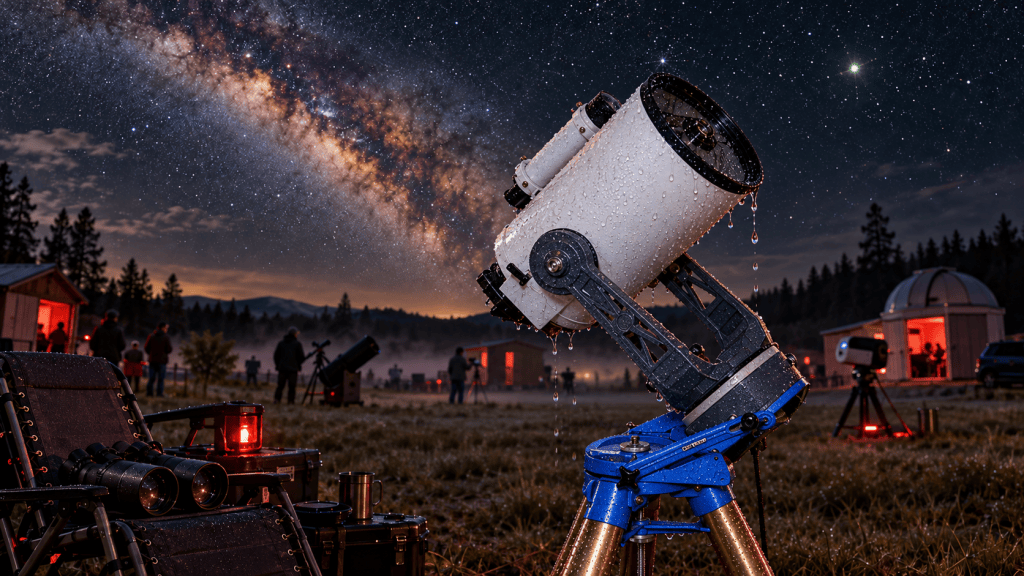
There were passionate disagreements about computerized telescopes, unexpected debates over lawn furniture, and an aging Schmidt-Cassegrain telescope slowly transforming itself into a rainwater collection system. Somewhere along the way, a humble pineapple cake achieved legendary status, and the Andromeda Galaxy proved considerably easier to find with binoculars than with a telescope.
But beneath the absurdity lies something worth remembering. Whether we’re navigating by printed star charts, collecting photons with sophisticated digital instruments, or simply wandering the Milky Way with a pair of binoculars, we’re all looking for the same thing: a little wonder beneath the stars. There’s no single correct way to enjoy the universe, and sometimes the best observing equipment is whatever makes you happiest.
Also in this episode: Remember when we said there were no green stars? Well, astronomers have discovered a remarkable white dwarf that may force us to qualify that statement. Drew revisits the science of stellar colors and explains how a dead star contaminated by the remains of its planetary system can appear ghostly green.
Links
Transcript
Howdy stargazers and welcome to this episode of Star Trails. My name is Drew and I’ll be your guide to the night sky for the week of October 25th to the 31st.
Last week, I ventured into the darkness with a pair of binoculars and found myself among a peculiar tribe of amateur astronomers, armed with expensive telescopes, elaborate electronics, and some very strong opinions about how one ought to observe the universe. There were ideological disputes, mechanical failures, questionable astronomical practices, and an unexpected revelation involving lawn furniture. Somewhere in the middle of all this madness, I actually managed to look at a few stars. Tonight, we’re taking a slightly different journey into the strange and wonderful world of star parties.
Later in the show, we’ll revisiting a subject I thought we’d settled more than 60 episodes ago: Why aren’t there any green stars? Well, astronomers may have found an exception, and I have some explaining to do. Plus, with Halloween approaching, our Night Sky Report features a Demon Star, ghostly sisters, and a few potential fireballs to light up the autumn sky.
Whether you’re tuning in from the backyard or the balcony, I’m glad you’re here. So grab a comfortable spot under the night sky, and let’s get started!
There was trouble at my astronomy club’s dark site.
Not the sort of trouble that comes from a supernova, a rogue asteroid, or an unexpected burst of gamma radiation. No, this was a distinctly terrestrial variety of madness involving a forty-five-year-old telescope, a small computerized box, and several grown men who had apparently confused their choice of optical equipment with a deeply held religious conviction.
I had come to my local club’s fall star party to see the universe. But I was beginning to suspect that the universe had other plans.
Driving to the remote site, the clouds lumbered overhead like the underside of a hurricane. Dark, circular and rotating. But as twilight fell, the clouds parted to reveal clear skies from horizon to horizon. Apparently, the weatherman got it right this time.
A band of amateur astronomers had gathered at the dark-sky observing site, a patch of rural real estate where we periodically assemble to conduct experiments in sleep deprivation, equipment management, and interpersonal relations.
The site isn’t quite as dark as it once was. The creeping glow of civilization has been slowly advancing across the horizon, threatening to turn another perfectly good astronomical refuge into something resembling a suburban parking lot.
But the Milky Way is still visible. The stars still come out. And on a good night, there’s enough darkness to remind you that the universe is a considerably larger place than the one we occupy during daylight hours.
I’d arrived with a pair of inexpensive 11-by-70 binoculars. No computer. No tracking mount. No elaborate power distribution system. Just two large lenses, two eyepieces, and the increasingly questionable strength of my upper arms.
This would prove to be an important distinction.
Because as I surveyed the observing field, it became apparent that I’d wandered into a strange and highly specialized society. And its inhabitants were preparing for another night of astronomical excess.
After years of occasional visits to star parties, I’ve come to recognize several distinct species of amateur astronomer.
Like the animals of the savanna, they occupy different ecological niches, display elaborate territorial behaviors, and occasionally engage in aggressive vocalizations when their preferred methods of survival are challenged.
First, there’s the Dobsonian guy. Every club has one.
He arrives with what we call a “light bucket.” In this case, an enormous, battered telescope that appears to have been constructed from plywood, plumbing supplies, and something scavenged from a construction job site. The instrument has seen better days. The paint is chipped. The hardware is worn. There may be structural components whose original purpose is no longer readily apparent.
But its owner is absolutely delighted. Ask him what he’s observing and he’ll tell you, with the enthusiasm of someone seeing the universe for the first time, that he’s looking at Saturn. Again.
He’s looked at Saturn a thousand times. He knows precisely what Saturn looks like. He’s probably shown Saturn to half the population of the surrounding counties. And yet there he is, grinning like a kid on Christmas morning.
And I deeply admire this fellow. He’s not trying to produce a magazine cover shot or demonstrate the superiority of his equipment. He’s happy to be there, looking at his old friends in the cosmos.
I suspect he’s achieved a level of astronomical enlightenment that the rest of us are still struggling to comprehend.
Then there are the techno-geeks. These people arrive with enough electronic gear to establish an independent communications network. There are laptops, tablets, computerized mounts, video cameras, battery packs, cables, drones, and assorted mysterious gadgets whose functions are not immediately apparent.
I’m not sure, but someone may have been wearing video goggles. Somebody else was flying something. There’s a good chance several pieces of equipment are communicating wirelessly with one another.
These are the people for whom amateur astronomy has become a branch of systems engineering.
And I say that with considerable affection. I’m a computer enthusiast myself. I understand the appeal of making complicated machines do extraordinary things. But there are moments when I look around the field and wonder whether we’re studying the universe or preparing to invade it.
Then there are the permanent residents: The observatory owners.
These are the aristocracy of the astronomy club. They have buildings. With roofs that open. There’s no crappy Jason refractor mounted in there. These are scopes capable of astronomy rivaling that of, and perhaps exceeding what the pros are doing.
I’ve occasionally wondered whether these structures are observatories in the traditional scientific sense or simply exceptionally sophisticated man caves. The distinction is largely meaningless. Either way, I want one.
After all, if you can construct a private building in the countryside where you can escape ordinary responsibilities, surround yourself with toys, and occasionally look at Jupiter, you’ve probably discovered something important about the human condition.
And finally, there are the novices. The innocents. The people who have wandered into this strange society hoping to learn something about the night sky.
They move from telescope to telescope, listening politely as one person explains right ascension and declination, another describes sensor architecture, and a third delivers a passionate lecture about the superiority of some discontinued piece of optical equipment. To be honest, I’m in this camp.
At the end of the day, we all want the same thing. We want to look up and see something amazing.
My travel companion for the evening was a longtime amateur astronomer who brought along a vintage Criterion Dynamax Schmidt-Cassegrain telescope. This was a substantial instrument, manufactured during an earlier age of amateur astronomy, when computerized telescope mounts were still the stuff of science fiction.
He’d been using this telescope, or at least living with its peculiarities, for decades. And he’s a man of strong convictions.
He knows the sky. He knows celestial coordinates. He knows how to use printed star charts. He learned astronomy in the traditional fashion, back when finding an object required knowledge, patience, and occasionally a willingness to spend twenty minutes staring into the wrong part of the heavens.
And he regards computerized telescopes with suspicion. This became apparent when another observer approached and asked him a perfectly reasonable question.
“Does that telescope have GoTo?”
GoTo, for the uninitiated, is a computerized system that automatically points a telescope toward a selected celestial object. You tell the telescope you want to see the Andromeda Galaxy, and the motors do the rest.
It’s a useful invention, particularly for those of us who would rather spend the evening looking at galaxies than hunting for them.
But my companion reacted to this innocent question as though someone had suggested replacing the United States Constitution with an iPad. What followed was a vigorous defense of traditional astronomy.
Real visual astronomers, he explained, know how to navigate the sky. They understand celestial coordinates. They didn’t need computers to tell them where the stars are.
There was something admirable about the conviction. But there was also something unfortunate about the timing. Because not long afterward, he and I were having considerable difficulty locating the Andromeda Galaxy.
You know, M31. The great spiral galaxy in our cosmic neighborhood. An object that I’d already located with my binoculars. And as the night grew darker, it was right on the edge of naked eye visibility.
Now, in fairness, even experienced observers can have trouble finding things. Equipment alignment, awkward viewing angles, and simple frustration can turn an easy target into an unexpectedly difficult exercise.
But after an impassioned lecture about the virtues of doing astronomy the hard way, the situation acquired a certain theatrical quality, thanks to atmospheric physics.
You see, the Dynamax has a recurring problem. One that had manifested itself on previous observing nights and was now preparing to make another appearance.
Schmidt-Cassegrain telescopes have a large corrector plate at the front of the optical tube. On humid nights, that glass can radiate heat toward the cold sky, fall below the dew point, and begin collecting moisture.
This is a well-understood phenomenon with well-understood solutions. Dew shields. Heater strips. Temperature controllers and so on. Unfortunately, none of these solutions accompanied us to the observing field.
And so the condensation began. Slowly at first — we could wipe it off and keep viewing — then with increasing determination, moisture accumulated on AND inside the telescope.
Eventually, there was enough water around the instrument that it seemed less like an optical device and more like an experimental rainwater collection system.
The discussion turned toward the humidity, the iffy seeing, and the disappointing condition of the sky.
Now, humidity can certainly affect transparency. Moisture and haze can scatter artificial light, brightening the background sky. Atmospheric turbulence can blur fine details. And dew can render a perfectly good telescope almost useless.
For all I know, others were having the same problem, yet, I was having a wonderful time using binoculars.
The Double Cluster in Perseus was beautiful. The Pleiades were magnificent. Andromeda was where it always is.
I managed to locate the Hercules Globular Cluster, M13, a tiny diffuse patch that looked almost like a bright star that had somehow lost its ability to come into focus. I thought I might have caught a glimpse of the Triangulum Galaxy, too, although I couldn’t reliably find it again.
Astronomy requires a certain amount of intellectual honesty. Sometimes you see a galaxy. Sometimes you see something that might be a galaxy. And sometimes you spend five minutes staring at a patch of sky because you desperately want it to contain a galaxy.
The distinction matters.
Then a meteor blasted through the night sky like a bottle rocket fired over the dark site. We ALL saw that, and the appropriate oohs and ahhs followed.
Meanwhile, my companion’s telescope continued to accumulate water.
A very different scenario was playing out about a dozen feet away from us. The owner of a smart scope was doing the sort of stargazing I eventually plan to try.
This new generation of compact smart telescopes combine optics, digital cameras, automated pointing, and image processing into a device small enough to carry around without consulting an orthopedic surgeon.
He was enthusiastic, rattling off telescope makes and models that, sadly, I have never heard of. Add to that manufacturers, sensor specifications, software algorithms and optical configurations.
At one point, he explained that the little telescope could produce images approaching 4K resolution through a process called drizzle integration, made possible by dithering the individual exposures.
Now, I work with digital imaging daily, so this interested me. And the images he showed me were impressive.
In fact, while my companion was wrestling with the Dynamax, this fellow was happily bouncing around the heavens.
The Hercules Cluster. The Pac-Man Nebula. The Moon. One object after another.
He’d collect a couple of minutes of exposure time, let the software stack and process the images, and show us what he’d captured on his tablet.
And like the Dobsonian evangelist, this guy was having the time of his life. He was enjoying astronomy — which, of course, is the entire point.
Somewhere amid the technological disagreements, another controversy emerged.
This time the subject was lawn furniture. Specifically, which type of reclining outdoor chair offered the best experience for binocular astronomy.
This was not an entirely frivolous question. Looking upward through heavy binoculars can become uncomfortable surprisingly quickly. Your neck complains. Your arms begin to tremble. The stars dance around the field of view.
A comfortable reclining chair can make a tremendous difference. And naturally, there were opinions. There are always opinions.
Different designs were considered. Different reclining positions were discussed. But eventually something extraordinary happened.
A consensus emerged: The zero-gravity chair.
Here, beneath a universe governed by the fundamental forces of nature, a gathering of amateur astronomers had finally found common ground on the subject of gravity.
Or rather, furniture that purported to eliminate it.
The chair doesn’t actually remove gravity, of course. It simply distributes your weight more comfortably. But I appreciate the marketing.
We’re so devoted to space that even our lawn furniture has to pretend it’s in orbit. For a brief moment, peace prevailed across the observing field.
Expeditions like this can’t survive on photons alone. Fortunately, the astronomy club president had assumed responsibility for feeding the assembled population.
He was working the grill, preparing a perfectly respectable meal for a group of people spending much of the evening discussing optical instruments and arguing about the proper way to use them.
He also happens to be an incredible supporter of the show, and I appreciate that enormously. Every serious astronomical podcast producer requires at least one devoted supporter, preferably one with access to grilled meat.
And the food was good. Sometimes I think that’s why we all really come out.
No one questioned the alignment of the hamburgers. No one suggested stacking sixteen exposures of a hot dog would improve its signal-to-noise ratio. But this peace was temporary.
Somewhere near the food table, a box of individually packaged miniature pineapple cakes had attracted attention. My travelling companion was raving about them, so I walked across the field to the food table and acquired one.
Before I could try it, he gave me further confirmation of the cake’s excellence by shouting across the field: “IT’S LIKE A FIG NEWTON ON STEROIDS!”
The declaration, fueled by the delight inherent to processed carbohydrates and pineapple filling, reverberated between the observatories.
I began laughing. Uncontrollably.
There was something about the sheer intensity of the announcement, delivered into the darkness among thousands of dollars’ worth of astronomical equipment, that overwhelmed my remaining capacity for composure.
I ate one of the cakes. The texture was extraordinary: Dry as the lunar regolith on the outside, with a punch of pineapple filling inside.
But the flavor was surprisingly good, so I ate another, trying to mitigate the dessicated texture with a can of Coke Zero. Now, fully engorged with sustanance, I returned to my binoculars.
Meanwhile, the vintage telescope contained more moisture than all the pineapple cake filling on the property combined.
The Moon was approaching first quarter, bright enough to wash out some of the fainter objects, but still offering a beautiful view.
Along the darker portion of the lunar disk, I could make out earthshine.
Sunlight had traveled to Earth, reflected from our planet toward the Moon, and then bounced back again toward my eyes. There was something wonderful about that. The Earth itself was illuminating another world.
I returned to the Double Cluster in Perseus, two lovely gatherings of stars sharing the same broad field of view.
And I checked in with Andromeda again.
That faint, elongated patch of light represented an entire galaxy, containing hundreds of billions of stars, some two and a half million light-years away.
The photons entering my binoculars had begun their journey before the dawn of modern man. They crossed the enormous emptiness between galaxies, traveled through Earth’s atmosphere, passed through two objective lenses, and finally arrived at my retinas.
No stacking. No drizzle. No firmware updates. Just light.
Of course, there’s nothing inherently superior about this method.
The gentleman with the smart telescope was collecting photons from the same universe. His camera was recording light that my eyes could never accumulate in the same way. His computer could reveal faint structures that would remain invisible to me.
And traditional observers with telescopes were practicing a skill that generations of astronomers had spent lifetimes developing.
Each approach offered something different. A smart telescope could show me the delicate structure of a nebula. A large Dobsonian could reveal details that my binoculars could never resolve.
Yet my binoculars gave me the freedom to wander.
To move from the Moon to Andromeda, from the Pleiades to Perseus, without waiting for motors or consulting an alignment routine. I could even follow satellites moving silently across the sky, objects too faint to see with the unaided eye.
For me, on that particular evening, it was more than enough.
Eventually, the observing session came to an end.
The equipment was packed away. The computers were shut down. The great astronomical civilization that had briefly occupied the field began to disperse.
On the drive home, I found myself thinking about the evening’s disagreements.
My companion had spent decades learning astronomy the traditional way.
He knew the constellations. He had learned to navigate the sky using printed charts, patience, and experience.
Those are valuable skills. But I wondered whether his attachment to the old methods had begun to interfere with his enjoyment of the hobby.
So I made a suggestion.
“You know, you might actually enjoy one of those smart telescopes.”
I expected resistance, after all, only a few hours earlier, computerized telescope mounts had been treated as something approaching an existential threat to amateur astronomy.
But I explained my thinking. He’d already done the hard work. He’d learned the sky. He’d mastered the traditional techniques. He had nothing left to prove.
Why not embrace new technology? Why not leave the heavy old telescope at home, spare his knees, and let a small computerized instrument do some of the work?
Why not spend more time enjoying the objects themselves?
And to my surprise, he seemed receptive.
Later, I began thinking about the people I’d encountered. The happy Dobsonian owner, returning to familiar celestial objects with the enthusiasm of a child.
The technology enthusiasts, surrounded by computers, cameras, drones, and enough electronics to make a NASA engineer feel at home.
The observatory owners, comfortably established in their castles. The smart-telescope enthusiast, collecting galaxies as quickly as possible.
The traditionalist, defending the old ways while his telescope slowly surrendered to the dew point. The newcomers, wandering among the competing factions, hoping to see something wonderful.
And me.
Standing in a field with a pair of oversized binoculars, privately judging everyone else’s astronomical habits while occasionally convincing myself that I’d spotted a galaxy I couldn’t reliably find a second time.
We’re a peculiar collection of people. We voluntarily drive into the countryside after dark. We haul expensive, fragile, and occasionally malfunctioning equipment into empty fields.
We stand around in the cold, staring at faint patches of light that most of humanity wouldn’t notice. We argue about apertures, focal ratios, image sensors, telescope mounts, optical coatings, and the proper way to sit in a lawn chair.
We complain about the weather. We complain about the Moon, light pollution and we occasionally complain about one another.
And yet, somehow, we keep coming back.
Because beneath all the arguments, the equipment, and the eccentric behavior, there’s something that connects us: Wonder.
The simple, extraordinary pleasure of looking up and discovering that the universe is far larger, stranger, and more beautiful than anything we encounter in our ordinary lives.
There’s no single correct way to experience that.
You can use a telescope built half a century ago. You can use a computerized instrument that finds galaxies at the touch of a button.
You can build an observatory, spend thousands of dollars on cameras, or simply lie back in a lawn chair with a pair of binoculars.
The universe doesn’t care. Its light arrives just the same.
And perhaps that’s the lesson I took away from this expedition. We spend so much time arguing about how we observe the universe that we occasionally forget why we started observing it in the first place.
Not to prove that our equipment is better. Not to demonstrate that our methods are more authentic. And certainly not to win some imaginary contest over who qualifies as a real astronomer.
But because there’s something out there worth seeing.
Something that makes us feel, for a moment, connected to a universe unimaginably larger than ourselves.
And if we’re being fair, there’s something undeniably ridiculous about the whole enterprise.
Most people are perfectly content to spend their evenings indoors, watching television, enjoying a meal, or getting a decent night’s sleep.
We drive into dark fields and stare at fuzzy patches of light. We get excited about photons.
And sometimes, if the humidity is sufficiently determined, we bring home a telescope full of water.
Maybe we’re all a little crazy.
But on a clear night, with the Milky Way stretching overhead and a universe full of wonders waiting to be discovered, I can’t think of a much better kind of crazy.
After a quick break we’ll be back with an update on green stars, and this week’s night sky report. Stay with us.
Welcome back.
Speaking of things that came up at the star party, at one point somebody challenged me about green stars. Apparently, the universe has decided to start fact-checking my podcast, because wouldn’t you know, a green star has been discovered.
Now, longtime listeners may remember that more than 60 episodes ago, we discussed why there are no green stars in the universe. And that’s a statement I made with considerable confidence, because the physics was pretty well established. But it turns out, we’ve been wrong, sort of.
First, a refresher. Stars come in a variety of colors, from the reddish glow of relatively cool stars to the brilliant blue-white of the hottest ones. Our Sun, despite its frequent depiction as a big yellow ball, is actually white. A star’s color is largely determined by its surface temperature, and stars emit light across a broad spectrum of wavelengths. Even a star whose spectrum peaks in the green portion of visible light also emits plenty of red and blue. Our eyes combine those wavelengths into something that looks white. That’s why we don’t ordinarily see green stars. And that explanation, I should point out, is still perfectly valid.
But now researchers at the University of Warwick have identified a rather extraordinary exception. Its romantic name is WD J1330+6435, and it’s a white dwarf approximately 280 light-years away in the constellation Draco. A white dwarf is the dense, leftover core of a star that has exhausted its nuclear fuel. In this case, the star has accumulated rocky debris from its former planetary system, contaminating its atmosphere with elements including calcium, lithium, and sodium. And it’s that sodium that’s responsible for the unusual color.
Under the crushing density of the white dwarf’s atmosphere, sodium absorbs a remarkably broad swath of light in the yellow, orange, and red portions of the spectrum. That changes the balance of colors escaping from the star. According to the researchers’ calculations, if we could get close enough to see its color properly, this particular white dwarf would appear chartreuse green. Not a brilliant emerald or the green of a traffic light, but a strange, ghostly yellowish-green. Nobody has actually looked through a telescope and seen a green star with their own eyes. Its color was reconstructed from measurements of its light and models of human vision.
And here’s where the discovery gets even more interesting. The researchers found that white dwarfs can exhibit an assortment of unexpected colors, including pink, purple, and cyan, depending on the chemistry of their atmospheres. It turns out that the dead remnants of stars can display colors their living counterparts generally cannot.
So, do green stars exist? Apparently, yes — at least one does, according to the best measurements we have. Does this mean everything we said about stellar colors 60-something episodes ago was wrong? Not at all. Ordinary stars still obey the same rules. We’ve simply discovered that the universe has a few tricks up its sleeve, particularly when it comes to dead stars wearing the remains of their planetary systems.
And to the gentleman at the star party who brought this up: fair play, sir. You have successfully forced me to issue a clarification. That’s science. Just when you think you’ve explained something, the universe comes along and says, “Well, actually…”
And with that settled, let’s turn our attention to the stars we can actually see from our own backyards in this week’s Night Sky Report.
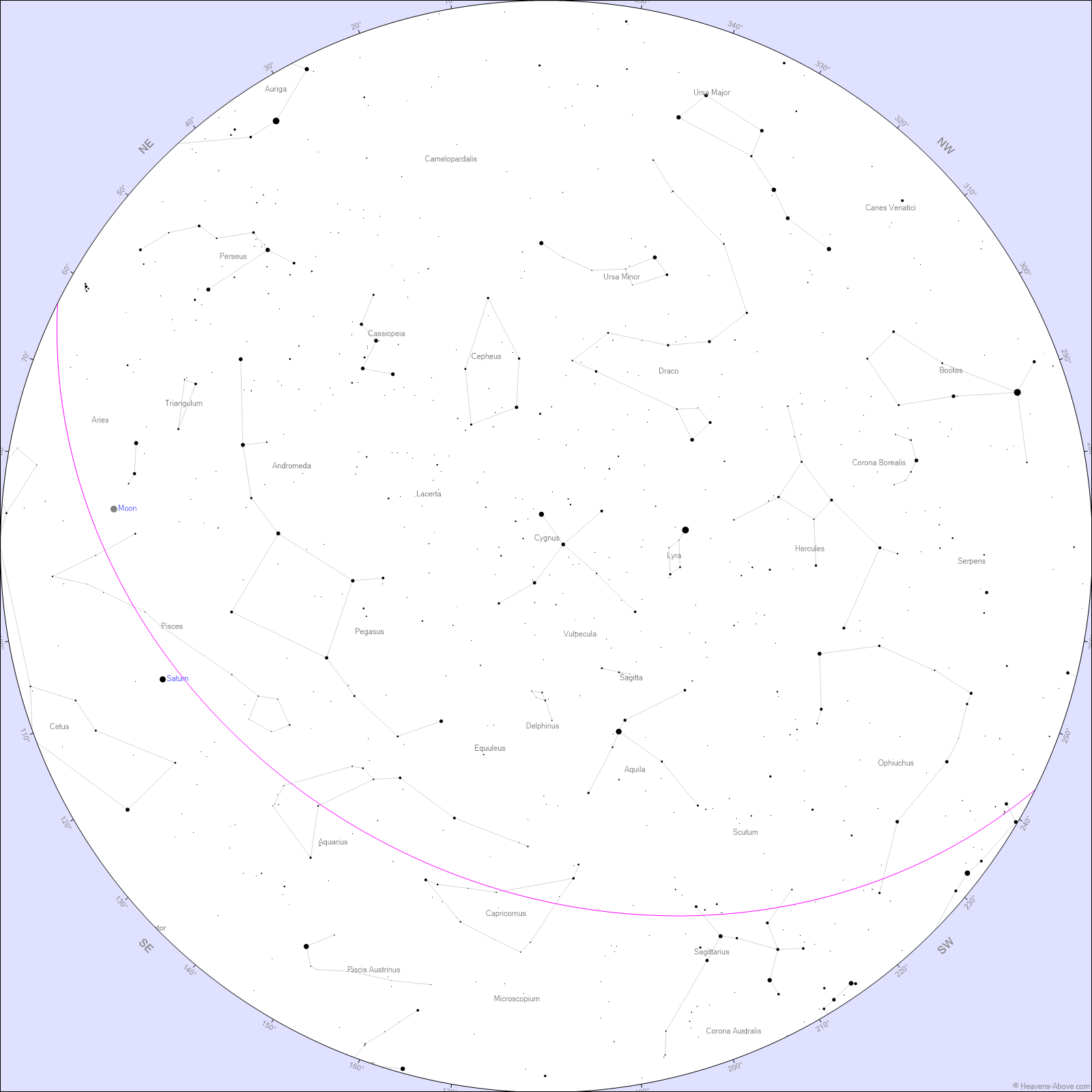
With Halloween approaching, we’ve got a few appropriately spooky sights in the heavens this week, including the Demon Star, some ghostly sisters, and a nearly full Moon to illuminate the early week.
Let’s begin with that Moon. October’s full Moon arrives very early Monday morning on the 26th, just after midnight Eastern Time. This is the Hunter’s Moon, traditionally associated with the autumn hunting season and preparations for winter. The Moon will gradually wane throughout the week, but it’ll still be more than half illuminated on Halloween night. So while we won’t have a full Moon for the trick-or-treaters, we’ll have a rather impressive waning gibbous Moon rising later in the evening.
On the 27th and 28th, that Moon pays a visit to the Pleiades, the famous Seven Sisters star cluster in Taurus. Look toward the east during the evening hours to spot the pairing. The Pleiades have an interesting connection to Halloween, having long been associated with the changing seasons and ancient autumn festivals, including Samhain. Under dark skies, the cluster resembles a tiny dipper made of blue-white stars, and binoculars reveal dozens more. Unfortunately, the bright Moon may wash out some of the fainter stars this week.
As for the planets, Saturn continues to dominate the evening sky after reaching opposition earlier this month. It’s an excellent telescope target, with its famous rings and several moons visible through modest backyard instruments. Jupiter and Mars are holding court in the predawn sky, with brilliant Jupiter shining below the more subdued, reddish Mars. Venus and Mercury, meanwhile, are lost in the Sun’s glare for most northern observers this week, so don’t expect much from either of them.
Now, for our Halloween attractions. Look toward the northeast on these autumn evenings for the constellation Perseus, home to Algol, sometimes called the Demon Star. Its name comes from an Arabic expression associated with the head of a ghoul, and in Greek mythology it represents the severed head of Medusa. But Algol has a genuinely strange property: it blinks! It’s an eclipsing star system, with two stars passing in front of one another every 2.87 days, causing the system’s brightness to noticeably diminish for several hours. With a little patience, you can observe this eerie behavior yourself, without a telescope.
And if you’re lucky, you might catch a Halloween fireball. The Taurid meteor showers are active during this period, producing relatively few meteors but occasionally delivering spectacularly bright fireballs. These slow-moving meteors come from debris associated with Comet Encke. The Moon will interfere with fainter meteors, but a particularly bright Taurid could still make an appearance.
Finally, as we approach Halloween, take a moment to enjoy the brilliant stars of the autumn sky. Cassiopeia is high in the northeast, Andromeda is well placed for evening observation, and Orion is beginning to make his return in the late evening. Winter’s familiar constellations aren’t far behind.
Whether you’re hunting ghosts, galaxies, or a few pieces of ancient comet dust, I hope you’ll find something wonderful overhead.
That’s going to do it for this week. If tonight’s episode sparked your curiosity, or maybe gave you something new to think about the next time you look up, I’d be honored if you shared Star Trails with someone who might enjoy the journey. You can always find the latest episodes, show notes, and extras at startrails.show.
And if you’d like to help support the show, there’s also a little “buy me a coffee” link on the site. It genuinely helps keep these stories coming.
Be sure to follow Star Trails on Bluesky and YouTube — links are in the show notes. Until we meet again beneath the stars … clear skies everyone!
Support the Show
Connect with us on Bluesky @startrails.bsky.social
If you’re enjoying the show, consider sharing it with a friend! Want to help? Buy us a coffee! Also, check out music made for Star Trails on our Bandcamp page!
Podcasting is better with RSS.com! If you’re planning to start your own podcast, use our RSS.com affiliate link for a discount, and to help support Star Trails.


Leave a Reply