One Light-Day From Home – Star Trails: From Backyard Astronomy to Cosmic Wonder
Episode 131
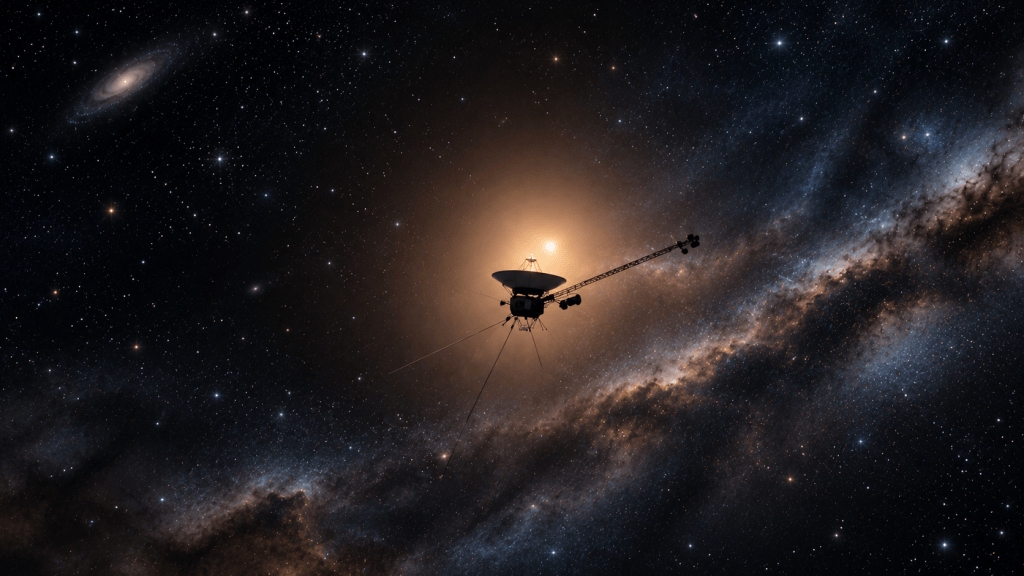
After nearly 50 years in space, Voyager 1 is about to cross a remarkable milestone. On November 18, humanity’s most distant spacecraft will reach a distance of one light-day from Earth — more than 16 billion miles away, so distant that even a radio signal traveling at the speed of light needs a full day to reach it.
In this episode, we celebrate the astonishing longevity of Voyager 1, including the recent engineering efforts to squeeze a few more precious watts from its fading power supply. Then we use Voyager’s journey to confront one of astronomy’s most humbling subjects: the sheer scale of space. How long would Voyager take to reach Alpha Centauri? How fast is the record-setting Parker Solar Probe compared with light? And why has BepiColombo needed eight years to reach Mercury when New Horizons crossed billions of miles to Pluto in only a little more time?
We’ll also look at a provocative AI-assisted proposal for an interstellar mission using technology that largely exists today — provided you’re willing to wait roughly 80,000 years for arrival.
Then, in this week’s night sky for November 15–21, Mars and Jupiter meet in a striking predawn conjunction, Mercury returns to the morning sky, the Moon passes Saturn, the Leonid meteor shower peaks, and the winter stars begin taking over the evening. We finish with Sirius — one of our nearest stellar neighbors at just 8.6 light-years away — and one final reminder of just how enormous even our own little corner of the galaxy really is.
Transcript
Howdy stargazers and welcome to this episode of Star Trails. My name is Drew and I’ll be your guide to the night sky for the week of November 15 through the 21st.
This week we celebrate an incredible milestone in the story of Voyager 1, the 49-year-old space probe that left our solar system and is still conducting science as it nears one light day from Earth.
This landmark sets up a discussion for one of my favorite topics: the scale of the universe, and the difficulty of travelling in it. Warning: There may be some sad astronomy ahead!
Later in the show we’ll take a look at this week’s night sky, including a startling conjunction with Mars and Jupiter, the Moon has a close encounter with Saturn, and Mercury returns to the morning sky.
Whether you’re tuning in from the backyard or the balcony, I’m glad you’re here. So grab a comfortable spot under the night sky, and let’s get started!
Think back, for a moment, to the world of 1977. Jimmy Carter had just moved into the White House. The first Star Wars movie was playing in theaters. Fleetwood Mac released Rumours. Elvis Presley died that summer. All the Beatles were still alive. On TV, Laverne & Shirley and Happy Days were the biggest shows in America.
The Apple II had just gone on sale, helping to introduce the idea that an ordinary person might actually want a computer in their home, and Atari’s Video Computer System — what we’d eventually call the Atari 2600 — arrived that September.
And on September 5th of that year, strapped to the top of a Titan-Centaur rocket at Cape Canaveral, NASA launched a machine called Voyager 1. Together with its twin, Voyager 2, the spacecraft had been built to take advantage of a rare alignment of the outer planets — an opportunity to use the gravity of one world to fling a probe onward toward the next. It was the realization of the long-dreamed-of “Grand Tour” of the outer Solar System: Voyager 1 would visit Jupiter and Saturn, while Voyager 2 would continue onward to Uranus and Neptune.
Forty-nine years later, both spacecraft are still working, although today, our focus is on Voyager 1.
Think about how much technology you’ve thrown away in that span of time. Computers. Televisions. Phones. Hard drives. Cameras. Cars. Entire formats have been born, become ubiquitous, and disappeared during Voyager’s flight. Cassette tapes gave way to compact discs, which gave way to MP3s, which gave way to streaming. VHS conquered the world and then vanished from it. The Internet went from a specialized research network to something billions of people carry around in their pockets. And while all of this was happening, Voyager 1 just kept going.
It flew past Jupiter in 1979 and showed us that the enormous moon Io was covered in active volcanoes. It passed Saturn in 1980 and made a close encounter with the moon, Titan, whose thick atmosphere fascinated scientists so much that Voyager’s trajectory was deliberately bent out of the plane of the planets to get a better look. Then, having completed the job it was actually built to do, Voyager kept going.
In 1998, it became the most distant human-made object in existence, overtaking Pioneer 10 — the earlier NASA probe that had blazed the trail to Jupiter and had held the distance record for roughly a quarter-century. At the moment Voyager 1 passed it, both spacecraft were about 69 astronomical units from the Sun, some 6.5 billion miles away, heading outward in very different directions. Pioneer had carried the baton for decades; now Voyager 1 took it and kept going.
In 2012, it crossed the heliopause and entered interstellar space — leaving behind the enormous bubble carved into space by the solar wind. And now, nearly half a century after it left Cape Canaveral, Voyager 1 is about to cross another boundary.
This one isn’t physically real. But I think it may be one of the most profound milestones Voyager has ever reached.
On November 18th, at 5:16 in the morning Eastern Time, Voyager 1 will become the first object humanity has ever made to reach a distance of one light-day from Earth. About 16.1 billion miles. So far away that a beam of light — moving at 186,000 miles every second — requires an entire day to travel from here to Voyager.
That means if engineers at NASA send Voyager a command, they wait 24 hours for it to arrive. If Voyager answers immediately, they wait another 24 hours for the reply. You could send Voyager 1 a message on Monday morning and the earliest possible response arrives Wednesday morning. Not because Voyager has a bad Internet connection, but because the universe has a speed limit.
The fact that Voyager can answer us at all is becoming increasingly remarkable. The spacecraft gets its electricity from radioisotope thermoelectric generators. Essentially, heat from the radioactive decay of plutonium is converted into electricity. But that source gradually weakens, and the Voyagers lose roughly four watts of available electrical power every year.
Four watts doesn’t sound like much until you’ve already turned off almost everything that isn’t absolutely necessary. So engineers have spent years finding ways to squeeze just a little more life from machines that were never intended to be operating in the 2020s.
Recently, they tried something unusually dramatic. The engineering team gave the procedure a wonderfully appropriate nickname: The Big Bang.
Voyager still carries electrical equipment designed in the 1970s, including systems for heaters and an old digital tape recorder. Engineers realized they could exchange three higher-power devices for three lower-power alternatives. But there was a catch: those systems don’t merely consume electricity. They produce heat, and heat, way out there, matters.
So the engineers couldn’t casually switch one thing off, wait, and then move on to the next. Changing the spacecraft’s thermal balance piece by piece could allow components to become dangerously cold. They had to make the swaps essentially together — a Big Bang.
Voyager 2 underwent the procedure first this summer. Then, in September, NASA successfully performed the same power-saving operation on Voyager 1. And this is the part of the Voyager story I find almost ridiculously endearing: we are still troubleshooting it.
Somewhere more than 16 billion miles away is a machine built when Gerald Ford had only recently left the White House, and engineers in California are still looking at its telemetry and saying, “You know… I think we can get a few more watts out of this thing.”
Every year now feels like borrowed time. But Voyager 1 remains alive, and it is still doing real science in a region no other spacecraft has ever explored. Two science instruments remain operating: its magnetometer continues measuring the strength and direction of the magnetic field in interstellar space, while its plasma-wave instrument listens for oscillations in the thin plasma surrounding the spacecraft, helping scientists probe the density and character of the interstellar medium itself. Nearly fifty years after launch, Voyager isn’t merely surviving — it’s still taking measurements. And it remains on the move at about 38,000 miles an hour.
Which sounds incredibly fast until we start talking about what happens next. Because Voyager 1 has spent 49 years traveling away from us, and it has made it one light-day.
This is where astronomy has a way of becoming almost cruel. Human beings are not naturally equipped to understand astronomical scale. We understand miles. We can sort of understand thousands of miles. Millions and billions very quickly become abstract numbers. A light-year is worse.
We hear that the nearest star system, Alpha Centauri, is about 4.37 light-years away, and we accept that as a fact. Four-point-three-seven. That doesn’t sound terribly alarming. Four of anything usually sounds manageable: four miles, four hours, four states away.
But Voyager gives us a way to make that distance hurt a little. Alpha Centauri isn’t four light-days away. It’s roughly sixteen hundred light-days away. And if Voyager 1 were actually pointed toward Alpha Centauri — which it isn’t — and simply kept moving at about its present speed, it would take on the order of 80,000 years to cover that distance. Voyager has spent nearly half a century reaching the first light-day. Alpha Centauri is still roughly sixteen hundred of those away.
Its sister spacecraft makes the point even more brutally. Voyager 2 actually launched first, on August 20th, 1977, but it followed a different path through the outer Solar System so that it could continue beyond Saturn to Uranus and Neptune. Voyager 2 won’t reach the one-light-day distance until 2035 — almost another decade from now. And neither Voyager is going anywhere remotely close to Alpha Centauri. They are simply drifting outward into the galaxy.
So perhaps we need something faster. Fortunately, we have something much faster.
The fastest object human beings have ever built is NASA’s Parker Solar Probe. During its closest approaches to the Sun, Parker reaches approximately 430,000 miles per hour. Four hundred and thirty thousand miles an hour. At that speed, you could cross the United States in seconds.
Surely *that begins to approach the kind of velocity we need to travel between stars.
No. Not remotely.
Light travels around 670 million miles per hour. Parker Solar Probe, the fastest thing humanity has ever made, reaches approximately 0.064 percent of the speed of light. Six hundredths of one percent.
And Parker can’t sustain that speed on a straight trip through interstellar space anyway. It achieves that extraordinary velocity while plunging deep into the Sun’s gravity well. But let’s cheat. Let’s pretend we could point Parker toward Alpha Centauri and somehow maintain its record speed the whole way.
The journey would still take roughly 6,800 years.
The pyramids of Egypt aren’t that old. Our fastest spacecraft ever is still prehistoric transportation on an interstellar scale.
And weirdly enough, Parker also helps demonstrate another lesson about traveling through space: distance isn’t always the thing that makes a journey difficult. Sometimes the hard part is stopping.
Right now another spacecraft is nearing the end of an eight-year journey to Mercury. Mercury! Cosmically speaking, Mercury really is right down the road. In fact, although Venus comes much closer to Earth at its nearest approach, Mercury spends more time as our closest planetary neighbor than Venus does. It races around the Sun every 88 days, and because its orbit stays tucked so close to the Sun, it never gets as enormously far from us as Venus can when Venus swings around to the far side. And yet getting a spacecraft into orbit there is extraordinarily difficult.
The European Space Agency and Japan’s space agency launched BepiColombo in October of 2018. It will finally be captured into orbit around Mercury this week, on November 21st.
Eight years to get to Mercury.
Meanwhile, NASA’s New Horizons spacecraft traveled more than three billion miles to Pluto in about nine and a half years.
So how can you reach Pluto in nine and a half years but need eight years to reach Mercury?
Because New Horizons didn’t stop.
It screamed through the Pluto system in July of 2015, gathered as much science as it possibly could during a furious few hours, and continued outward. BepiColombo has to arrive at Mercury slowly enough for Mercury’s gravity to capture it.
And that is surprisingly difficult.
When you leave Earth for the outer Solar System, you generally need to add orbital energy. But Mercury lies deep inside the Sun’s gravity well. You might think that makes the trip easy. Just fall toward the Sun.
And you absolutely can. The problem is that when you fall toward the Sun, you speed up. A lot.
If BepiColombo simply plunged inward toward Mercury, it would arrive moving far too quickly for tiny Mercury to grab it. It would whip past and continue around the Sun.
So BepiColombo’s eight-year voyage has essentially been an extraordinarily elaborate exercise in putting on the brakes. The spacecraft flew past Earth once, Venus twice, and Mercury itself six times. Each encounter carefully stole away a little orbital energy.
For eight years, engineers have been arranging a game of cosmic billiards, bouncing the spacecraft around the inner Solar System until finally — finally — it will approach Mercury moving slowly enough to stay.
ESA has pointed out that, by some measures, it can actually take less energy to reach Pluto than to establish an orbit around Mercury. Mercury is right down the road, and getting there is harder than going billions of miles in the other direction.
That is space travel.
Which finally brings us back to Alpha Centauri, because people are seriously thinking about how to make that journey.
One recently announced concept is called the Fermi Explorer. And I need to warn you: this is not one of those proposals where someone waves their hands and says we’ll invent a warp drive. The entire point is almost the opposite.
The people behind Fermi Explorer asked a wonderfully strange question: What if we tried to launch something toward another star using technology we basically have right now?
No antimatter engine. No fusion drive that doesn’t exist yet. No enormous laser array accelerating a postage-stamp spacecraft to a significant fraction of the speed of light. Just build a small spacecraft, give it electric propulsion, and figure out some way of getting the thing out of the Solar System on a trajectory toward Alpha Centauri.
They enlisted an artificial-intelligence physics system to work on the problem. The system spent days chewing through the possibilities — reportedly consuming on the order of a billion tokens. Tokens are the little chunks of text an AI uses to process information — sometimes a whole word, sometimes part of a word, or even punctuation. So a billion tokens represents hundreds of millions of words’ worth of computational conversation and problem-solving — while a human astrophysicist supervised its work and checked the results.
And it came up with something clever. Instead of immediately heading outward, the spacecraft would initially do almost the opposite. It would spend years gradually modifying its orbit so that it could repeatedly dive close to the Sun — even closer than Mercury.
Near the Sun, its solar panels would receive vastly more energy. And by firing its electric propulsion system while moving rapidly through the deepest part of the Sun’s gravity well, the spacecraft could take advantage of a phenomenon called the Oberth effect: a propulsion burn performed while you’re already moving quickly can produce a larger change in orbital energy.
In other words, to get to another star, first dive toward our own.
It’s an elegant solution. It uses known physics. It uses technologies that already exist. And according to the people proposing the mission, it could potentially launch before the end of this decade.
There is only one small problem.
The trip to Alpha Centauri would take somewhere around 80,000 years.
Eighty thousand years.
And I think that number may explain interstellar space better than almost anything else we’ve discussed.
Because Fermi Explorer isn’t really proposing that any of us send a spacecraft to Alpha Centauri and wait for the pictures. There will be no mission control team celebrating arrival. No engineer who worked on the spacecraft will see it reach another star. Neither will their children, or their grandchildren, or their grandchildren’s grandchildren.
If something launched toward Alpha Centauri in 2029 and traveled for 80,000 years, the span between launch and arrival would be longer than the entire recorded history of human civilization many times over. When the journey began, humanity would be building spacecraft and artificial intelligence systems.
When it ended, who knows what humanity would even be?
The people behind the proposal fully expect something else to overtake it. And this may be my favorite detail of the whole idea.
Launch a spacecraft toward Alpha Centauri now. Then, centuries or thousands of years from now, perhaps humanity invents something faster. That spacecraft launches later, passes the Fermi Explorer somewhere in the darkness, and arrives at Alpha Centauri thousands of years before it.
The first spacecraft we send to another star might become an archaeological artifact before it ever gets there. A message in a bottle that its own descendants race past.
There is something both heartbreaking and wonderful about that.
And maybe that’s what Voyager 1 represents already. Not because Voyager is heading toward Alpha Centauri. It isn’t. And not because Voyager is fast. On the scale of the galaxy, it emphatically isn’t.
Voyager matters because it is the first little piece of us that has traveled far enough to begin making these numbers real.
For centuries we talked about the stars in terms of light-years. Now we finally have something human-made far enough away that we can begin measuring its distance in light-time without using seconds or minutes.
One day.
One day for our fastest messenger — light itself — to reach the machine. And it took Voyager almost fifty years to get there.
That disparity is humbling. We are incredibly small. Our machines are incredibly slow. The distances between the stars are so enormous that even after nearly half a century, humanity’s greatest traveler has barely stepped off the front porch.
And yet, look at what that little machine has already done.
It visited Jupiter. It visited Saturn. It photographed worlds nobody had ever seen up close. It helped reveal active volcanoes on another moon. It carried a record of Earth’s sounds, languages and music into the dark. It survived long enough to leave the Sun’s protective bubble and directly sample interstellar space.
It has outlived technologies, careers, institutions, cultural eras and generations. And nearly fifty years after launch, human beings are still talking to it. Still listening. Still finding ways to keep it warm. Still figuring out how to save four watts. Still asking it to tell us what it finds.
Voyager 1 will cross the one-light-day mark next week. Light will take one day to reach it. Voyager took forty-nine years to get there.
Alpha Centauri lies more than four light-years beyond us.
And somewhere between those numbers is perhaps the most important lesson astronomy ever teaches: the universe is much, much bigger than we are.
But somehow, we keep going anyway.
After a quick break … Stay with us.
Welcome back.
And now, from humanity’s most distant traveler, let’s turn our attention back toward the sky we can see from home.
The Moon begins our reporting period as a waxing crescent, about 35 percent illuminated on Sunday, November 15th. It reaches first quarter early Tuesday morning, November 17th, and then continues fattening into a waxing gibbous Moon for the rest of the week. By Saturday night, November 21st, it’s more than 90 percent illuminated and heading toward next week’s full Moon. Here in the Southeast, that means the beginning of the week still offers reasonably dark skies after the Moon sets, while moonlight becomes increasingly dominant as the week goes on.
And there are several good reasons to get up before sunrise this week.
Mars and Jupiter are putting on one of the month’s best planetary pairings. Look toward the east before dawn on the mornings of November 15th through the 17th, and brilliant Jupiter and reddish Mars will appear only a little more than a degree apart at their closest — roughly two full-Moon widths in the sky. Below them you’ll find Regulus, the bright heart of Leo the Lion. Jupiter will be overwhelmingly brighter, so once you’ve found it, Mars should be easy to pick out nearby. Watch them over several mornings and you’ll actually be able to see their geometry change as Mars moves past Jupiter.
There’s more happening lower down in that same morning sky. Venus is blazing near the eastern horizon before sunrise, and Mercury is climbing into its best morning appearance of this cycle. Mercury reaches greatest western elongation around November 20th into the 21st, meaning it gets about as far from the Sun in our sky as it’s going to get this time around. If you’ve ever had trouble finding Mercury, Saturday morning, November 21st, is worth a try. Look low in the east before sunrise, below brilliant Venus. Mercury is never particularly generous about giving us observing time, so you’ll still need a clear eastern horizon and good timing.
In the evening, Saturn remains one of the easiest planets to find. It’s now about a month past opposition and appears as a steady golden point of light toward the east and southeast as darkness falls, climbing higher as the evening progresses. A telescope will, of course, reveal the rings — although we’re still seeing them at a relatively shallow angle compared with some years.
The Moon gives Saturn a handy signpost late in the week. On the evenings of November 19th and 20th, look for the waxing gibbous Moon near Saturn. It’s an easy naked-eye pairing and a particularly good opportunity for someone who isn’t already familiar with Saturn to positively identify the planet.
This is also Leonid week.
The Leonid meteor shower is active through most of November, with peak activity arriving around November 16th through the 18th. Under ideal dark skies, the Leonids typically produce something on the order of 10 to 15 meteors per hour in an ordinary year. This is not expected to be one of the legendary Leonid meteor storms — those occur when Earth encounters particularly dense trails of debris left by Comet 55P/Tempel-Tuttle — but the shower is still worth watching.
The best observing should come after midnight, particularly during the predawn hours. That’s fortunate this year because the first-quarter Moon will be heading down around the time Leo and the Leonid radiant are climbing into a better position. You don’t need to stare directly at Leo; in fact, meteors appearing farther away from the radiant often produce longer trails. Find the darkest patch of sky you can, get comfortable, and give your eyes some time to adjust.
And while you’re outside, the seasonal handoff is becoming unmistakable.
The Summer Triangle is still hanging around in the western sky after dark, with Vega prominent in the west, but winter is coming up in the east. Orion is now clearing the eastern horizon by roughly 8 or 9 in the evening. Above Orion you’ll find orange Aldebaran in Taurus, and above Aldebaran the compact little knot of the Pleiades — the Seven Sisters — is becoming one of the signature sights of late fall evenings.
The Pleiades are especially good in binoculars. To the naked eye they look like a tiny misty dipper, but even modest binoculars explode the cluster into dozens of brilliant blue-white stars. NASA places the cluster roughly 445 light-years away. So the light reaching your eyes from those stars tonight began its journey toward Earth sometime around the late 1500s.
And a little later in the evening, another star rises that gives us one last way to think about the theme of this week’s show.
Below Orion comes Sirius, the brightest star in the nighttime sky. By around 10 or 11 o’clock it’s climbing into view in the southeast. Sirius is one of our relatively close stellar neighbors, just 8.6 light-years away.
And after everything we’ve just said about Voyager, that’s worth thinking about for a moment. Sirius is practically next door as stars go, and yet 8.6 light years might as well be unreachable with our current technologies. If we’d aimed Voyager 1 at Sirius, it would take, oh, nearly 160,000 years to get there.
If you want one naked-eye object this week that makes the scale of the universe feel real, I think that’s the one.
That’s going to do it for this week. If tonight’s episode sparked your curiosity, or maybe gave you something new to think about the next time you look up, I’d be honored if you shared Star Trails with someone who might enjoy the journey. You can always find the latest episodes, show notes, and extras at startrails.show.
And if you’d like to help support the show, there’s also a little “buy me a coffee” link on the site. It genuinely helps keep these stories coming.
Be sure to follow Star Trails on Bluesky and YouTube — links are in the show notes. Until we meet again beneath the stars … clear skies everyone!
Support the Show
Connect with us on Bluesky @startrails.bsky.social
If you’re enjoying the show, consider sharing it with a friend! Want to help? Buy us a coffee! Also, check out music made for Star Trails on our Bandcamp page!
Podcasting is better with RSS.com! If you’re planning to start your own podcast, use our RSS.com affiliate link for a discount, and to help support Star Trails.


Leave a Reply