The Star That Wouldn't Die – Star Trails: From Backyard Astronomy to Cosmic Wonder
Episode 132
How many times can a star explode before astronomers begin to suspect something strange is happening?
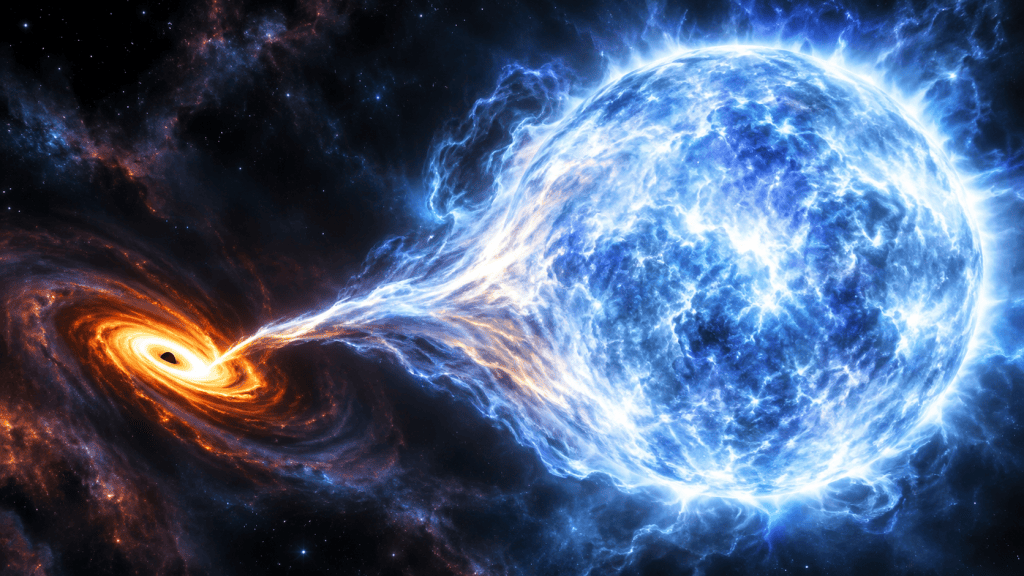
In a galaxy some 30 million light-years away, a massive star known as AT 2016blu has been putting on an extraordinary performance. Since 2012, astronomers have recorded at least 27 dramatic outbursts, roughly one every 113 days. Each resembles a stellar explosion, yet somehow the star survives to do it all over again.
Now, new observations from NASA’s Chandra X-ray Observatory suggest that the secret behind these recurring eruptions may be an unseen companion—a neutron star or black hole left behind by the death of another massive star. We’ll explore how astronomers pieced together this cosmic mystery and how more than 30 amateur variable-star observers helped make the discovery possible.
Then, in our night sky report for November 22–28, 2026, we’ll look for the full Beaver Moon, a close encounter between the Moon and the Pleiades, Uranus at opposition, and a busy morning sky featuring Jupiter, Mars, Venus, and Mercury. We’ll also revisit Algol, the famous Demon Star, an eclipsing binary whose brightness changes are visible to the naked eye. An eclipse predicted for Thanksgiving evening offers backyard observers a chance to witness a star’s changing light for themselves.
Links
Transcript
Howdy stargazers and welcome to this episode of Star Trails. My name is Drew and I’ll be your guide to the night sky for the week of November 22nd to the 28th.
This week, we’re heading 30 million light-years away to investigate a star that apparently refuses to die. Astronomers have watched it erupt more than two dozen times, only to settle down and do it all over again. Now, thanks to some careful detective work and a little help from amateur astronomers, scientists may finally know what’s behind this star’s repeated brushes with death.
Later in the show, we’ll bring things a little closer to home with our tour of the night sky. We have a full Moon, Uranus making its closest approach of the year, and a particularly interesting event involving one of Jupiter’s moons. Plus, we’ll visit a famous star that regularly changes its brightness, and this Thanksgiving, you can watch it happen with nothing more than your own eyes.
Whether you’re tuning in from the backyard or the balcony, I’m glad you’re here. So grab a comfortable spot under the night sky, and let’s get started!
A star explodes, and astronomers pay attention. A star apparently explodes a second time, and now things are getting interesting. But when the same star seems to blow itself up again and again and again, more than two dozen times, you begin to suspect that maybe “exploding” isn’t quite the right word.
And that brings us to a star with the wonderfully bureaucratic name AT 2016blu.
It lives in NGC 4559, a spiral galaxy about 30 million light-years away. And between 2012 and the middle of this year, astronomers watched this thing erupt at least 27 times. It brightens dramatically, fades back down, and then, roughly 113 days later, it does it again. Three times a year, give or take, this star puts on something that looks disturbingly like its own funeral.
Except it keeps showing up for the next one.
That is why AT 2016blu belongs to a wildly named class of objects called “supernova impostors.” They can suddenly brighten enough to resemble a stellar explosion, but they don’t actually destroy themselves. A real core-collapse supernova is pretty much a one-performance engagement. Once the core of a massive star collapses and the star blows itself apart, there is no coming back for an encore. AT 2016blu, on the other hand, has become the astronomical equivalent of that movie villain you were absolutely certain died three sequels ago.
And this is already a strange star even when it isn’t pretending to explode.
AT 2016blu appears to be a luminous blue variable, a very massive, extremely luminous and rather unstable kind of star. Earlier observations with Hubble suggest it contains at least 33 times the mass of our Sun. Stars like this can throw enormous amounts of material into the space around them, and they sometimes undergo dramatic changes in brightness. Eta Carinae, one of the most famous unstable stars in our own galaxy, is another example of the general breed.
But AT 2016blu was doing something especially interesting. Its outbursts weren’t merely dramatic. They were repeating on something resembling a schedule.
About every 113 days. And whenever nature starts keeping a schedule, astronomers get suspicious.
Stars can brighten and fade for lots of reasons. Their surfaces can pulsate. They can throw off material. Dust can get in the way. But if something dramatic happens over and over again at roughly the same interval, one possibility immediately becomes attractive: maybe something is going around something else.
An orbit.
Imagine that AT 2016blu isn’t alone. Imagine another object circling it, not in a nice circular orbit but in a stretched-out ellipse. Most of the time the two objects are relatively far apart. But once every orbit, the companion comes sweeping in close to this enormous unstable star, and something happens.
That idea had already been proposed to explain the 113-day cycle. But there was a problem. What exactly was the companion?
At 30 million light-years, we can’t simply zoom in until we see two little stars circling one another. Even with our best telescopes, this entire system is essentially a point of light.
Instead, astronomers have to become detectives. They look at how much light arrives, what wavelengths that light contains, how that light changes with time, and from those clues, they try to reconstruct something happening in a galaxy 30 million light-years away.
And in this case, visible light could only take them so far. So astronomers turned to X-rays.
X-rays can reveal some of the most energetic environments in the universe. Gas falling into an extremely powerful gravitational field can accelerate to tremendous speeds. As that material swirls around, collides and heats up, it can reach temperatures high enough to pour out X-rays.
If AT 2016blu had an ordinary stellar companion, astronomers might expect one kind of X-ray behavior. But if the companion were something much denser, a neutron star, perhaps, or a black hole, then this recurring stellar death might make a lot more sense.
There was only one catch. You had to look at the right time.
Imagine taking your car to the mechanic because it makes a horrible grinding noise every Tuesday morning, and then asking the mechanic to diagnose it on Thursday afternoon when everything sounds fine. AT 2016blu spends most of its time in-between outbursts. If astronomers wanted to know what was really happening during one of these eruptions, they needed Chandra, NASA’s great X-ray observatory, looking at the star while the fireworks were actually underway.
But finding the answer required considerably more than one spacecraft.
Astronomers had been keeping a close watch on AT 2016blu with telescopes on the ground. And beginning in 2024, more than 30 amateur astronomers working through the American Association of Variable Star Observers joined the effort. Night after night, they measured the star’s changing brightness, adding their observations to those from professional observatories around the world.
That may not sound as glamorous as taking a spectacular photograph of a nebula. But there’s a different kind of astronomy happening here.
A photograph can tell you what something looks like. Repeated measurements can tell you what it is doing. And sometimes the most valuable telescope in the world is simply the one that happens to be watching when something changes.
In March of this year, the ground-based observations showed that AT 2016blu was brightening again. The alert went out, Chandra was pointed toward NGC 4559, and this time astronomers caught the system in X-rays while the outburst was happening.
And there it was.
AT 2016blu was blazing in X-rays, at least 100 times brighter than the upper limits measured in older Chandra observations from 2001 and 2002, before these recurring outbursts had even been documented.
The invisible companion had left evidence all over the crime scene.
The best explanation is that AT 2016blu is orbiting either a neutron star or a stellar-mass black hole. And if that is correct, this story gets weirder.
A neutron star and a black hole can both be left behind after the death of a massive star. A neutron star crushes more mass than our Sun into an object roughly the size of a city. A black hole takes gravitational collapse even farther, producing an event horizon from which light itself cannot escape.
So whatever this companion turns out to be, there is a good chance that we are looking at the corpse of another star. Now put that dead body into an elongated orbit around AT 2016blu.
As it swings in close every 113 days, it encounters material being thrown off by this enormous unstable star. Some of that gas gets captured by the compact companion. It doesn’t simply fall straight down. It has angular momentum, so it swirls around the object, accelerating and heating to extraordinary temperatures. Hot enough to shine in X-rays.
Those X-rays then slam into gas surrounding the system and heat that material as well. Some of that energy gets re-radiated as visible light.
And suddenly we have our supernova impostor.
The brilliant optical eruption, the thing that initially caught everyone’s attention, may not be coming from some mysterious explosion inside AT 2016blu at all. It may be the much larger visible response to a feeding event taking place around the tiny, nearly invisible object beside it.
That’s a wild reversal.
For years, astronomers watched the enormous star because it was the thing putting on the show. But the real engine of those repeating outbursts may be something far smaller, something we can’t see directly, periodically swooping past and stealing some of the star’s material.
The star that apparently refuses to die may be having its eruptions triggered by something that already did.
And Chandra’s observations make this case particularly interesting. Researchers say this is the first X-ray detection of this particular class of erupting supernova impostor, and apparently the first known example in which the repeated eruptions are being driven by material falling onto a compact object.
It may even qualify as what astronomers call an ultraluminous X-ray source, a class of objects so bright in X-rays that they’ve posed mysteries of their own. Some appear to contain black holes. Others, surprisingly, contain neutron stars. AT 2016blu may give astronomers another laboratory for understanding how these extreme X-ray systems work.
But there are still things we don’t know.
Chandra can tell us that something very energetic is happening. The timing strongly suggests the 113-day cycle is orbital. And the X-ray brightness is consistent with matter falling onto a compact object. But researchers still can’t say whether that object is definitely a neutron star or definitely a black hole.
That answer will require more observations. And that uncertainty is worth emphasizing because astronomy rarely gives us the whole picture in one beautiful photograph. More often, we get fragments.
A point of light brightens. Someone notices that it has happened before. Someone else discovers that it happens every 113 days. Observers around the world keep watching until the next eruption begins. Science gives us a physical picture as the details emerge.
We often tell the lives of stars as though they are solitary things. A cloud of gas collapses. A star ignites. It spends millions or billions of years burning through its fuel. Eventually it changes, dies, and leaves something behind.
But stars frequently aren’t alone.
One star can steal material from another. They can exchange mass. They can alter one another’s evolution. One can explode first and leave behind a neutron star or black hole, and that remnant can then continue interacting with the star that survived it.
Death, in other words, doesn’t necessarily end the relationship.
And systems like AT 2016blu may help astronomers answer another important question. Some massive stars behave strangely before they finally explode for real. They brighten, throw off material and undergo eruptions. If some of that behavior is actually being driven by unseen companions, then understanding systems like this one could help astronomers distinguish between a star genuinely approaching its final moments and a star being harassed by something orbiting nearby.
So someday, AT 2016blu really will die.
A star containing more than 30 Suns’ worth of mass is not going to live quietly forever. Eventually one of those apparent supernovae may be the genuine article.
But for now, somewhere in NGC 4559, a giant unstable star and the remains of another star appear to be locked together in a strange cosmic dance. Every few months they draw close. Matter changes hands. X-rays erupt. Gas lights up. And 30 million years later, a handful of photons arrive here, where people with telescopes notice that something has changed.
Astronomers watch, and recognize a steady rhythm. And from a tiny flickering point in a distant galaxy, they begin to reconstruct two objects circling one another, one very much alive, the other perhaps already dead, still finding new ways to make trouble together.
After a quick break we’ll be back with this week’s night sky. Stay with us.
Welcome back.
Last week, we celebrated a remarkable milestone for Voyager 1. On November 18, the little spacecraft became the first human-made object to reach a distance of one light-day from Earth. That’s more than 16 billion miles, so far away that a radio signal takes a full 24 hours to reach it.
But here’s an interesting question. Is it possible that Voyager could cross that one-light-day boundary again, only this time coming back toward us?
Of course, Voyager isn’t turning around. But Earth is moving, too. We’re traveling around the Sun at about 67,000 miles an hour, considerably faster than Voyager’s 38,000 miles an hour. And during part of our orbit, we’re actually moving toward Voyager faster than it’s moving away. So even though Voyager continues its journey into interstellar space, its distance from Earth can temporarily decrease.
That fact had some folks wondering whether we might actually catch up enough to bring Voyager back inside that one-light-day boundary. Spoiler alert, we don’t, but as it turns out, we come surprisingly close!
Calculations based on NASA’s spacecraft tracking data suggest that Voyager’s distance from Earth will reach another minimum around April 24 of next year. But by then, Voyager will have traveled just far enough that even Earth’s orbital motion can’t bring it back inside one light-day. We’ll miss the boundary by approximately 17 million miles.
Now, 17 million miles sounds like an enormous distance. But compared with the more than 16 billion miles separating Earth and Voyager, it’s practically nothing. In terms of light-travel time, that’s only about a minute and a half beyond the 24-hour mark.
So Voyager won’t get to celebrate its one-light-day milestone twice. But for a few months next year, our planet will actually be gaining on the most distant spacecraft humanity has ever built.
While Voyager continues its long journey into interstellar space, there’s plenty happening a little closer to home. Let’s see what’s waiting for us in the night sky this week.
We have a bright Moon to contend with this week, but there are still some nice sights overhead, including a planet making its closest approach of the year, a disappearing moon of Jupiter, and a star that provides an appropriate companion to tonight’s main story.
We’ll begin with our own Moon, which reaches its full phase on Tuesday. This is the traditional Beaver Moon, named for the time of year when beavers prepare for winter. It’s also a supermoon, meaning the Moon is relatively close to Earth in its elliptical orbit, making it appear slightly larger and brighter than an average full Moon. The difference is subtle, and most people would be hard-pressed to recognize it without a side-by-side comparison.
There is something especially nice happening with the Moon early in the week. During the overnight hours of the 23rd into the 24th, it passes very close to the Pleiades, the famous Seven Sisters star cluster in Taurus. From some parts of the world, the Moon will actually pass in front of individual stars in the cluster, briefly hiding them from view. Here in the eastern United States, the main attraction is the close pairing itself. The Moon will be extremely bright, of course, so binoculars may help you pick out some of the Pleiades against the glare.
Moving on to the planets, Saturn remains our most prominent evening planet. Look toward the southern sky after sunset for its steady, pale yellow light. It is still well positioned for telescope observers.
We also have a particularly good opportunity to find Uranus this week. The distant ice giant reaches opposition around the 25th and 26th, placing it opposite the Sun in our sky and making it visible throughout the night. Uranus is currently in Taurus, not far from the Pleiades. At magnitude 5.6, it’s theoretically visible without optical aid under exceptionally dark skies, although binoculars will make the task considerably easier. It will look like a faint star rather than an obvious planetary disk, so a good star chart or planetarium app is essential for identifying it.
For early risers, the morning sky is quite busy. Jupiter and Mars are both shining in Leo, accompanied by the bright star Regulus. The two planets made a close approach earlier this month, and on November 22, the three objects form a pleasing triangle in the predawn sky. Jupiter is unmistakably the brighter of the two planets, while Mars offers its familiar reddish-orange color.
Farther down toward the eastern horizon, Venus is putting on a performance. It’s approaching its greatest brilliance for this morning apparition, shining at nearly magnitude minus five by the end of the month. It will be impossible to miss if you have a clear view toward the east before sunrise.
Below Venus, Mercury is also visible, following its greatest western elongation on November 20th. Mercury is more challenging because it stays close to the horizon, but this is one of the better opportunities of the season to catch it.
There’s also an interesting event involving Jupiter’s moons in the early hours of Monday, November 23. At approximately 2:24 a.m. Eastern, the volcanic moon Io disappears into Jupiter’s shadow. Unlike an occultation, in which a moon disappears behind the planet itself, this is a genuine eclipse. Io moves into the shadow Jupiter casts into space, and its light fades away. With a telescope, you can watch a tiny world apparently vanish into darkness.
Finally, let’s return to tonight’s main theme and visit a star that has been fascinating astronomers for centuries. And we’ve mentioned it as recently as a few episodes back.
High in the autumn evening sky, in the constellation Perseus, you’ll find Algol. Its name comes from an Arabic expression associated with a demon, and it has long been known as the Demon Star. In Greek mythology, it represents the head of Medusa, held by the hero Perseus.
Algol is also one of the most famous eclipsing binary stars in the sky.
It looks like a single star to the unaided eye, but it’s actually part of a multiple-star system. Two of its stars orbit one another so closely, and our viewing angle is so favorable, that one regularly passes in front of the other. Every two days and 21 hours or so, Algol noticeably fades as the dimmer star blocks some of the light from its brighter companion.
And you can actually see this happen without a telescope.
At its normal brightness, Algol shines at about magnitude 2.1. During an eclipse, it fades to around magnitude 3.4. That’s a substantial difference, and you can follow it simply by comparing Algol with nearby stars over several hours.
As luck would have it, one of these eclipses is predicted to reach its minimum on Thanksgiving evening, November 26, at approximately 9:40 p.m. Eastern Time. If your Thanksgiving plans include a little time outdoors, find Algol early in the evening, then return to it a few hours later. You may be surprised by how much its brightness changes.
You don’t need NASA’s Chandra Observatory to appreciate this one. Just your eyes, a reasonably clear sky, and the patience to look more than once.
That’s going to do it for this week. If tonight’s episode sparked your curiosity, or maybe gave you something new to think about the next time you look up, I’d be honored if you shared Star Trails with someone who might enjoy the journey. You can always find the latest episodes, show notes, and extras at startrails.show.
And if you’d like to help support the show, there’s also a little “buy me a coffee” link on the site. It genuinely helps keep these stories coming.
Be sure to follow Star Trails on Bluesky and YouTube — links are in the show notes. Until we meet again beneath the stars … clear skies everyone!
Support the Show
Connect with us on Bluesky @startrails.bsky.social
If you’re enjoying the show, consider sharing it with a friend! Want to help? Buy us a coffee! Also, check out music made for Star Trails on our Bandcamp page!
Podcasting is better with RSS.com! If you’re planning to start your own podcast, use our RSS.com affiliate link for a discount, and to help support Star Trails.


Leave a Reply